Analysis of Developments in the Space Domain
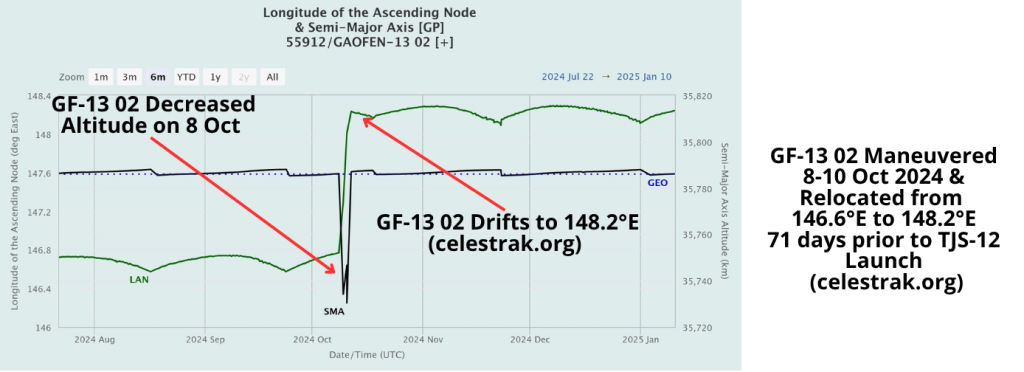
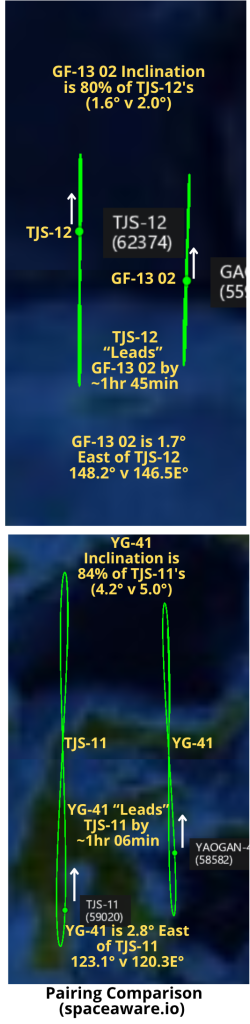
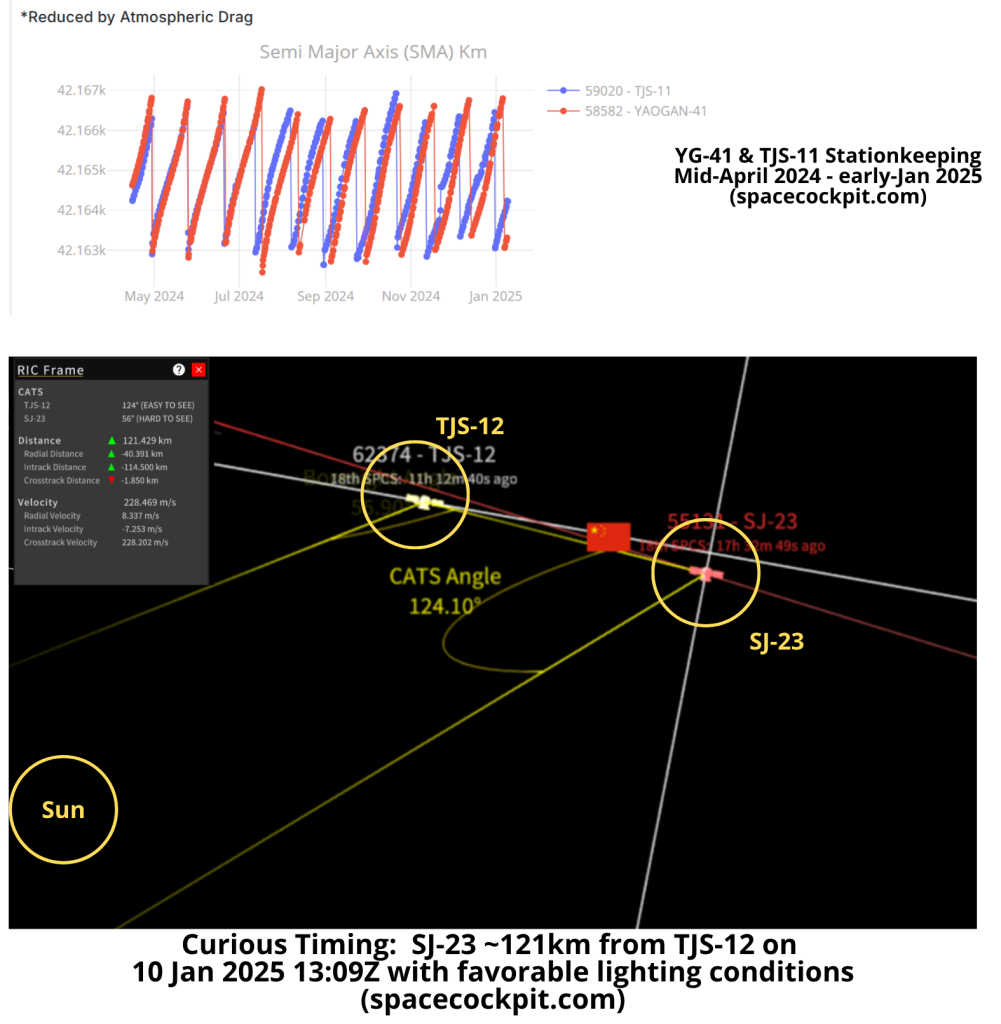
31 Dec: China placed its TJS-12 (62374) satellite, launched on 20 Dec 2024, into Geosynchronous Orbit (GEO) over the Earth at 146.5°E. TJS-12 is inclined 2.0°; higher than any of the other suspected TJS Missile Warning or SIGINT satellites. At its current location, TJS-12 is located 1.7° west of Gaofen-13 02 (55912), a Chinese GEO based imaging satellite launched in 2023. Interestingly, GF-13 02 maneuvered from its position at 146.6°E to 148.2°E in early October 2024. The relationship between TJS-12 and GF-13 02 has some similarities to that of TJS-11 (59020) and Yaogan-41 (58582).
– TJS-12 was first observed at 146.5°E and 2.0° inclination on 31 Dec 2024.
– Per Gunther’s Space Page, TJS-12 is possibly associated with China’s Qianshao-3 SIGINT constellation. TJS-12 may also be a GEO based missile warning satellite.
– China’s official launch statement noted TJS-12 was developed by SAST. This is significant in that SAST is believed to be the developer of the 4 TJS missile warning satellites China operates in GEO: TJS-2 (41911), TJS-5 (44978) & TJS-6 (47613).
At this time the mission of TJS-12 remains unknown. It is likely fulfilling either a SIGINT or Missile Warning function but other uses remain possible.
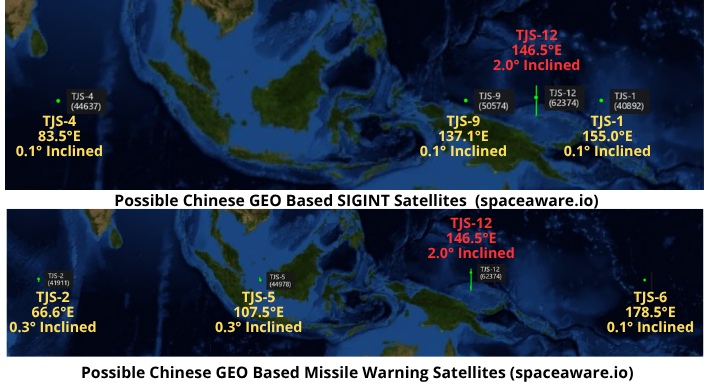
– Comparison between TJS-12 / GF-13 02 and TJS-11 / YG-41 “Pairings”
– Background
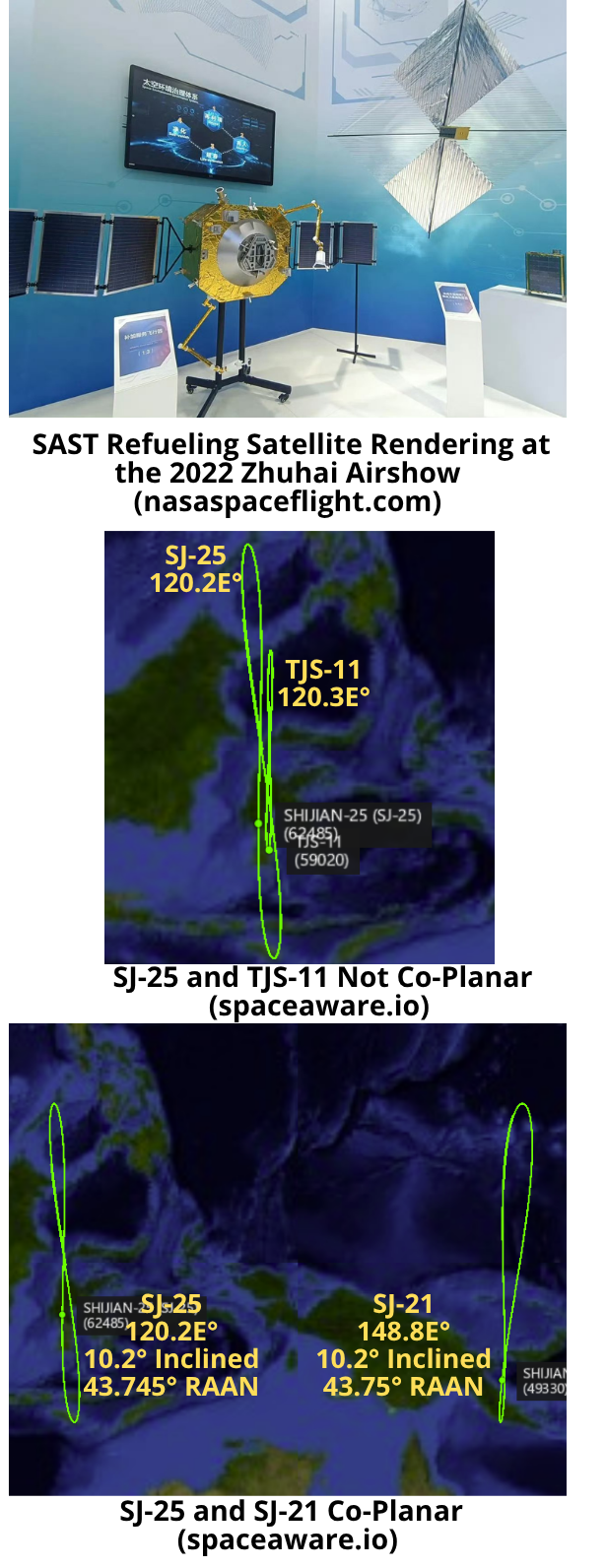
16 Jan 2025: On 6 Jan 2025 China launched a Long March-3B with the Shijian-25 (62485) satellite from Xichang. According to official sources, the satellite entered the planned orbit and will be “primarily used for the verification of satellite fuel replenishment and life extension service technologies”. Most interesting is the fact that China placed SJ-25 into a co-planar orbit with Shijiian-21 (49330.) SAST is the manufacturer for both SJ-21 and SJ-25 satellites. SJ-21 may be the intended refueling customer. Launch Video.
– China maneuvered SJ-25 out of GTO on ~13 Jan 2025. China has placed the satellite at 120.2°E which is 0.1° west of TJS-11. SJ-21 is 28.6° away at 148.8°E.
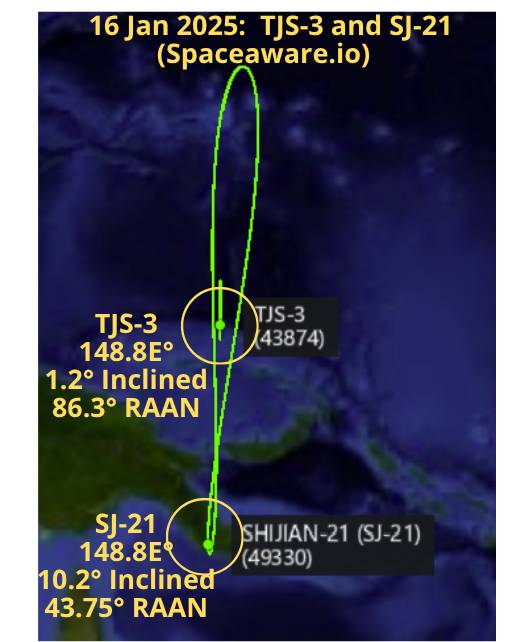
– SJ-25’s orbit is inclined 10.2° with a RAAN (orbit twist) value of 43.75°. SJ-21 is also inclined 10.2° and has nearly the exact same RAAN value of 43.745°.
– Recall that for two objects to be co-planar they must have the same inclination and RAAN. SJ-25 and SJ-21 meet this criteria. Also recall that changing inclination or RAAN requires significant energy/fuel.
– Why China initially located SJ-25 “near” TJS-11 is an open question. Examining their orbits, SJ-25 does not get closer than 450km from TJS-11. TJS-11 is inclined 5.0° with a RAAN of 322.3°…it is NOT co-planar with SJ-25.
– China can relocate SJ-25 to conduct proximity operations with SJ-21 using only 22-32m/sec of fuel. The exact fuel usage will depend on how quickly China moves SJ-25 to intercept SJ-21. Thanks to Bob Hall and the COMSPOC team for their analysis.
-Background on SJ-21
– Background on SJ-25: Per Andrew Jones:
The fact SJ-25 is co-planar with SJ-21 strongly suggests SJ-21 is the intended refueling target. Both satellites were manufactured by the Shanghai Academy of Spaceflight Technology increasing the chances of collaboration between development/design teams. SJ-21 may have expended most of its onboard fuel during the debris mitigation demonstration and it may have been equipped for refueling in anticipation of SJ-25 development and launch. Time, and SJ-25 maneuvers, will tell.

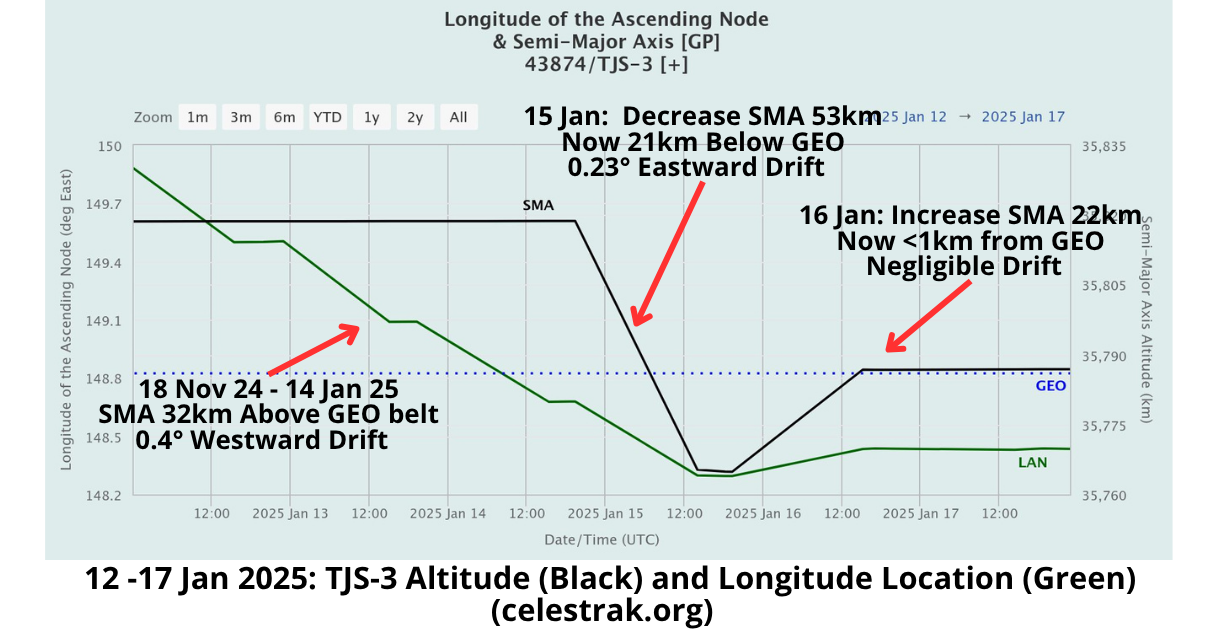
18 Jan: TJS-3 conducted a series of maneuvers resulting in its positioning in the neighborhood of SJ-21 at 148°E. While the TJS-3 has a different inclination and RAAN than SJ-21 (it is NOT co-planar) its positioning could be in preparation to support a re-fueling demonstration involving SJ-25 and SJ-21.
– Here is a brief timeline of TJS-3 maneuvers:
– TJS-3 is NOT co-planar with SJ-25 & SJ-21.
TJS-3 Background: China launched TJS-3 on 24 Dec 2018 (thanks guys) and immediately engaged in unusual behavior for geostationary satellites. It performed several RPO events with its Apogee Kick Motor (see COMSPOC video) and has been rumored to be a GEO “inspector sat.” See review of TJS-3 and other Chinese proximity operations in this excellent SWF overview.
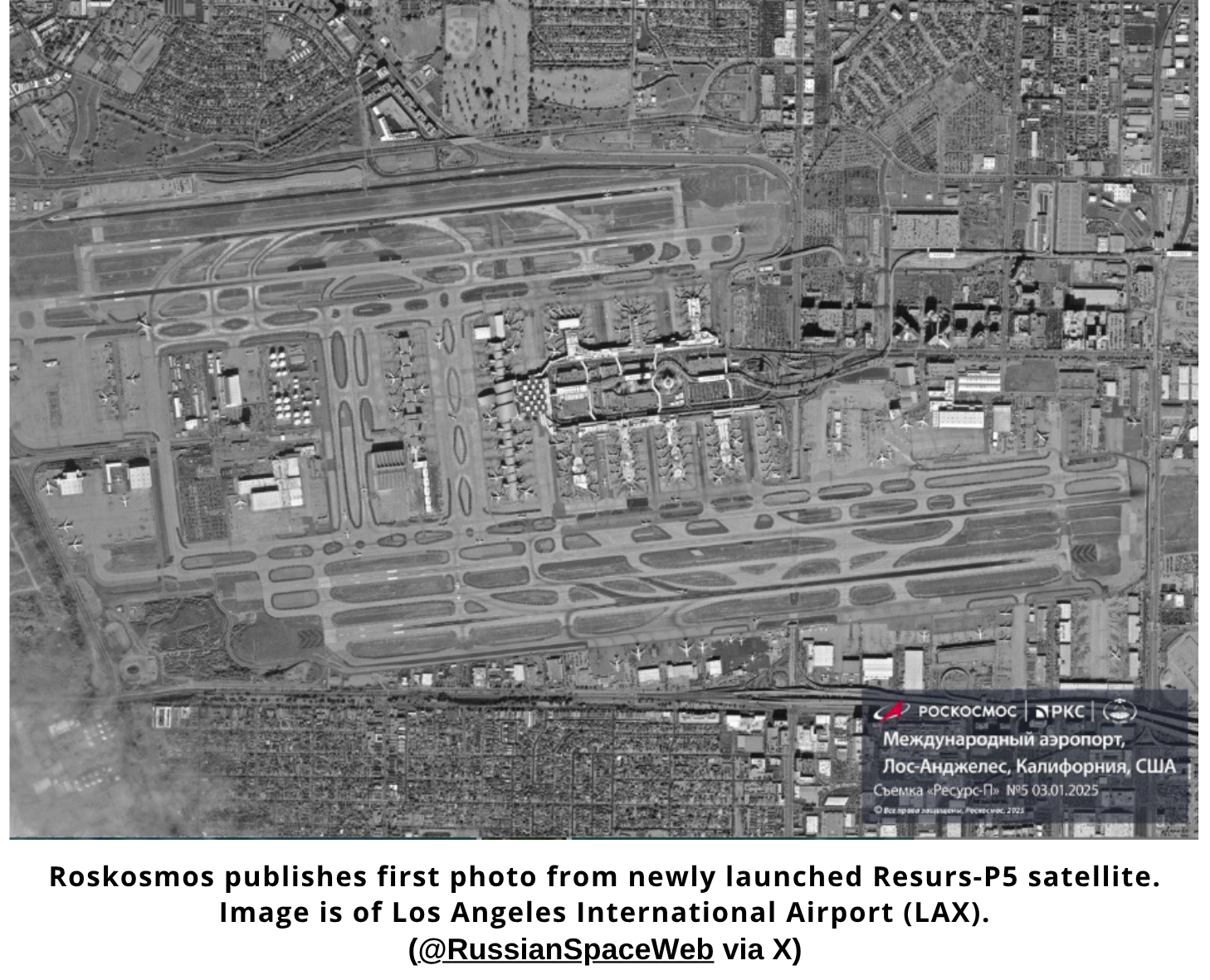
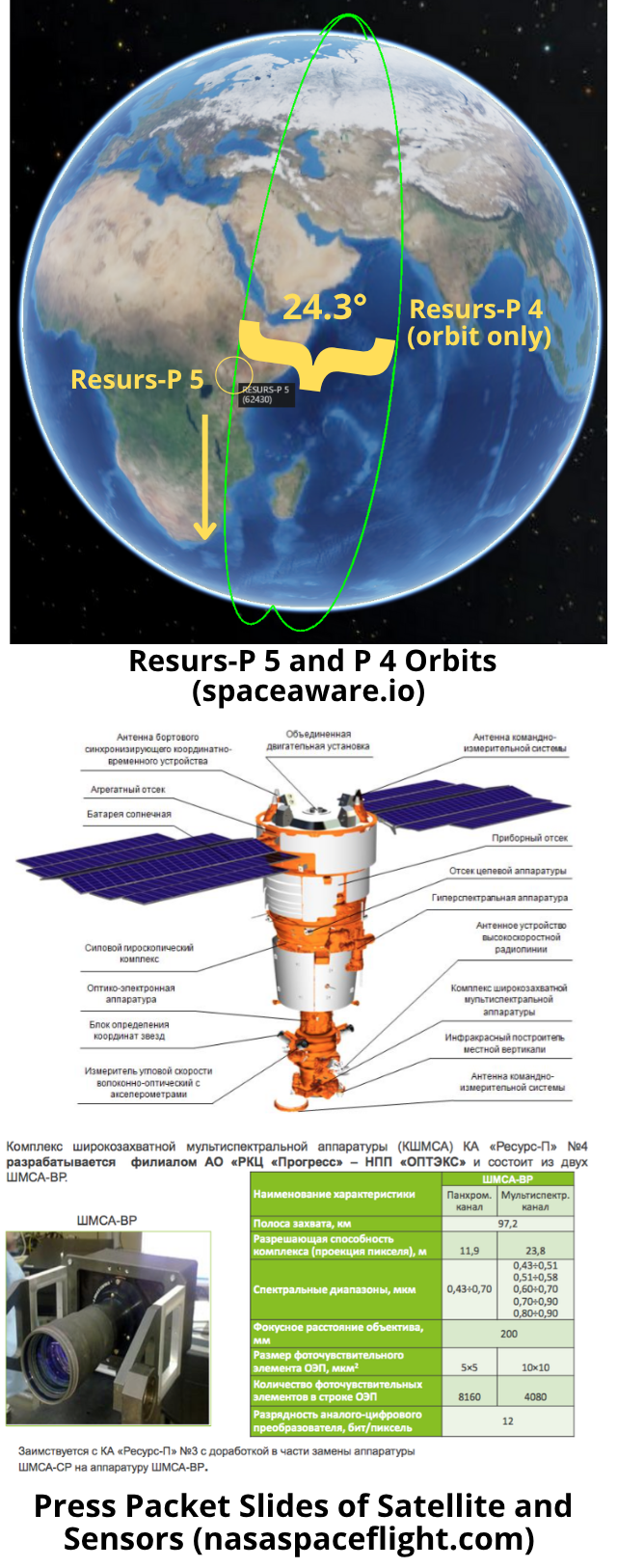
25 Dec: Russia launched a Soyuz-2-1b from Baikonur with the fifth and final Resurs-P earth observation satellite. Resurs-P 5’s (62430) initial orbit was 287x467km with a 97.3° inclination. About 5 days after launch Russia completed the circularization maneuver to raise its perigee and the satellite is now in a sun-synchronous 411x467km orbit (inclination remains at 97.3°). This launch occurred ~9 months after Russia launched Resurs-P4 (59371) also from Baikonur. Launch Video.
– The two satellites are both inclined 97.3° but are not co-planar as Resurs-P 5 RAAN is offset ~24.3° west of Resurs-P 4.
– Resurs-P 5’s orbit was lower than that of P 4 with an SMA of 443km. P 4’s initial SMA after orbit circularization was 470.6km. On 5-6 Jan Russia raised P 5’s SMA to ~470km.
– Resurs-P 4 did not conduct any orbit raising maneuvers in its first 9 months on orbit and its SMA declined to 456.6km. However, 2 days following the Resurs-P 5 launch Russia did raise P 4’s SMA to near its original value of 470.4km.
-From Bart Hendrycx:
– Both Resurs-P 4 and P 5 have an expected maximum resolution of 1.0m.
– Western sanctions appear to have significantly delayed Resurs-P 4 and 5 as #4 was originally scheduled to be launched in 2018 and #5 in 2019, but both were postponed due to the unavailability of certain components.
-Resurs-P 4 & 5 are the only operational Resurs-P satellites. Per Russianspaceweb.com “Resurs-P2 failed prematurely in 2017, while Resurs-P3 was seriously crippled by technical problems in the same year. The original Resurs-P1 lasted the longest, before going out of business in the Fall of 2021, thus leaving Roskosmos and its customers without a spacecraft in this class.”
– Russia intentionally de-orbited Resurs-P no3 in October 2023. It had been paired with the experimental Russian satellite, Kosmos-2562 fromOct 2022 – Jul 2023.
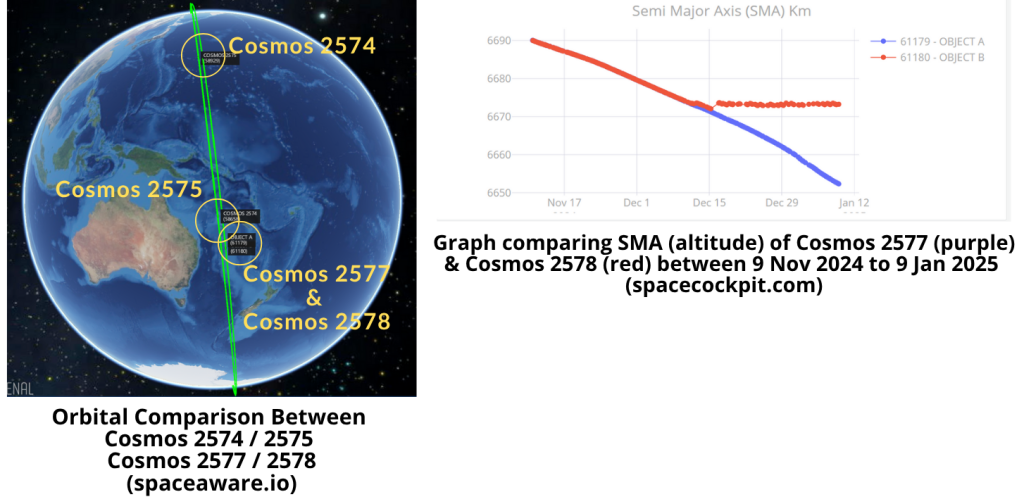
Russia’s Cosmos 2577 (still unnamed in Spacetrack.org catalog but probably 61179) may have experienced an on-orbit failure as the satellite appears to be no longer performing maneuvers to maintain its altitude. By contrast, Cosmos 2578 (also unnamed but likely 61180) continues to maneuver regularly. As a result the two spacecraft have begun to diverge. For the first several weeks the two satellites orbited relatively close to one another, however this appears to have changed in mid-December.
– Russia launched Cosmos 2577 and 2578 on 17 Sep 2024 from Plesetsk on an Angara 1.2. Russia placed both satellites into a sun synchronous orbit which is typical for imagery satellites. Both are operating at a low altitude of 339x322km and inclination 96.77°.
– Cosmos 2577/2578 are nearly co-planar with Cosmos 2574 (58658) and Cosmos 2575 (58929).
– Per Bart Hendrickx, “ until mid-December, when Kosmos-2578 started performing regular burns to maintain a mean altitude just under 300 km. Kosmos-2577’s orbit, however, has continued to decay and the satellite is now flying more than 10 km below Kosmos-2578 (278×289 km vs. 290×301 km). Possibly, some kind of on-board failure is preventing it from countering its orbital decay, but it’s too early to draw any definitive conclusions. The first three satellites believed to have belonged to this series (Kosmos-2551, 2555, 2560) showed similar behavior, re-entering only months after launch without having made any obvious maneuvers. It’s not known if this was intended or not.