issue 114 | 2 Feb 2025

The integrity flash

Analysis of Developments in the Space Domain

in this issue

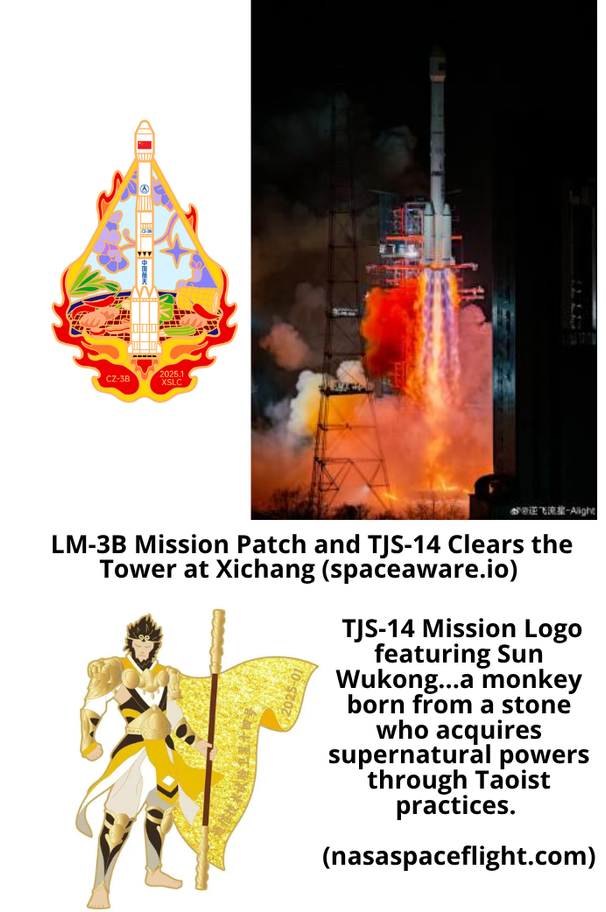
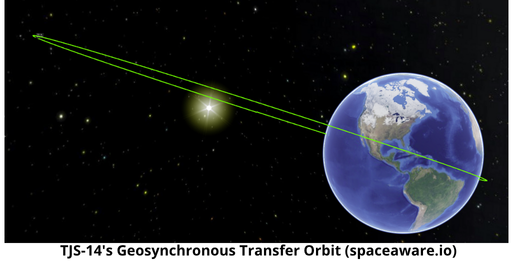
23 Jan 2025: China launched a Long March-3B rocket with the TJS-14 (62804) satellite from Xichang. According to official sources, the satellite has entered the planned orbit and will be used for satellite communications, radio and television, data transmission, other services and tests of related technologies. As of 1 Feb, the 18 SDS had cataloged TJS-14 in Geosynchronous Transfer Orbit (GTO). More to follow on this satellite once it settles into its GEO position. Launch Video. Bonus coverage of terrified civilians “observing” a spent stage from a Long March 3B hypergolic rocket falling in Zhenyuan County, Guizhou China (sound on).

TJS-14’s inclination (28.5°) is indicative of a satellite heading to GEO. Recall TJS-13 launched into a Highly Eliptical Orbit from Xichang on 8 Dec 2024. TJS-13’s initial inclination was 51.0°.

-From Andrew Jones:

  • The TJS-14 satellite will be mainly used for satellite communications, radio and television, data transmission and other services, and to carry out related technical tests and verifications, according to Chinese state media reports. No images of the satellite were published.
  • TJS satellites are believed by outside observers to fulfill a range of functions, perform technology tests and test out new tactics, techniques and procedures. These include electronic intelligence (ELINT), technology related to missile detection and possibly early warning systems, new sensors, possible inspector satellites and experiments on advanced communications or signals intelligence.
  • The satellite series could support the People’s Liberation Army (PLA) activities and capabilities in space, provide critical infrastructure for missile defense systems, and enhance China’s capacity for space-based communications.

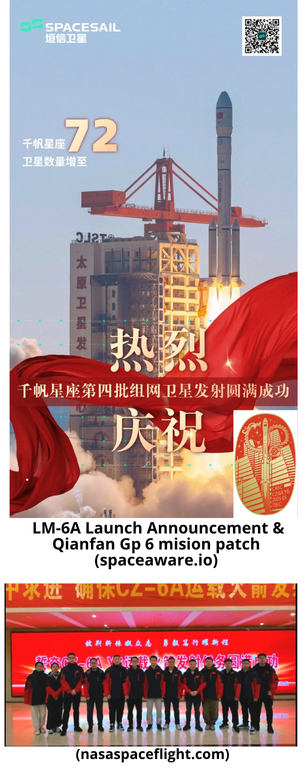
23 Jan: China launched a Long March-6A with 18 SpaceSail Polar Orbit Group 6 satellites (2025-016) from Taiyuan. According to official sources, the 18 satellites constitute the fourth batch of the first generation of the SpaceSail Constellation (Qianfan Constellation), developed by Shanghai SpaceSail Technologies Co., Ltd. to “provide global users with low-latency, high-speed and ultra-reliable satellite broadband internet services”. There are now 72 Qianfan satellites in orbit. Launch Video.

– As of 1 Feb 2025 none of the satellites had been added to the satellite catalog, thus no Satellite ID numbers or orbit visualization is possible (at least for me!)

– The name, Polar Orbit Group 6, is confusing as this is only the 4th launch. It is possible Groups 4 & 5 will launch at a later date.

  • From Cosmic Penguin (a must follow on X)
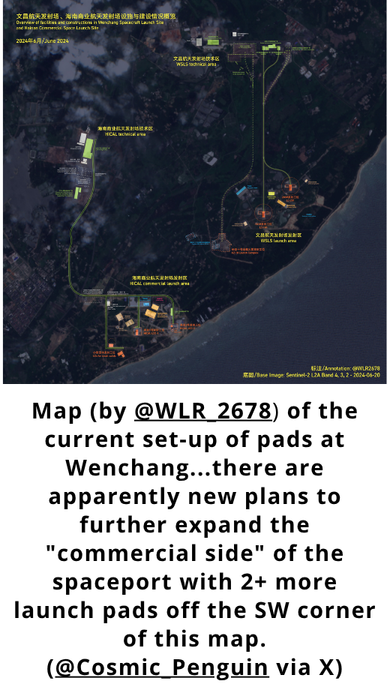
    • There are reports – probably validated by the orbit raising histories of the previous satellite batches…that some of the launched G60 satellites may have problems that caused at least one batch’s launch on LM-8 at Wenchang to be delayed since December…which would cause the skipping of Group 04/05, but with SpaceSail apparently sourcing satellites from multiple vendors around Shanghai…it seems at least some of those “thousand sails” are still fit to fly.
  • More from Andrew Jones:
    • Spacesail, plans to construct a constellation of 14,000 satellites, including having around 600 in orbit by the end of 2025. Spacesail has garnered substantial support, securing approximately $943 million in funding in early 2024.
    • Of the three batches already in orbit, the first batch of 18 satellites have mostly raised their orbits from around 800 kilometers to around 1,060 kilometers in altitude, according to U.S. space tracking data. The second batch have so far performed little orbit raising, suggesting issues with the satellites. All satellites are in orbits inclined by 89 degrees.


In spite of whatever issues Space Sail may be experiencing with its satellites, the company appears to be conducting connectivity testing…more from Blane Curcio in the next article!


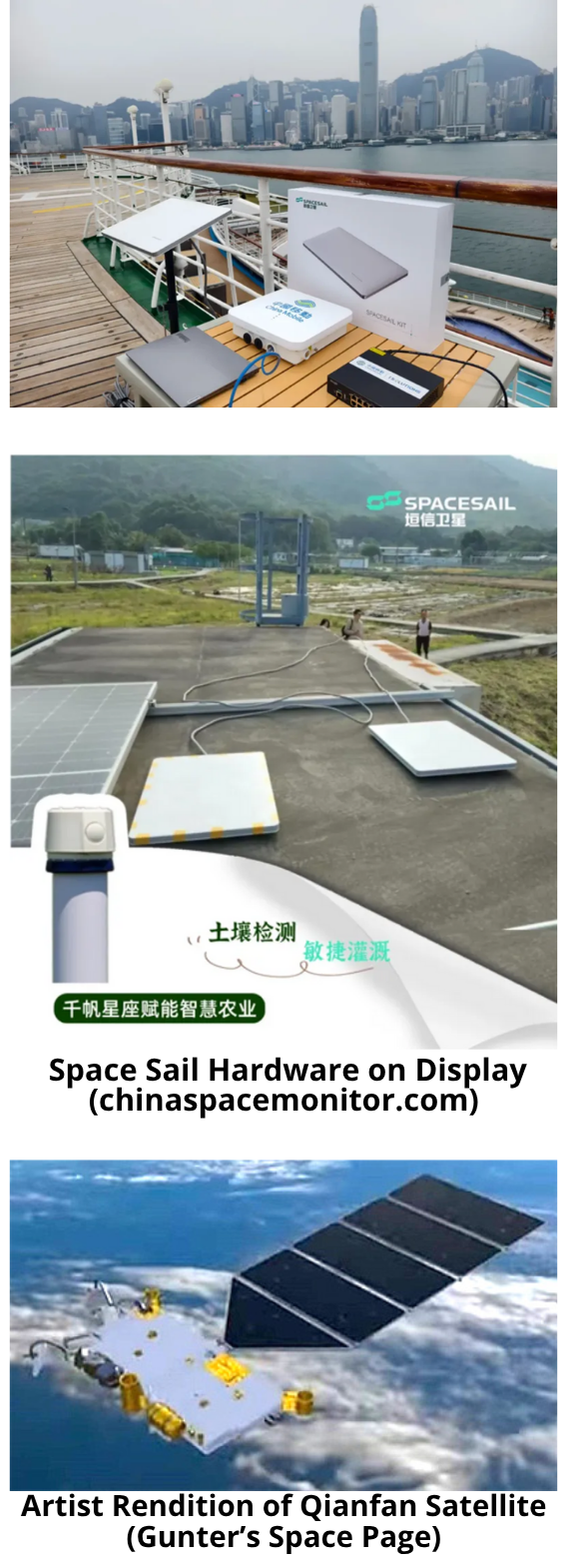
18 Jan: In his China Space Monitor China “Biweekly Brain Droppings” Blaine Curcio examines possible conncetivity testing underway and even reveals pictures of Qianfan customer ground equipment. Excerpts below and sign up here to get on Blaine’s distribution list.

– SpaceSail, the operator of the Thousand Sails (formerly G60) constellation…announced that they had connected a cruise ship to the Thousand Sails constellation using a slick-looking antenna.

1. The tests were conducted in Hong Kong, and the company upped their marketing game with the sexy HK skyline in the background. Why Hong Kong? Because SpaceSail does not have market access in Mainland China. The article was very specific in noting that the connection occurred as soon as the ship had entered Hong Kong waters


2. The tests were conducted with China Mobile Hong Kong as a partner. China Mobile is, of course, the massive state-owned telco. It should be considered a good sign for SpaceSail that they, as a nominally commercial company, are working with such heavyweights.


3. The ship outfitted with the terminal, known as the Gulangyu, also does voyages to Northeast and Southeast Asia (e.g. Shanghai to Jeju), which could mean that SpaceSail starts connecting ships in international waters.


Not long after, there was an announcement from CETC 54th Institute (CETC Network Communications Research Institute) about the first Thousand Sails gateways being shipped overseas. According to 54th, they tested four 1.8m Q/V-band antennas in Shijiazhuang, Hebei Province, before sending them overseas to Malaysia.


And finally, to round out a busy few weeks, SpaceSail was mentioned in the Islamabad Post (H/T to the man Richard H.) alongside Starlink and OneWeb as constellations that have applied for market access to Pakistan.


SpaceSail is moving very quickly 1) into different downstream verticals such as maritime, and 2) into different international markets such as Malaysia and Pakistan. Following some orbit-raising issues on their 2nd batch of satellites, we may expect to see a temporary slowdown in launch cadence, but I <Blaine> would not expect that to last.

Special Relationship: A Look at Yaogan-31 & Yaogan-34

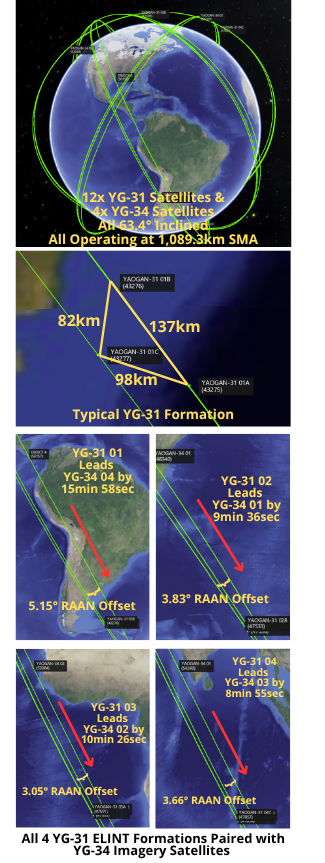
31 Jan: I took some time over the past couple of weeks to analyze the relationship between the Yaogan-31 (YG-31) and Yaogan-34 (YG-34) satellites. I was surprised to find that all were orbiting at almost the identical altitude of 1,089.3km. The satellites are not co-planar (except for 2 of the 3 YG-31 in each formation) but they do have identical inclinations (63.4°) and the 4 YG-34 satellites have an east RAAN offset of 3-5° from a YG-31 triplet. YG-34s are also all trailing YG-31 triplets between 9-16 minutes. Based on only circumstantial evidence, China may be using YG-31 to “listen” for radio frequencies of interest and then using a set of “eyes” (YG-34) following 10-15 min behind to better identify the signal source.

Western defense analysis suggests that Yaogan (“remote sensing”) satellites are military reconnaissance satellites and part of intelligence, surveillance and reconnaissance systems for the People’s Liberation Army.

– YG-31 satellites orbit in triplet formation where they form a nearly equilateral triangle, typical for satellites designed to collect and geolocate radio signals.

– They may be seen as analogous to U.S. Department of Defense Naval Ocean Surveillance System (NOSS) satellite triplets. Such satellites locate and track vessels by detecting and triangulating radio transmissions.

-YG-31s are the latest variant of Chinese satellites to fly in these formations. YG-9, YG-16, YG-17, YG-20 and YG-25 are similarly deployed. However, the YG-31 orbits are ~200km lower than those of their predecessors.

– YG-34s operate as a single satellite and are reported to be a “government optical remote sensing satellites, likely also used as a military reconnaissance satellites.” Open sources report it has a “ground image resolution of a few meters.”

– Other known Chinese imagery satellites operate at much lower altitudes. For example, China’s 5 Gaofen-11 series of satellites operate between 400-500km. Imagery resolution improves with proximity to the intended target.

– Here are the pairings (I only listed one YG-31 for brevity):

  • YG-31 01 (43276) (2018) & YG-34 04 (56157) (2023)
  • YG-31 02 (47533) (2021) & YG-34 01 (48340) (2021)
  • YG-31 03 (47691) (2021) & YG-34 02 (52084) (2022)
  • YG-31 04 (47857) (2021) & YG-34 03 (54249) (2022)

– The most recent pairing between YG-31 01 and YG-34 04 is the biggest outlier in terms of RAAN offset (5.15°) and Trail time (15min 58sec). These values may trend toward the other three pairings over time.

China has established at least 4 pairings of differing ISR capabilities (in this case ELINT and Imagery). It appears China has made a trade-off between its optimal ELINT collection altitude and optimal imagery collection altitude in order to leverage ELINT to cue imagery collection.

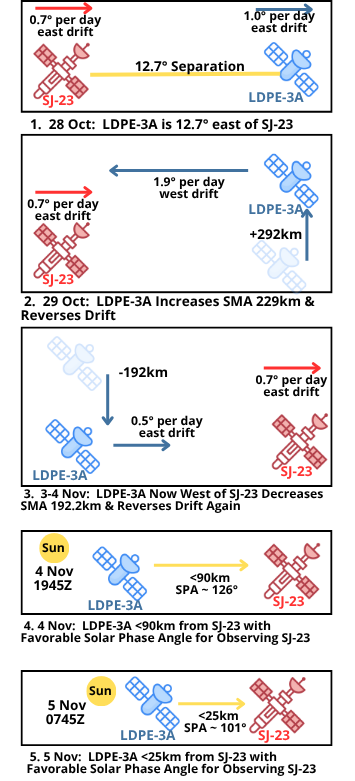
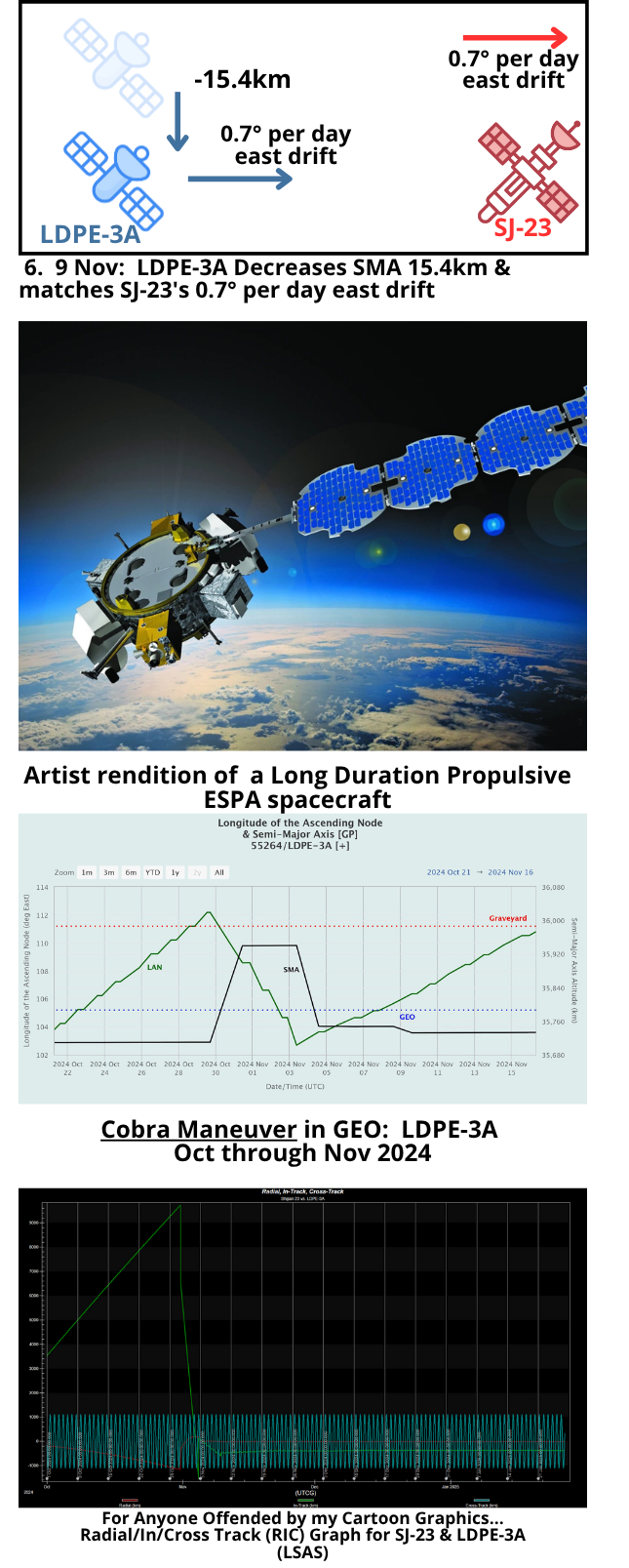
28 Jan: I was collaborating with Robin Planell from LSAS again and we (Robin really) noticed an unusual interaction between two GEO satellites, the US test satellite LDPE-3A (55264) and the Chinese test satellite SJ-23 (55131), between Oct-Nov 2024. Specifically, LDPE-3A conducted a series of maneuvers which resulted in a close approach (<25km) with SJ-23 with favorable lighting conditions for LDPE-3A to view SJ-23. SJ-23 did not maneuver during this time period. These interactions were reported in open source. Below is a more detailed analysis. See Video.

– The Timeline:

  • Mid-September-28 October 2024: LDPE-3A was further east than SJ-23. On 28 October LDPE-3A was located over 111.2°E and SJ-23 was at 98.5°E (a difference of 12.7°)
  • 29 Oct: LDPE-3A increased its SMA ~229km, reversing its 1.0° per day eastward drift and initiating a westward drift of ~1.9° per day.
  • 30 Oct – 3 Nov: SJ-23 (which continued its 0.7° eastward drift) passed LDPE-3A moving east.
  • 4 Nov: LDPE-3A decreased its altitude 192.2km and reversed its westward drift and initiated a 0.5° per day eastward drift.
  • 4-5 Nov: LDPE-3A has two point of closest approach (POCA) with SJ-23.
    • The first POCA was on 4 Nov at ~1945Z at <90km with optimal lighting conditions for LDPE-3A to observe SJ-23.
    • The second POCA occurred 12 hours later at ~0745Z on 5 Nov. Range was <25km and again lighting conditions were favorable for LDPE-3A to observe SJ-23.
  • 6-9 Nov: LDPE-3A falls further behind SJ-23 as SJ-23 is drifting 0.2° further east per day.
  • 9 Nov: LDPE-3A reduces its SMA 15.4km and matches SJ-23’s 0.7° per day eastward drift. With this change LDPE-3A maintains its position ~ 0.7° behind SJ-23.
  • 10 Nov-Present: SJ-23 remains 0.7° further east of LDPE-3A.

LDPE-3A conducted at least 2 significant maneuvers 29 Oct – 3 Nov: the first closed its distance with SJ-23 and put it to the west of SJ-23. The second placed LDPE-3A into a trail position with favorable lighting conditions to support observation for 24 hours. During that first 24 hour period the POCA between LDPE-3A and SJ-23 was <25km. On 9 Nov LDPE-3A again adjusted its orbit to match SJ-23’s 0.7° per day eastward drift and maintain a consistent relative position.

Background:

  • Per Gunter’s Space Page: LDPE (Long Duration Propulsive EELV Secondary Payload Adapter (ESPA)) are experimental satellites built for the U.S. Air Force Space and Missiles Center (AFSMC) to carry small payloads and deploy small satellites.
  • LDPE-3A was launched from Cape Canaveral, Florida on 15 Jan 2023 on a Falcon Heavy. It hosts five payloads, which remain attached…one of them, Catcher, is a prototype sensor designed to provide local space domain awareness insights. WASSAT…is a prototype wide-area sensor with four cameras that searches for and tracks other spacecraft and space debris in geosynchronous orbit. LDPE 3A also carries payloads from the military’s Space Rapid Capabilities Office, two of which are operational prototypes for space situational awareness missions.
  • China launched Shijian-23 from Wenchang using a LM-7A on 9 Jan 2023. It was the first Shijian satellite to be launched on a LM-7A Space Launch Vehicle (SLV). Initially, analysts believed SJ-23 was a communications test satellite and a follow-on to theSJ-13. However, on 19 Jan 2023 SJ-23 released a small object. The release of a sub-payload is more indicative of SJ-17, TJS-3, and SJ-21. In its 2+ years on orbit SJ-23 has drifted between 19.8°E to 174.4°E and its most recent large maneuver was on 14 July 2024 when it decreased its SMA (altitude) to reverse its westward drift and begin drifting east at ~0.7° per day.
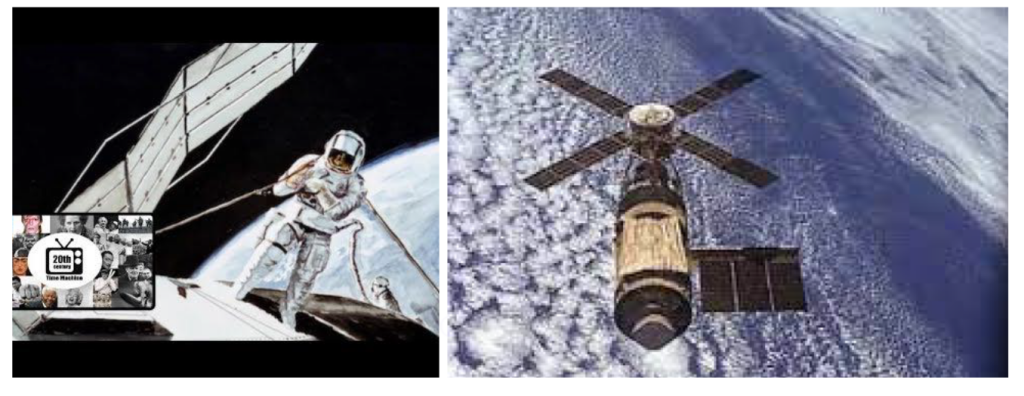
I met with one of our Space Cyber Fundamentals instructors, Glenn Reynolds, this week at Keesler AFB. Glenn had a model of a Saturn V rocket on his desk and we got to talking about some space history events when it occurred to me that many of the students I was meeting were born after 2005 and probably had never heard the incredible story of the Skylab mission in 1973. After doing some math it occurred to me that this event may have unfolded before their parents had been born. After I muscled through that realization, I decided to revisit Jack Anthony’s excellent article. Heritage: pass it on.

“Moral of the story: Things don’t always go as planned. Really bad days may be salvaged with some out of the box thinking and “just getting on with it” — where “it” means finding new ways to reach the goal.” Paul S. Hill, former NASA Mission Ops Director, Shuttle Flight Director, author of the book “LEADERSHIP: From the Mission Control Room to the Boardroom” (See Video).

What was the first on-orbit satellite servicing mission? The repair and on orbit maintenance of the Hubble Space Telescope is perhaps what you’ll hear most folks answer. It was a remarkable feat to send Space Shuttle crews to Hubble to correct Hubble’s “eyesight” and then over the years complete upgrades and part replacements. It’s an awesome story! However, in my mind, the first satellite servicing mission was Skylab in May 1973. Let’s learn more…it’s a story of grit, determination, creativity and a few dramatic demonstrations by the astronauts of Newton’s 3rd law….read on!

Skylab was launched 14 May 1973. It was America’s first space station. The modified Saturn V headed skyward and at one minute into flight an electrical glitch causes a premature deployment of the Skylab’s micrometeoroid shield. That was not suppose to happen until it reached orbit. This also ripped away one of the 2 solar arrays. In the melee, the other solar array was sprayed with debris and pinned to the side of the station. It was unable to be deployed once in space. Skylab made it to orbit and within a few orbits the Mission Control folks knew something was very wrong. Telemetry showed no electrical power being generated by the solar arrays and the internal temperature of the Skylab was HOT! The first crew of Peter Conrad, Paul Weitz, and Joe Kerwin would have to wait beyond the scheduled 15 May launch to go dock with Skylab. The next 10 days was a race against time. Skylab was ailing and they needed to get to it and help save it before the damage would make it uninhabitable. Great minds came up with plans, devices and procedures to fix Skylab.

On 25 May, the crew launched into orbit. Stuffed into their Apollo Command Module was all sorts of materials, tools, ropes and things they would use to repair Skylab. They completed a rendezvous with Skylab and did a fly around. The first views were disheartening. They confirmed one solar array was gone, the other jammed in a closed position, and the micrometeoroid shield was gone. Skylab was being cooked by the Sun, the external surface of the station was blistering from direct sun effects. Yikes, the astronauts needed to get to work.

First, they “soft docked” with Skylab. This was to connect the Command Module but not lock it into place. With the spacecraft de-pressurized, Paul Weitz stood up in the open door with Joe Kerwin hanging onto his ankles and Weitz tried to use a 4.5 m pole with something that looked like a modified tree lopper on the end. They relentlessly tried to free the remaining and very stuck solar array. No Go. A closer look showed there was a mess of shield debris that would have to be removed to deploy the array.

Then they attempted to “hard dock” with Skylab and lock the two spacecraft together. That ran into some problems, the holding device would not fire. Like Maytag repairmen, they worked on the docking system hardware in the Command Module nose section and jerry-rigged a fix. They gave it another try and eureka, they were hard docked. Time to get inside Skylab. The large workshop section inside temp was 130 degrees F.

Next, they had to get a reflective mylar-like sun shield over the part of the external Skylab where the shield was to be. The shield had many purposes, including insulation from the sun’s heat from transiting into the station. There was another section of the Skylab not as hot, so the crew did find refuge from the steaming workshop there or actually back in the Command Module. There was a way to access space via an air lock, a tunnel that enabled them to deploy things into space. So, they brought with them a parasol, a mylar reflective umbrella looking thing. They were able to push the parasol through the airlock and get the device unfolded to then protect the skin. Hooray, the temperatures in the workshop started to cool. OK, so this install and deploy parasol fix went AOK. Now to get solar array deployed.

Astronauts Conrad and Kerwin performed a spacewalk. Their plan was to use bolt cutter type devices to cut straps and free the array which was pinned up against the Skylab’s side. They assembled six 1.5 m rods (made a long pole), attached cutters and Kerwin worked hard to get the cutters in place on straps that held the array and was jammed by debris from the 1-minute into launch anomaly. Kerwin diligently got everything in place but struggled. He tried to pull the

lanyard to activate the cutters, No Luck. So, here’s where the repair job gets exciting. Do you remember Newton’s Third Law (Action-Reaction)? Well, Conrad went over to take a peek at the set up. Upon his arrival, the cutters suddenly fired and freed the solar array to a 20-degree deployment (they needed 90 degrees). But, the array bonked into Conrad and in his own words sent him “ass over teakettle” (my pardon, but that’s what he said). Thankfully he was tethered and didn’t go off into space. Whew.

The array was deployed 20 degrees, 70 degrees to go to get it fully deployed. Conrad worked his way to stand on the hinge part, rigged a tether over his should and just like when you use a strap to help lift things, he stood up and Kerwin joined in pulling on a tether. WHAM, the solar array released and travelled to final 90 degree position. Of course, Isaac Newton had a say and both astronauts were catapulted away from the now deploying solar array. Good news, they were caught by their tethers and not propelled into space. The solar array was deployed and soon working, the overall output power from a small set of arrays that deployed OK after launch and this big array went from 40% to 70%. Yay!

Thus, Skylab was revived/saved, the temperatures inside were manageable and the power adequate for the planned year-long US space station operations. From May 1973 to February 1974, three crews of three astronauts work on the Skylab. It didn’t look exactly as planned and was a little shy on full power, had a funny gold-ish thing covering it, but the first crew saved the Skylab with this amazing first ever on orbit servicing and repair. Future crews would further help repair Skylab more so. There you have it…the first ever on-orbit repair- Skylab 1973 Skylab would eventually re-enter the Earth’s atmosphere. On July 11, 1979, with Skylab rapidly descending from orbit, engineers fired the station’s booster rockets, sending it into a tumble they hoped would bring it down in the Indian Ocean. They were close. While large chunks did go into the ocean, parts of the space station also littered populated areas of western Australia. Fortunately, no one was injured.

Pics o' the week!

All content is considered Integrity ISR Proprietary Information and may not be copied or distributed without written consent from Integrity ISR, LLC.

Days
Hours
Minutes
Seconds

become a member

Subscribe now to unlock full access.

Already a member? Log in