issue 120 | 5 May 2025
The integrity flash
Analysis of Developments in the Space Domain
in this issue
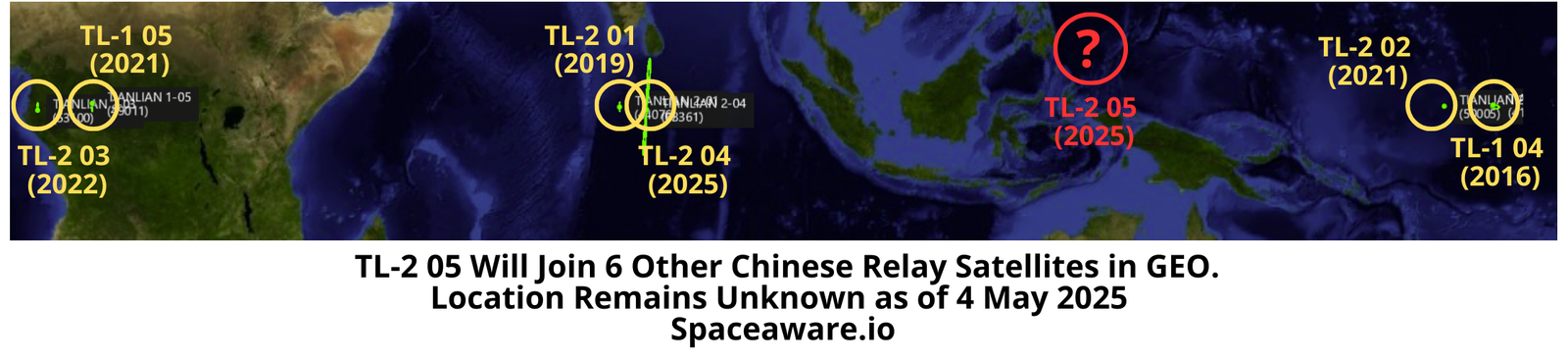
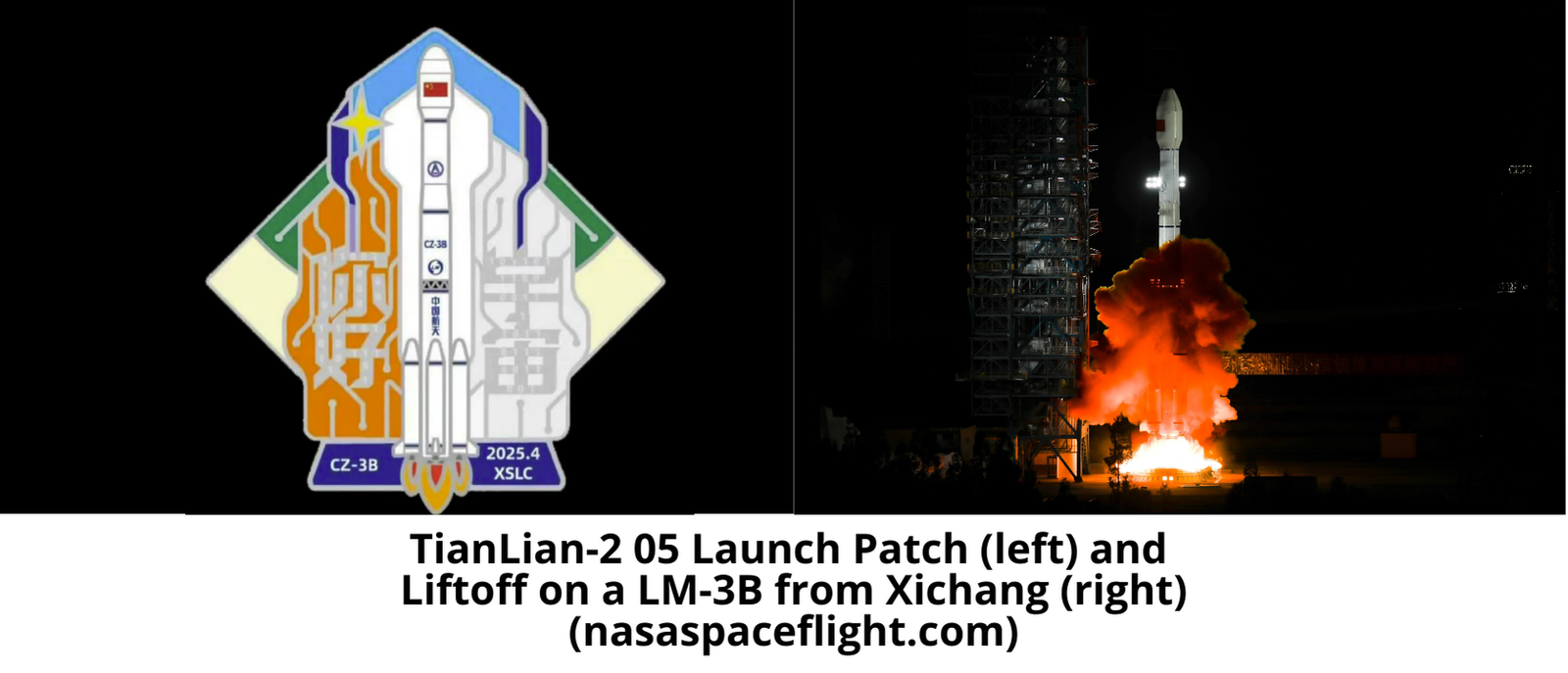
27 Apr: China launched a Long March-3B from Xichang carrying the TianLian-2 05 (TL-2 05) (63662) relay satellite to Geosynchronous Transfer Orbit. TL-2 05 is the fifth satellite of China’s second-generation data relay satellite system and joins TianLian-1 04 & 05 and TianLian-2 01, 02, 03 and 04 to provide global data relay and transmission services. The relay satellite network allows near real time communications between China Space Station (and other LEO satellites) and their mission control centers. As of 4 May the satellite remained unlocated. Launch Video.
– The addition of Tianlian-2 05 brings the total to 7 operational Tianlian relay satellites. This is China’s second Tianlian launch in 2025. There were zero TL launches in 2023 or 2024.
– The Tianlian satellites are similar to NASA’s Tracking and Data Relay Satellite network and the European Space Agency’s European Data Relay Satellite network. Overall, the Tianlian network consists of 2 first generation and 5 second generation satellites.
– The first generation of TianLian (“sky chain”) satellites were built around the DFH-3 satellite bus and were launched between 25 Apr 2008, and 6 Jul 2021 using Long March 3C rockets from Xichang.
– The second generation of Tianlian satellites are built around the DFH-4 satellite bus and have switched to the more powerful Long March 3B also launching from Xichang.
– The second generation of the satellites introduced multi-targeting ability and improved data transmission rates into the overall network.
– TL-2 uses K-band frequencies (TL-1 satellites used S-band) to enable 1.2 Gbps data transfer rates between the Chinese Space Station and ground control stations.
– The satellites make real-time communications including video possible between the ground and the Tianhe space station module, where three Shenzhou 14 astronauts are currently living and working. See video on China’s relay satellite capabilities.
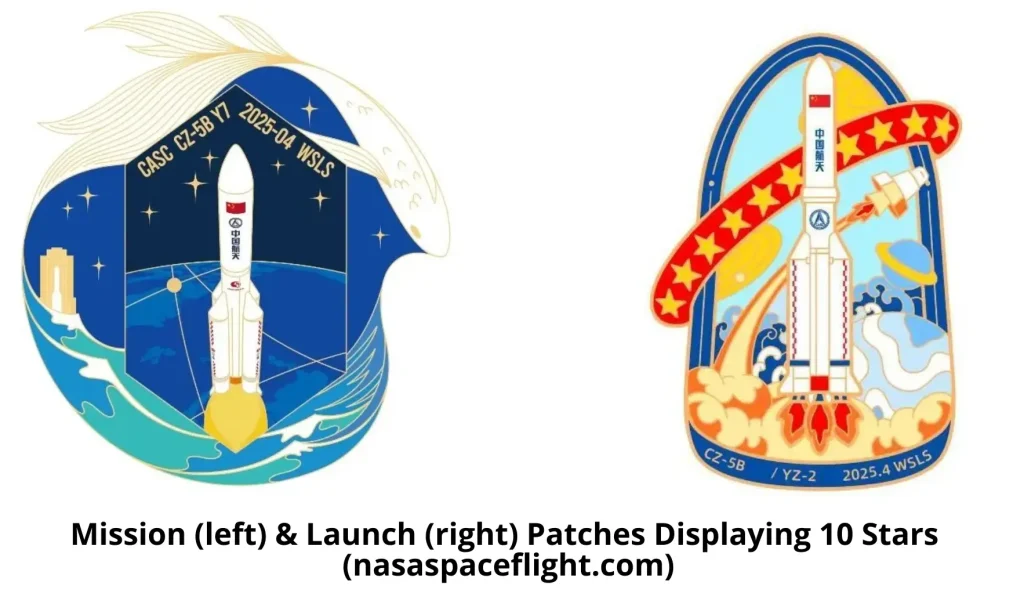
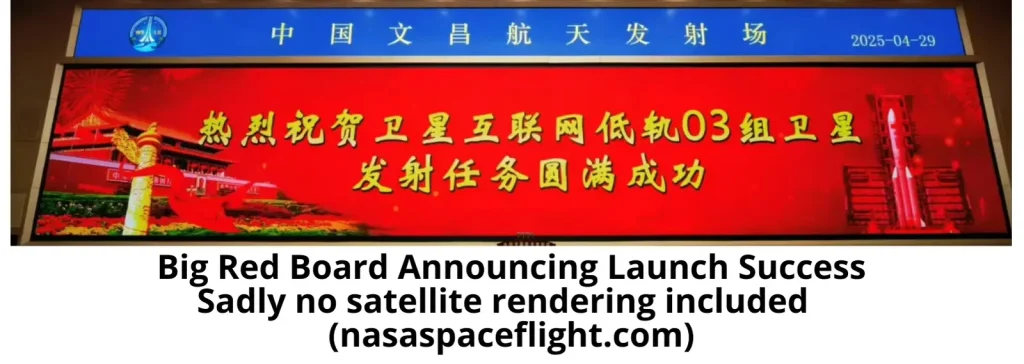
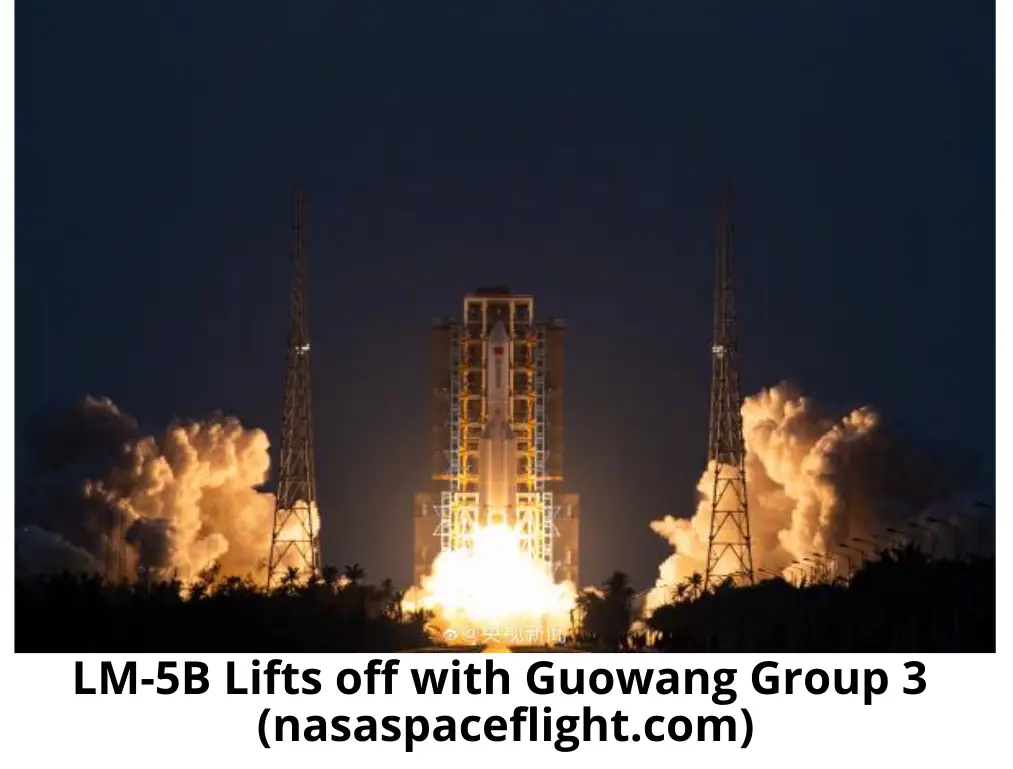
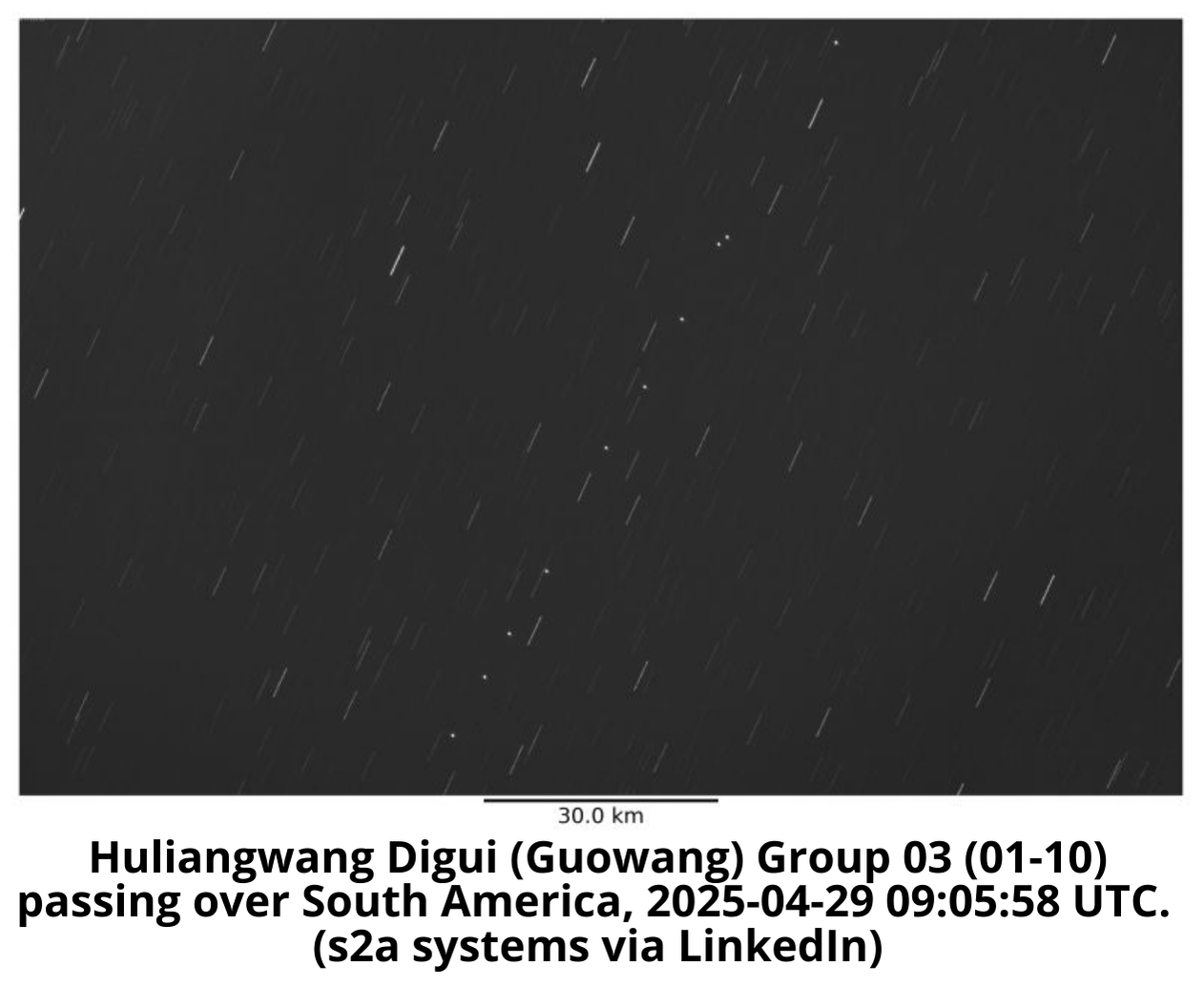
28 Apr: China launched a Long March-5B with a Yuanzheng-2 upper stage from Wenchang carrying 10 Guowang (63687-63696) satellites. This was the third group of China’s state-sponsored Starlink-like Guowang constellation. The satellites are cataloged under the name Hulianwang Digui. There have been unconfirmed links between the SatNet constellation supporting China’s DF-21D & DF-26B missiles. The DF-26B is China’s first conventionally-armed ballistic missile capable of striking Guam. Launch Video.
– All 10 of the satellites are orbiting at ~1,100 average altitude and are inclined 86.5°.
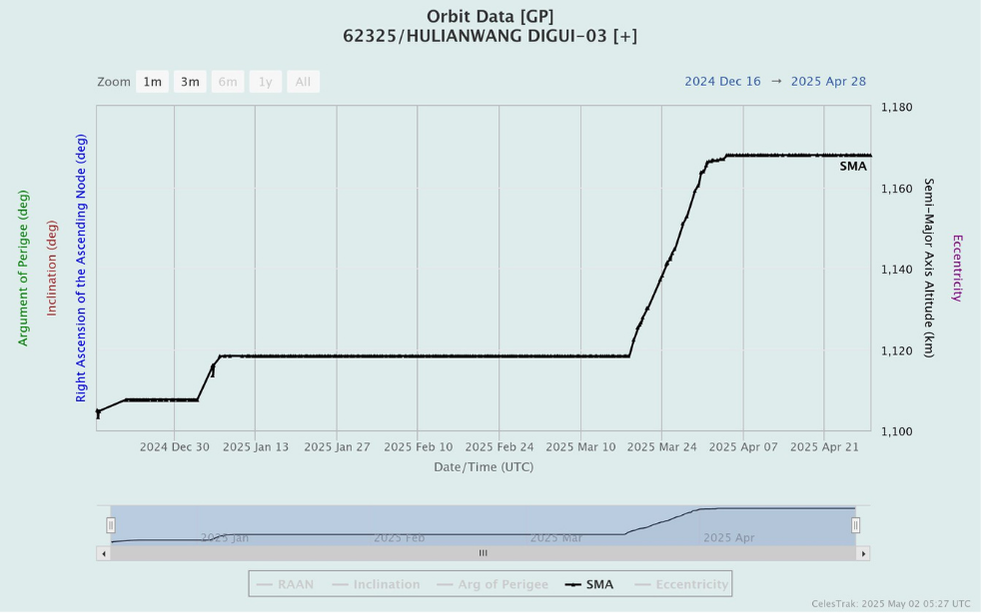
– The Group 1 Launch (16 Dec 2024) also used the LM-5B to place 10 satellites in orbit. Those satellites are currently orbiting at 1,166km and at an identical 86.5°.
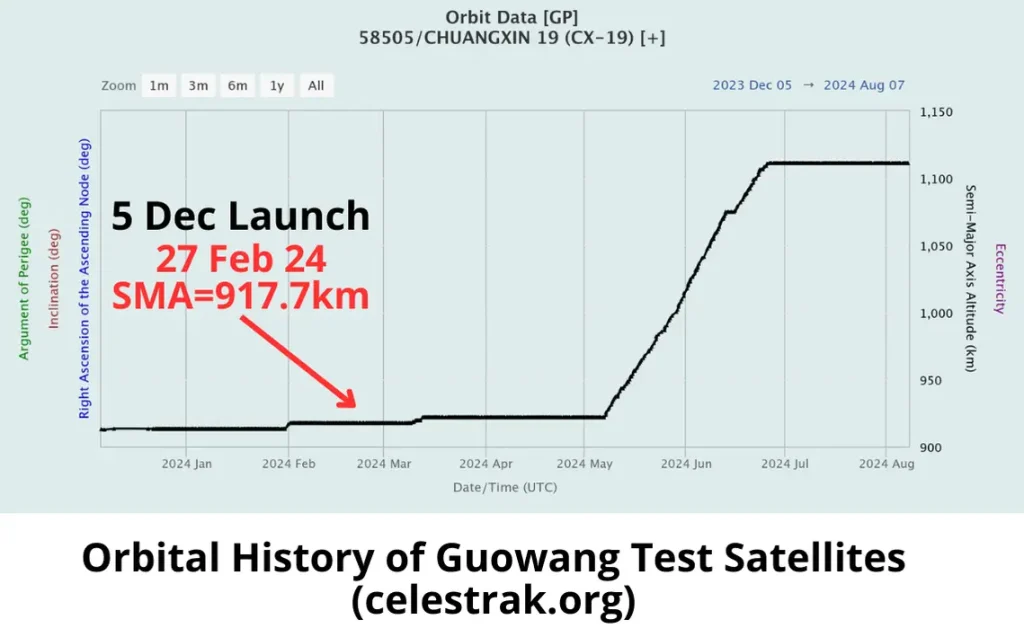
- China also launched the Group 1 satellites to an average altitude of 1,100km. The satellites raised their altitude ~10km in the first 10 days on orbit. They stayed at this altitude for ~3 months and then increased their orbits another 50km over the course of 2 weeks. Expect the Group 3 satellites to follow a similar pattern.
– In contrast, China launched 9 satellites on a LM-8A on 11 Feb 2024. These satellites are believed to be significantly smaller than the Group 1 & 3 satellites.
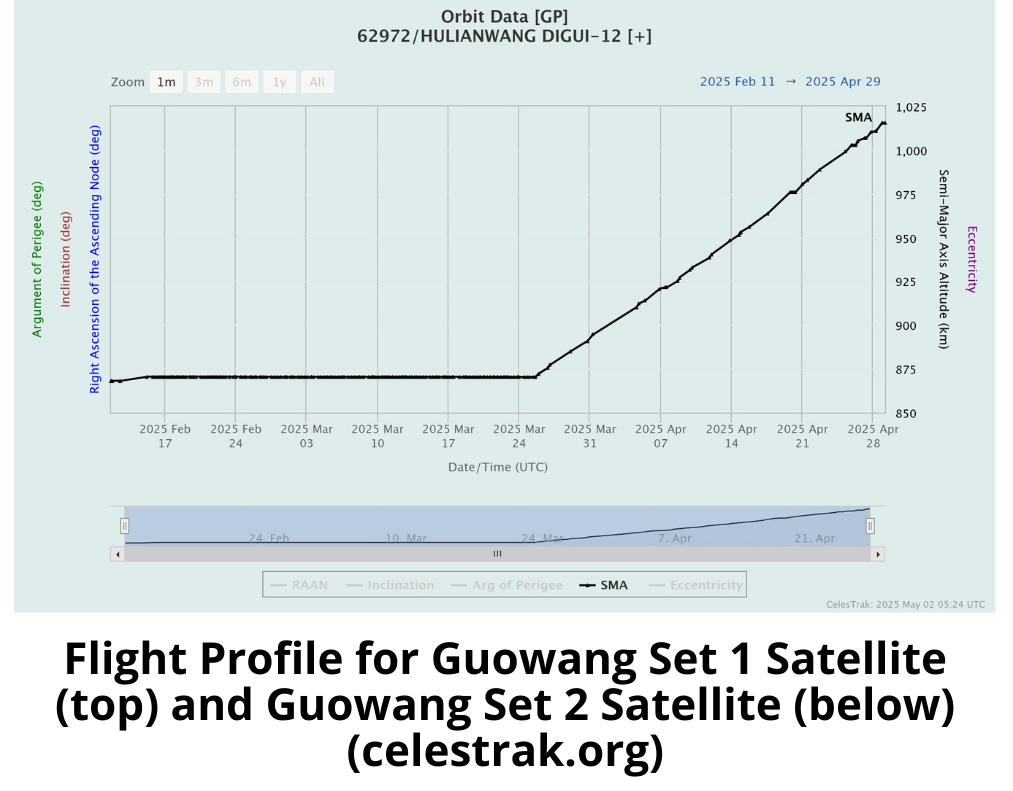
- The Group 2 orbit also differs significantly from Groups 1 & 3 in that it is inclined at only 50°.
- China also launched the Group 2 satellites into a lower average altitude of only ~870km. The satellites remained at this altitude until 25 March when all began to raise their orbits. As of 29 April all were slightly over 1,000km and do not appear to have settled into their final altitude yet.
– Per Chinese news sources: Guowang plans to launch a total of 12,992 satellites. 6,080 will be in an extremely low orbit of 500 to 600km; the other 6,912 satellites will orbit at 1,145km.
– Additional Chinese News Sources: The “GuoWang” satellite program can carry a variety of payloads, including broadband communication payloads, laser communication payloads, synthetic aperture radar payloads, optical remote sensing payloads, and others, to meet the needs of different users and scenarios. It offers comprehensive technical support across numerous fields such as maritime and aviation operations, information security, navigation and positioning, and meteorological research, while also enabling expansion into the global satellite internet access market.
– Per Andrew Jones:
- CAST stated in December it had developed large and small satellite platforms for Guowang, without disclosing functional differences. It is likely, given the payload capacity and voluminous payload fairing of the Long March 5B, that the group 03 satellites belong to the larger category.
A Closer Look: Guowang Support to Long Range Strike
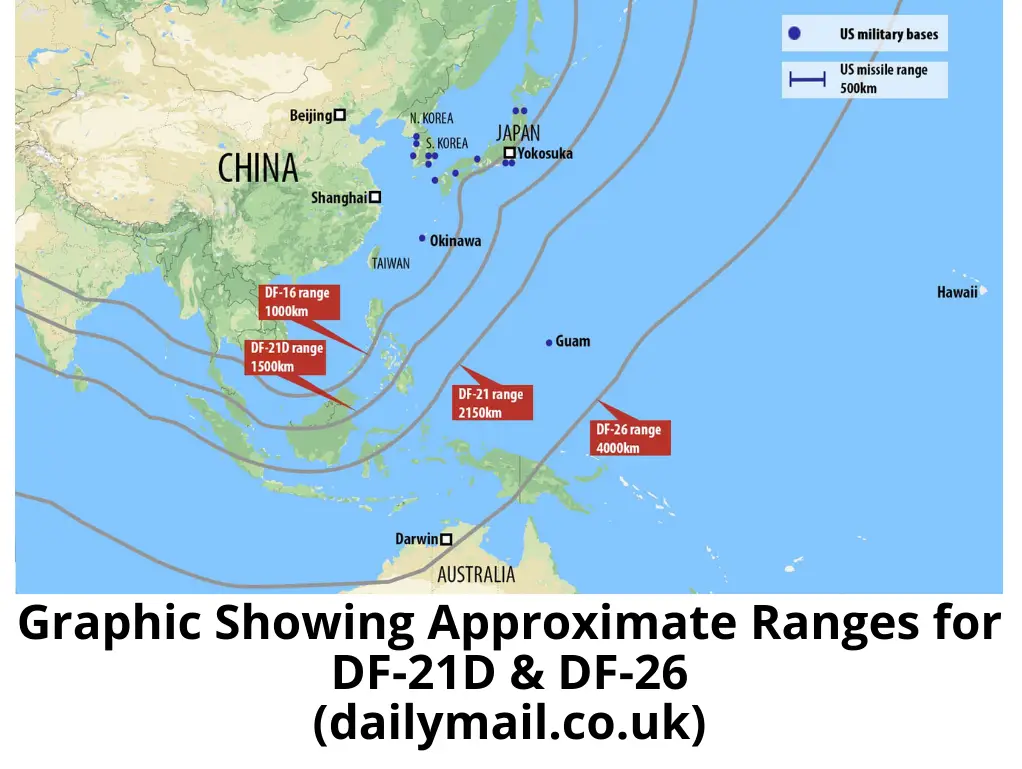
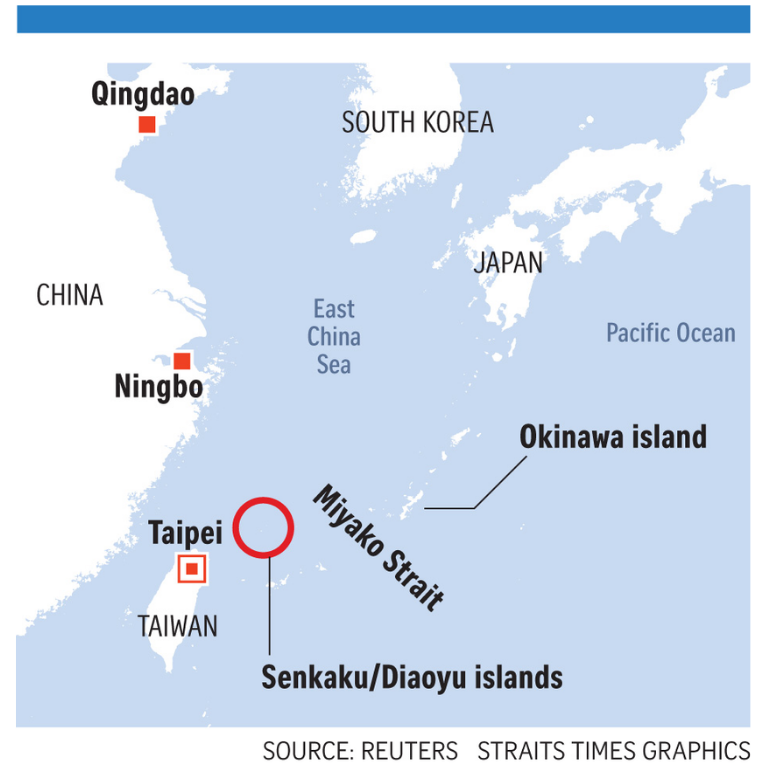
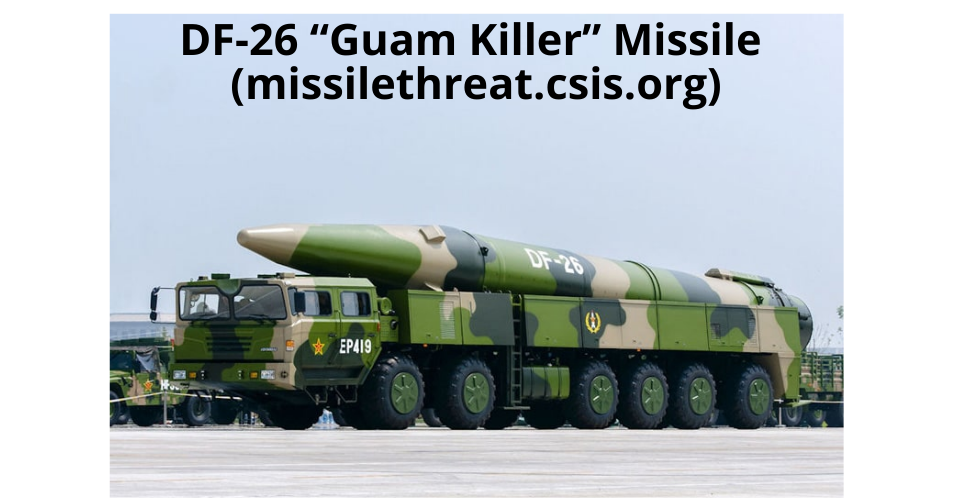
Doing research for this launch I came across a very interesting press report from Taiwan. The report was published in April 2024 and discussed some activity involving Chinese Coast Guard vessels operating near (or in) Taiwanese territorial waters. The report alleges that the Coast Guard vessels were involved with some sort of testing involving the Guowang constellation and China’s DF-21D & DF-26B missiles. The DF-21D is known as a “carrier killer” designed to target US aircraft carriers in the Western Pacific and South China Sea while the DF-26B is known as the “Guam Killer” and is China’s first conventionally-armed ballistic missile capable of striking Guam. My assessment below.
The Report:
- In April 2024 Taiwanese media reported: “On the afternoon of 27 February (2024), three Chinese coast guard ships No. 2303, 2304 and 2305 raided the waters adjacent to (Taiwan’s) eastern 24 km (territorial waters) at a high speed of close to 20 km/hr…According to people familiar with the matter…the Chinese coast guard ships sailed at high speed in a ‘full silence’ mode, and after the analysis of electronic signals detected by friendly forces, it was judged that it should be helping the PLA test China’s version of Starlink’s “State Grid” (Guowang) to provide information on future precision strikes by the Rocket Force.”
- “According to a person familiar with the matter, the three (Chinese) coast guard ships are testing the Dongfeng-21D and Dongfeng-26B missiles of the Chinese State Grid (Guowang) and providing information to the Chinese Rocket Force to achieve precision strikes. It was not until the southernmost point of the Miyako Strait that the three coast guard ships were detected by friendly forces, and it cannot be ruled out that they were linked to low-orbit satellites launched by China.”


Taking a Closer Look:
- This event occurred 10 months prior to China’s launch of Guowang Group 1 satellites in December 2024.
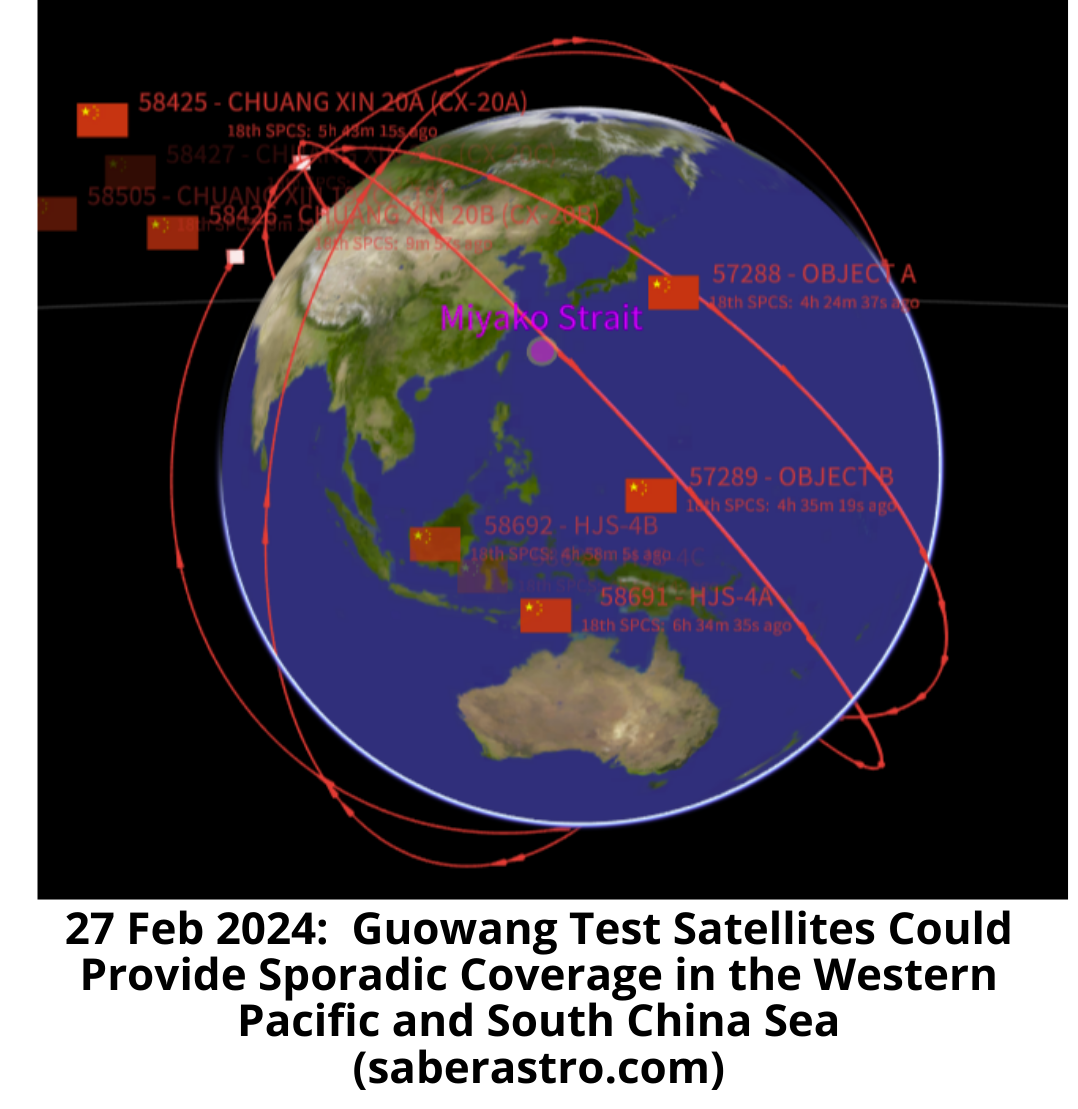
- However, China launched 9 “internet technology test” satellites in 2023 which could have supported this operation. China conducted 4 launches: 1) 9 Jul: LM-2C with 2 satellites (57288, 57289) 86.5° inclined; 2) 23 Nov: LM-2D with 3 satellites (58425, 58426, 58427) 50° inclined; 3) 5 Dec: Jielong-3 (sea-based launch) with 1 satellite (58505) 86.5° inclined; and 4) 30 Dec: LM-2C with 3 satellites (58691, 58692, 58693) 50° inclined.
- The orbital parameters for the 9 test satellites are nearly identical to those observed with the first three operational Guowang Groups; all are inclined at 50° or 86.5° and have an average altitude of ~1,100km. All of the satellite groups are in separate orbital planes.
- At the time of the incident with the Chinese Coast Guard all test satellites had been launched, however only the satellites launched in July and Nov were at their operational altitudes. While the 4 satellites launched in December were at lower altitudes, it is possible they could have supported the operation/demonstration.
- For 3 of the 4 launches China publicly stated an incorrect number of satellites. Seems like a deliberate (and rudimentary) obfuscation.
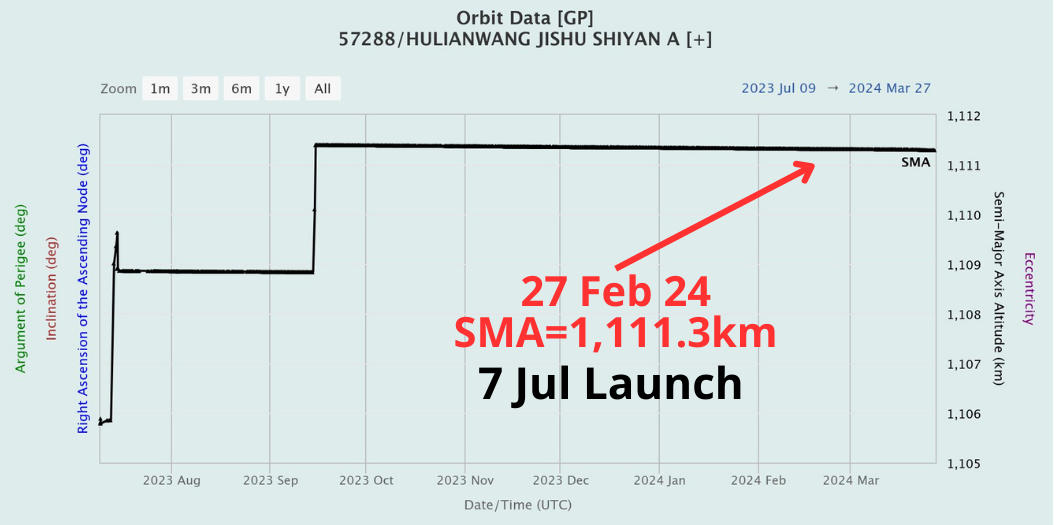
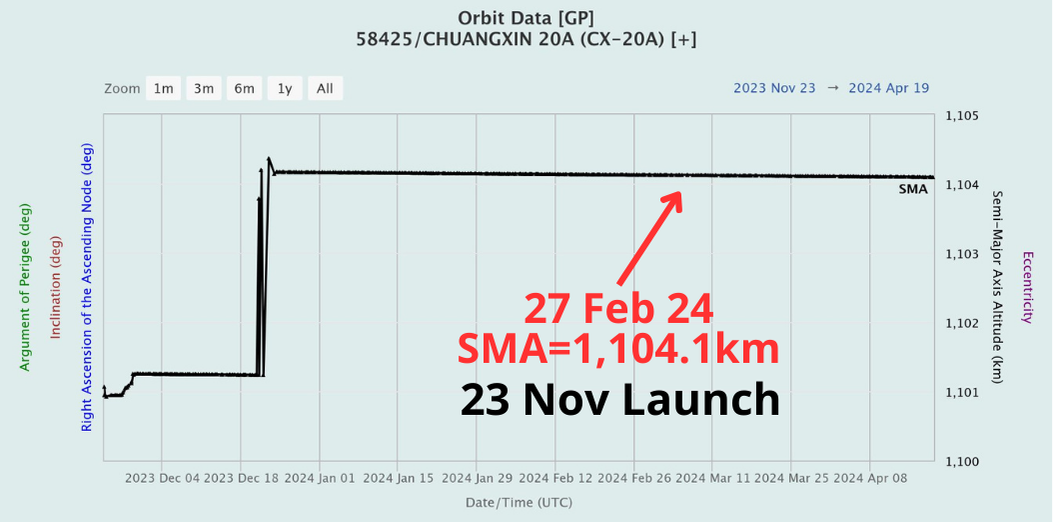
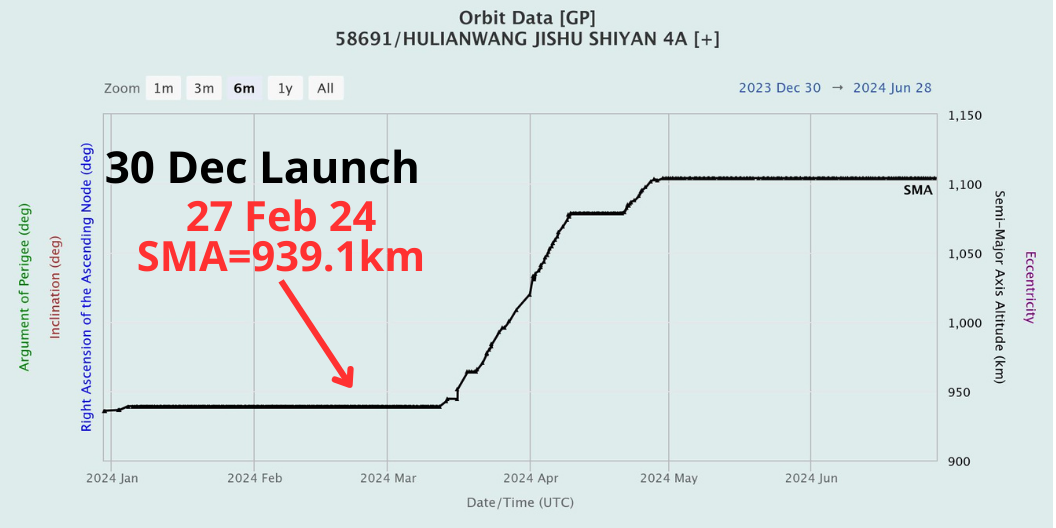
– Potential coverage area:
- Based only on the orbital information available on 27 Feb 2024 it appears China would have had Guowang coverage of the Miyako Strait for ~7 hours and 50 minutes on that day.
- There were several instances where the Guowang satellites provided ~30 min of consecutive coverage. (see graph below)

-Comparison with Western Constellations
- In terms of average altitude and inclination, China has placed their satellites into orbits which are similar to those used by the OneWeb constellation.
- OneWeb satellites orbit ~100km higher than Guowang (1,200km vs 1,100km average altitude respectively). All of OneWeb’s satellites are in orbits inclined at 87.5°. China appears to be using 2 inclinations, one of which is 86.5°. Inclination does not factor into the size of the satellite footprint.
- OneWeb is able to provide global coverage with its 654-satellite constellation. If China is able to field a 13,000 satellite constellation with many of the satellites at 1,100km it will provide extremely redundant/resilient connectivity.
- In contrast, Starlink satellites operate at ~550km or half the average altitude of Guowang and OneWeb. Starlink has previously announced its final constellation would be about 12,000 satellites, but that number has been revised several times. As of late March there are 7,135 Starlink satellites in orbit, of which 7,105 are working.
Conclusion: While we do not know the specific support the Guowang test satellites may have provided the Chinese Coast Guard vessels during this exercise/demonstration/operation, we do know there were 9 satellites on orbit and China could have used them in some capacity and in a way which was difficult for the Taiwanese to track. With these test satellites Guowang could provide sporadic coverage to the Miyako Strait. Coverage limitations would constrain testing to ~30 consecutive minutes at specific times of the day. However, testing would still be possible (see example of US military testing of Starlink in 2020 when Starlink had ~10% of its current number of satellites on orbit). The 10-month gap between the test near Taiwan and the first operational launch may have provided China with time to incorporate lessons learned into the operational satellites or just confirmed the performance of existing technologies and weapon system compatibility.
“Up” Date: 6 Newest Yaogan Triplet Formations Maneuver
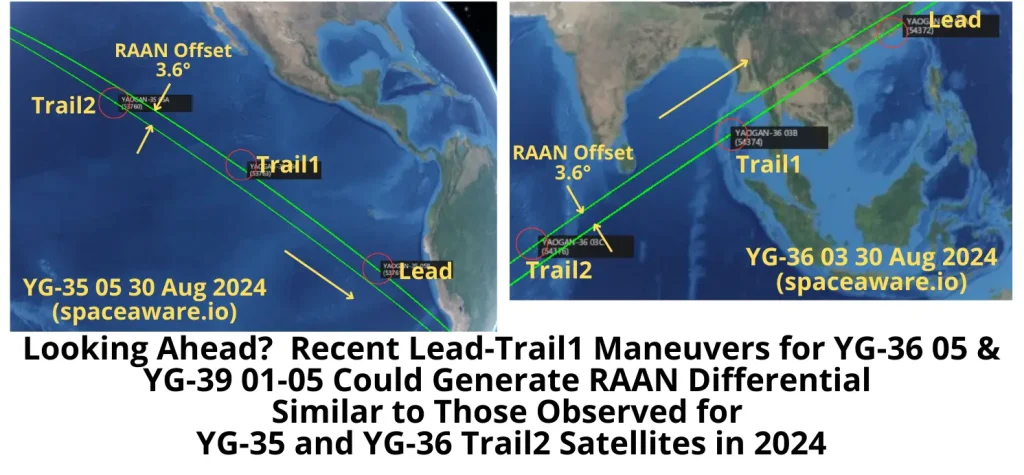
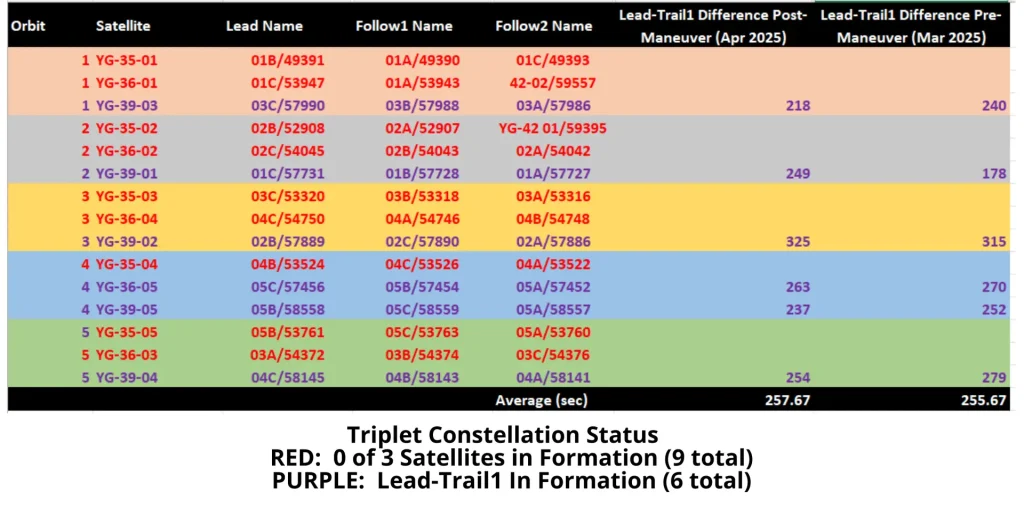
4 May: In the 8 April Integrity Flash I noted that China appeared to be “pulling the plug” on 9 of the 15 Yaogan-35/36/39 triplets. Between 16-22 April, I noticed some developments with the remaining 6 triplets. During this period China increased the average altitude (semi-major axis/SMA) for the Lead and Trail1 satellites for its most recently launched triplets: 1) YG-36 05; 2) YG-39 01; 3) YG-39 02; 4) YG-39 03; 5) YG-39 04; and 6) YG-39 05. China did not significantly alter the SMA for any of the Trail2 satellites in these formations. As a result the Lead and Trail1 satellites are maintaining their relative positions with one another (and potentially maintain inter-satellite communication links) while the Trail2 satellites now have a shorter orbital period and are not maintaining their relative position with the Lead or Trail1 satellites. I do not believe this is a “pull the plug” scenario, rather I suspect China is establishing a RAAN offset for the Trail2 satellites in the YG-36 05 and YG-39 01-05 formations and we will see the formations restored in the next 6 months. For now, none of the 15 YG-35/36/39 triplets are in their original formations.
– China appears to have conducted two sets of maneuvers. Western observers noted three sets of the Lead/Trail1 satellites (39 02, 39 03 & 39 04) increased their SMA on 16-17 April while the other three sets (36 05, 39 01 & 39 05) increased their SMA on 21-22 April.
– The maneuvers appear to have been very precise. All of the Lead and Trail1 satellites increased their SMA an average of 21.35km to ~518km. All Trail2 satellites maintained their average altitudes of ~497km.
– All of the Lead and Trail1 satellites remained in formation. The new SMA for the Lead and Trail1 satellites differed by only an average of 220m. As a result the satellites will maintain their relative positions with one another.
– In early March (before these maneuvers) the average time separation between Lead and Trail1 satellite was 255.7 seconds. On 28 April the average separation between Lead and Trail1 satellites had increased 2 seconds to 257.7 seconds (a 0.8% variance).
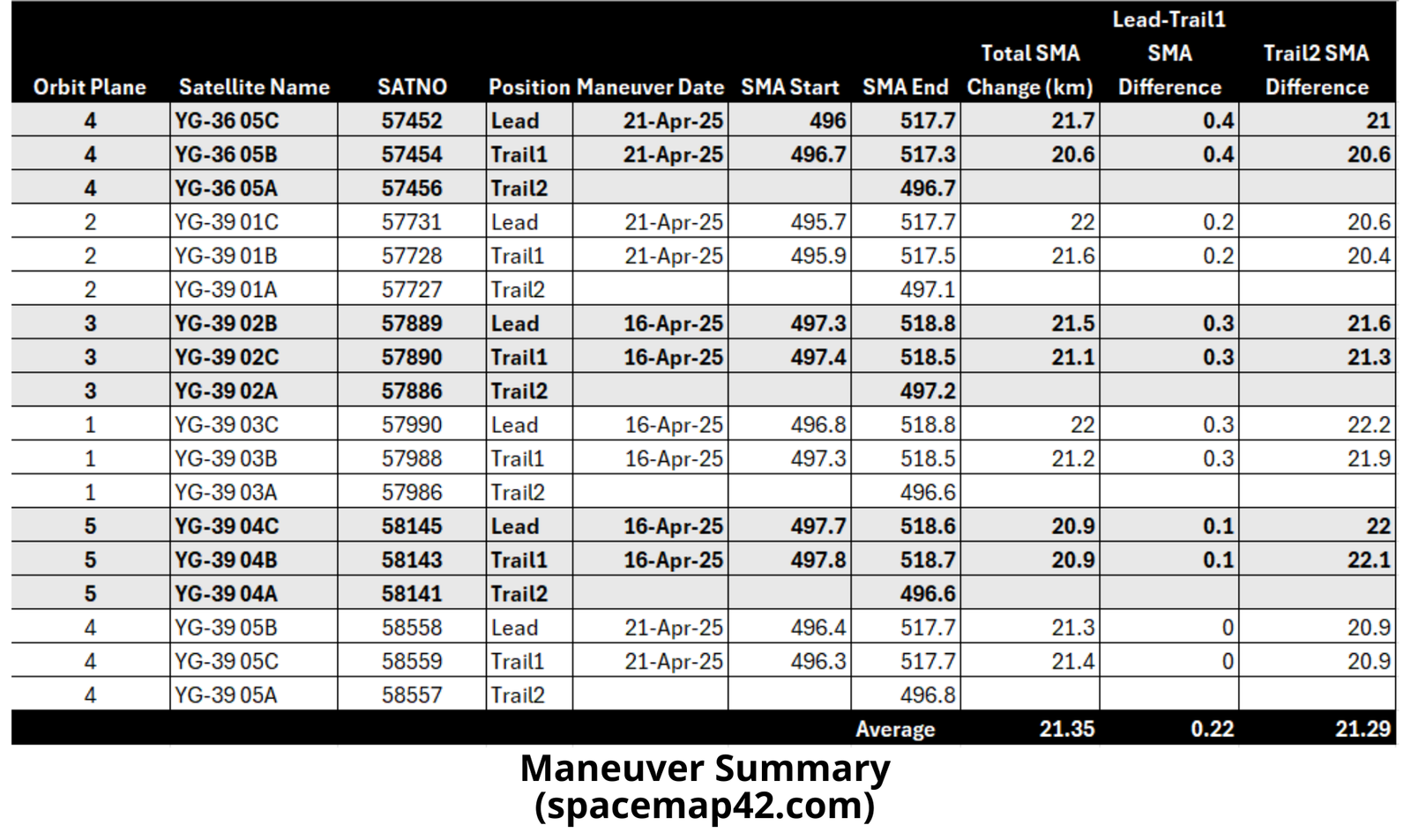
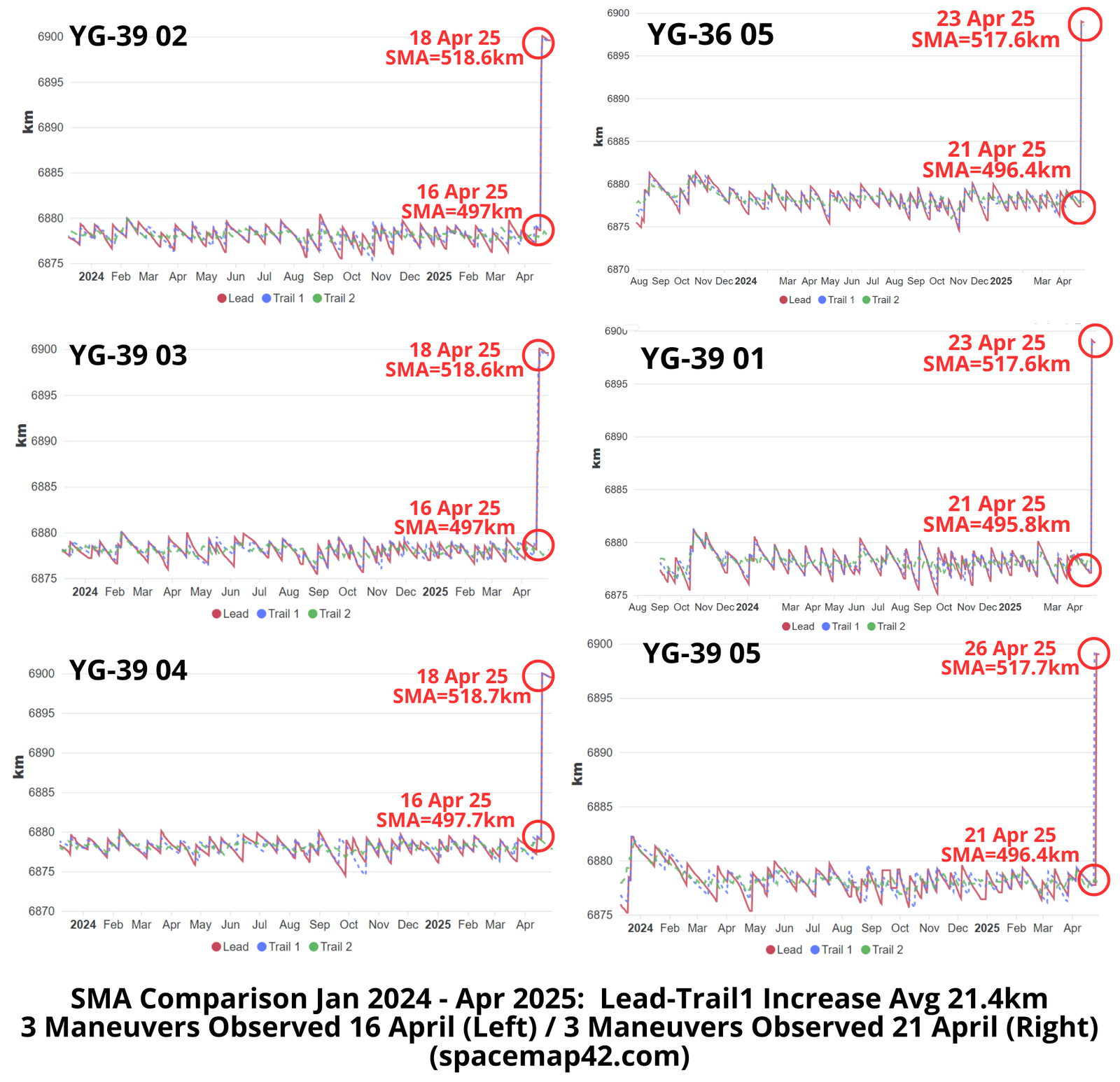
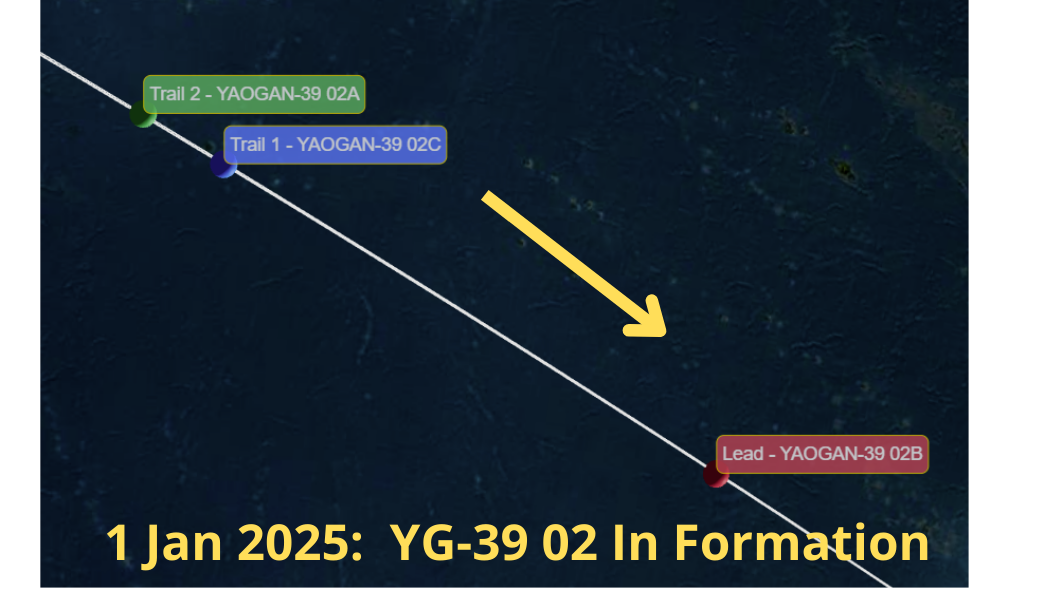
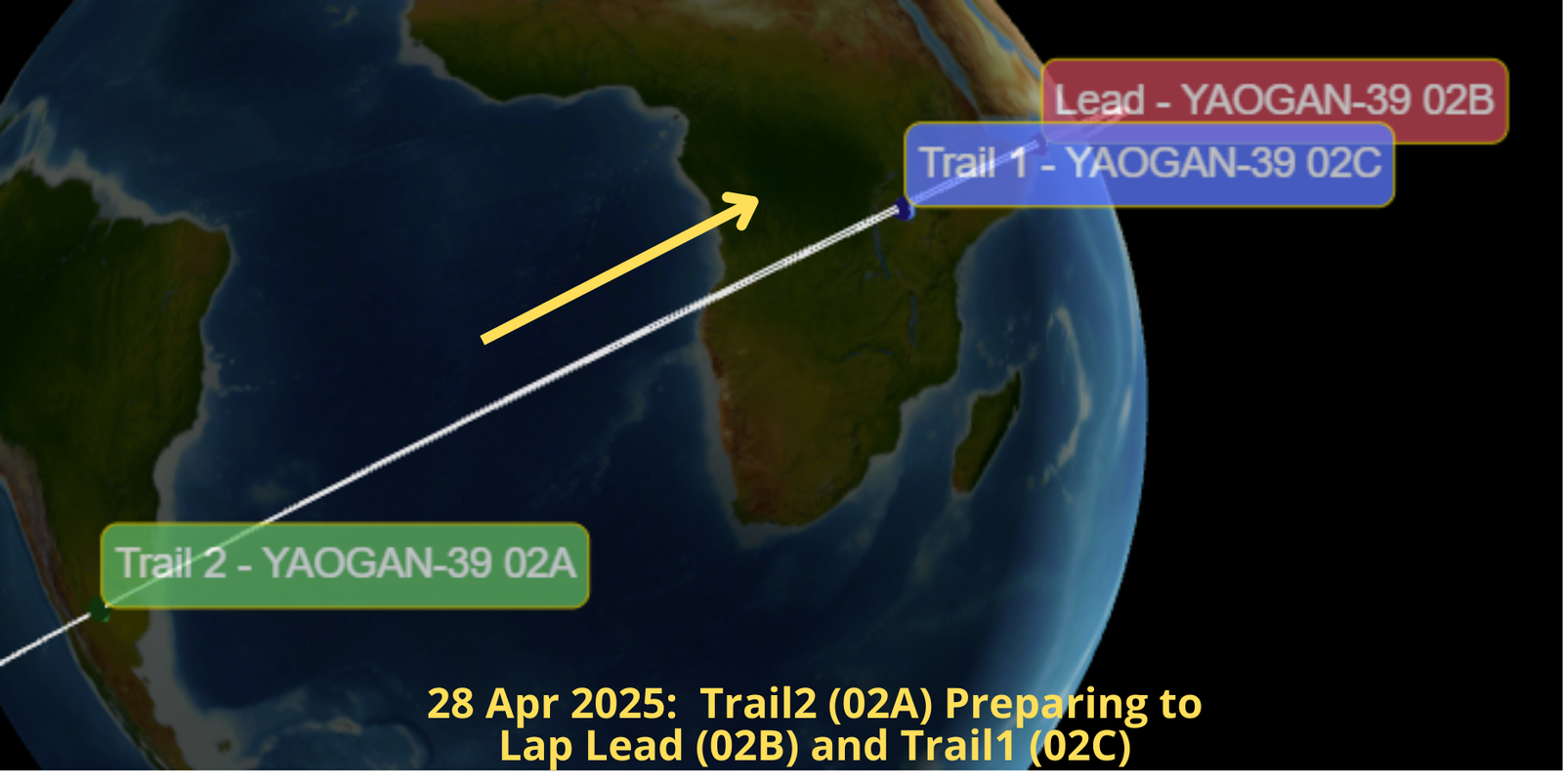
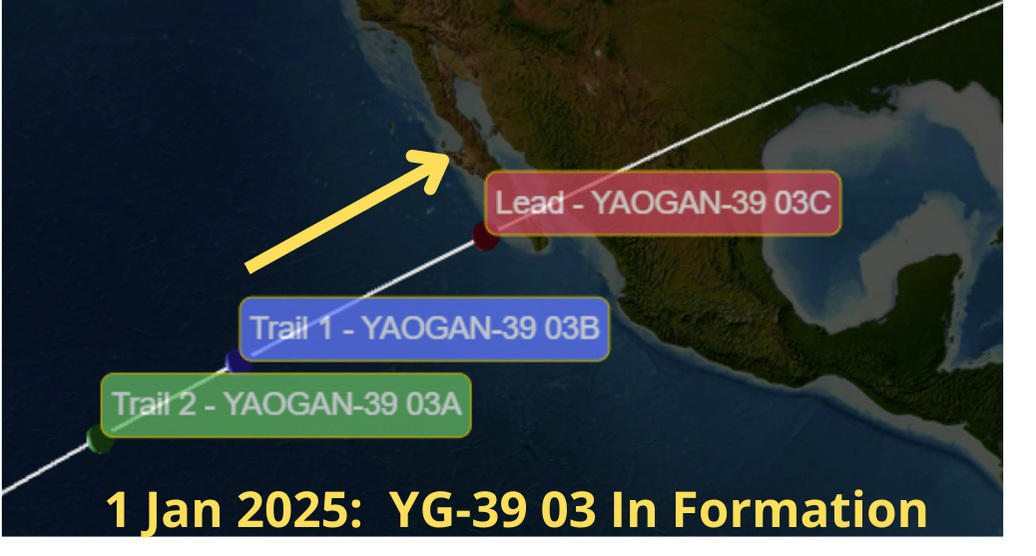
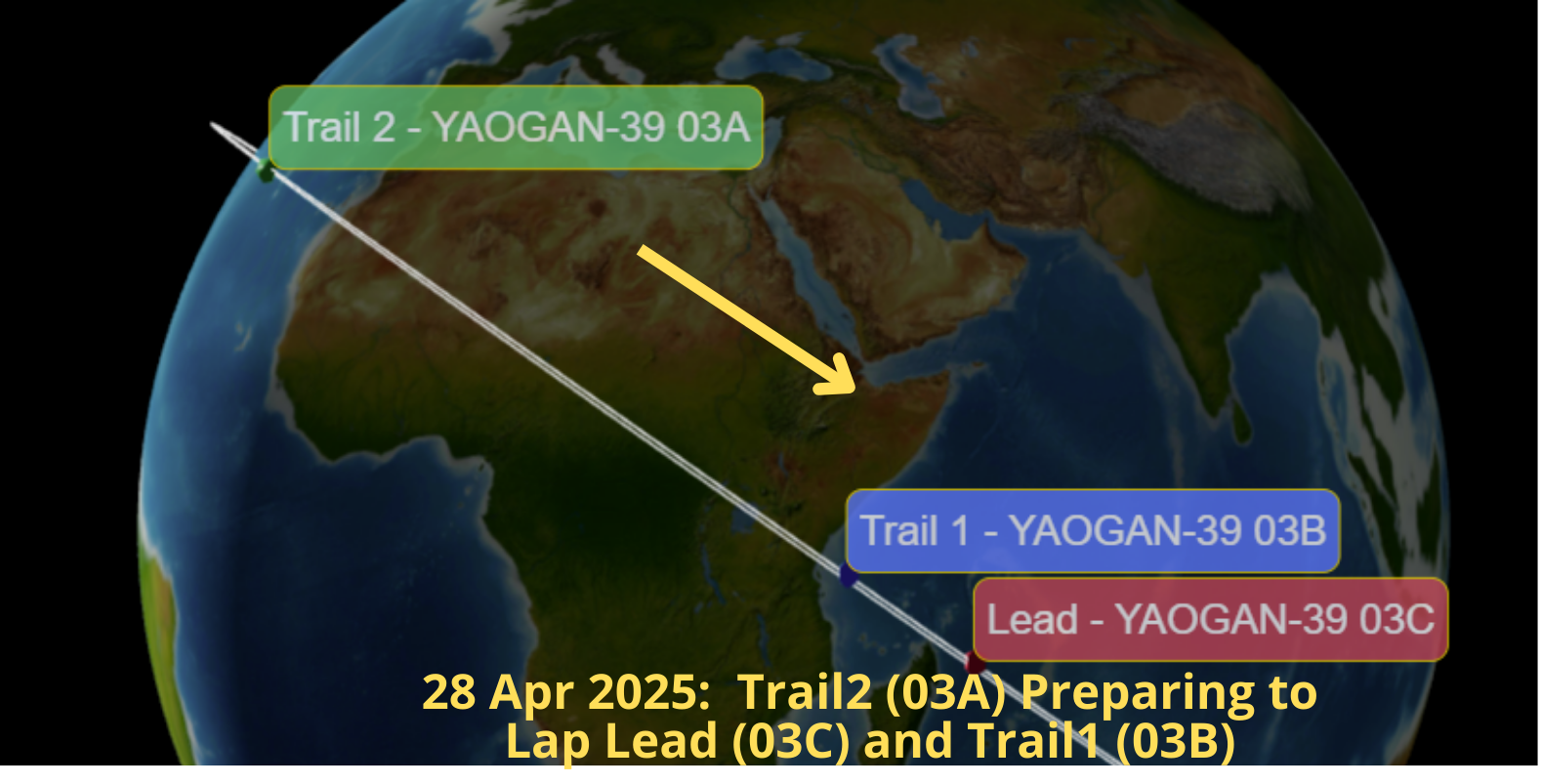
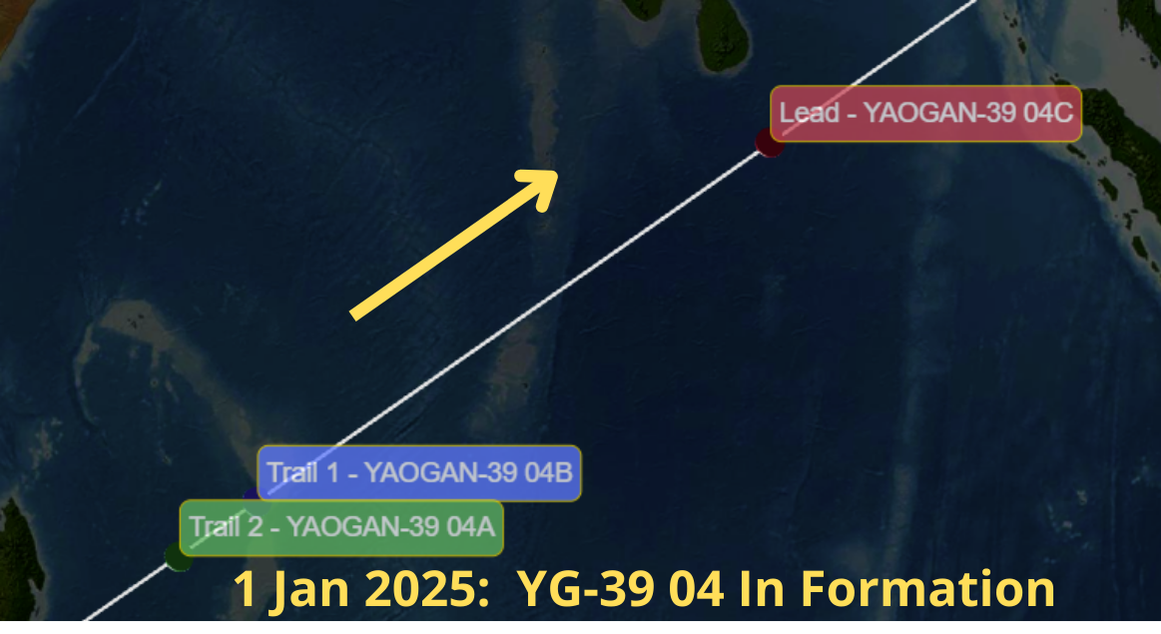
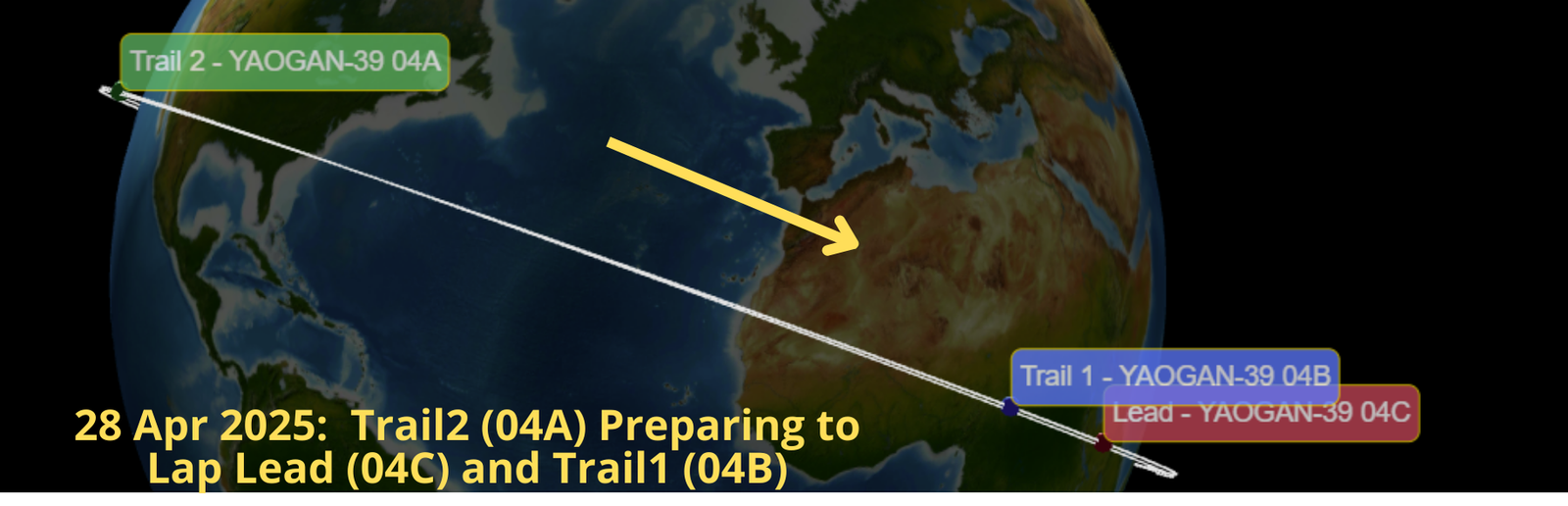
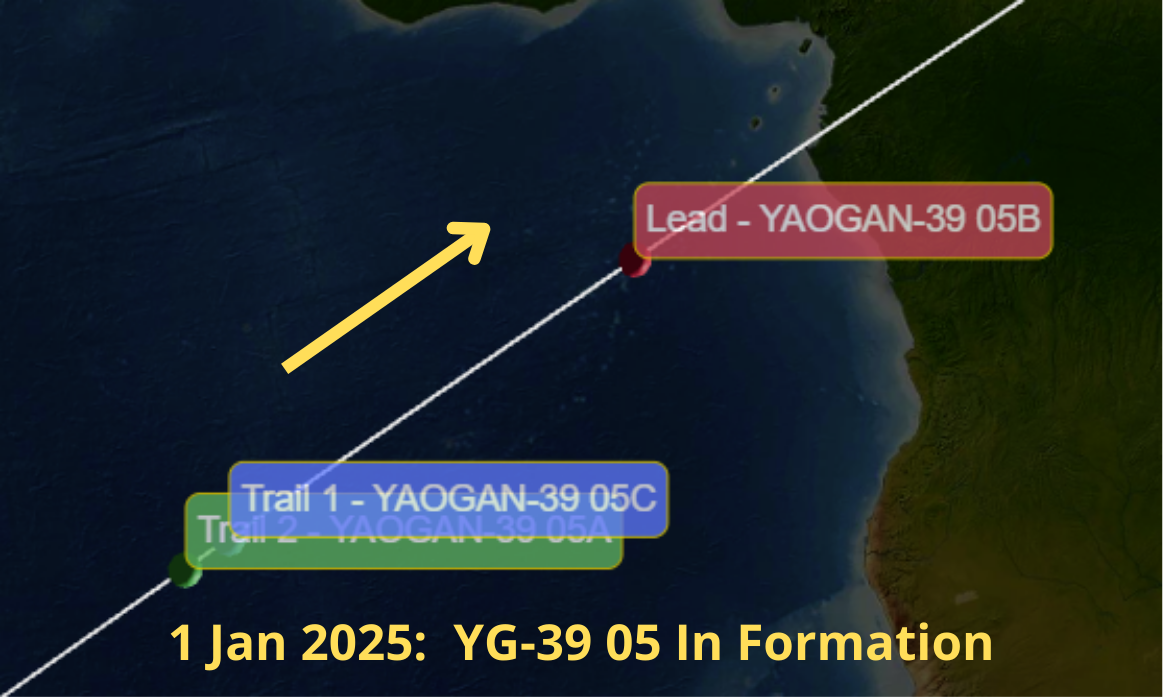
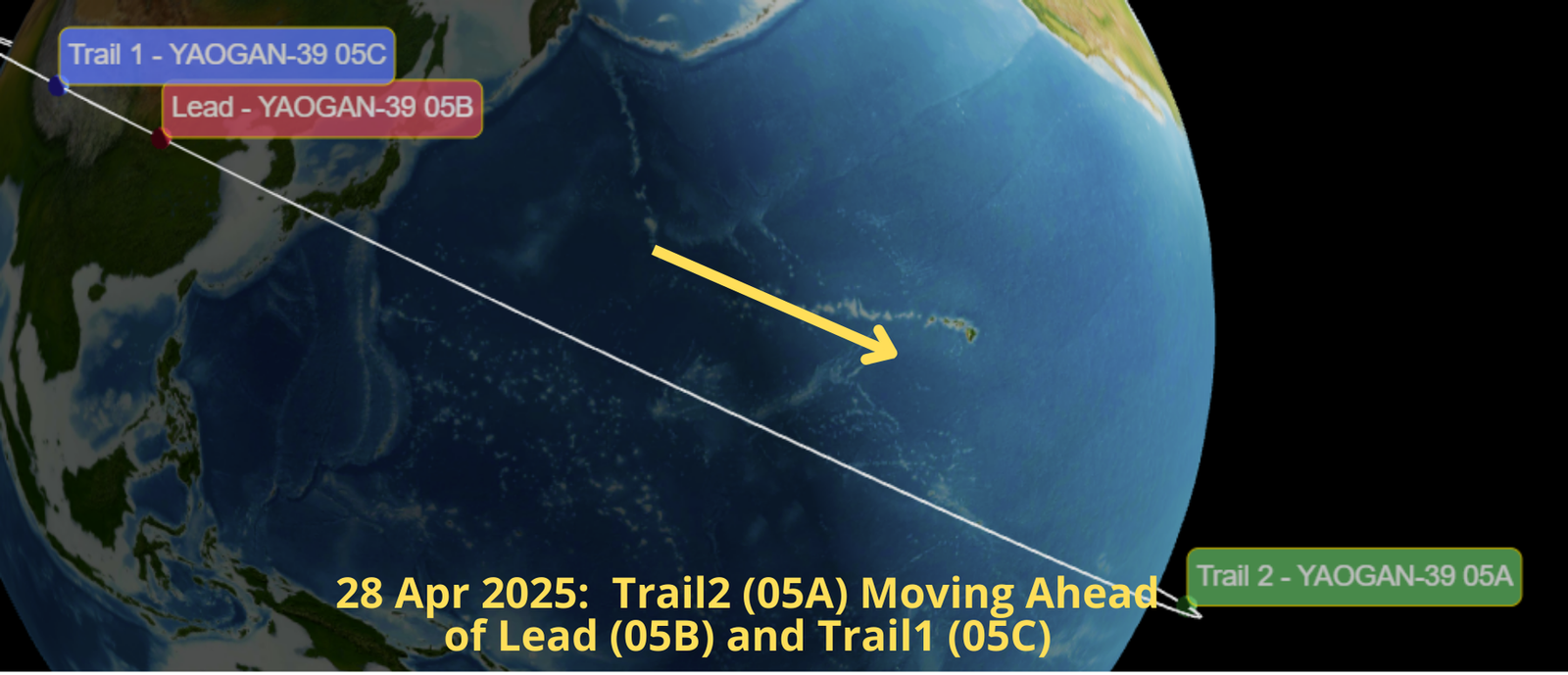
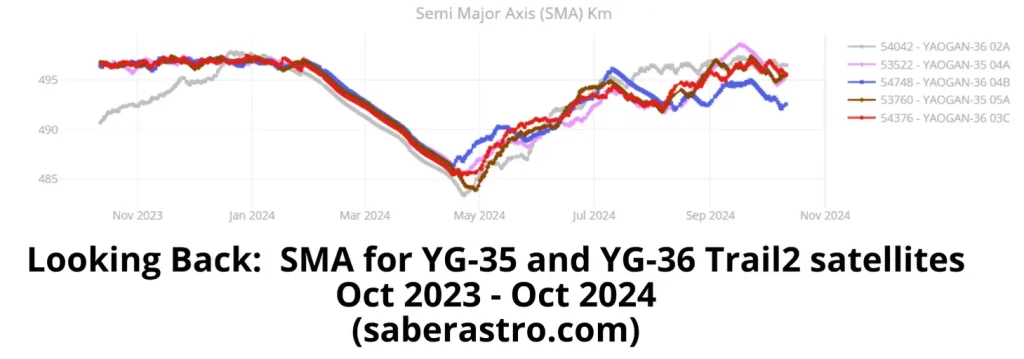
– I don’t believe China is “pulling the plug” on these 6 formations. This looks like an inverse from what we saw from late-Jan through Sep 2024 with the older YG-35 & 36 triplets. In those instances China allowed the SMA of the Trail2 satellites to gradually decrease for about 4 months and then attempted to increase their SMA to bring the Trail2 satellites back into formation once they had achieved the desired RAAN offset.
– This time, instead of Trail2 decreasing its SMA, China increased the SMA for Lead and Trail1 satellites. The result is the same, RAAN progression for Lead and Trail1 will differ from Trail2. Once China has achieved the desired RAAN offset they can then lower the SMA for Lead and Trail1 to restore the formation.
– China may have increased the SMA of Lead and Trail1 to a point where natural SMA degradation will bring them down to Trail2 while minimizing the need for additional maneuvers and conserving fuel.
– We will be able to observe how the triplet formations evolve over the coming weeks. For now, and for the first time since late-2021, none of the 15 triplet formations appear to be fully operational.
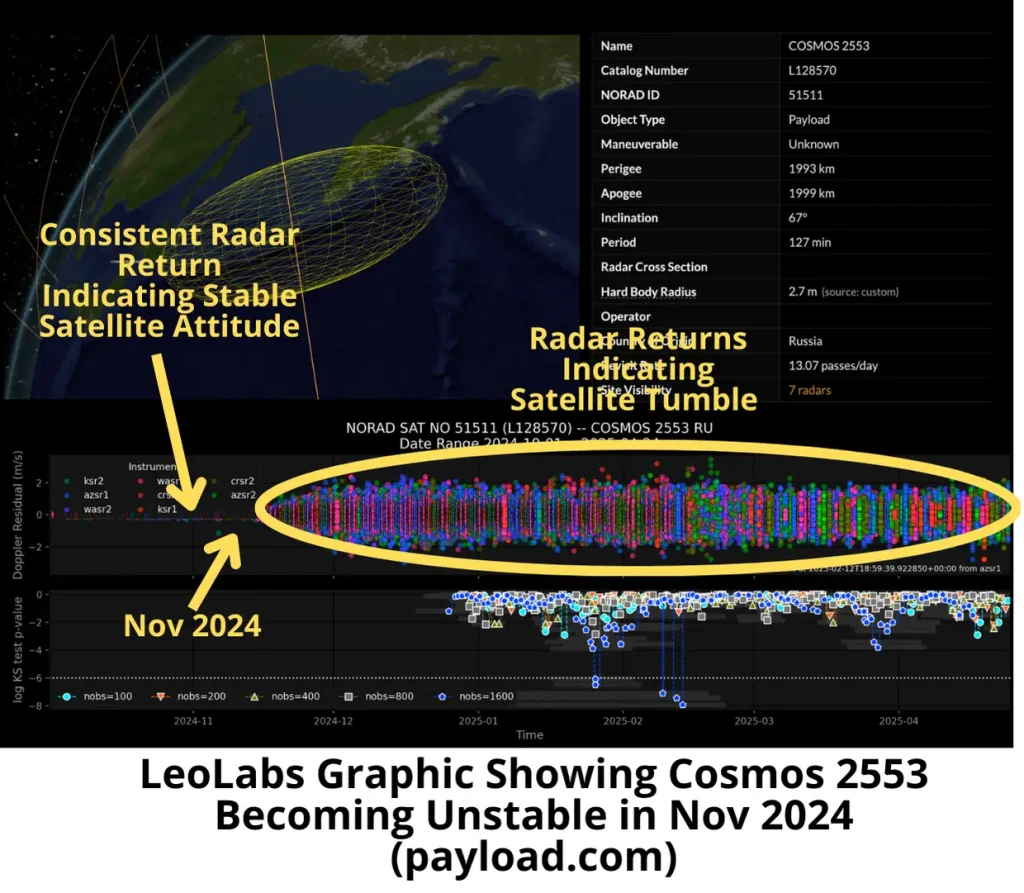
25 Apr: Various news sources reported that the Russian Cosmos 2553 (51511) satellite appeared to become unstable in November 2024. Russia launched Cosmos 2553 on 5 Feb 2022 (editor’s note: this was less than 3 weeks prior to Russia’s invasion of Ukraine and 82 days after Russia’s destructive Nudol ASAT test) and soon-after there were rumors that the satellite was potentially a test of a nuclear armed anti-satellite weapon (although there have been no reports that Cosmos 2553 actually has a nuclear weapon on board.) Secure World Foundation did an excellent article which you should read. LeoLabs recently released data indicating its (LeoLabs) space tracking radars had detected Cosmos 2553 had become unstable in November 2024. In mid-December the LeoLabs hypothesis was confirmed with optical imagery from Maxar satellites.
LeoLabs Senior Technical Fellow (and friend of the Flash), Dr Darren McKnight was nice enough to provide some insight on what LeoLabs was able to observe.
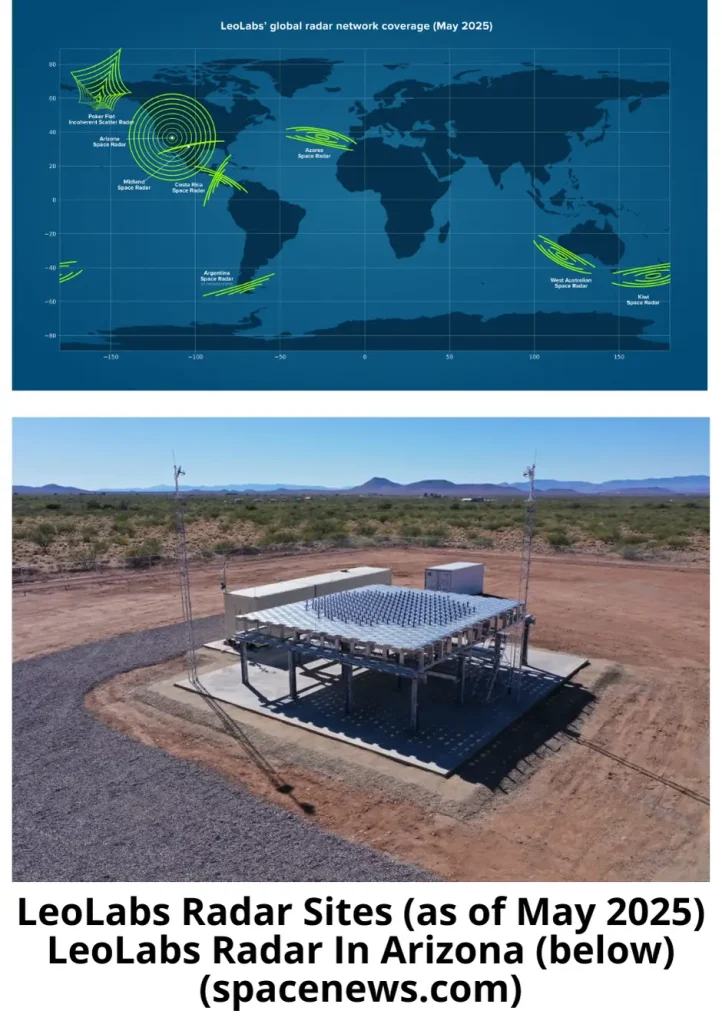
– LeoLabs provides persistent orbital intelligence on nearly 24,000 objects in LEO by providing not only updated state vectors six to eight times a day but also object characteristics to include radar cross-section, maneuverability, area-to-mass ratio, proximity operations characterization, attitude instability, etc.
– LeoLabs monitored Cosmos 2553 since its launch in Feb 2022. LeoLabs has developed and conducted doppler
residuals tests to determine satellite instability. In the Fall of 2024 LeoLabs examined Cosmos 2553 and the results initially found the satellite stable. However, through continuous monitoring it was shown to have become unstable around 15 November 2024.
– In object characterization tradecraft, we (LeoLabs) do not assign an object with a certain state with high confidence from a single feature, so we considered the fact that Cosmos 2553 had an unstable attitude (i.e., tumbling) as of 15 November 2024 with moderate confidence.
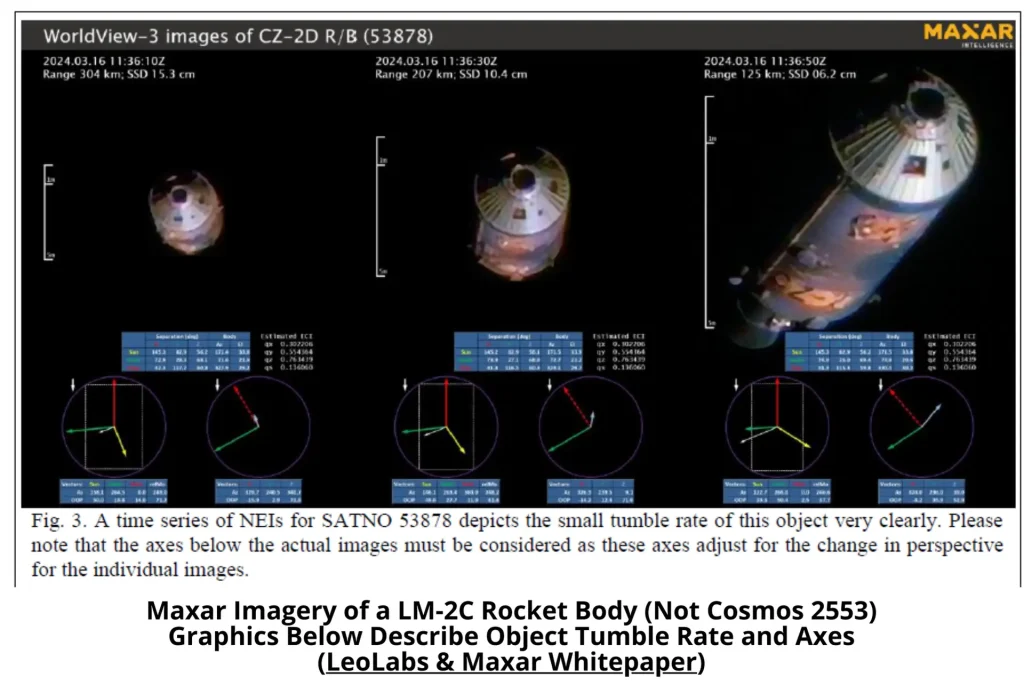
– LeoLabs then pursued verification through a non-Earth imaging (NEI) partner and in mid-December a sequence of images showed a clear instability (i.e., tumbling). At that time, LeoLabs concluded that Cosmos 2553 was tumbling with high confidence.
– Over the past few months, the doppler residuals plot has shown a slight reduction in magnitude hinting that either the tumble is slowing, or the orientation of the spacecraft tumble relative to the ground is changing slightly.
I also spoke to Stephen Hannah, the SSA/SDA Product Manager for Maxar Intelligence. Stephen provided some great insights into the Non-Earth Imaging support Maxar provided to confirm Cosmos 2553 tumbling status.
– Maxar imaged Cosmos 2553 in January 2024 (pre-tumble). Using its Worldview Legion satellites, Maxar collected a 3 image sequence at a range of 1380-1587km at 52.1-79.5 cm Space Sample Distance (or resolution). Maxar’s Non Earth Imagine (NEI) analytics showed a fully stable to possibly a ~0.5° slew; perfectly within expected range for a stable satellite.
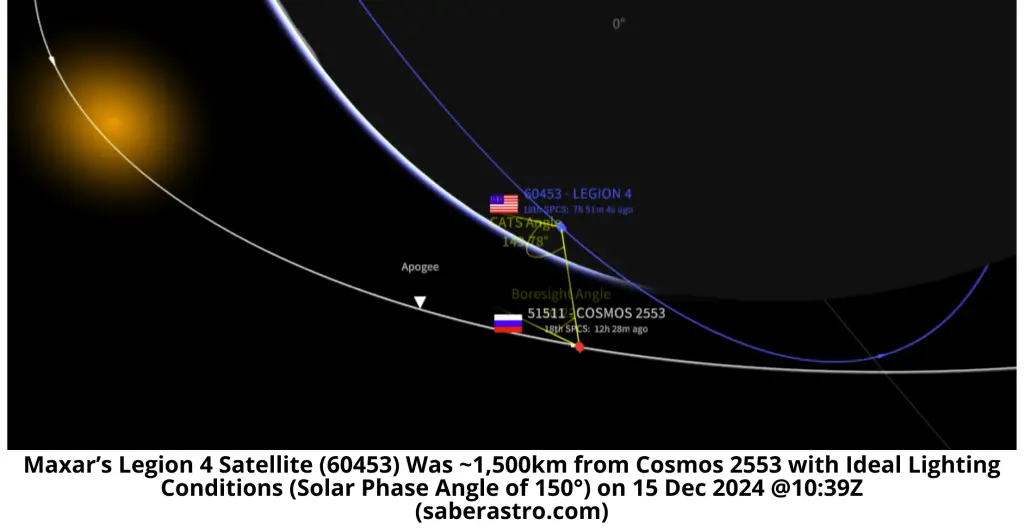
– Following a conversation with LeoLabs, Maxar collected 9 image sequence at a range of 1421km – 1686km at 71.2 – 84.5 cm SSD/resolution on 15 Dec 2024. Maxar’s NEI analytics showed a rotation rate of around ~2.3-2.4°/sec, appearing to be close to a flat spin about the payload line of sight.
Bottom line: Maxar imagery showed a stable Cosmos 2553 in Jan 2024 and a tumbling (and likely non-operational) Cosmos 2553 in December 2024.
(editor’s note: Thanks for the inputs Dr McKnight & Stephen Hannah! This is the way.)
– It appears the story of Cosmos 2553 may not have ended. A spokesperson from Slingshot Aerospace (another space domain monitoring company that operates 150+ optical telescopes), initially noted Cosmos 2553’s brightness became variable, indicating a potential tumble.” However, according to Slingshot’s latest observations, Cosmos 2553 appears to have stabilized, according to Belinda Marchand, the company’s Chief Science Officer.
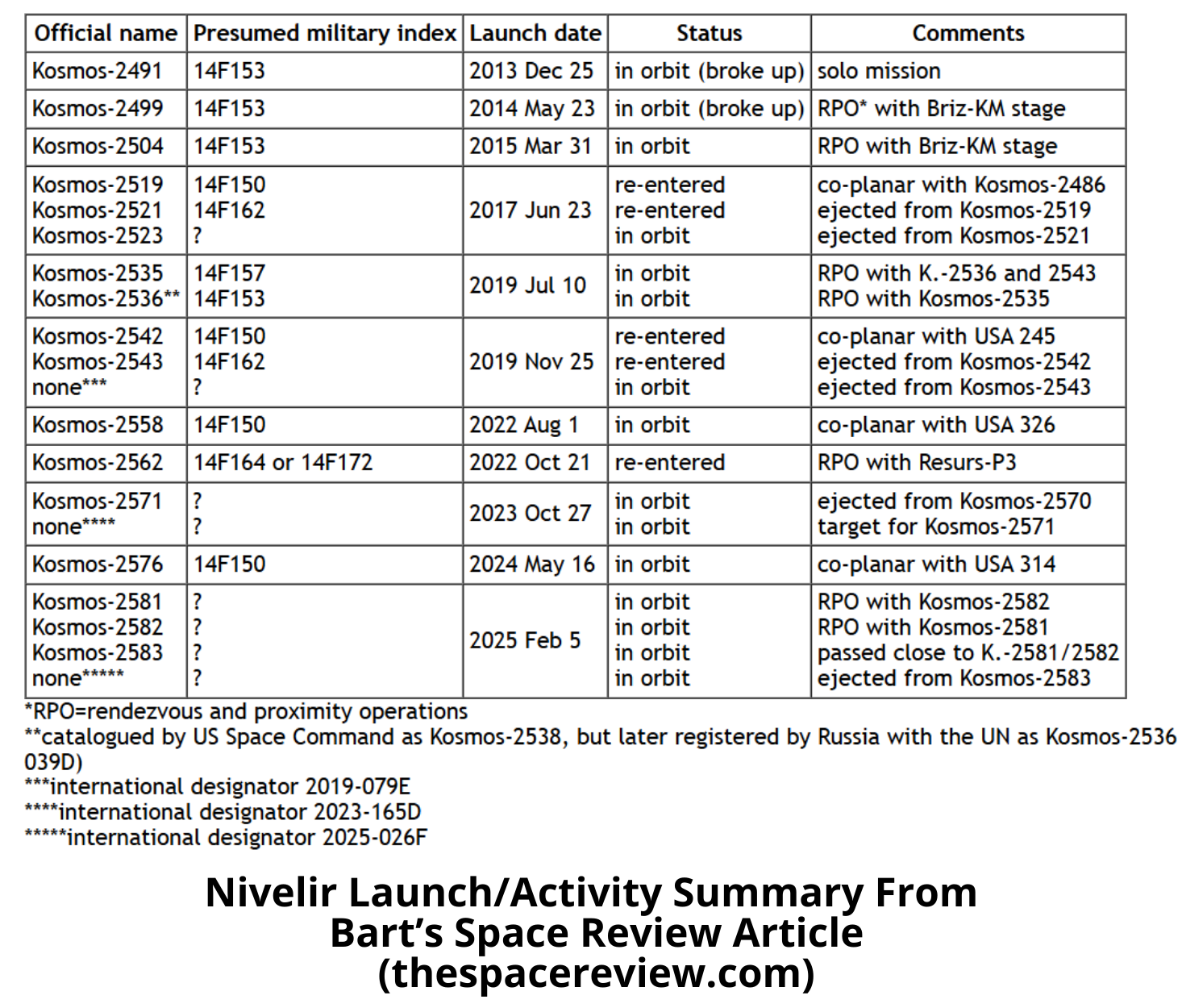
28 Apr: The Space Review published another tremendous article from Bart Hendrickx in which Bart takes a look at the history of the Russian inspector/anti-satellite Nivilir development and testing. I’ve included excerpts below to capture Bart’s description of Nivilir flight history. As is the norm for Bart’s articles, there is a ton of additional details in the article which you should read in its entirety.
History of Russian inspection satellites
- The first Russian satellites categorized in the West as “inspection satellites” were three objects launched between December 2013 and March 2015 aboard the Rokot launch vehicle (Cosmos 2491 and 2499)…the satellites performed rendezvous and proximity operations with the Briz-KM upper stage that had delivered them to orbit.
- In June 2017 Russia launched Cosmos-2519 aboard a Soyuz-2.1v rocket…the Ministry of Defense gave the mission objectives as remote sensing of the Earth and photography of other objects in space. Orbit parameters showed that the satellite had been placed into the same plane as Kosmos-2486, a Russian optical reconnaissance satellite of the Persona type launched in 2013…About two months after launch, Kosmos-2519 deployed a subsatellite that was later designated Kosmos-2521. In late October 2017, when Kosmos-2521 itself released an object that later got the name Kosmos-2523. This immediately performed a single maneuver that lowered its perigee by about 100 kilometers.
- In July 2019 Russia launched Cosmos 2535 & 2536, which…soon started a long series of mutual encounters. The first of those, in August 2019, was the subject of another Ministry of Defense press release, which described one satellite as an “inspection satellite” and the other as a “registering satellite.” Later in the mission, one of the two satellites generated about two dozen pieces of space debris that ended up in widely scattered orbits, indicating they were the result of some kind of energetic event. The satellites themselves remained operational after these debris-shedding events.
- In November 2019, Russia launched a mission that was a near carbon copy of the one flown in 2017. It again involved a “parent satellite” (Cosmos 2542), which released a small subsatellite (Cosmos 2543) several days after launch. Tracking data showed that both were in the same orbital plane as the US electro-optical reconnaissance satellite USA 245. In July 2020, Cosmos 2543 approached Cosmos 2535 and ejected an object that significantly changed its perigee (by about 100 kilometers) and apogee (by almost 170 kilometers.)
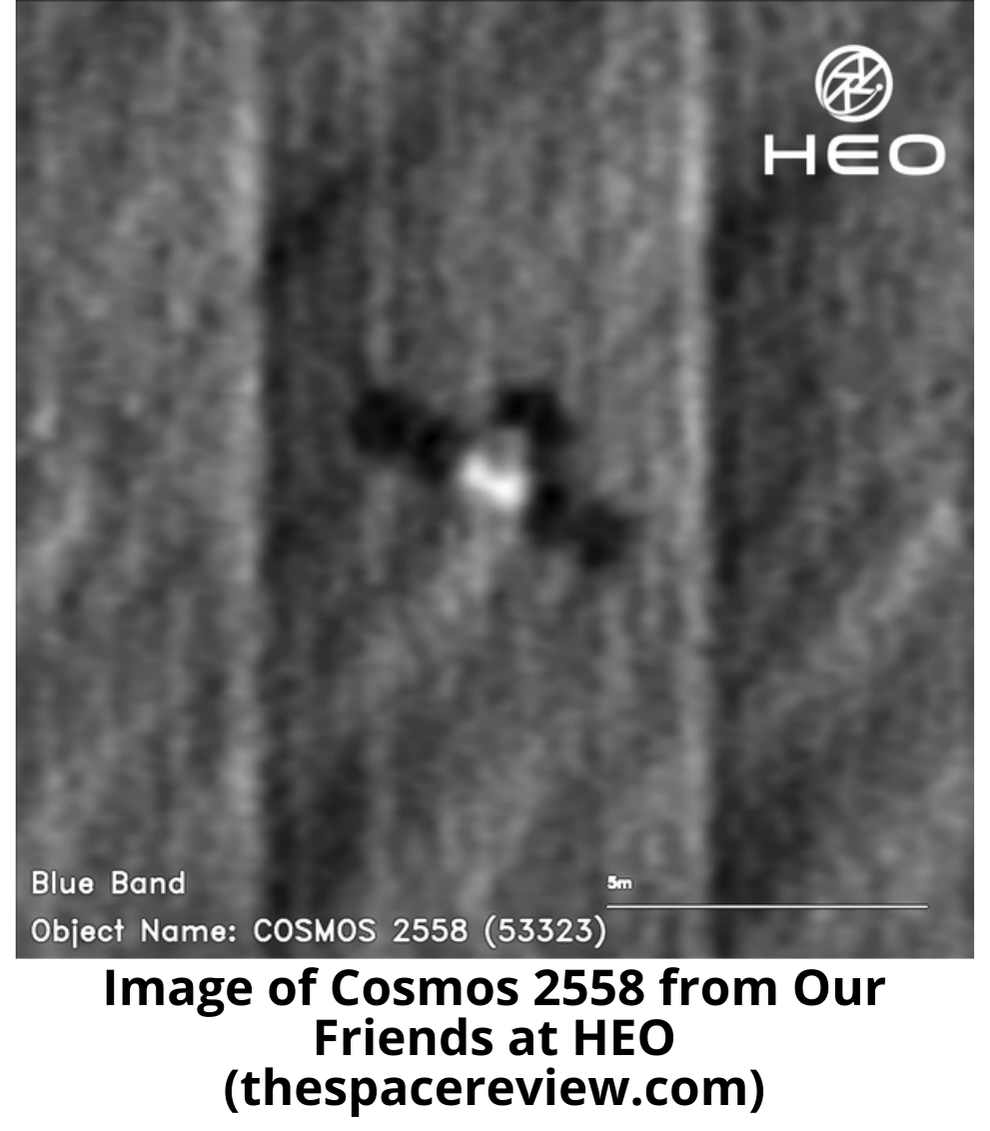
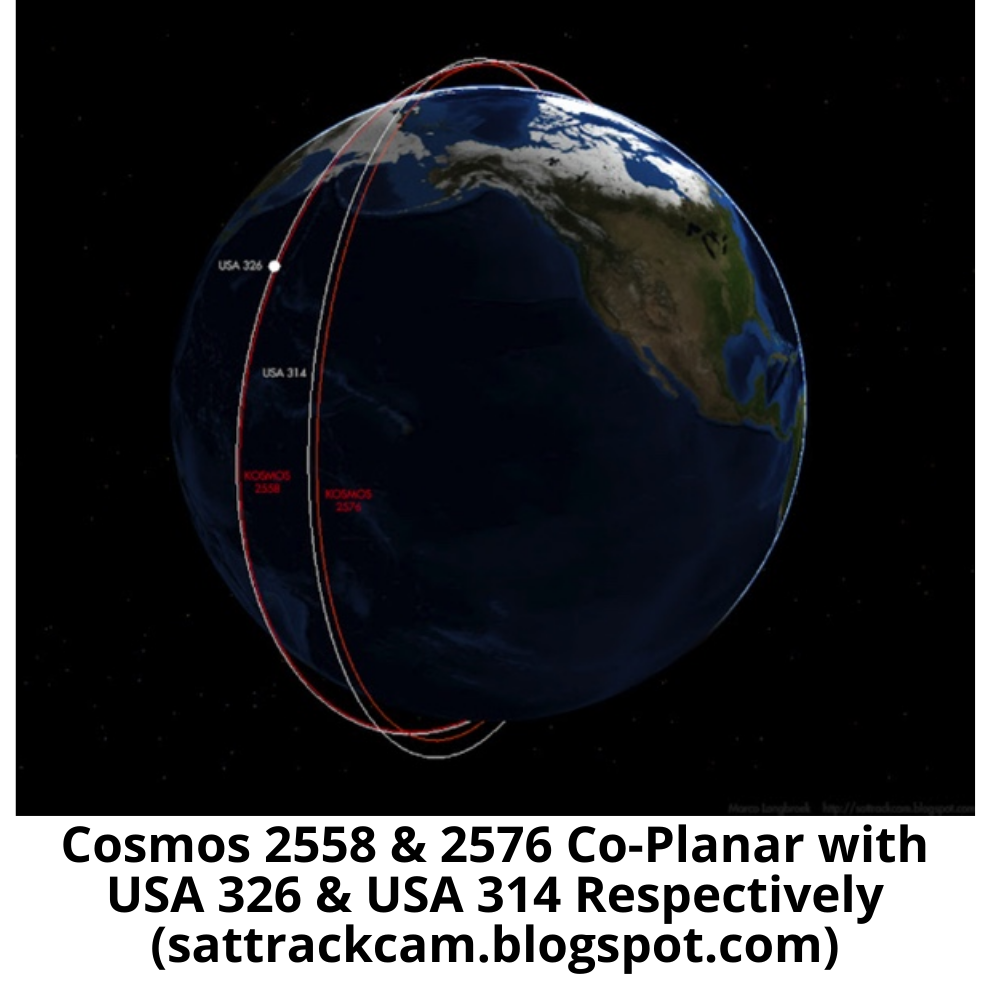
- In August 2022 and May 2024, Russia orbited two more satellites (Cosmos 2558 & 2576) that were inserted into the same orbital plane as US reconnaissance satellites (USA 326 and USA 314, respectively.)
- Russia has not provided any details about Cosmos 2558 & 2576, but all indications are that they are of the same type as Cosmos 2519 & 2542, the only difference with the two earlier missions being that they have so far not released any subsatellites. They have been conducting maneuvers on a regular basis to ensure that their orbits remain synchronized with those of the American satellites, although a new series of orbit corrections by Cosmos-2576 in February are reported to have moved it out of plane with USA 314.
- Small subsatellites with likely inspection missions were launched attached to two electronic intelligence satellites of the Lotos-S type (Cosmos 2565 & 2570) in November 2022 and October 2023. Several weeks after being detached from the parent satellites, they split into two pieces, one of which was presumably an inspection satellite and the other a rendezvous target. While the first mission seems to have failed, the second one saw the inspection satellite (labeled Kosmos-2571) performing rendezvous and proximity operations with the target in December 2024.
- Small subsatellites with likely inspection missions were launched attached to two electronic intelligence satellites of the Lotos-S type (Cosmos 2565 & 2570) in November 2022 and October 2023. Several weeks after being detached from the parent satellites, they split into two pieces, one of which was presumably an inspection satellite and the other a rendezvous target. While the first mission seems to have failed, the second one saw the inspection satellite (labeled Kosmos-2571) performing rendezvous and proximity operations with the target in December 2024.
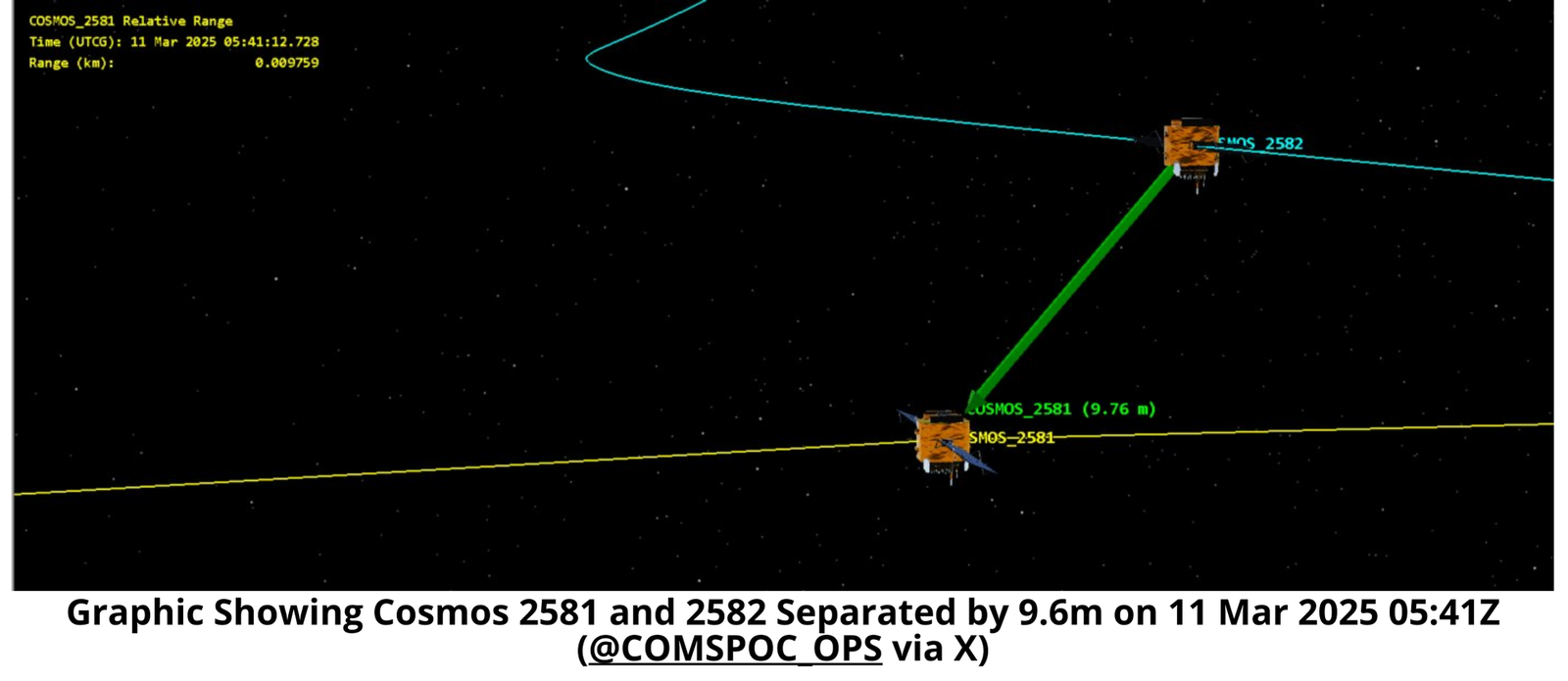
- Finally, three satellites (Cosmos 2581, 2582, and 2583) launched together this February also have all the hallmarks of being on some type of inspection mission. The Cosmos-2581/2582 pair has been flying in tandem since early March, coming as close as about 50 meters. Cosmos 2583 passed very close to them in early March and is now flying well ahead of them. It released an object, so far unidentified, on March 18.
- Russia has not provided any details about Cosmos 2558 & 2576, but all indications are that they are of the same type as Cosmos 2519 & 2542, the only difference with the two earlier missions being that they have so far not released any subsatellites. They have been conducting maneuvers on a regular basis to ensure that their orbits remain synchronized with those of thecond one saw the inspection satellite (labeled Kosmos-2571) performing rendezvous and proximity operations with the target in December 2024.
- Finally, three satellites (Cosmos 2581, 2582, and 2583) launched together this February also have all the hallmarks of being on some type of inspection mission. The Cosmos-2581/2582 pair has been flying in tandem since early March, coming as close as about 50 meters. Cosmos 2583 passed very close to them in early March and is now flying well ahead of them. It released an object, so far unidentified, on March 18.
Pics o’ the Fortnight