issue 116 | 9 Mar 2025
The integrity flash
Analysis of Developments in the Space Domain
in this issue
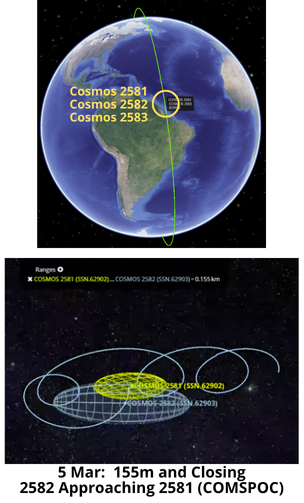
7 Mar: Since launching Cosmos 2581 (62902), Cosmos 2582 (62903) and Cosmos 2583 (62904) on 5 Feb 2025, Russia has maneuvered 2581 and 2582 into formation with one another. On 5 Mar the 2 satellites briefly came within <100m from one another. For its part, Cosmos 2583 has yet to maneuver, however it is flying at a slightly lower altitude than the 2581/2582 pair and passed both satellites on 7 Mar with a point of closest approach of <1km. The situation continues to evolve, but I worked with the COMSPOC team to analyze the orbital activities of all three satellites from 13 Feb through 7 Mar. Watch COMSPOC video of 2581/2582 Close Approach. Watch COMSPOC video of 2581/2582/2583 Close Approach.
– All 3 satellites are in an 82.0 inclined orbit. Cosmos 2581 & 2582 have an average altitude of 588.2km while Cosmos 2583 has an average altitude of 587.5km.
– Immediately after orbit insertion Cosmos 2582 was in “lead” position followed by Cosmos 2583 and then 2581. Cosmos 2581 and 2582 were at 586.6km average altitude while 2583 was at 588.5km, so both 2581 and 2582 drifted “ahead” of 2583.
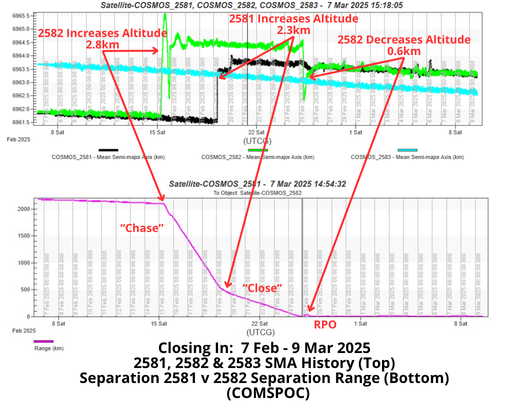
– On 15 Feb, 2582 increased its average altitude 2.8km to 589.4km, slowing its motion relative to both 2583 and 2581.
-On 19-20 Feb 2581 does a series of burns to increase its average altitude 2.3km to 588.7km. At this point 2581’s average altitude is 0.6km less than 2582.
– On 24-25 Feb 2582 lowers its average altitude to match 2581. Both satellites are orbiting at an average altitude of 588.4km.
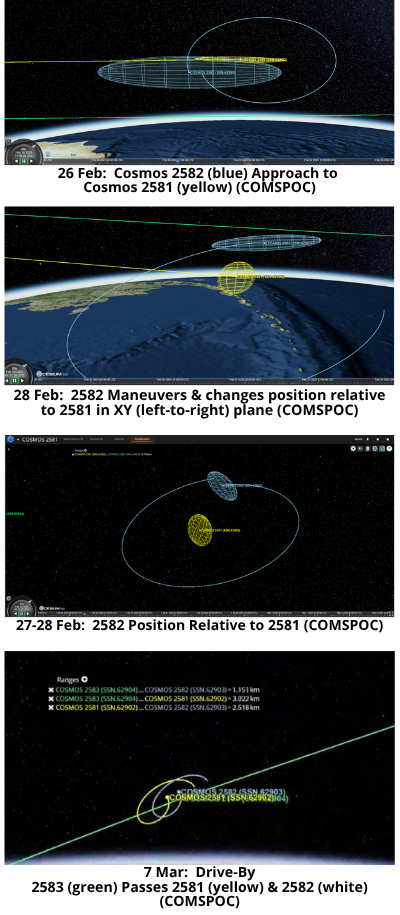
– These maneuvers lead to a series of 2581/2582 close approaches between 26 Feb to 3 Mar. The closest of these approaches was <100m.
– On ~3 Mar 2582 makes a slight adjustment to its average altitude (~100m) resulting in 2581/2582 naturally maintaining a relative distance of ~0.1-4km. See Video.
– Cosmos 2583 has not appeared to maneuver since arriving on orbit. As noted, its average altitude is lower than 2581/2582. As a result 2583 passed through the 2581/2582 formation on 7 Mar, resulting in several close approaches of less than 0.5km. See Video.
Russia has released virtually no information regarding the mission of these satellites other than to say they were launched for the Ministry of Defense. Cosmos 2581 and 2582s’ coordinated maneuvers would at the very least enable satellite inspection and could indicate a counter-space capability test. Russia has conducted co-orbital counterspace testing in the past (see next article as a refresher) and has been accused by the United States as having two satellites on-orbit (Cosmos 2558 and Cosmos 2576) with counterspace capabilities.
The relationship between Cosmos 2581 and 2582 warrants continued monitoring. Cosmos 2583 remains a mystery; unknown if it will eventually join the 2581/2582 formation, conduct some other mission, or has suffered some anomaly.
The United States has accused Russia of conducting on-orbit counterspace testing in the past. Testing thus far has not resulted in the creation of space debris. Below is an excerpt from the most excellent Secure World Foundation (SWF) 2024 Global Counterspace Capabilities Report describing the activities of Cosmos 2519 and its sub-satellites, Cosmos 2521 & Cosmos 2523, from July 2017 – June 2018.
Cosmos 2519
- On June 23, 2017, a Russian Soyuz 2-1v rocket was launched from Plesetsk with two military payloads.
- One payload was rumored to be the first of the new series of military geodetic satellites, used to create extremely precise maps of the Earth’s shape and gravitational field.
- Russian officials declared that the launch also included a “space platform which can carry different variants of payloads” which was designated Cosmos 2519 (2017-037A, 42798).
- In late July and early August, Cosmos 2519 made a series of small maneuvers. Publicly available information strongly suggests that Cosmos 2519 had a remote sensing mission.
- On August 23, 2017, Russian officials announced that a small satellite, designated Cosmos 2521 (2017-037D, 42919) had separated from the platform and was “intended for the inspection of the condition of a Russian satellite.”
- Russia reported that the satellite-inspector completed a series of proximity operations experiments and returned to the Cosmos 2519 host satellite on October 26.
- On October 30, Russia announced that another small satellite, Cosmos 2523 (2017-037E, 42986), separated from Cosmos 2521 and would have a satellite inspection function but to date, it has not been proven to approach other satellites.
- Jonathan McDowell calculated that Cosmos 2523 was released at a relative velocity of 27 meters per second (60 miles per hour).
- Comments from senior US military leadership suggest they consider the deployment of Cosmos 2523 to have been an ASAT test, given its relatively large deployment velocity.
- Throughout March, April, and June 2018, Cosmos 2519 and 2521 conducted several RPOs of each other.
- After March 2018, Cosmos 2519 and Cosmos 2521 did not maneuver to approach any other space objects but made small adjustments to their orbits, likely to forestall natural orbital decay.
- Cosmos 2521 eventually re-entered the atmosphere on September 12, 2019 and Cosmos 2519 re-entered on December 23, 2021. As of February 2024, Cosmos 2523 remains in orbit.
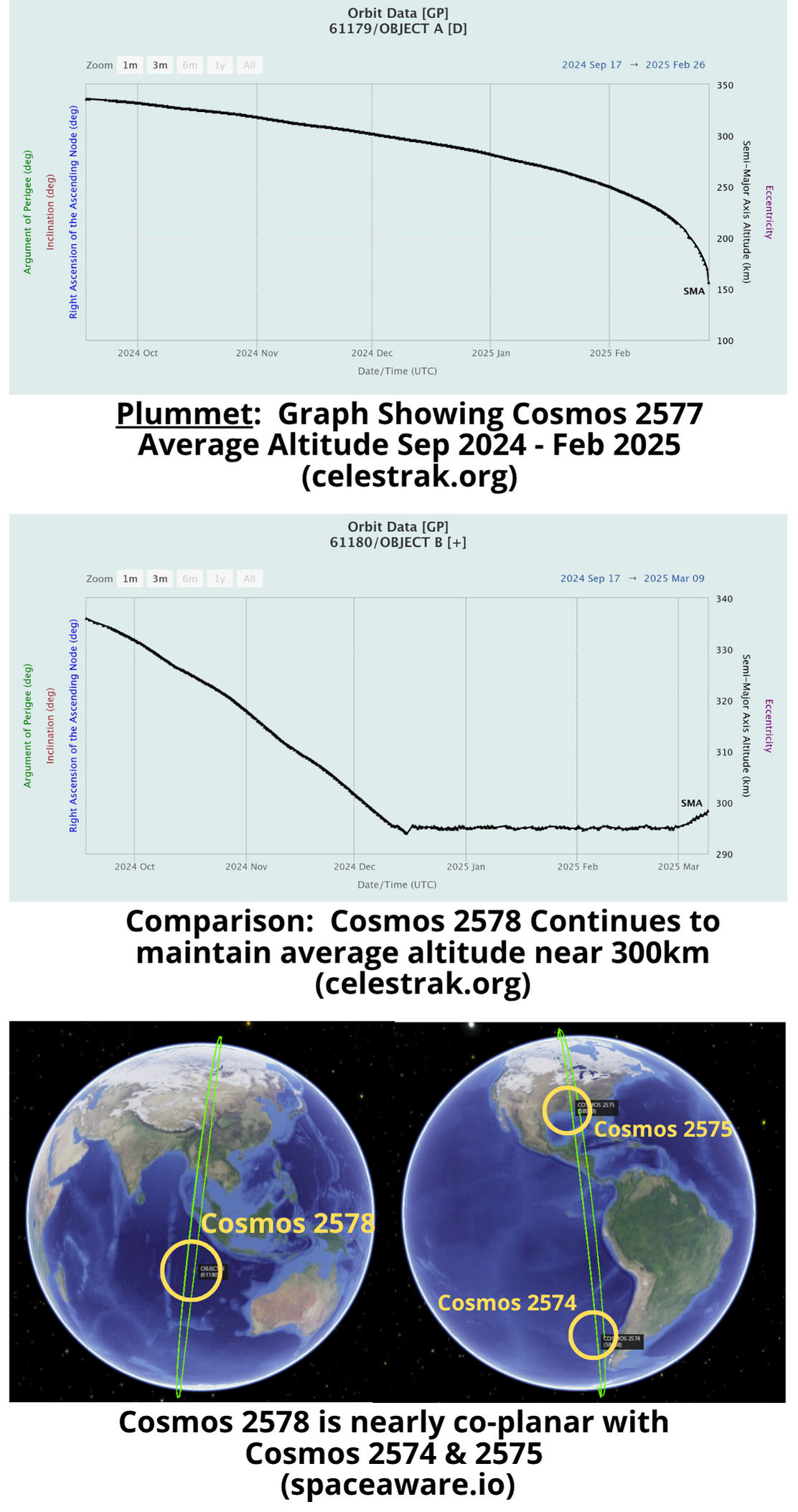
Russia Splashes another One: Cosmos 2577's Demise
28 Feb: Cosmos 2577 (61179) re-entered the Earth’s atmosphere on 26 Feb. The satellite’s demise came just 5 months after its launch with Cosmos 2578 (61180) (which remains in orbit). During its 5 months on orbit Cosmos 2577 does not appear to have made any maneuvers.
Background:
- Russia launched Cosmos 2577 and 2578 on 17 Sep 2024 from Plesetsk on an Angara 1.2. Russia placed both satellites into a sun synchronous orbit which is typical for imagery satellites.
- Both were operating at a low altitude of 339x322km and inclination 96.77°.
- Russia placed Cosmos 2577/2578 into a nearly co-planar orbit with Cosmos 2574 (58658) and Cosmos 2575 (58929).
- Cosmos-2574 may be an EO MKA or Razbeg imagery satellite. EO MKA / Razbeg imagery satellites are believed to be a small optical reconnaissance satellites (~150 kg) built by VNIIEM. Expected ground resolution is 0.9m.
From Bart Hendrickx:
- The most logical conclusion is that Object A (Cosmos 2577) experienced some kind of on-board failure, but it’s impossible to tell for sure.
- The first three satellites believed to have belonged to this series (Cosmos 2551, 2555, 2560) also re-entered after just a few months without performing any maneuvers.
- Object B (Cosmos 2578), on the other hand, has been maintaining an orbit with an average altitude of around 295 km since mid-December. (Technically this average altitude makes Cosmos 2578 a Very Low Earth Satellite <VLEO>).
Interestingly, after Cosmos 2577 re-entered, Cosmos 2578 began to slowly raise its average altitude. 2578’s SMA on 9 Mar was 298.4km (an increase of ~3km from 28 Feb). For their part, both Cosmos 2574 and 2575 have also recently increased their average altitudes (2574 is now 335.8km and Cosmos 2575 is at 324.9km).
Trading Places: China Swaps YG-39 02 Trail1 & Trail2...Twice
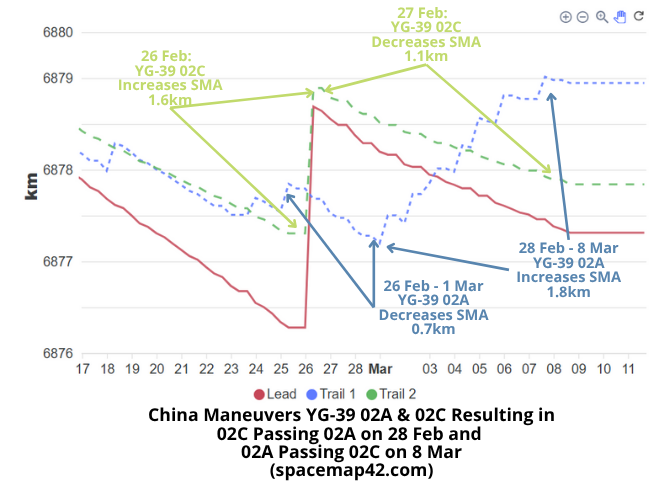
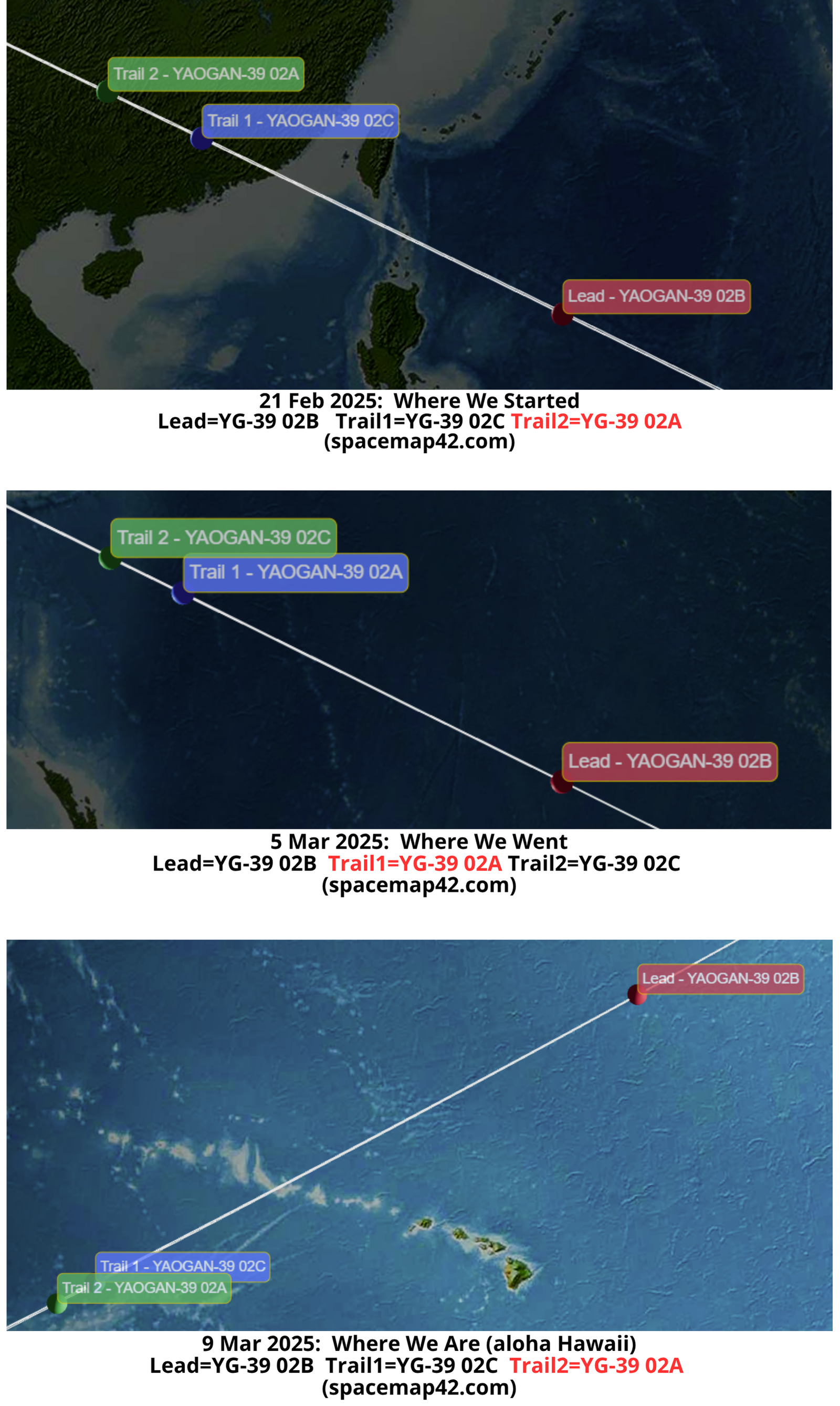
7 Mar: China swapped the Trail1 and Trail2 satellites’ position in the Yaogan-39 02 (57886, 57889 & 57890) formation for about a week in late February/early March before maneuvering both satellites to resume their previous formation (believe me, I know it is confusing…graphic support on following page). This is the second such swap since October 2024 when Yaogan-39 04 also maneuvered its third satellite into second position (that change continues to persist).
I think you all are tracking that China launched a series of 15 “triplet” Yaogan satellite formations from late 2021-2023. China launched the Yaogan-39 02A/B/C triplets which China launched on 17 September 2023.
From October 2023 – late-February 2025 YG-39 02B was lead and YG-39 02C in Trail1 and YG-39 02A was Trail2. From 26 Feb – 4 Mar China increased the average altitude of YG-39 02C while decreasing the average altitude of YG-39 02A. On 28 Feb YG-39 02A passed YG-39 02C and became the Trail1 satellite. This condition lasted until 8 Mar, when 02C passed 02A to return to the Trail1 position.
YG-36 05 and YG-39 05 also have Trail1 and Trail2 satellites that appear to be getting closer to one another. So more to follow.
SJ-23 Changes Course
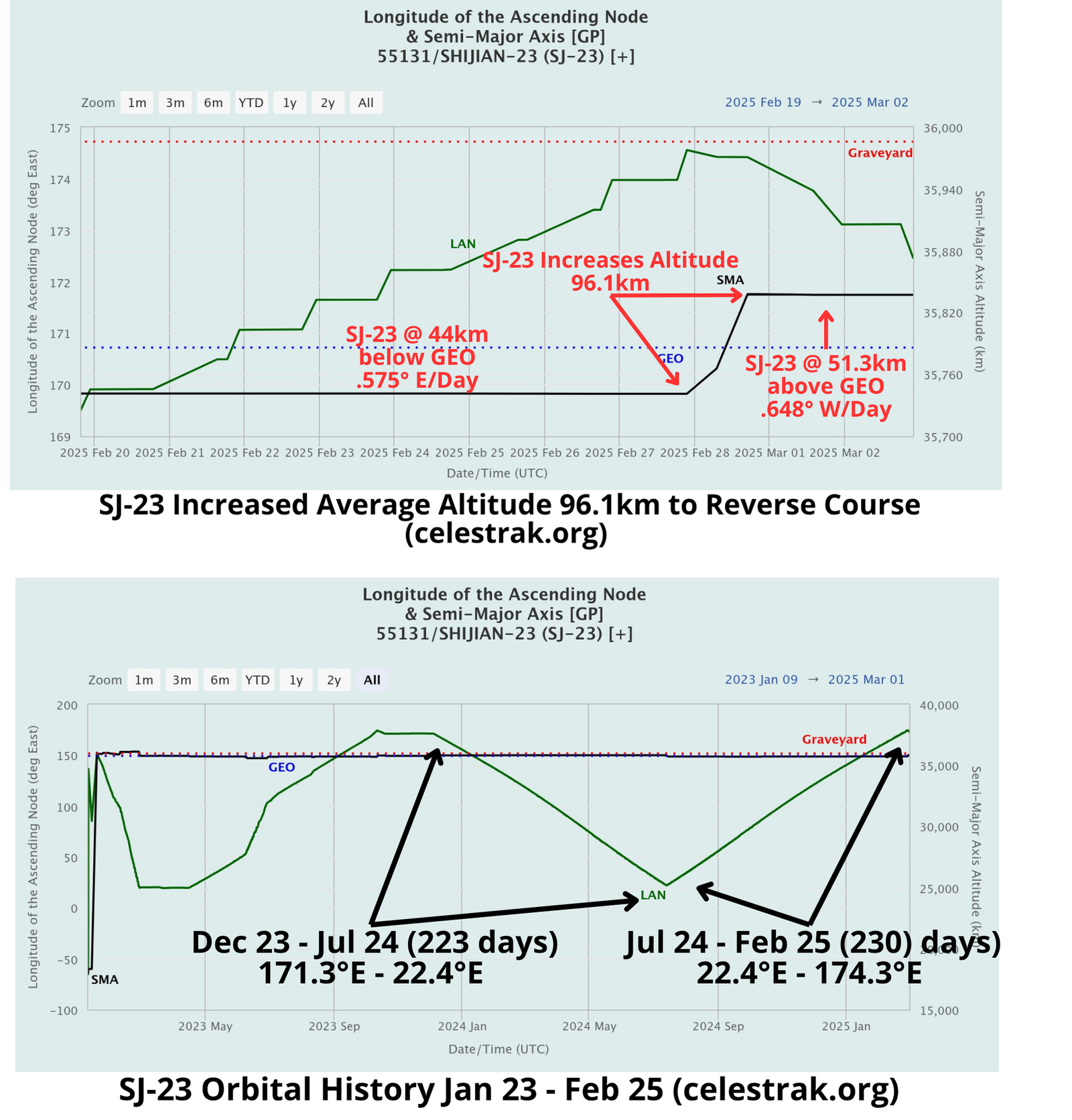
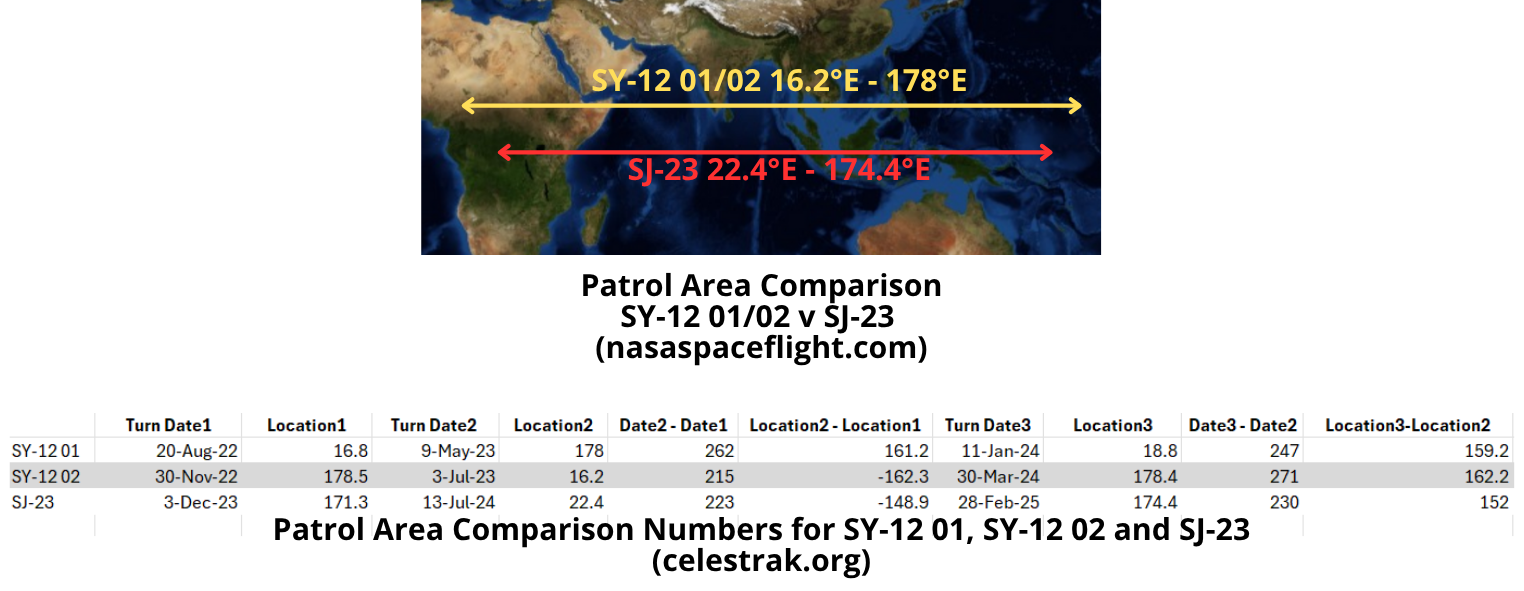
28 Feb 2025: It appears SJ-23 (55131) reached the easternmost limit of its GEO wandering and has increased its SMA to initiate a westward drift. I took the opportunity to compare SJ-23’s pattern of life with China’s other two GEO wanderers, Shiyan 12-01 and 12-02 (50321 & 50322).
-On 28 Feb SJ-23 increased its average altitude 96.1km. At the time its position was 174°E longitude.
- Previously it had been orbiting 44km below the GEO belt resulting in an eastward drift of .575° per day.
- After the raising its average altitude, SJ-23 is now orbiting 51.3km above the GEO belt causing a westward drift of .648° per day.
- The Joint Commercial Operations Cell (JCO) estimates the maneuver required delta v (fuel) expenditure of 1.92 m/s.8
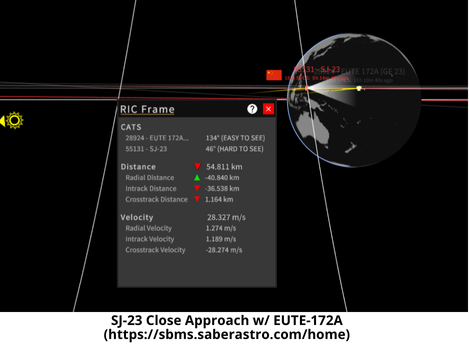
- – Prior to increasing its average altitude, SJ-23 had a close approach with satellite EUTE-172A (28924) on 27 Feb at ~ 06:49:04z. At this time SJ-23 was <55km from EUTE-172A and the solar phase angle was optimal (134°) for SJ-23 to image EUTE-172A. After maneuvering and heading west, SJ-23 did not have a close approach (<100km) with EUTE-172A.
– Comparison with Shiyan 12-01 and 12-02
- After launching on 8 Jan 2023, SJ-23 spent its first 11 months traveling from 144.9°E (Jan 2023) to 19.9°E (Apr 2023) and then to 173.4°E (Oct 2023).
- Having completed its first “lap” SJ-23 has settled into a more regular pattern. It reversed course at 171.3°E in Dec 2023 and continued West for 223 days.
- At 22.4°E it decreased its average altitude to initiate an eastward drift on 13 Jul 2024. 230 days later it conducted the maneuver described above to begin heading west again.
- SY-12 01 and SY-12 02 travel further east before maneuvering, both have reversed course at ~178-179°E (compared with SJ-23 174.4°E).
- SY-12 01 and SY-12 02 also appear to have a further western boundary as both have executed maneuvers at 16-18°E (compared with SJ-23 22.4°E).
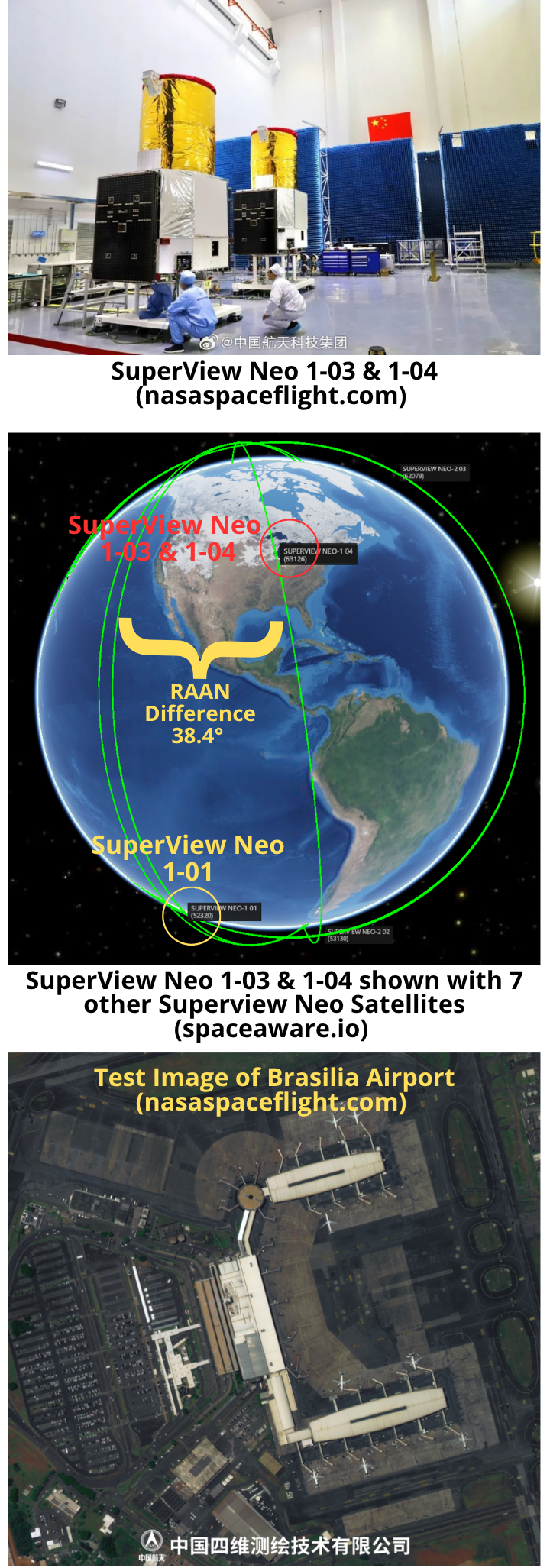
27 Feb: China launched a Long March-2C with the SuperView Neo 1-03 (63125) and SuperView Neo 1-04 (63126) remote sensing satellites from Jiuquan. According to official sources, “the two high-resolution optical satellites mainly serve fields such as natural resources, urban safety, emergency management and maritime affair, providing users with rich data products and diverse application services”. The satellites join 7 other SuperView Neo satellites in Low Earth Orbit. Launch Video.
– SuperView Neo 1-03 & 1-04 are in co-planar orbits, with an initial average altitude of 497km and an inclination of 97.3°. Both increased their average altitude ~4km in early-March.
– Neo 1-03 and 1-04 are high resolution satellites and join Neo 1-01 (52320) and 1-02 (52322) which were launched in 2022 (also using a LM-2C from Jiuquan).
– Neo 1-03 and 1-04 are not co-planar with any other Superview Neo satellites. They all share similar average altitude and inclination, however are distributed over 5 orbital planes. Neo 1-03/04 have a RAAN offset 38.4° east of the Neo 1-01/02. (see graphic).
– Neo 1-03/04 are orbiting near one another. They will likely spread out over time, similar to 1-01/02.
-The Superview NEO constellation is operated by a Chinese commercial company, China Sewei Surveying and Mapping Technology Co Ltd (aka China Sewei). China Sewei currently operates 40 earth observation satellites and offers “diversified products in resolution, accuracy and spectral bands.”
– China Sewei plans call for a Superview NEO constellation of at least 28 total satellites.
– Current Status
- SuperView Neo-1 (20 to 30 cm optical): 4 of planned 16 on orbit.
- SuperView Neo-2 (50 cm SAR): 4 of 8 on orbit.
- NEO-2 01/02 (53128 & 53130) are co-planar but not operating within proximity of one another. In fact, they operate on opposite sides of the Earth (as one passes the North Pole the other is over the South Pole).
- NEO-2 03/04 are orbiting in formation and are less than 1km from one another. This is consistent with previous statements that 2-03/04 “will be the first time in the world that a commercial satellite can achieve a 100-meter-level autonomous strict return orbit and sub-meter-level fly-around formation coordinated control.”
- SuperView Neo-3 (wide-width with 0.7m resolution + 100km swath width): 1 of 4 on orbit. Superview NEO 3-01 (59510) launched in April 2024.
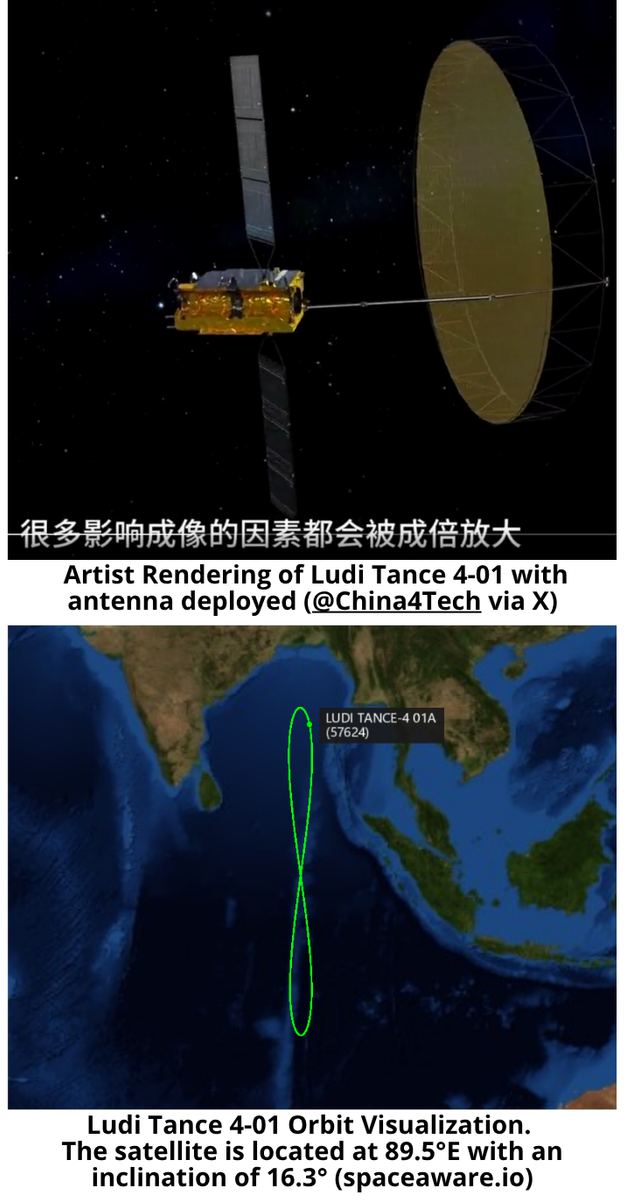
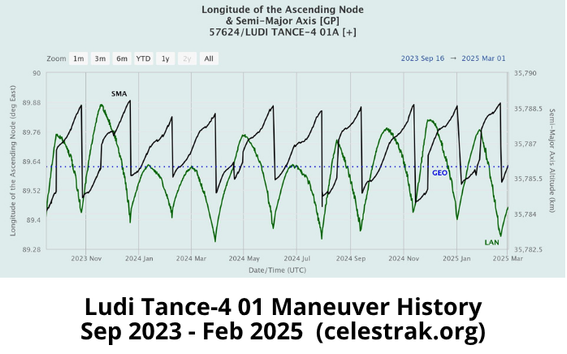
22 Feb 2025: Many will recall that on 12 Aug 2023 China launched the world’s first GEO based Synthetic Aperture Radar (SAR) imaging satellite, Ludi Tance-4 01 (57624) on a Long March 3B rocket from Xichang. Watch mission rendition Video. On 27 Feb 2025 Chinese scientists officially disclosed some of the technology behind this satellite. Excerpts below are from
– The satellite’s beam synthesis technology integrates phased-array emitters across a 65-foot deployable antenna for enhanced radar precision.
– Ludi operates at an altitude of 22,370 miles (36,000 km), granting China persistent surveillance over one-third of the Earth’s surface. This high-altitude system significantly surpasses US radar satellites, which remain confined to low Earth orbit.
– Ludi employs a novel “space power combination” system that synthesizes multiple microwave beams mid-space between two objects, thereby enhancing radar signal strength and stability.
– Given its capabilities, the system could be integrated with other Chinese reconnaissance satellites to enhance real-time tracking and targeting.
– Ludi Tance 4 employs an advanced stability control mechanism that relies on ultra-precision gyroscopes, as well as positioning signals from both China’s Beidou and the US GPS network, allowing it to maintain exact antenna alignment despite gravitational perturbations.
– A key innovation is Ludi’s back-projection algorithm, which corrects for orbital curvature distortions that traditionally degrade SAR image quality. “It mathematically compensates for orbital curvature that would blur conventional SAR images beyond recognition,” the research team explained. This computational enhancement ensures high-resolution imaging even under dynamic orbital conditions.
– China is already working on next-generation geosynchronous SAR satellites designed to meet higher performance benchmarks.
Gaofen-4 Conducts Inclination Station Keeping
27 Feb – 1 Mar: China made an inclination adjustment for Gaofen-4 (41194), its first Geostationary based imaging system. GF-4 is entering its 10th year on orbit (it was China’s “Holiday Launch” on 28 Dec 2015) and this maneuver appears to be for station-keeping. Thank you to Robin Planell of LSAS for his assistance.
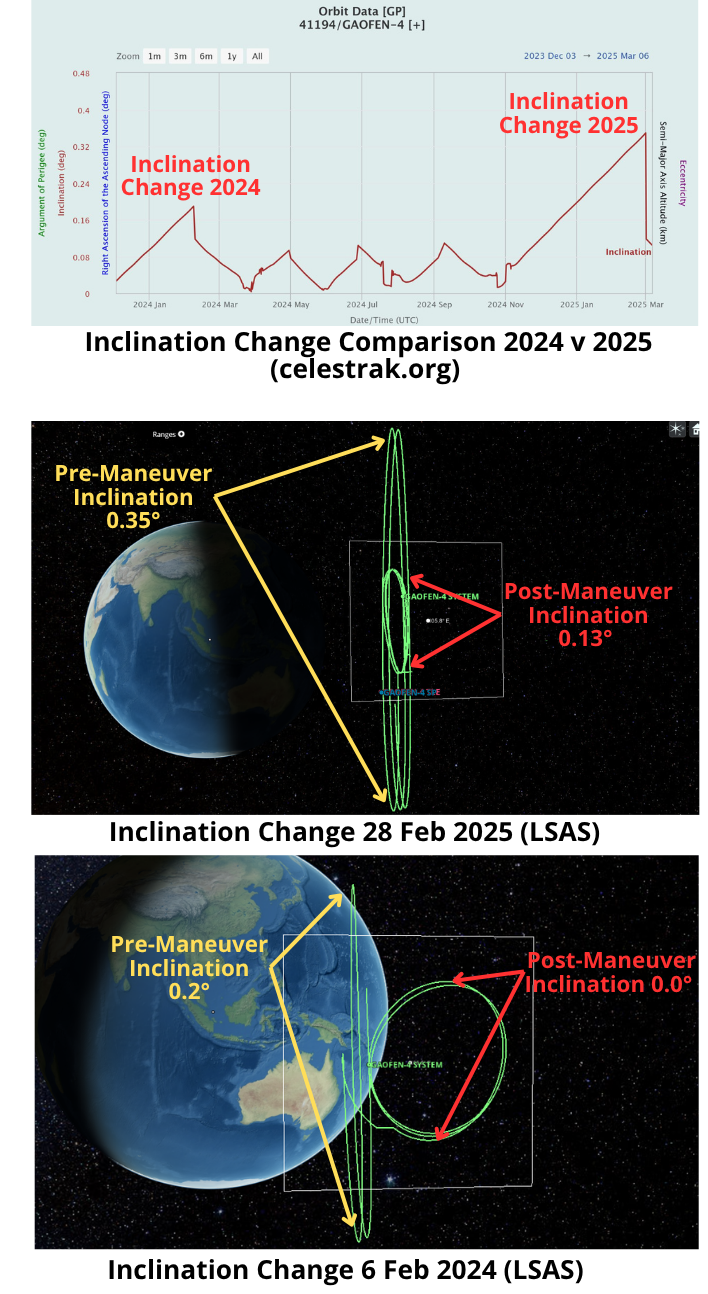
– Chinese space operators conducted a series of maneuvers to reduce GF-4’s inclination from 0.35° to just under 0.13°. Unlike changes in average altitude, inclination changes require significant energy and therefore are relatively expensive in terms of fuel use.
- The Joint Commercial Operations cell (JCO) estimated the maneuver to reduce GF-4’s inclination .22° required a delta-v of 24.38 m/s. Other associated station keeping maneuvers were smaller in magnitude and required less than 1 m/s of fuel.
- GF-4 had previously never had an inclination greater than 0.2° until 2024-2025. For its inclination maneuver in February 2024 the satellite maneuvered from 0.2° to 0.0°.
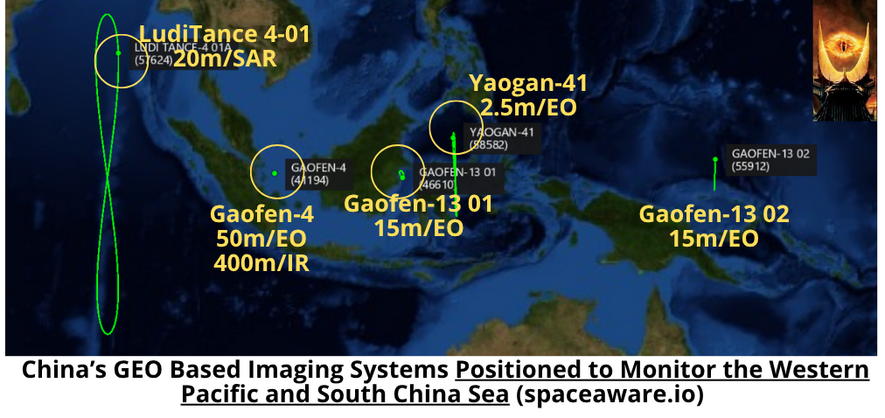
– GF-4 is China’s first GEO based imaging satellite and is believed to have a 50m resolution. From its position at 105.7°E GF-4 can keep a watchful eye on the Western Pacific and assist with tracking US aircraft carrier battle groups operating in the area.
– China has learned from GF-4 and has launched 3 other GEO based optical imaging satellites (GF-13 01, GF-13 02 and YG-41) with improving resolution. The two GF-13 satellites are believed to have 15m resolution and the YG-41 might approach 2.5m. China also operates the world’s only GEO based SAR imager (LudiTance-4 01) with a resolution of 20m.
Update: China’s Zhongxing 10R Finds a Home
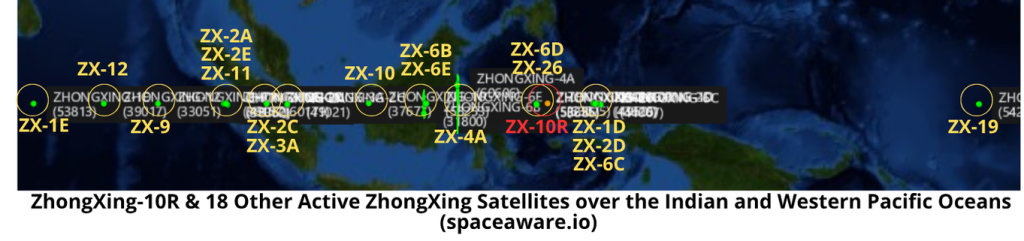
4 Mar: China’s ZhongXing (ChinaSat)-10R satellite (63075) has been cataloged at 126°E longitude. This puts the satellite in the general vicinity of ZhongXing-6D (52255, launched in 2022) and ZhongXing-26 (55686, launched in 2023). Orbital inclination is 0.1° which is consistent with other ZhongXing spacecraft. There are now 19 active ZhongXing satellites on orbit, all between the eastern Indian Ocean through the western Pacific with the heaviest concentration over the South China Sea.16