issue 110| 24 NOV 2024
The integrity flash
Analysis of Developments in the Space Domain
in this issue
China Qianfan-2 Satellites: An Initial Look
11 Nov: All 18 of the Qianfan satellites China launched on 15 October 2024 (61552-61569) are now in the catalog. As a reminder, China launched a Long March-6A launch vehicle (LM-6A) with the second group of 18 Qianfan (SpaceSail Polar Orbit) satellites from Taiyuan. The first Qianfan launch also contained 18 satellites (60379-60396), bringing total number of on-orbit satellites to 36. Shanghai SpaceSail Technologies (SSST) Co., Ltd. is launching to the Qianfan constellation to “provide global users with low-latency, high-speed and ultra-reliable satellite broadband internet services.” SSST plans for the constellation’s first stage to consist of 1,296 satellites. 648 of these are to be launched by the end of 2025 to provide regional network coverage. The completed network will consist of more than 14,000 low Earth orbit broadband multimedia satellites.
– Here’s a quick look at the first 36 satellites.
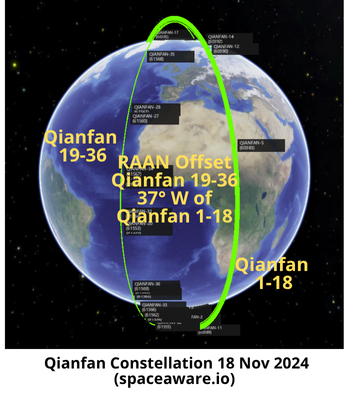
- The satellites are labelled Qianfan-1 – Qianfan-36. Qianfan 1-18 were on the first launch, Qianfan 19-36 were on the second.
- All 36 satellites are inclined at 89.0° and Qianfan 1-18 are co-planar with one another, Qianfan 19-36 are also co-planar with one another. However, the two sets are not co-planar with one another as the Qianfan-19-36 satellites have a west RAAN offset of ~37°. (see graphic)
- One satellite (Qianfan-7 60385) from the first launch may be experiencing difficulties as it has not increased its SMA since arriving on orbit. Its current apogee is 808km and perigee is 789.1km.
- All other Qianfan 1-18 satellites have varying SMAs ranging from 875.5-1,062.3km apogees and 855.1-1,043.1km. With this range of SMA values the satellites relative position with one another will continue to evolve.
- None of the Qianfan 19-36 satellites have been observed increasing their SMA since arriving in orbit. The apogee range is 805.4-814km and the perigee range is 791-798.6km.
– Qianfan is China’s commercial proliferated LEO constellation. It’s orbits are significantly higher than that of SpaceX Starlink (~500km) but slightly lower than OneWeb (~1,200km).
Deck Chair Shuffle: China’s Yaogan-43 02/03 Evolution
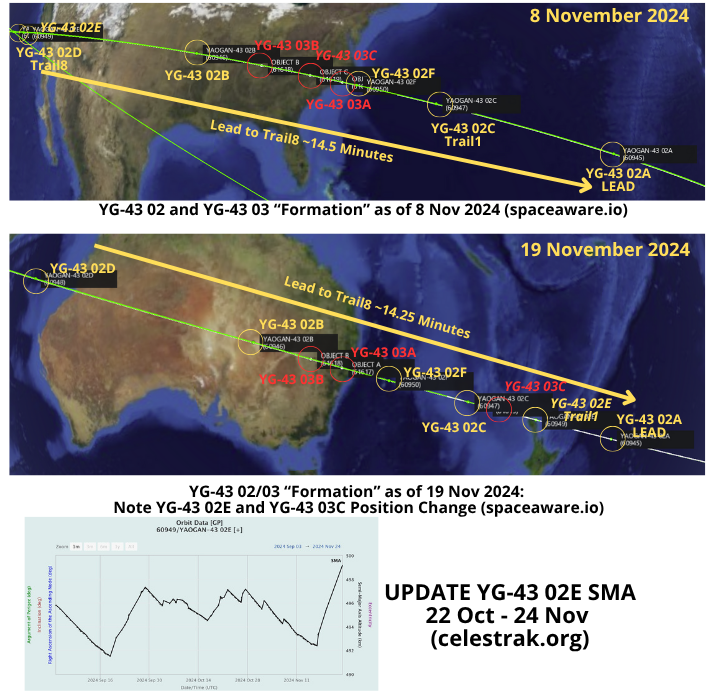
19 Nov: Taking a closer look at the 9 satellites that make up the Yaogan-43 02/03 train (60945-60950 & 61617-61619) and there have been some significant changes. What was the Trail8 satellite (Yaogan-43 02E <60949>) dropped from 497.2km to 492.4km (4.8km) and as a result (10:1 rule again) passed 7 of the 9 satellites and is now in the Trail1 position, 1min 59sec behind LEAD satellite YG-43 02A (60949). I suspected YG-43 02E may have suffered some sort of anomaly as none of the other satellites in the formation exhibited this behavior. However, from 18-24 November, YG-43 02E climbed 6.8km. The other notable change involves YG-43 03C (61619). YG-43 03C moved from being in the Trail4 position to the Trail2 position, 1min 10sec behind the aforementioned YG-43 02E. See graphics below. Note, there were no position changes within the 9 YG-43 01A-J satellites (60458-60464).
Time Flies: 3 Years & Counting for YG-35/36/39/42
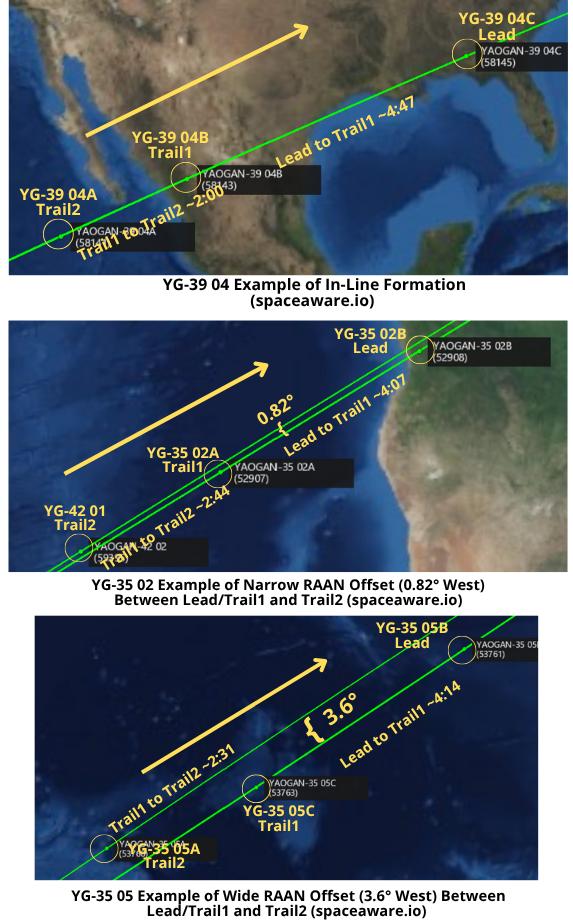
22 Nov: Between 6 Nov 2021 and 10 Dec 2023 China conducted 15 LM-2D launches and placed 45 Yaogan satellites into 5 orbital planes (500km SMA and 35° inclination but different RAAN/twist…see graphic below). Each launch contained 3 satellites which deployed into a Lead, Trail1, Trail2 formation. Each plane had 9 of these satellites, 3 YG-35, 3 YG-36 and 3 YG-39. Today, 13 of the 15 triplets are operating in formation.
There appear to be 3 types of formations: in-line, narrow RAAN offset, & wide RAAN offset.
- In Line (6): 1) YG-36 05; 2) YG-39-01; 3) YG-39 02; 4) YG-39 03; 5) YG-39 04; & 6) YG-39 05
- Narrow RAAN Offset (2): 1) YG-35 02 + YG-42 01; & 2) YG-36 01 + YG-42 02
- Wide RAAN Offset (5): 1) YG-35 04; 2) YG-35 05; 3) YG-36 02; 4) YG-36 03; & 5) YG-36 04
– (Kind of) Fun Facts
- On average the Lead satellite is 4 minutes and 45 seconds ahead of Trail1. On average Trail1 is 1 minute and 46 seconds ahead of Trail2.
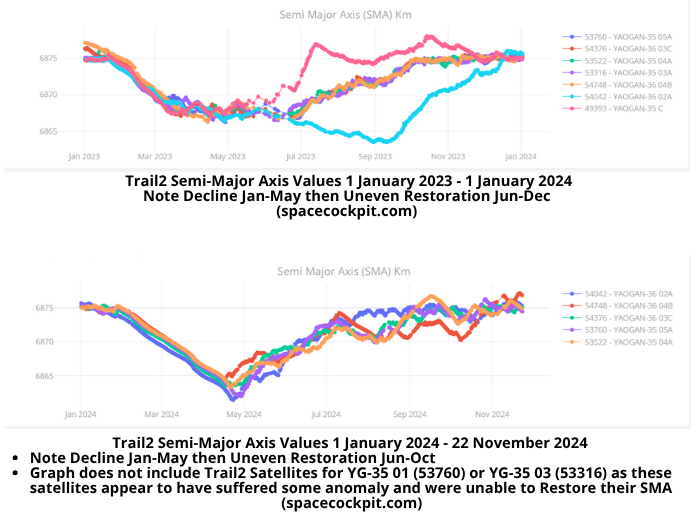
- In January 2023 and again in January 2024 China allowed the orbits of 7 of its Trail2 satellites to decay for ~5 months. It will be interesting to see if China does anything similar in January 2025. (see graphs below)
- The original triplet (YG-35 01A/B/C) has fallen apart. The satellites may be functioning but they are no longer in any sort of formation. Lead satellite may be dead.
- The other problem child seems to be Yaogan-35 03, where the Lead/Trail1 satellites continue to orbit in formation but the Trail2 satellite (53316) is no longer co-planar and is at a lower altitude and thus not able to maintain a consistent relative position with Lead/Trail1. In mid-Oct 2024 it began maintaining and then slightly increasing its altitude (apparently it’s not dead yet), but it is still orbiting ~60km below YG-35 03 Lead and Trail1 satellites.
- Yaogan-35 03, Yaogan-36 04 and Yaogan-39 02 are nearly co-planar with the newly launched Yaogan-43 02 and 03 satellites discussed in previous article.
- All of the in-line formation triplets were all launched after January 2023.
I know it’s a lot. Thanks for bearing with me.
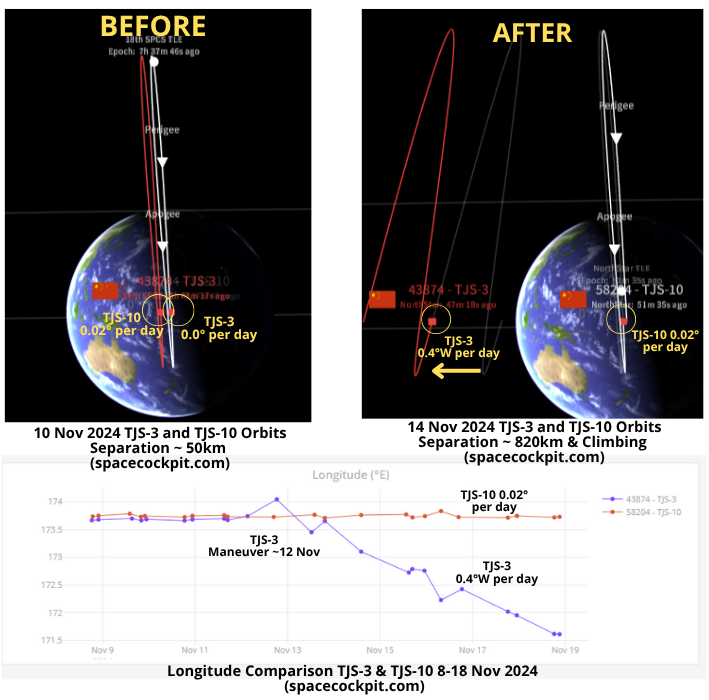
18 Nov: In the 11 November 2024 Integrity Flash I described the unusual relationship between TJS-3 (43874) and TJS-10 (58204). Both have been in proximity to one another since TJS-10 arrived in GEO on 9 November 2023. Almost a year to the day, that relationship ended. On 11 November 2024 TJS-3 was orbiting just ~0.8km above the GEO belt. By 12 November, TJS-3 increased its altitude (semi major axis) ~31.8km.
With it’s 11-12 November maneuver, TJS-3 is now operating 32.6km above GEO and heading westward at a rate of 0.408° per day. As of 18 Nov 2024, TJS-3 was at 171.5°E longitude and is now West of TJS-10 which is at 173.8°E. TJS-10 has not made any maneuvers and is currently orbiting 1km above the GEO belt and heading west at a rate of 0.02° per day. Before TJS-3’s maneuver the 2 satellites were consistently <50km apart. After only ~7days that distance grew to 800+km.
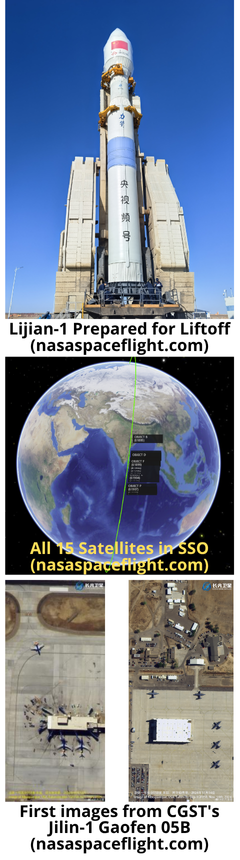
11 Nov: China launched a Lijian-1 (Kinetica-1 or KZ-1A) rocket with 15 satellites (61894-61908) from Jiuquan. All 15 satellites reached their desired orbits. On board were the following satellites: Shiyan-26 A, B and C, Jilin-1 Gaofen 05B, Jilin-1 Pintai 02A 03, Yunyao-1 satellites 31-36, Xiguang-1 satellites 04 and 05, the Omani IRSS-1/OL-1 remote sensing satellite and Tianyan-24. Launch Video.
– All 5 Lijian-1 launches have been successful. For this launch the rocket used a 3.35m diameter fairing for the first time.
– Lijian-1 is a four-stage solid-propellant launch vehicle. According to Shi Xiaoning (chief designer of Lijian-1, CAS Space), the launch vehicle could accommodate 18 or 36 satellites in the future.
-China has not released any information related to the Shiyan-26 A/B/C satellites which is typical for satellites of this family. “Shiyan” refers to an experimental and often classified series of Chinese satellites.
– As of 19 November, all 15 satellites were in a sun-synchronous (SSO) ~528x509km orbit with an inclination of 97.5°. They have not been identified by name yet, so it is not possible to determine which are the SY-26 satellites.
-Other notable satellites: per Andrew Jones:
- The 2 Jilin-1 satellites were launched for satellite manufacturer and operator Chang Guang Satellite Technology Co., Ltd., (CGST)….CGST now has at least 117 satellites in orbit. CGST apparently aims to launch 200 such satellites by 2027 to provide daily global coverage.
- The Jilin-1 Gaofen 05B satellite serves as a technology demonstrator for the high-resolution Gaofen 05 constellation.
- Jilin-1 Pintai 02A03 is a high-resolution optical remote sensing satellite that can provide users with remote sensing information services such as situation analysis and target monitoring, according to CAS Space.
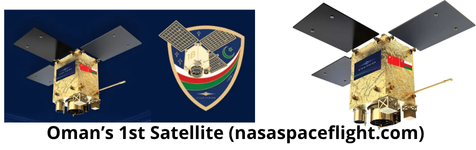
- The government of Oman now has its first satellite on orbit, the Oman Intelligent Computing Satellite (WJ-1B), developed by the Spacecraft Intelligent Technology Team of Zhejiang University. The satellite has an optical resolution better than 1 meter, and can also carry out on-orbit intelligent satellite networked communications, space-based cloud computing, and remote sensing large models.
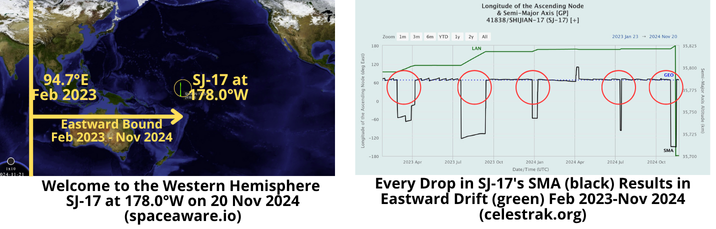
20 Nov: China’s Shijian-17 (SJ-17) (41838) recently crossed 179.9°E longitude and officially drifted into the Western Hemisphere (just barely). The satellite is now at 178.0°W longitude and has rejoined the GEO belt and has stabilized at its new longitude. This is the furthest west (or east depending on how you look at it) since SJ-17 its 2018 encounter with Chinasat 20.
– SJ-17 began its eastward journey 21 months ago, all the way back to late February 2023. At that time the satellite was at 94.7°E (due south of the center of mainland China).
– Over the past year and a half, SJ-17 has significantly changed its altitude (SMA) 6 times, 5 of the 6 maneuvers resulted in decreased altitude which increases eastward drift.
– Most recently (on about 1 Nov 2024), SJ-17 decreased its altitude ~76.2km and stayed below the GEO belt until 14 Nov. During this time it drifted eastward nearly 13° from 169.3°E to 178.0°W. On 14 Nov, SJ-17 increased its altitude 76.2km and stabilized at 178.0°W.
– The nearest operational satellite in this vicinity appears to be Russia’s Yamal-300 (38978), a communications satellite launched in 2012.
SJ-17 Background
– SJ-17, is a technology demonstrator for testing various payloads on-orbit for satellite design improvements. China has publicly stated that SJ-17 is being used for testing a new “green propellant,” composite load carrying structures, solid composite lithium-ion batteries, and various temperature and vibration control systems. It was designed by the National University of Defense Technology. It also hosts a test kit for Global Navigation Satellite System (GNSS) in GEO.
-Per Kristin Burke’s report: “SJ-17 has conducted RPOs with a ChinaSat-5A in 2016 (launched in 1998, manufactured by Lockheed Martin, and moved to graveyard orbit two years later in 2018) and three other Chinese satellites probably experiencing anomalies: ChinaSat-1C in 2018 (launched in 2015 and had been drifting at the time of RPO), a dedicated military satellite ChinaSat-20 also in 2018 (launched in 2003 and had been experiencing anomalies at time of RPO), and ChinaSat-6B in 2020 (launched in 2007 and had experienced a power outage in 2009, but is expected to operate until at least 2022, manufactured by Thales Alenia).”
– When he was the head of USSPACECOM in April 2021, General James Dickinson, warned Congress that robot arms, such as the one attached to the Chinese spacecraft Shijian-17, could have nefarious purposes like attacking satellites.
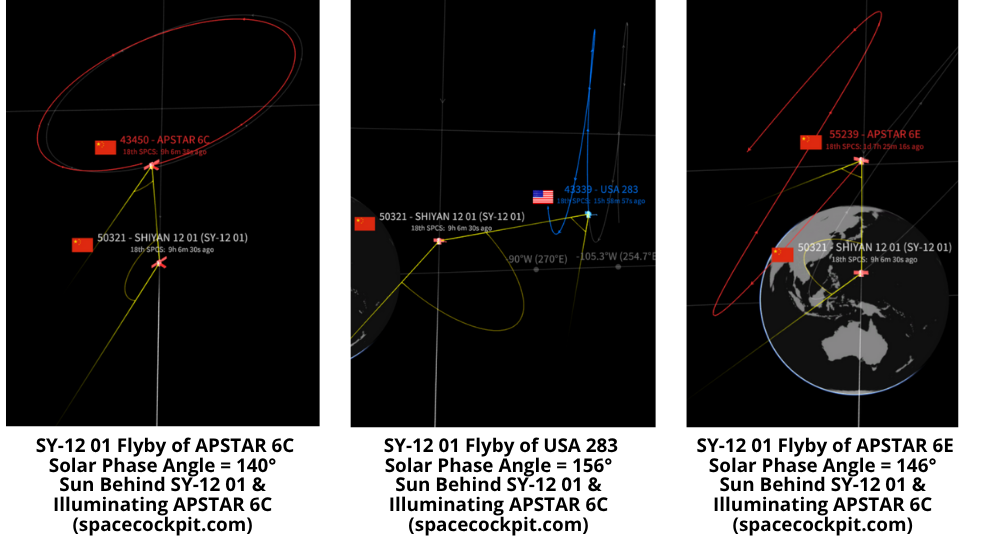
22 Nov: As we’ve noted before, China’s Shiyan-12 (SY-12) 01 and 02 satellites are traversing the GEO belt and may be conducting some inspection mission. On 22 November, SY-12 01 had close approaches with three satellites: 1) APSTAR 6C (43450); 2) USA 283 (43339); and 3) APSTAR 6E (55239). At the time of closest approach with each satellite, the Solar Phase Angle (SPA) was ideal (defined here as >120°) for SY-12 01 to image the three satellites. The APSTAR satellites are Chinese communication satellites. USA 283 is also known as CBAS (Continuous Broadcast Augmenting SATCOM), and is a military communications relay station designed to keep commanders in contact with senior government leaders. SY-12 01 did not maneuver recently (at least that I can tell) in order to produce these optimal imaging conditions. Here is the point of closest approach (POCA) and SPA for each:
- APSTAR 6C (PRC) (134.0°E)— POCA 60.147 km. SPA at POCA ~140°
- USA 283 (US) (134.1°E) — POCA 57.473 km. SPA at POCA ~156°
- APSTAR 6E (PRC) (134.1°E) — POCA 33.724 km. SPA at POCA ~146°
Pics o' the week!