issue 106 | 29 sep 2024
The integrity flash
Analysis of Developments in the Space Domain
in this issue
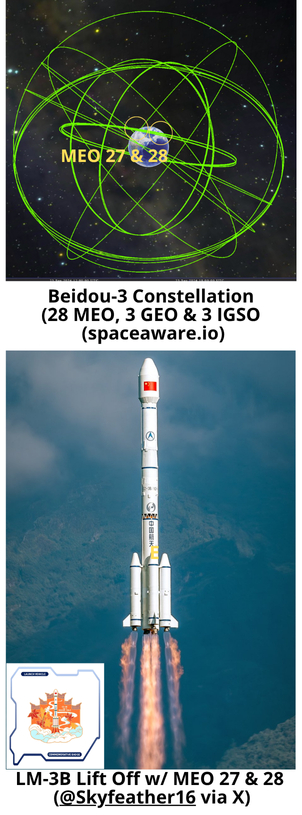
19 Sep: China launched a Long March-3B with a Yuanzheng-1 (Expedition-1) upper stage and two backup Beidou-3 navigation satellites (2024-168) from Xichang. The two medium earth orbit (MEO) satellites (BeiDou-3 MEO-27 and MEO-28) are the 59th and 60th of the Beidou family and the fourth and fifth to act as backup satellites for China’s Beidou-3 Navigation Satellite System (BDS-3). They are the final satellites in the Beidou-3 constellation. Launch Video.
– Both satellites reached their intended orbit of 22,192 x 21,530km with an inclination of 55°. The satellites will be used as spares for the existing 24 MEO Beidou-3 satellites as well as for testing new upgraded atomic clock parts and new inter-satellite link terminals for China’s planned Beidou-4 constellation.
– Prior to the 19 Sep launch, the most recent Beidou-3 launch occurred in late-2023 and also sent 2 satellites to MEO. Those satellites were also considered spares.
– Most of the Beidou-3 satellites have been operational for six years. The spare satellites allow for the system to keep operating while older satellites are maintained and managed.
– Beidou is China’s own global navigation satellite system (GNSS) to rival U.S. GPS, Europe’s Galileo and Russia’s GLONASS systems. China completed its construction in mid-2020. See video on Beidou development history.
– China embarked on building the Beidou constellation in 1996 after it suspected two of its three missile tests over Taiwan failed due to their reliance on GPS.
– According to one PLA Colonel at the time: “It was a great shame for the PLA … an unforgettable humiliation.”
– In 1996, China decided to build its own navigation system, to be completed within 25 years. Their goal was to establish truly independent military command and control, and precision missile guidance and tracking.
– Beidou-3 operates in 3 MEO-planes (8 satellites per plane not counting spares), GEO Stationary Orbit (3 satellites) and Inclined GEO Synchronous Orbit (3 satellites). Beidou-3 provides global coverage and offers more accessible and accurate PNT data in the Asia-Pacific region than any other GNSS, including GPS, according to a 2023 report by Harvard’s Belfer Center.
– China is expected to begin launching Beidou-4 satellites to Low Earth Orbit (LEO) as early as 2025.
– With Beidou-4, China aims to build a more ubiquitous, integrated and intelligent PNT system by 2035. China intends for Beidou-4 to be more powerful, secure and reliable, providing services from indoors to outdoors, and from deep sea to deep space.
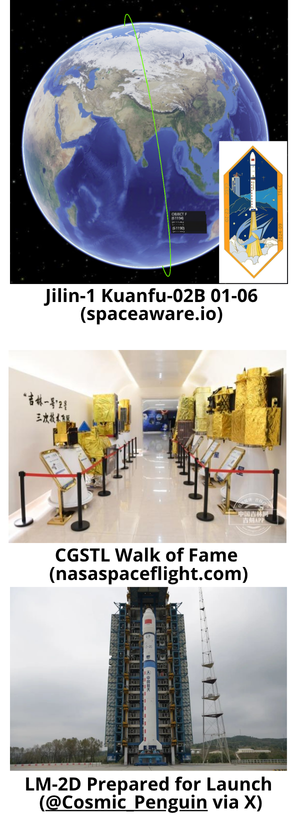
20 Sep: China launched a Long March-2D with six Jilin-1 Kuanfu-02B satellites (2024-169) from Taiyuian. The Jilin-1 Kuanfu-02B 01-06 satellites are “the first ultra-large-width, high-resolution optical remote sensing satellites developed in small batches in China”. Sources reported that the satellites are capable of capturing 150km image swaths with a 0.5m resolution. Launch Video.
– All 6 satellites are in a sun-synchronous orbit (SSO) 543 x 527km with a 97.6° inclination.
-Changguang Satellite Technology Co., Ltd. (CGST) manufactures and operates the Jilin constellation. Per their press release: “Jilin-1” wide-width 02B01-06 is the latest generation of coverage satellites…It is the first ultra-wide-width, high-resolution optical remote sensing satellite developed in small batches in (China). The “Jilin-1” wide-width 02B series satellites have achieved a number of key technological breakthroughs in the design and manufacturing stage. Its payload is an off-axis four-mirror optical camera. It is currently the lightest ultra-wide-width sub-meter optical remote sensing satellite in the world. It can provide users with high-definition satellite image products with a width of 150km and a resolution of 0.5m. It has the characteristics of batch production, wide width, high resolution, high-speed data transmission, and low cost.”
– In 2022, CGST announced its goal to put more than 300 satellites in orbit by 2025, more than doubling its earlier plan of launching 138 Jilin-1 satellites.
– Per Andrew Jones: “CGST has by far the largest Chinese commercial constellation in orbit. It is one of the most prominent and well-funded of the commercial space companies to have emerged in China since a 2014 policy decision to open up the sector to private capital.”
– Jilin-1 satellites generally deliver panchromatic imagery with a resolution of between 0.50 and 0.75-meters. Other satellites in the constellation have video, multispectral, multipurpose, infrared and other capabilities.
– In April 2022, Asia Times reported “that China had equipped its Jilin-1 commercial Earth observation satellite with AI that allows it to serve as a powerful spy platform, achieving a 95% precision rate in identifying small objects, seven times greater than the satellite’s previous technology.”
– A Oct 2023 China Space Monitor report alleged CGST sold two of its on-orbit Jilin-1 GF03D satellites to the Russian paramilitary Wagner Group. These satellites are capable of collecting 0.75m full color imagery or 3m hyperspectral imagery. The transaction reportedly took place in November 2022. These satellites could support Wagner operations in Ukraine and Africa.
– Future tests include a 100km flight test and orbital launch and recovery test mission.
– Per Andrew Jones: “The orbital Nebula-1 is a two-stage, 3.35-meter-diameter rocket. It will be capable of carrying 2,000 kilograms to low Earth orbit (LEO) while an improved version will be able to lift 8,000 kilograms to LEO…Deep Blue Aerospace is also working on a larger Nebula-2 rocket. That will be capable of sending 20,000 kilograms of payload to LEO.”
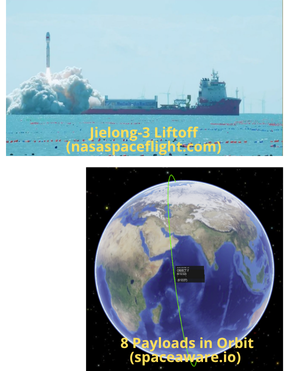
24 Sep: China Rocket launched a Jielong-3 (Smart Dragon-3) off the coast of Haiyang, Shandong Province. The launch was a ride-share mission and carried eight satellites: 1) Tianyi-41; 2) Star Age-15; 3) Star Age-21; 4) Star Age-22; 5) Yuxing-2 05; 6) Fudan-1; 7) Tianyan-15; and 8) JiTianxing A-01. Jielong-3 is a 4-stage solid fueled rocket which can deliver a 1,500kg payload to a 500 km Sun-synchronous orbit. Launch Video.
– All of the satellites are in a sun-synchronous orbit at 486 x 502km and an inclination of 97.4°.
– Jonathan McDowell compiled brief descriptions of all 8 payloads:
- Tianyi-41 is a C-band radar satellite.
- Star Age-15 is an imaging satellite.
- Star Age-21 and 22 are a pair of lasercom test satellites.
- Yuxing 2-05 is an imaging satellite dedicated to studying environmental effects on health
- Fudan-1, science sat for Fudan University, Shanghai, with X-ray solar flare spectrometer.
- Tianyan-15, for tests of imaging technology.
- Jitianxing A-01 is an imaging satellite.
– The Dongfang spaceport has been active since 2019 and has been the site of several solid rocket launches: LM-11, Jielong-3, Ceres-1 and Gravity-1. It may host liquid propellant launchers in the future.
– China modified the ship for this launch and added a platform at rear.
25 Sep: The fourth Lijian-1 launch vehicle (also known as ZK-1A and Kinetica-1) launched five satellites from the Jiuquan. The Lijian-1 delivered the five satellites into the desired orbit. The satellites are: 1) AIRSAT-01; 2) AIRSAT-02; 3) Jilin SAR01A; 4) Yunyao-21 and 5) Yunyao-22. Lijian-1 is a four-stage solid-propellant launch vehicle. Launch Video.
– All of the satellites are in 509 x 527 km orbit with 97.5° inclination.
- AIRSAT-01 & 02 are two flat-panel Ku-band SAR with 1m resolution
- JILIN-1-SAR01A is ChangGuang’s first SAR
- Yunyao-1-21 & 22 are two weather satellites with GNSS payloads
– Per CAS Space’s Chief Engineer, “this launch marks the beginning of the company’s high-density launch schedule…there are about three more planned launches for this year (2024) and possibly eight to 10 or more launches next year.
– Since the first launch of the Lijian-1 in July 2022, it has successfully sent a total of 42 satellites into their preset orbits, with a total payload mass of more than 4 tons.

20 Sep: The Chinese company, Expace, launched a Kuaizhou-1A (KZ-1A) from Xichang. The KZ-1A delivered four Tianqi satellites (Tianqi-29 – 32) to their planned orbits. The satellites are part of the Tianqi Constellation (also known as the “Apocalypse Constellation”). Launch Video.
– All 4 of the Tianqi satellites were successfully placed into a 854 x 835km orbit with a 45° inclination. The satellites will likely increase their spacing in the coming weeks.
– The launch brings the total Tianqi constellation to 29 satellites (38 are planned for the complete constellation). The satellites are in a variety of orbits and several appear to have not maneuvered in quite some time.
– With this launch the constellation will provide global coverage with an average revisit time of ten minutes.
– The Tianqi constellation will provide low-bandwidth communication to connect Internet of Things (IoT) devices in remote or hard-to-reach locations.
– “The Tianqi LEO satellite constellation is being built and operated by LEO satellite operator Guodian Gaoke Guodian Gaokeji), a Chinese private commercial space company and leading provider of domestic satellite IoT.”
– Lu Qiang, chief executive of Guodian Gaoke, told Chinese media last year that the company plans to “expand our services to other fields, including outdoor emergency response and military applications.”

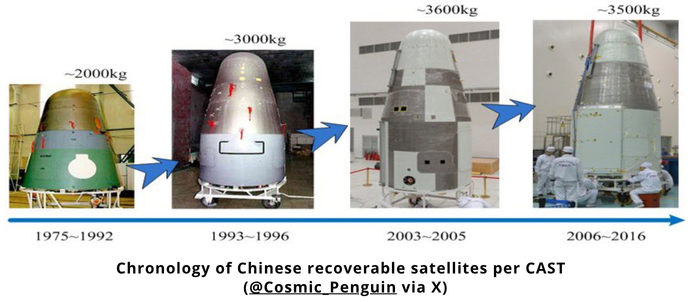
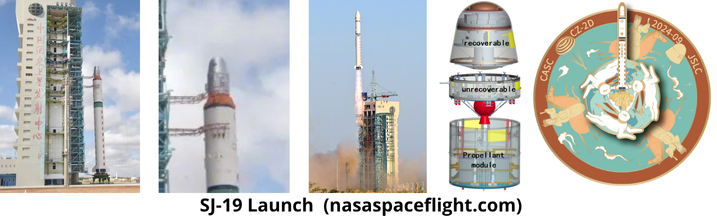
27 Sep: China launched Long March-2D from Jiuquan carrying the the Shijian-19 (SJ-19) satellite to Low Earth Orbit. According to official sources, SJ-19 is China’s “first reusable and returnable test satellite”. SJ-19 (61444) is in a 342x324km orbit with an inclination of 41.6°. From Gunter’s Space Page: “The return capsule is to be reusable up to 15 times and can carry about 500 kg of recoverable payload. 200 kg unrecoverable payloads can also be carried. This type of satellite can be flown in a short term configuration powered by batteries or in a long term configuration with solar arrays. A drop test of the return capsule has been conducted in 2018. The launch was planned originally for 2019.” One on-line post stated the mission: “carries out flight test missions such as aerospace breeding (editor’s comment: what the hell? Note rabbits on mission patch), independent and controllable new technology verification, and space science experiments. After flying in orbit for about 13.5 days, it (will) return to Dongfeng Landing Field.” Launch Video.
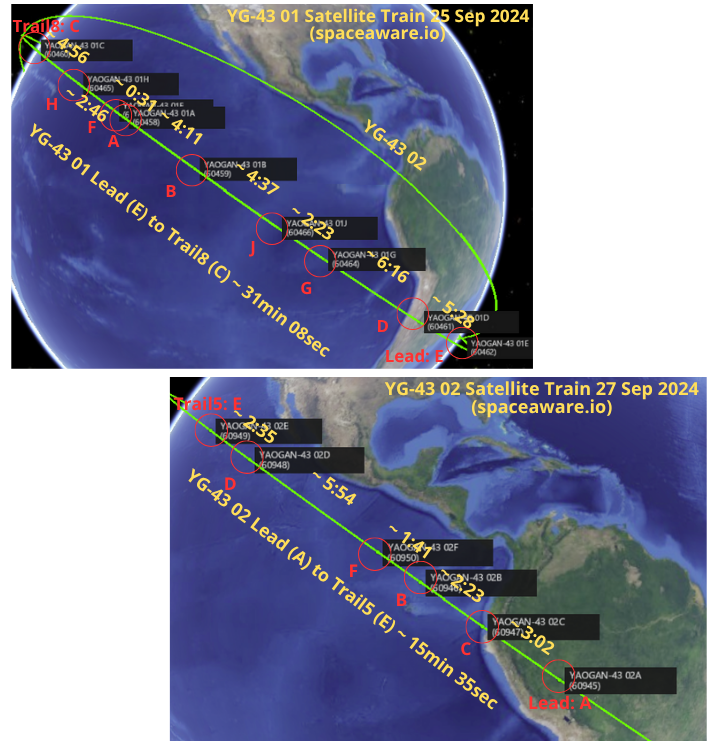
27 Sep: China launched 9 Yaogan-43 01 (YG-43 01) satellites on 16 Aug 2024 and another 6 Yaogan-43 02 (YG-43 02) satellites on 3 Sep 2024. The two launches were to different orbital planes, but are orbiting at ~500km altitude and inclination of 35°. All 9 YG-43 01 satellites have maneuvered and most appear to be maintaining their relative position with one another (the average SMA difference for all 9 satellites is 275m). They do not appear to be in a similar YG-35/36/39 like formation. The YG-43 02 satellites have started to maneuver and many have changed their relative positions in the past 2 weeks. They also do not appear to be in similar formation with the YG-35/36/39 triplets, nor do they match with YG-43 01 satellite spacing. My theory that YG-43 might be miniaturized YG-35/36/39 satellites requires re-evaluation!
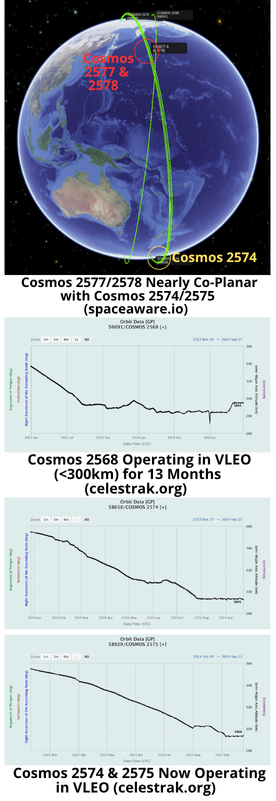
- 17 Sep: Russia launched an Angara 1.2 from Plesetsk carrying two satellites, likely Earth Observation, into Low Earth Orbit. Cosmos 2577 and 2578 (61179, 61180) are both in a sun synchronous orbit which is typical for imagery satellites. Both are operating at a low altitude of 339x322km and inclination 96.77°. Their flight profile is similar to previous experimental missions, Cosmos 2568 (56091), 2574 (58658) and 2575 (58929). Cosmos 2577/2578 are virtually co-planar with Cosmos 2574/2575. Launch Video.
– Cosmos 2577 and 2578 are likely EO-MKA or OO-MKA imagery satellites. Per posts from Bart Hendryckx: EO-MKA satellites are “Mysterious low-orbiting satellites, four of which are believed to have been launched so far (Kosmos-2551, 2555, 2560 and 2568). The first and fourth went up on a Soyuz-2.1v, the second and third on an Angara-1.2/AM. The first three re-entered after just weeks in orbit without having made any maneuvers. Kosmos-2568, however, suddenly started making orbit corrections several months into its mission and remains in a low orbit under 300 km 1.5 years after its launch.”
– More from Bart: “Here’s a comparison of their initial orbit parameters:
Cosmos-2551: 295×307 km, 96.34°
Cosmos-2555: 278×293 km, 96.45°
Cosmos-2560: 329х344 km, 96.35°
Cosmos-2568: 329×345 km, 96.46°
Cosmos-2577/2578: 328×343, 96.77°
The initial perigee/apogee of the latest four satellites are strikingly similar.”
– “EO is manufactured in the research (“NIR”) phase of a project and can be used to refine the final design (somewhat similar to a prototype) and an OO is manufactured in the development (“OKR”) phase of a project to determine if it can enter production. That would imply that the latest two satellites more closely resemble the operational version of the satellite than the earlier ones.”
– Regarding similarities with Cosmos 2574/2575: Cosmos 2574/75 “are in an orbital plane quite close to that of Cosmos 2577/2578, so there could be a link between these missions, which may imply that Cosmos 2574 and 2575 also belong to the EO MKA/OO MKA series.”
– “One difference is that Cosmos 2574 and 2575 were placed into higher initial orbits (349×360 km)…what they do have in common with Cosmos 2568 is that both are now performing regular burns to maintain an orbit just below 300 km (the mean altitude for both is 293 km).”
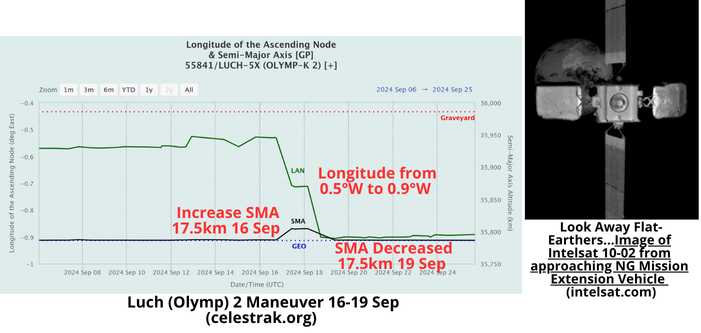
- 16 Sep: After spending 77 days in vicinity of THOR 07 (40613), Russia maneuvered its Luch (Olymp)-2 (55841) satellite and it is now operating in vicinity of Intelsat 10-02 (28358) and Thor 6 (36033). Excerpts below from Dr Marco Longbroek’s excellent blog post on the event.
– “Luch (OLYMP) 2 is the second Russian OLYMP-K/LUCH 5X SIGINT satellite in geosynchronous orbit. It has changed position several times since its launch in 2023. Each time, it was placed near a commercial communications satellite.”
– “From its previous position stalking THOR 7 at longitude 0.54 W, where it arrived on July 1 2024, it has now made a small hop to the other side of the THOR + INTELSAT grouplet, to 0.92 W, taking a position in between THOR 6 and INTELSAT 1002.”
– “The move started on 16 September 2024 near 2200 UTC and was completed on September 18.”
– “It is not the first time either that a LUCH (OLYMP-K) satellite is checking out INTELSAT 1002. The latter has been visited by an earlier LUCH (OLYMP) satellite, LUCH (OLYMP) 1 (40258) twice before.”
– “The relocations of LUCH (OLYMP) 2 so far come at intervals of roughly 3 months.” End of excerpts.
– Readers may recall Intelsat 10-02 was visited by a Northrop Grumman Mission Extension Vehicle on 12 April 2021. The MEV latched onto Intelsat 10-02 in deep orbit and extended its lifespan by five more years.
-During the docking Intelsat 10-02 remained in its original orbital slot and without interrupting service. This was the first-ever in-orbit servicing of a live commercial satellite in geostationary orbit.

Pics o’ the Fortnight!