issue 100 | 30 june 2024
The integrity flash
Analysis of Developments in the Space Domain
in this issue
YG-35 01 Formation Falls Apart
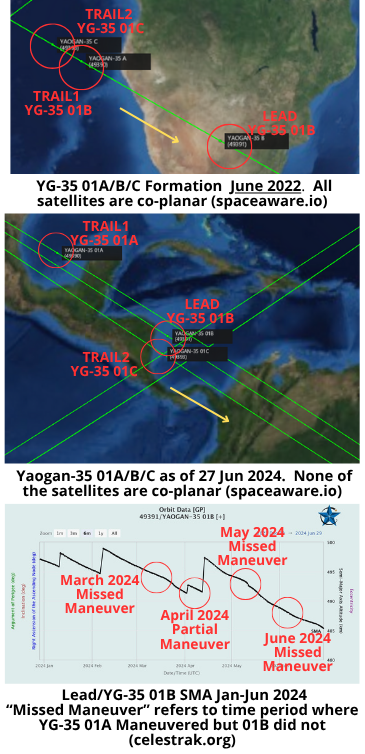
28 Jun: The Yaogan-35 01A/B/C triplet formation appears to have completely broken down with the lead satellite, YG-35 01B (49391) having lost 11.6km of altitude from 13 Apr – 27 Jun. As a result it is increasing it’s separation from Trail1/YG-35 01A (49390) and is also no longer co-planar as RAAN for the two satellites no longer matches 119.8° vs 121.7°. The Trail2 satellite, YG-35 01C has been increasing its altitude and now has an SMA 12.6km greater than Lead/YG-35 01B. YG-35 01B difficulties appear to have started Feb-Mar 2024.
– China launched YG-35 01A/B/C on 6 Nov 2021. It was the first of 15 triplets on orbit.
– For the first 24 month YG-35 01 maintained a “Lead-Trail1-Trail2” formation with all three satellites in co-planar orbits with Lead-Trail1 gap being significantly larger than Trail1-Trail2 gap.
– In late Jan 2024, Trail2 satellite (YG-35 01C) decreased its altitude and quickly passed both Trail2 and Lead satellites.
– Between 6-8 Feb both Lead and Trail1 satellites increased their SMA and remained co-planar.
– On ~14 Mar Trail1 satellite increased its SMA 2.2km going from 495.6 to 497.8km. Lead did not maneuver during this time period and its SMA continued to naturally decrease. As a result (10:1 rule again) Lead increased its separation with Trail1.
– On ~2-3 April China successfully increased Lead SMA ~1.3km to 492.7km. During this time China also increased Trail1 SMA ~2km to 497.6km. At this point Lead and Trail1 were on separate sides of the Earth (~13,500km separation).
– On 14 April China successfully increased Lead SMA 5.8km to 497.4km. There was no corresponding change to Trail1 which was at 497.0km. Lead has not increased SMA since this maneuver.
– Trail1 has increased its SMA 25 Apr, 17 May, 5 Jun and 28 Jun. Trail1 SMA is 12.6km greater than Lead SMA. Lead has now lapped Trail1 twice (27 May/27 Jun).
China’s first YG-35 mission has completely fallen out of formation. Of the remaining 14 triplets on orbit 7 appear to be operating in full formation while the other 7 triplets are maintaining Lead-Trail1 formation with Trail2 out of position.
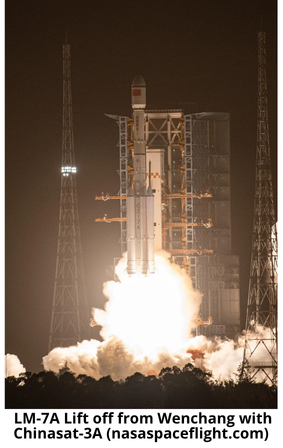
29 Jun: China launched Long March-7A with the ZhongXing-3A (ChinaSat-3A) communications satellite from the Wenchang Spacecraft Launch Site Hainan Province. The satellite is currently in Geostationary Transfer Orbit (GTO). Per Chinese government press releases, ChinaSat-3A will “provide voice, data, radio and television transmission services”. Launch Video.
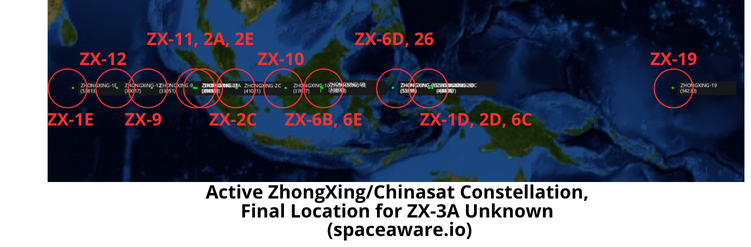
– China released very limited information regarding Chinasat-3A. The satellite will join 16 other ZhongXing (Shentong or Chinasat) satellites in GEO in the coming days.
-China is in the process of replacing its older satellites. In Nov 2023 it launched Chinasat-6E to augment/replace Chinasat-6B which was launched in 2007.
-Chinasat-3A was not mentioned previously. The next expected launch was Chinasat-9C to replace Chinasat-9 sometime in 2025.
-The original Chinasat-3 was launched in 1990 and is listed as “Dead” in the spacetrack.org catalog.
-Assuming Chinasat-6E has replaced Chinasat-6B and Chinasat-9 will be replaced by Chinasat-9C in 2025, the next likely candidates for augmentation/replacement are Chinasat-10 (2011), Chinasat-2A (2012) and Chinasat -12 (2012).
-Chinasat satellites have a life expectancy of 15 years.

24 Jun: SpaceNews released in opinion article written by Chengxin Zhang. The article describes that while SpaceX is clearly a launch leader, it lacks many of the capabilities China has demonstrated. Furthermore, SpaceX’s cooperation with the US government and support of Ukraine, “threatens China’s national security and development interests.” Mr Zhang is a researcher and doctoral candidate specializing in international political economics. He is affiliated with the School of Politics and International Relations at Lanzhou University, China, and holds a Master’s degree in International Relations from Jinan University, China.
Excerpts Below.
– In 2023, SpaceX conducted 98 space launches, compared to China’s 67 and Russia’s 19. And SpaceX delivered far more payload mass to orbit: 1,195 tons of payloads…80% of the globe.
– CASC, the largest state-run aerospace company of China, has officially acknowledged that it’s “larger in size but weaker in capabilities” compared to SpaceX.
– The fact is that SpaceX…has not yet flown beyond the earth orbits while China has already succeeded in orbiting, landing on and patrolling both the moon and Mars.
– Even within earth orbits, SpaceX is not an undisputed leader. Can SpaceX independently build and operate a space station of the third-generation technical standards like China? The answer is no. Of course, SpaceX owns Starlink, the largest low-orbit satellite constellation for high-speed internet service around the world. But China also maintains the largest global navigation satellite system.
– SpaceX is at least a passive spokesperson of U.S. interests, which means the development of SpaceX fails to directly contribute to China’s welfare.
– From the Cox Report to the Wolf Amendment, Washington consistently endeavored to contain the development of China’s aerospace industry by stifling its opportunities for international cooperation as much as possible.
– SpaceX is not only involved in U.S. intervention on the regional order but also threatens China’s national security and development interests.
– In March 2022, Starlink satellites transmitted data to F35A stealth fighters of the U.S. Air Force at a speed of 160 Mbps in a test, which is 30 times faster than the conventional connection method.
– Starlink has engaged in intelligence transmission for the Ukrainian army, enhanced the precision of striking Russian troops in the ongoing Ukraine war. And there’s the launch of Starshield, the military variation of Starlink at the end of 2022. Recently, the Pentagon has been coordinating with SpaceX to blunt Russia’s unauthorized use of Starlink internet terminals.
– In 2021, Starlink satellites even approached China’s space station at high speed more than once, posing dangers to the astronauts on board.
It may be prudent for China to adopt an approach toward SpaceX characterized by strategic despise and tactical emphasis…China should clearly define its strategic priorities while taking the entire U.S. aerospace industry as its primary reference frame, as a target for catching up, rather than allowing SpaceX to disrupt its overall plans.
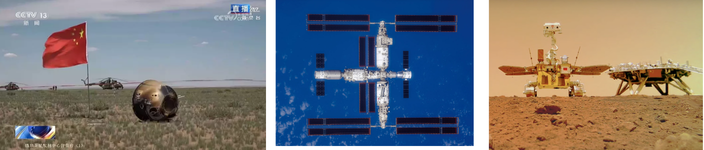
26 Jun: RAND released a report from Howard Wang, Gregory Graff, and Alexis Dale-Huangi investigating how Chinese military leadership sees themselves in competition with the US as both nations develop and deliver military power to space. The entire report can be found here. Excerpts below but recommend reading this excellent analysis in full!
– The report surveys open-source literature across the Chinese defense enterprise to present a composite image of People’s Liberation Army (PLA) perspectives and key factors for U.S.-China crisis stability in space. It draws on authoritative Chinese writings to understand Chinese perceptions of threats from the United States by reviewing Chinese publications on U.S. intent and capabilities in space. The report additionally traces the evolution of PLA thinking on escalation dynamics in space over the past two decades.
– Space power is a critical component of the CCP’s vision for China’s national rejuvenation. CCP leaders have repeatedly called on party members and the Chinese populace to work toward “realizing the Chinese Dream of the great rejuvenation of the Chinese nation.
–Space power in CCP thinking cannot be separated from military power…The 2020 Science of Military Strategy

published by PLA’s NDU…argues, “in the context of the new military revolution, space has already become a new domain of military conflict, not only changing the traditional form of warfare of mankind, but also expanding the struggle for national strategic interests.”
– To achieve China’s national rejuvenation, CCP leaders and China’s space enterprise believe China must dominate—and dominate militarily—in space.
– PLA thinking on space conflict strongly suggests the belief that space is offense-dominant… The PLA’s official PME on space operations clearly defines space as an offense-dominant domain. It explicitly describes two dominant trends in the development of space technology: First, space-based capabilities are characterized as “strong on offense and weak on defense,” and second, space operational tempo continues to increase and shortens the decision space available to state leaders.
– PLA literature emphasizes deterrence rather than stability in space. In PLA writings, deterrence is a tool to cow an adversary who would otherwise complicate Chinese activities, not an effort to prevent an adversary from destabilizing an environment.
– PLA academics have used the Schriever Wargame as a locus for analyzing U.S. space capabilities. Studies of the wargame extend across major PLA PME institutions and consistently reveal the PLA impression that the annual wargame serves to accelerate U.S. development of offensive space capabilities to preserve space superiority.
– NDU Professor Zhong Jing asserts that the United States is actively engaged in space cooperation with its allies to build a space alliance, draw allies in by sharing space situational awareness and promises of cooperative development, increase their dependencies on the United States, and ensure that potential opponents cannot use or access the allies’ space capabilities.
PLA discourse indicates the PLA has operationalized new guidance to take more proactive and assertive actions in general while accepting higher levels of escalation risk that might arise as consequence…The PLA of 2020 and beyond is more likely to undertake coercive activities and accept the risk of escalation with the United States than it was a decade prior.
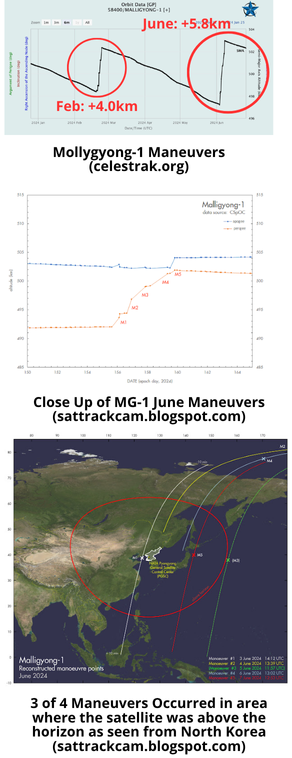
7 Jun: From ~3-7 June, North Korean satellite operators executed a series of 5 maneuvers to raise the altitude/SMA of its Mallygyong-1 reconnaissance satellite. This is the second such maneuver, North Korea conducted a similar series of burns 19-24 Feb 2024. It appears that all of the maneuvers occurred when the satellite was within communication range of the Satellite Control Center in Pyongyang. The maneuvers in February resulted in an altitude increase of 4.0km while the June maneuvers raised the Malligyong-1’s altitude 5.8km. As he did back in February, Dr Marco Langbroek provided an excellent analysis in his blog. Excerpts below.
– Mollygyong-1 raised its orbit again, slightly over 3 months after the February orbit raise. As was the case for the February orbit raise, it was done in five increments, one on each successive day, the first incremental raise in this series happening on June 3 and the last on June 7, 2024.
– The fifth and last of the June incremental raises also raised the apogee, by 1.6 km, something that did not happen during the previous orbit raise in February.
– Each incremental raise raised the average orbital altitude by about 1.15 kilometer, for a total orbit raise of 5.8 kilometer. Perigee was raised by 10 km in total, apogee by 1.6 km.
– The average orbital altitude was lifted to 503 km, half a kilometer higher than the initial insertion orbit from November 2023. The new maneuvers also further circularized the orbit.
– The orbit raise effectively compensates for the loss in orbital altitude due to natural orbital decay since February (and since launch in November 2023), maintaining the orbit within the preferred operational altitude limits.
– The current series of orbit raises also served to bring the rate of RAAN precession even closer to the ideal sun-synchronous value than it was before.
– We now likely can expect periodic orbit maintenance raises to happen about each three months, The first orbit maintenance raise in February 2024 was three months after launch, and the current second orbit maintenance raise three months after the previous. The next orbit raise therefore probably will happen near mid-September 2024.
– For this series a very similar pattern <compared with the February manevuers> emerges again: all maneuvers occurred around 22h-23h local time, one of two moments in the day when the orbital plane of the satellite is passing over North Korea.
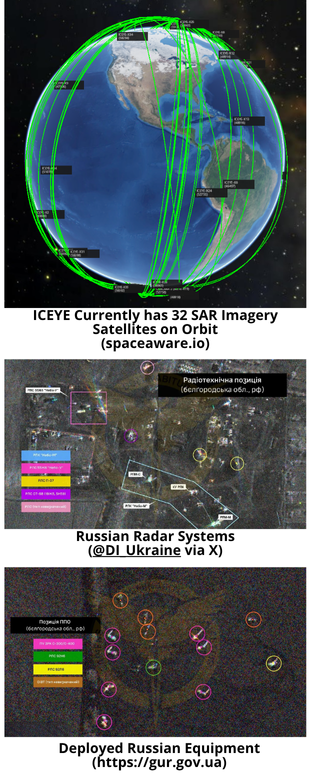
26 Jun: Ukraine’s Defense Intelligence Directorate (GUR) said it is making good use of SAR imagery provided by it’s “People’s Satellite.” The satellite an ICEYE SAR imager which the company agreed to “transfer full capabilities…for the Government of Ukraine’s use over the region.” According to a Ukrainian post 38% of the nearly 4,200 images were used to strike Russian targets. Ukraine gained access/control of the satellite in August 2022.
– Per ICEYE press release: ICEYE transferred full capabilities of one of its SAR satellites already in orbit for the Government of Ukraine’s use over the region. The SAR satellite will be operated by ICEYE. In addition, ICEYE provided access to its constellation of SAR satellites, allowing the Ukrainian Armed Forces to receive radar satellite imagery on critical locations with a high revisit frequency.
– ICEYE currently operates a constellation of 32 SAR imagery satellites on orbit. In addition to the satellite operated by Ukraine, 2 are operated by the Brazilian Air Force. 27 of the 32 satellites were launched in 2021 or later.
– Ironically the first 4 ICEYE satellites were launched by Russia on Soyuz 2.1b rockets.
– ICEYE resolution can be as good as .5 meters in spot mode covering a 5x5km area. Other modes offered are as follows: 10x10km spot at 1m resolution; 50x50km strip at 3m resolution; and 100x100km area scan at 15m resolution.
– Per Ukrainian posts: Since August 2022, Ukraine has collected a total of 4173 pictures of enemy objects, among them: 1) 370 airfields; 2) 238 positions of air defense and radio technical intelligence; 3) 153 oil depots and fuel warehouses; 4) 147 warehouses of missile, aviation weapons and ammunition; and 5) 17 naval bases.
-Also per Ukrainian post: “About 38% of the entire array of data obtained thanks to ICEYE was used to directly prepare fire damage to the enemy.”
– Ukraine is leveraging both space-based SAR and optical imagery in its fight with Russia. Per a separate post, a Ukrainian official noted, “Ukraine got the opportunity to combine optical satellite data from partners and SAR data. This fundamentally increases our ability to detect and impress Russian occupiers. Satellites with SAR technology become especially relevant in autumn and winter when there is bad weather, cloudiness or snow. It makes no difference for them – day or night. That’s why the enemy doesn’t hide.”
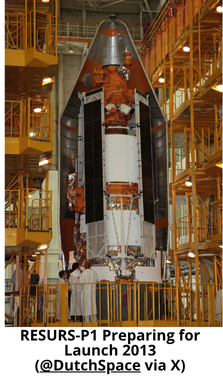
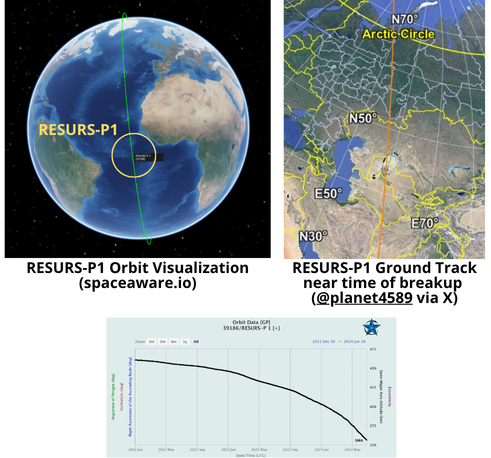
27 June: LEOLabs and others reported that a defunct Russian ISR satellite, RESURS-P1 (39186) suffered a fragmentation event. The event was likely the result of improper passivation procedures or perhaps a debris strike. A 27 Jun update from LEOLabs noted there were at least 180 pieces of debris. RESURS-P1 was decommissioned 3 years ago and is at an altitude of 355km. At this altitude it is expected that RESURS-P1 and associated debris will re-enter the Earth’s atmosphere before the end of the year.
-RESURS-P1 was a 5,500kg imagery satellite launched in 2013 from Baikonur, Kazakhstan. After operating for 8 years Russia decommissioned the satellite in 2021 and ceased to maintain its orbit.
-RESURS-P1’s operational orbit was ~470km in altitude and was in a sun-synchronous orbit. The satellite’s lower orbit at the time of breakup decreases the time required for the debris to deorbit.
– Optical observers have noted that the satellite appears to be rotating with a 2-3 seconds period.
– The breakup occurred at a slightly lower altitude than the International Space Station. Astronauts were instructed to temporarily take shelter in the moments just following the event.
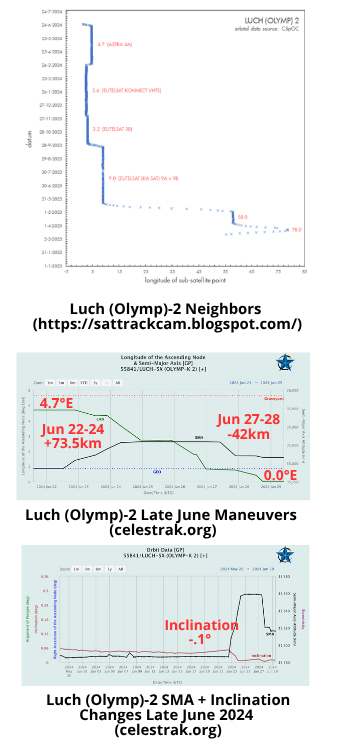
29 Jun: After spending ~88 days in vicinity of Astra 4A, Russian space operators increased the SMA of the Luch (Olymp)-2 (55841) and initiated a westward drift. Luch (Olymp)-2, like its predecessor, Luch (Olymp)-1, is believed to be a Russian signals intelligence (SIGINT) satellite. Just prior to its arrival in vicinity of Astra 4A, that satellite was jammed by Russian sources (likely from the ground) temporarily disrupting a Ukrainian broadcast. Next intended neighbor remains unknown at this time.
– Russia moved Luch (Olymp)-2 to 4.7°E in late March 2024. The satellite remained at that location until 22 June. From 22-24 June the satellite increased altitude ~72.5km and initiated a .9° per day westward drift.
– Luch (Olymp)-2 maintained its new altitude above the GEO belt until 27 June.
– Luch (Olymp)-2 reduced altitude 27-28 June ~42km leaving it ~30.5km above the GEO belt and continuing to drift west at .38° per day. At this time it had drifted from 4.7°E to 0.0°E. The satellite also decreased its inclination .1°.
– Since arriving in GEO in mid-March 2023 LUCH-5X has operated IVO the following satellites:
- 58°E: 6 Apr – 3 May unknown object of interest, the closest object (POCA ~308 km) was COSMOS 1897, a dead Russian COMSAT launched in 1987.
- 9.0°E: 22 May – 25 Sep operating in vicinity of Eutelsat 9B.
- 3.2°E: 5 Oct – 3 Dec in vicinity of Eutelsat 3B. Reported POCA ~16 km.
- 2.6°E: 5 Dec – 26 Mar in vicinity of EUTE KONNECT VHTS
- 4.7°E: 30 Mar – 22 Jun Operating in vicinity of ASTRA 4A. POCA ~12.6km.
– For its part, Luch (Olymp)-1 (40258) remains near Intelsat 37E at 18.1°E.
-For an excellent review of Russia’s GEO based SIGINT satellites, please take a look at Bart Hendryckx’s 2 part series from November 2023. Here are a couple of excerpts:
- Available information suggests that Luch (Olymp)-2 uses some of the same payload components as Luch (Olymp)-1, but is not identical to it.
- The FSB is not the most obvious organization to lead an effort to eavesdrop on foreign satellites. The FSB (roughly comparable to the FBI) is primarily a domestic security and counter intelligence agency that evolved from the KGB’s internal security departments.
- Currently, there is no evidence more eavesdropping satellites are under construction. Thenearly nine-year gap between the launch of Luch (Olymp)-1 and Luch (Olymp) -2 indicates these are not satellitesthat Russia plans to launch on a regular basis.
Pics o’ the Fortnight!