Analysis of Developments in the Space Domain
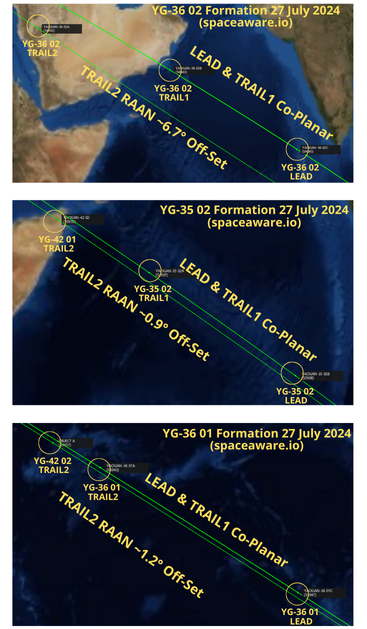
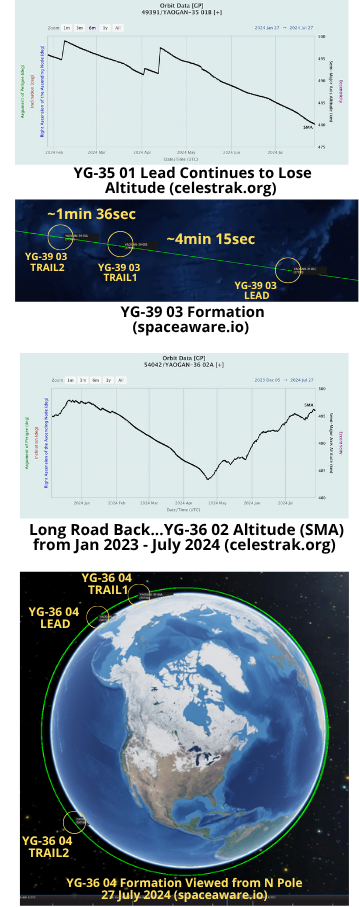
27 Jul: It appears the Yaogan-36 02 (YG-36 02) triplet has reconstituted its formation. All three satellites (Lead YG-36 02C (54045), Trail1 YG-36 02B (54042), and Trail2 YG-36 02A (54042)) have resumed their previous positions with Lead being ~ 3min 35sec ahead of Trail1 and Trail1 being ~2min 41sec ahead of Trail2. All three are now operating at the same altitude of 496km, however they are not co-planar as the RAAN value of the Trail2 satellite is now 6.7° less than the RAAN for either Lead or Trail1. Lead and Trail1 remain co-planar. The YG-36 02 formation resembles the recently constituted formations for YG-35 02 and YG-36 01 which both have co-planar Lead and Trail1 with a RAAN off-set Trail2. (I know it can be confusing…please see graphics below!)
– China launched the YG-36 02 triplets on 14 Oct 2022. It was the 6th of 15 launches for the YG-35/36/39 constellation.
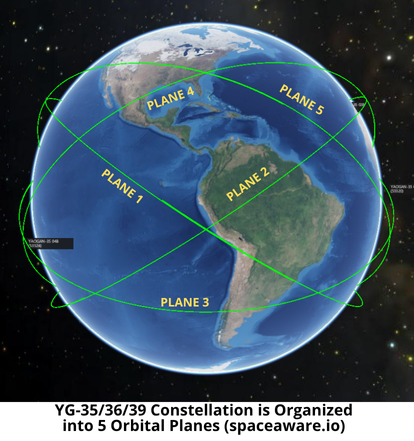
– The YG-35/36/39 constellation operates in 5 orbital planes with each orbital plane containing 3 triplets (9 satellites total per plane).
– YG-36 02 is co-planar with YG-35 02 and YG-39 01. Note: the original YG-35 02 Trail2 satellite failed and de-orbited on 19 Apr 2024. China replaced it with YG-42 01 on 2 Apr 2024.
Public Service Announcement: YG-42 01 (59395) and YG-42 02 (59557) are currently mislabeled in the catalog. YG-42 01 is mislabeled as YG-42 02 and the actual YG-42 02 is labeled as “Object A”. Little Help 18 SDS!
-From 28 Jan 2023 – 23 Apr 2024 (15 months) YG-36 02A’s altitude decreased 12.5km (495.8 to 483.3). China did not change the altitude of either of the other YG-36 02 satellites. As we know from Jack Anthony’s recent lesson, satellites orbiting at different altitudes will experience different RAAN progression and their orbits will gradually differentiate.
-From 24 Apr 2024 – 25 Jul 2024, YG-36 02C increased its altitude 12.9km and matched the altitude of the other two YG-36 02 satellites.
-Due to the 15 months of altitude mismatch YG-36 02C has an 6.7° RAAN offset.
It appears China is experimenting with having a RAAN offset for Trail2 satellites in the YG-35/36/39 constellation. China launched the two YG-42 satellites which replaced the original, failed Trail2 satellites are also have a RAAN off-set. However, the 6.7° RAAN difference in the YG-36 02 formation is much greater than the 0.9° RAAN difference in YG-35 02 or the 1.2° RAAN difference in YG-36 01. I expect the other Trail2 satellites (with the exception of YG-35 03A/53316 which appears to have failed) will eventually rejoin their formations. I will continue to monitor and provide updates.
27 Jul: Can’t get enough of Chinese LEO Formations? If so, read on! Here are my latest notes for all 15 triplets. List organized by 5 orbital planes.
Orbital Plane #1
– YG-35 01 (49391/49390/49393): Trio is a mess. None of the satellites are co-planar and Lead now at 480km and may not be maneuverable. Trail2 is near 492km and seems maneuverable but is nearly 1/2 an orbit behind Trail1. No longer in formation.
– YG-36 01 (53947/53943/59557): In formation with YG-42 02 (59557) as new Trail2. YG-42 02 (labeled in catalog as Obj A) replaced the now de-orbited YG-36 01B (53946). Trail2 has a slight RAAN offset.
– YG-39 03 (57990/57988/57986): In formation, Lead ~4min 15sec ahead of Trail1 and Trail1 ~1min 36sec ahead of Trail2. No RAAN offset.
Orbital Plane #2
– YG-35 02 (52908/52907/59395): YG-42 01 replaced YG-35 02C as Trail2 in April 2024 (still mislabeled in SpaceTrak.org as YG-42 02). Trail2 has slight RAAN offset.
– YG-36 02 (54045/54043/54042): First trio to re-form after Trail2 altitude decrease in Jan 2023. Significantly larger Trail2 RAAN offset than other formations.
– YG-39 01 (57731/57728/57727): In formation, Lead ~4min 15 ahead of Trail1 and Trail1 ~1min 01sec ahead of Trail2. No RAAN offset.
Orbital Plane #3
– YG-35 03 (53320/53318/53316): Trail2 satellite appears dead and heading for re-entry. Now at 464.7km. Likely candidate for YG-42 03? Lead is ~5min 33sec ahead of Trail1.
– YG-36 04 (54750/54746/54748): Trail2 SMA just below nominal 494.1km. Way out of formation. Recently started to drop altitude, may attempt to close gap with Trail1. Lead to Trail1 ~4min 55sec and Trail1 to Trail2 gap ~1hr 8min 44sec.
– YG-39 02 (57889/57890/57886): In formation, Lead ~3min 55sec ahead of Trail1 and Trail1 0min 46sec ahead of Trail2. No RAAN offset.
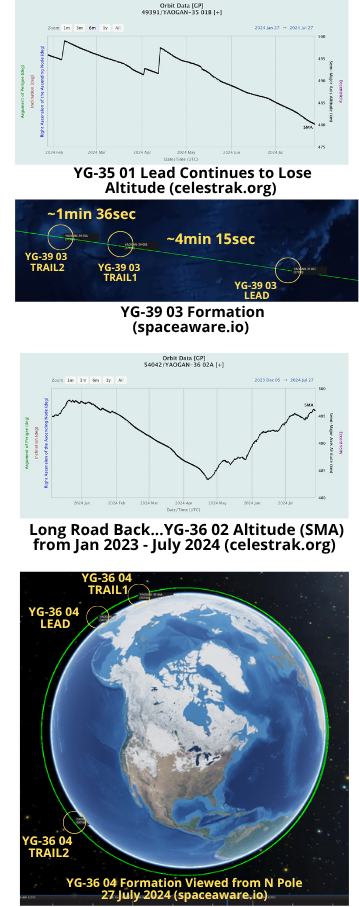
16 Aug: China launched a Long March-4B with the first group of Yaogan-43 remote sensing satellites (YG-43 01) from Xichang. Official sources stated the satellites entered the preset orbit and will be “mainly used for carrying out tests on new technologies of low-orbit constellations”. Launch Video.
– This was the first LM-4B launch with a 4.2m fairing (typical is 3.7m.)
– Initial observations indicate there are 9 satellites and 1 upperstage/rocket body on orbit. There are currently only 8 satellites in the spacetrack.org catalog and all are in a ~503x495km orbit with an inclination of 35°. As of 17 Aug the satellites were not in any discernable formation.
– We will likely see another satellite added to the catalog in the near future.The mission patch displays 9 stars and the launch video displays an animation showing 2 rows of 4 satellites with another satellite on top. (4×2)+1 = 9.
– YG-43 01’s orbital profile is nearly identical to the 47 YG-35/36/39/42 satellites that China launched over the past 3 years. However, due to a RAAN offset, the YG-43 01 cluster is not co-planar with any of the previously launched YG-35/36/39/42 spacecraft.
– From 2017-21 China also launched 30 YG-30 satellites into a 35° inclined orbit and at 585x580km altitude. The YG-43 01 cluster is not co-planar with any of these satellites.
– Open source reports indicate CAST, SAST, IAM CAS, and MonoSpace contributed to YG-43 01. We do not know if this refers to individual satellites or components or a mixture of both. Minospace and IAMCAS specialize in small, networked satellites.
Orbital Plane #4
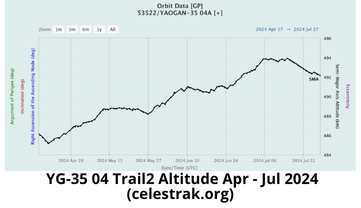
– YG-35 04 (53524/53526/53522): Trail2 has regained most of SMA and is now 492.5km but not close to being in formation. Trail2 recently started to drop altitude (see graph), may attempt to close gap with Trail1. Lead is ~6min 24sec ahead of Trail1 and Trail1 is ~40min 23sec ahead of Trail2.
– YG-36 05 (57456/57454/57452): In formation, Lead ~4min 34sec ahead of Trail1 and Trail1 ~1min 56sec ahead of Trail2. No RAAN offset.
Orbital Plane #5
– YG-35 05 (53761/53763/53760): Trail2 satellite SMA now just 2km (493km) below normal but still way out of formation. Trail2 recently started to drop altitude, may attempt to close gap with Trail1. Lead is ~5min 16sec ahead of Trail1 and Trail1 is ~36min 41sec ahead of Trail2.
– YG-36 03 (54372/54374/54376): Trail2 satellite SMA now just 2km (493km) below normal but still way out of formation. Trail2 recently started to drop altitude, may attempt to close gap with Trail1. Lead is ~5min 17sec ahead of Trail1 and Trail1 is ~36min 39sec ahead of Trail2.
– YG-39 04 (58145/58143/58141): In formation, Lead ~2min 59sec ahead of Trail1 and Trail1 ~2min 19sec ahead of Trail2. No RAAN offset.
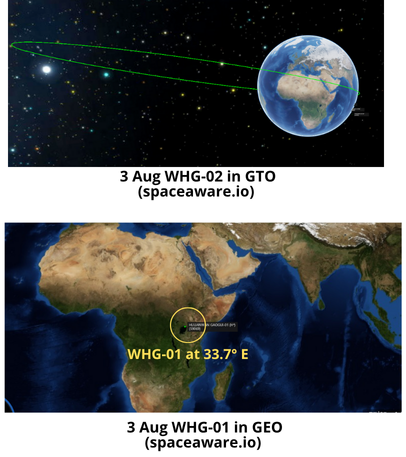
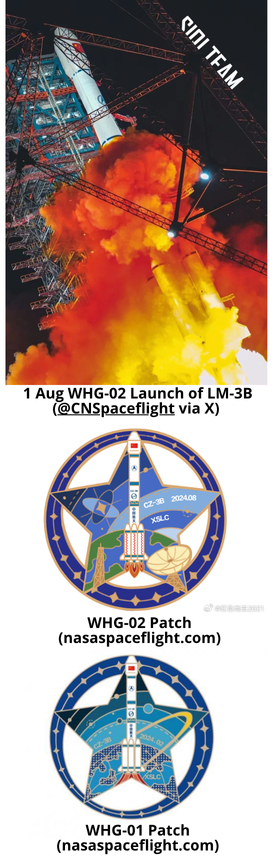
1 Aug: China launched a Long March-3B with WHG-02 (high-orbit internet services satellite) from Xichang. WHG-02 is currently in Geostationary Transfer Orbit (GTO) and will likely settle into its GEO slot in the next 2 weeks. China has released no details regarding the mission and capabilities for the WHG satellite series. Launch Video.
– WHG-02 (60327) is currently in a 35,792 x 216km orbit and is inclined 26.7°. This is similar to the profile of WHG-01 (59069) launch. China launched both satellites from Xichang using the LM-3B.
– According to a November 2023 Xinhua report, the China Aerospace Science and Technology (CAST) Corporation had completed the first high-orbit satellite Internet. The report noted that the purpose of the satellite(s?) was to completely cover the entire territory of China and key areas along the “Belt and Road” countries.
– More information to follow in the coming weeks as WHG-02 settles into its GEO slot. I could not find any information regarding the ultimate GEO location for WHG-02.
– China placed WHG-01 in an interesting orbital slot…33.7°E is due south of Eastern Ukraine. Kharkiv is 36.3°E and Donetsk is 37.8° E. This would also be a good location for supporting “Belt & Road” initiative states in Africa and the Middle East as well as Western China.
16 Jul: Asia Times published an article highlighting a recently released Chinese study about using low-resolution imagery from commercial satellites and artificial intelligence to identify track US warships from their wakes. The article referenced several other open source reports regarding China’s use of space to track US Naval and Air Forces. Christopher McFadden of Interesting Engineering also published his analysis of China’s wake analyzing study. Below is a compilation from those reports.
– China has developed a new algorithm to use low-resolution satellite images to track US warships globally, marking a significant development in maritime surveillance capabilities and military strategy.
– A Dalian Naval Academy research team, said it had discovered a U.S. Nimitz-class aircraft carrier, a Ticonderoga-class cruiser, and an Arleigh Burke-class destroyer using satellite images with resolutions of tens, even hundreds of meters.
– Their method focuses on analyzing the waves behind the ships (wakes)…Different ships create distinct wave patterns on the sea surface, similar to fingerprints.
– The Chinese scientists outlined in their paper how to remove interference and enable computers to detect targets of interest swiftly. However, they cautioned that the method could fail if the target moved at speeds exceeding 20 knots (23mph, 37kph).
-China has previously used AI to enhance significantly the capabilities of its commercial satellites, enabling them to become powerful intelligence, surveillance and reconnaissance (ISR) assets.
– In April 2022, Asia Times reported “that China had equipped its Jilin-1 commercial Earth observation satellite with AI that allows it to serve as a powerful spy platform, achieving a 95% precision rate in identifying small objects, seven times greater than the satellite’s previous technology.”
– “The AI can reportedly track moving objects even if they turn sharply or disappear into a tunnel. Traditional satellite AI assumes it made a mistake when losing track of a target, resulting in a mere 14% success rate when analyzing satellite video.”
– “The new AI estimates a moving target’s direction based on experience and continues tracking it based on the most likely direction it would take. The AI can recapture the target as soon as it reappears and works even better from space. By 2025, China plans to launch the entire constellation of 138 Jilin-1 satellites in orbit.”

28 Jun: Clayton Swope and Makena Young from the Center for Strategic and International Studies (CSIS) published an article exploring ways in which Russia may be influenced to refrain from placing destructive counterspace weapons, including a nuclear anti-satellite capability, on orbit. Excerpts below, read entire article here.
– One of Russian president Vladimir Putin’s top goals has always been to weaken the stature and influence of the United States. Because the United States maintains unrivaled advantages and prestige in space, while conversely Russian space equities have declined, there is no better domain in which Russia can erode U.S. standing.
– The United States has little economic leverage left, as Russia is mostly economically isolated from the West. On the other hand, China and India have significantly increased their trade ties with Russia. They have unique leverage that could be used to convince Russia to drop its pursuit of indiscriminate space weapons.
– Russia either already fields or is developing many different types of counterspace weapons. Russia is allegedly developing a nuclear space-based anti-satellite weapon that would probably be capable of disabling hundreds of satellites through radiation effects or the resulting electromagnetic pulse.
– China has far surpassed Russia as the second most prominent spacefaring nation behind the United States. India is motivated to succeed in space, landing a probe on the Moon last year and pursuing ambitious crewed missions to Earth orbit, and will likely soon overtake Russia as the world’s third most important space power.
– Russian space capabilities do not play a significant role on the battlefield. Russia’s version of GPS, called GLONASS, is extremely unreliable. Almost all of the GLONASS satellites are past their service lives and starting to fail. To supplement insufficient Russian satellite communications capabilities, Russian troops allegedly use illicitly procured Starlink terminals in Ukraine.
– Russia has little to lose from a disruption to space access, whereas the United States has everything to lose. Moscow is using its aerospace engineering expertise, derived from Soviet-era achievements, to develop counterspace strike capability that can harm vital U.S. space interests.
– Even with Western sanctions, the Russian economy managed to grow over the last year. In fact, the International Monetary Fund expects the Russian economy to grow faster over the next year than any other advanced economy. To a large degree, credit for this achievement goes to China and India. Trade between China and Russia hit a record high in 2023, increasing over 26 percent since the year prior. China gets more oil from Russia than from any other country. India is also buying a lot of Russian oil. Indian trade with Russia has markedly increased since 2022, with no signs of slowing down.
– Militarily and economically, China is probably as dependent on space capabilities as the United States. China’s military operates hundreds of ISR satellites in multiple orbits. Space is integrated into China’s Digital Silk Road initiative, strengthening relationships in Africa and the Global South.
– China and Russia have the economic leverage to impact Russian national interests. They could require Russia to abandon certain indiscriminate counterspace capabilities or suffer the economic consequences when China and India buy less Russian oil and China stops selling Russia advanced technologies.
– The United States could link Indian support for pressuring Russia to give up indiscriminate space weapons with the initiation of discussions with India on a free trade agreement, potentially like the Indian and Australian one signed last year.