issue 103 | 18 AUG 2024
The integrity flash
Analysis of Developments in the Space Domain
in this issue
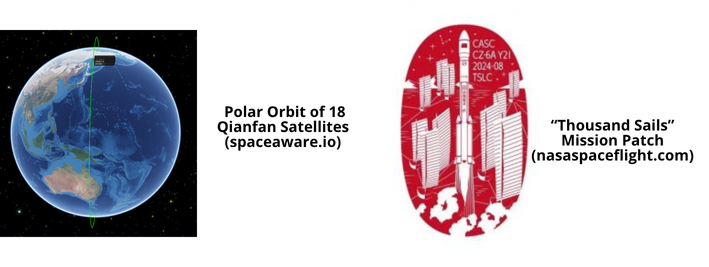
6 Aug: China launched a Long March-6A with the first 18 Qianfan polar orbit satellites from Taiyuan. The 18 satellites are in a onboard constitute the first batch of the SpaceSail Constellation, developed by Shanghai Spacecom Satellite Technology (SSST) to “provide global users with low-latency, high-speed and ultra-reliable satellite broadband internet services”.
Launch Video.
– Qianfan translates to “Thousand Sails” and the first satellites are currently in a 811x789km, 89.0° orbit.
-SSST filings with the ITU notes the constellation may consist of 1,296 satellites at an altitude of about 1,160 kilometers (721 miles). By comparison, SpaceX satellites operate at ~500km and OneWeb satellites are at ~1,200km.
– The first phase of the constellation is to have 1,296 satellites at 1,100km by the end of 2027.
– Second phase will be at a lower altitude, 300-500km and consist of 13-14,000 satellites. SSST hopes to begin launching this phase in 2028.
-Images from Chinese media reveal the Qianfan satellites incorporate flat-panel/stackable design. “It meets the needs of stacking multiple satellites with one rocket,” said Shanghai Gesi Aerospace Technology, a joint venture set up by SSST and the Chinese Academy of Sciences to oversee manufacturing of Qianfan satellites.
-Last year Blaine Curcio published an article on G60’s development and history. Excerpts below:
– The documentation sets out plans for 36 polar orbital planes, each filled with 36 satellites, totaling 1,296 spacecraft. The satellites would operate in the Ku, Q and V bands.
– The G60 constellation is separate from Guowang, state-owned enterprise China established in 2021 to oversee and coordinate the construction of a 13,000-satellite network.

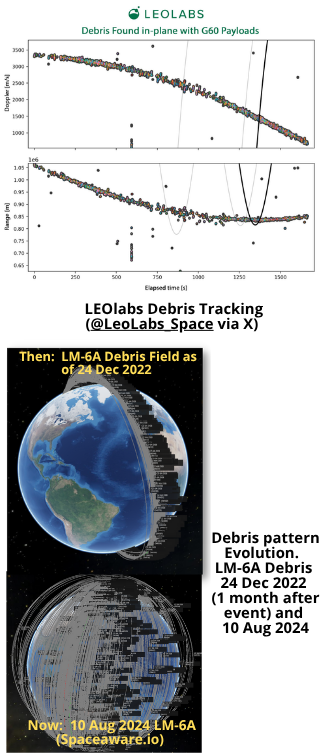
And Another LM-6A Pollutes LEO with Debris
7 Aug: Shortly after delivering its payload to an ~700-800km orbit, the LM-6A upper-stage appears to have generated a large debris field (LEOlabs estimates of 700-900+ pieces). The event creates a hazard for other spacecraft operating at similar or lower altitudes for decades. This is the same altitude region that China previously polluted with its 2007 kinetic Anti-Satellite (ASAT) test which generated 3,432 pieces of trackable debris, over 80% of which remain on orbit. This is not the first LM-6A upper-stage debris generating event. To date 4 of 7 LM-6A upper-stages have generated debris.
– The US Space Force released a statement confirming the breakup: “The breakup likely occurred Aug. 7, at 1548 UTC. The tracked pieces are being incorporated into routine conjunction assessment to support spaceflight safety. There are currently no threats to human spaceflight. Analysis is ongoing.”
– The LM-6A is one of China’s newest rockets and can deliver up to 4.5 metric tons (9,900 pounds) into a 700-kilometer (435-mile) Sun-synchronous orbit.
– The LM-6A has had a history of orbital mishaps resulting in unnecessary debris. In addition to the 6 Aug 2024 launch there have been the following incidents:
- 11 Nov 2022: Launch of Yunhai-3 01 (2022-151) suffered an upper-stage anomaly and generated nearly 700 pieces of trackable debris (409-1,600km) polar orbit.
- 26 Mar 2024: Launch of Yunhai-3 02 (2024-058) generated ~60 pieces of debris per S2A Observations. These objects are not cataloged. Satellite is in ~850km polar orbit.
- 4 Jul 2024: Launch of Tianhui-5 C/D (2024-126) generated numerous pieces of debris as observed by S2A. Again, none of these objects are in the space catalog. Satellite is in 600km polar orbit. CASC reported prior to this launch that it had modified the upper-stage to make it safer: “In this mission, the Long March 6 modified rocket optimized the passivation process of the final stage and improved the safety of the final stage on orbit.”
– The space catalog also lists 2 pieces of debris with launch of the Yaogan-40 triplets in 2023 (2023-139).
– The LM-6A upper-stage is proving to be a menace for all space faring nations (China included).
– China released a statement on 14 Aug 2024, acknowledging the debris event and “to take space debris mitigation measures.” Talk’s cheap.
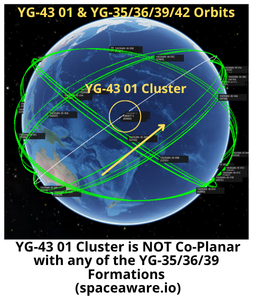
China Launches Yaogan-43 01 Satellites
16 Aug: China launched a Long March-4B with the first group of Yaogan-43 remote sensing satellites (YG-43 01) from Xichang. Official sources stated the satellites entered the preset orbit and will be “mainly used for carrying out tests on new technologies of low-orbit constellations”. Launch Video.
– This was the first LM-4B launch with a 4.2m fairing (typical is 3.7m.)
– Initial observations indicate there are 9 satellites and 1 upperstage/rocket body on orbit. There are currently only 8 satellites in the spacetrack.org catalog and all are in a ~503x495km orbit with an inclination of 35°. As of 17 Aug the satellites were not in any discernable formation.
– We will likely see another satellite added to the catalog in the near future.The mission patch displays 9 stars and the launch video displays an animation showing 2 rows of 4 satellites with another satellite on top. (4×2)+1 = 9.
– YG-43 01’s orbital profile is nearly identical to the 47 YG-35/36/39/42 satellites that China launched over the past 3 years. However, due to a RAAN offset, the YG-43 01 cluster is not co-planar with any of the previously launched YG-35/36/39/42 spacecraft.
– From 2017-21 China also launched 30 YG-30 satellites into a 35° inclined orbit and at 585x580km altitude. The YG-43 01 cluster is not co-planar with any of these satellites.
– Open source reports indicate CAST, SAST, IAM CAS, and MonoSpace contributed to YG-43 01. We do not know if this refers to individual satellites or components or a mixture of both. Minospace and IAMCAS specialize in small, networked satellites.

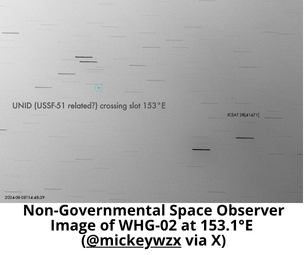
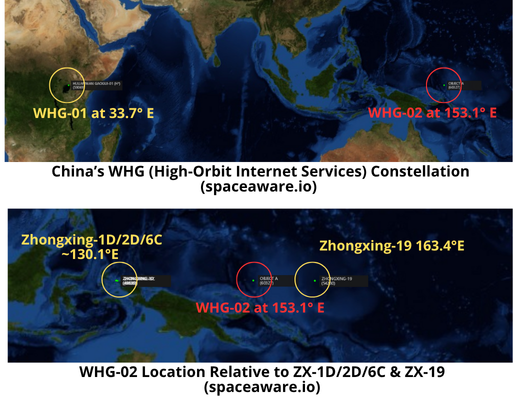
13 Aug: China’s WHG-02 (60327) (high-orbit internet services satellite) settled into its geostationary orbital slot of 153.1°E after its 1 Aug launch. China has not released any additional details relating to the WHG mission. WHG-02 now joins WHG-01 in providing some form of communications support.
– Both of the WHG satellites followed a similar flight profile. Both were launched from Xichang on a LM-3B space launch vehicle.
– According to a November 2023 Xinhua report, the China Aerospace Science and Technology (CAST) Corporation had completed the first high-orbit satellite Internet. The report noted that the purpose of the satellite(s?) was to completely cover the entire territory of China and key areas along the “Belt and Road” countries.
– China has not released any further information regarding the mission of these satellites, nor the
number of WHG spacecraft it intends to launch.
– China may intend for WHG-02 to assist with providing communications support in the Western Pacific. Locating the satellite at 153.1°E places it to the East of the Zhongxing-1D/2D/6C communication satellite grouping and to the West of Zhongxing-19.
14 Aug: Friend of the Flash, Nicolas Pillet, offers his review of how Russia is attempting to increase their use of space intelligence, surveillance and reconnaissance (ISR) assets in support of Ukrainian operations. He notes that Russia has recently conducted tests using its Gonets constellation to command and control unmanned aerial vehicles (UAVs).
Signals Intelligence
– Russia has significantly increased its quantity of space-based Signals Intelligence (SIGINT) satellites since the beginning of the war.
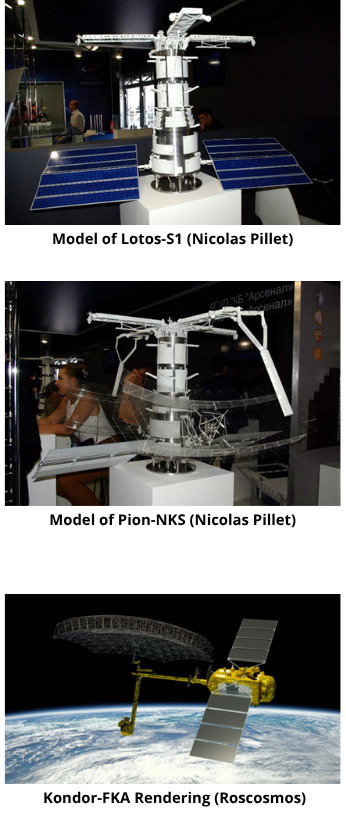
– From 2010-20, Russia had launched a total of 3 Lotos-S1 satellites (2014-086A, 2017-076A, 2018-082A) and two of them failed years before their expected lifespan, probably because of malfunctions.
– Beginning in 2021 Russia has launched no less than 5 satellites. 2 prior to the Ukraine invasion and 3 afterwards.
– 4 were additional Lotos-S1 (2021-008A, 2022-036A, 2022-163A, 2023-165A), and the 5th was the first Pion-NKS (2021-056A). All were designed and built under the responsibility of Moscow TsNIRTI (Central Research Institute for Radiotechnics), who develop the SIGINT payload internally and subcontracts the satellite bus to Saint-Petersburg KB Arsenal.
– Russia used the Soyuz-2.1b launch vehicles to place Lotos-S1 spacecraft in their 900km x 900km x 67.1° orbits.
– Pion-NKS also detects electromagnetic signals, but can also collect Synthetic Aperture Radar (SAR) imagery.
Earth observation
– Russia’s capacity to observe the Earth lags far behind other space powers such as China, the US or European Union.
– Beginning in early 2022, the Russians have launched two radar observation satellites (Neytron and Kondor-FKA), three Bars-M cartography satellites, one Resurs-P very high-resolution satellite and four unidentified satellites (Cosmos 2555 <no longer in orbit>, Cosmos 2568, Cosmos 2574, Cosmos 2572) with orbital parameters typical for optical intelligence collection.
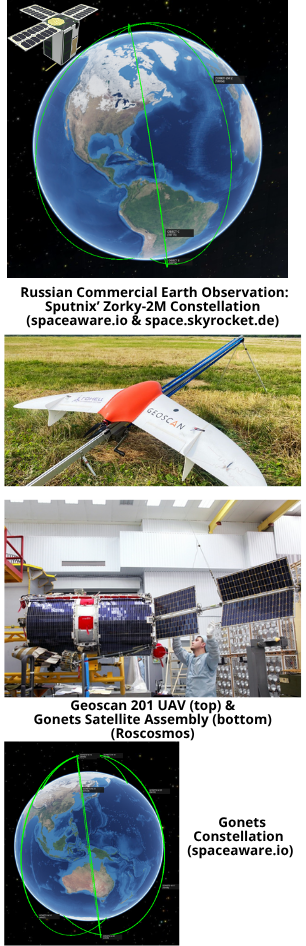
– The Russian commercial space company, SPUTNIX, began the deployment of the Zorky-2M constellation in 2023. There are 4 Zorky-2M satellites in orbit.
– The Zorky-2M are 12U-type Cubesats with a multispectral capacity and a resolution of 2.75 m.
– Sputnix intends to launch 28 more in the next few years to complete a 32-satellite constellation.
– Both the high-level system engineering and the optical system design are made by private companies that do not belong to traditional Russian space industry.
– Russia continues to struggle to meet the needs of its units operating in Ukraine. ChVK Vagner private military company bought at least two Jilin-1 Chinese satellites directly in orbit.
UAV Test Flight Using Gonets Constellation
– In July 2024, Roscosmos announced that the Gonets company successfully tested the control of a Geoscan 201 Unmanned Aerial Vehicle (UAV) through the Gonets satellite constellation. The experiment was conducted at the Pushistyi aerodrome on Sakhalin Island.
– Testing included telemetry reception throughout the flight and the remotely controlled landing at the predetermined point.
– Gonets are small communication satellites – called ‘messaging’ satellites, in Russian nomenclature – in 1,400 km orbits. They allow the transmission of SMS-like messages from and to anywhere on Earth. They are more on less a precursor to Iridium or Starlink, but with much more limited capacity.
– Russia launched the first Gonets in 1996, and fifteen Gonets-M are operational at this moment. Reshetnev company is now developing a new generation, called Gonets-M1.
The UAV control experiment was 100% civilian. However, the concept can easily be used for military purpose as well. And the link with the Defense industry is not very far: the vehicle used to qualify the technology is provided by Geoscan, a company partially owned since 2023 by the Innopraktika foundation, which is headed by Vladimir Putin’s daughter. For its involvement in the war in Ukraine, Geoscan was sanctioned by US Department of the Treasury’s Office of Foreign Assets Control (OFAC) on June 12th, 2024.
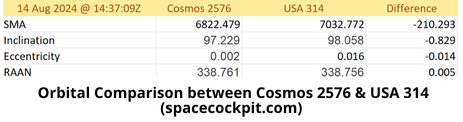
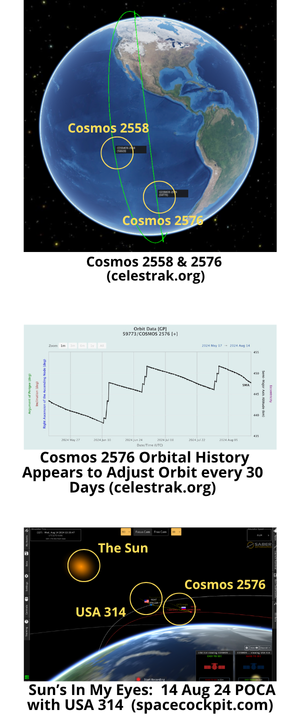
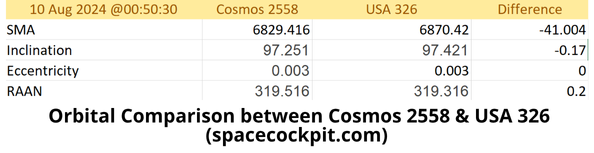
Russia currently operates 2 satellites in Low Earth Orbit (LEO) that are co-planar with US national security satellites. On 1 Aug 2022, Russia launched Cosmos 2558 (53323) into a co-planar orbit with USA 326. More recently, on 16 May 2024, Russia launched Cosmos-2576 into a co-planar orbit with USA 314. The first instance of this behavior occurred on 25 Nov 2019 when Russia launched Cosmos 2542 (44797) into a co-planar orbit with USA 245, however Cosmos 2542 re-entered the Earth’s atmosphere on 24 Oct 2023. With the assistance of Nathan Parrott of Saber Astronautics, we take a closer look at Cosmos-2576/USA 314 & Cosmos-2558/USA 326. For the USA satellites, we used orbital data from Mike McCants’ Satellite Tracking Web Pages.
Cosmos 2576
– Russia launched a Soyuz-2.1b from Plesetsk with Cosmos 2576 and 9 additional payloads (including 2 of the Sputnix Zorky-2M satellites mentioned in the previous article). The launch prompted an rapid response from the US Department of Defense after it became apparent that Cosmos 2576 was co-planar with a US national security satellite (USA 314).
– Per Dr Marco Longbroek’s SatTrackCam Leiden (b)log: “Cosmos-2576 orbital plane might not be random. As was first pointed out by Bob Christy, the orbital plane closely matches that of the American KH-11 ADVANCED CRYSTAL spy satellite USA 314 (2021-032A).”
– “Cosmos 2576, differs in RAAN with USA 314 by only 0.02 degrees, and in inclination by only 0.8 degrees. Its current orbital altitude (451 x 436 km) is lower than that of USA 314 (769 x 548 km), but both orbital altitude and inclination are the same as that of a previous ‘inspector satellite’.”
– Based on Celestrak data it appears Cosmos 2576 has adjusted its orbit 3 times. In each instance the spacecraft appears to perform 3 SMA boosts, the past 2 maneuvers appear to be similar with an overall increase of 6.2km on 29 Jun and 5.6km on 31 July. In both cases Cosmos 2576 maneuvered to reach a 451.6km SMA.
– Orbital orbital relationship with USA 314: Every 1.5 days Cosmos-2576 has a ~269km Point of Closest Approach (POCA) with USA 314. Solar phase angle (SPA) varies for each POCA event. In the case of the POCA event on 14 Aug 2024, the sun is nearly directly behind USA 314 making any imaging from Cosmos 2576 virtually impossible.
Cosmos 2558
– Russia launched a Soyuz 2.1v on 1 Aug 2022 carrying Cosmos 2558 into a Polar orbit. Astronomers noted that Cosmos 2558’s orbit was co-planar with US national security satellite USA-326. The US DoD also released a statement.
– Just 3 days later, on 4 Aug 2022, Cosmos 2558 had a ~67kms POCA with USA 326.
– On 29 Sep 2022 Cosmos 2558 made a small orbit raising maneuver to fine-tune its RAAN precession to match that of USA 326.
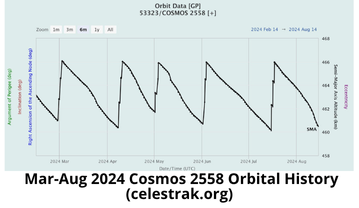
-Analysis of Cosmos 2558 orbital history reveals the satellite raises its orbit on average 5.5km every 40 days to restore its 466.1km SMA.
– Orbital orbital relationship with USA 326: Cosmos 2558 has an ~50km point of closest approach (POCA) every 7.26 days. As with Cosmos 2576 the solar phase angle (SPA) varies each POCA event. In the case of the 10 Aug 2024 POCA event, Cosmos 2558 had favorable lighting conditions with respect to USA 326 as it moved from 200km to 100km from USA 326. However, by the time the two satellites closed to within 100 km both had transitioned to the night side of the Earth, which would prevent effective optical imaging.
Watch This Space: Barring any orbital adjustments, Cosmos 2558 and Cosmos 2576 will simultaneously approach USA 314 and USA 326 (respectively) on 12, 18 & 24 September 2024.

15 Aug: Arstechnica article from Eric Berger notes the financial impact of on-going Ukrainian operations and resulting sanctions has resulted in Russia’s lowest yearly number of launches in 60 years. Excerpts Below.
– (With only 9 launches to date) It appears that Russia’s space program is on pace for the fewest number of Russian or Soviet space launches in a year since 1961. That was when Yuri Gagarin went to space at the dawn of the human spaceflight era.
-In recent weeks, the first deputy director of Roscosmos, Andrei Yelchaninov, has given a series of interviews to Russian news outlets. (Most Russian media are state-owned or state-controlled, so none of this information can be independently verified, but it is interesting nonetheless.) One of the most revealing of these interviews was given to national news agency Interfax.
– “We are in an ongoing process of emerging from financial crisis, and it’s complicated,” Yelchaninov told Interfax. “I would remind you that contract cancellations by unfriendly contacts cost Roscosmos 180 billion rubles ($2.1 billion US). This forces us to build a new economy in severe conditions.”
– Russia’s space industry has been operating at a loss in recent years and may not begin to break even until 2025. Russia’s invasion of Ukraine also came as United Launch Alliance finally ended its practice of purchasing RD-180 rocket engines, manufactured by NPO Energomash. This fact, in concert with decreased commercial demand for Russia’s Proton and Soyuz rockets, has forced the Russian government to subsidize these elements of Roscosmos.
– Russia had to look to new sales markets after what Yelchaninov euphemistically refers to as the “special military operation,” which is Russia’s term of art for its war against Ukraine. “After the beginning of the SMO we were forced to shift from our traditional partners in Europe and the US, with whom we had many years of interaction, for new international directions including the countries in Africa, the Mideast, and Southeast Asia,” he said.
– Rather than working with the United States in space, Yelchaninov said that Russia’s space program would focus on cooperation with China rather than competition there.

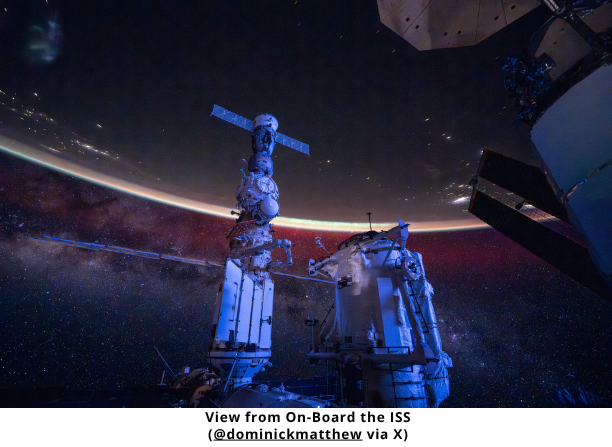
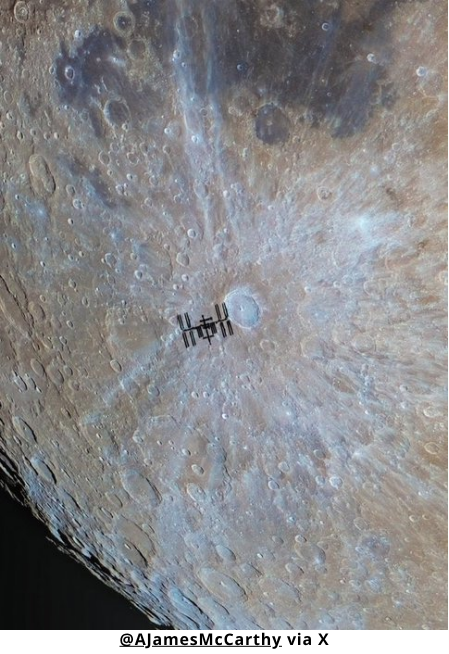
Pics o’ the Fortnight!