


Analysis of Developments in the Space Domain
15 Jan: With the help of the amazing LSAS team, we take a closer look at the relationship between the Shiyan-24A/B/C triplet (SY-24, launched 25 Dec 2023), and the Shijian-6 05B satellite (SJ-6 05B launched with SJ-6 05A on 9 Dec 2021). According to China’s official sources, the three SY-24 satellites “will be mainly used for space science and technology experiments.” The LM-11 sea launch placed the SY-24 trio nearly co-planar with the SJ-6 05 satellites, and there were some interesting interactions between all three SY-24 satellites and SJ-6 05B in early January 2024. Watch the fantastic LSAS video.
– The SJ-6 05A/B satellites have an interesting history. China launched them during the western holiday season, and appears to have chosen a naming convention designed to confuse space domain awareness tracking.
-There are ten other SJ-6 satellites in orbit. All were launched in pairs between 2004 and 2010. Their reported mission was to probe the space environment, radiation and its effects, record space physical environment parameters, and conduct other related space experiments.
– The news release from the China Academy of Space Technology (CAST) stated the purpose of SJ-6 05 was the same as the four pairs a decade ago: detection of the space environment & new technology validation.
– However, the SJ-6 05 initial orbit was ~130 km (21%) lower than previous missions. SJ-6 05 satellites are at a similar inclination (97.4°), but had apogees between 465-467 km, and perigees between 451-453 km.
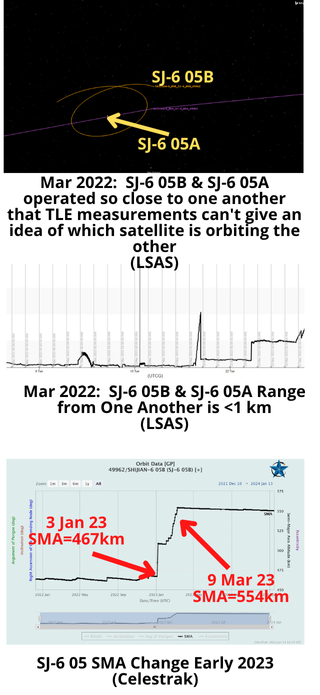
– Shortly after their December launch, SJ-6 05A & 05B began to maneuver for Rendezvous and Proximity Operations (RPO).
– The two satellites conducted RPO setup maneuvers in February, and more persistent in March, resulting in periods of apparent rendezvous mid-March 2022.
– On 16 Mar 2022 LEO Labs noted the two satellites were ~0.011 km apart.
– The SJ-6 05 satellites have not repeated RPO since this initial encounter. On 19 Jan 24, the satellites were ~13,468.0 km apart.
-Between 3 Jan – 9 Mar 2023 both satellites increased their altitude (SMA) ~87.2 km or 15.7%. Both have a current SMA of ~554 km, which is closer to the other SJ-6 pairs.
– China launched the SY-24 satellites into a nearly identical orbit as the current SJ-6 05… they are slightly lower, with an SMA of 546.6 km and nearly identical inclination (~97.3°).
– Analyzing Two-Line Elements (TLEs), it becomes apparent that both the SJ-6 05 pair and the SY 24-C triplets share the same, or extremely close, orbital plane in Sun-Synchronous Orbit (SSO).
– While their orbits are notably similar, it appears the SY-24 satellites potentially conducted safety maneuvers and Rendezvous and Proximity Operations (RPO) with SJ-6 05B.
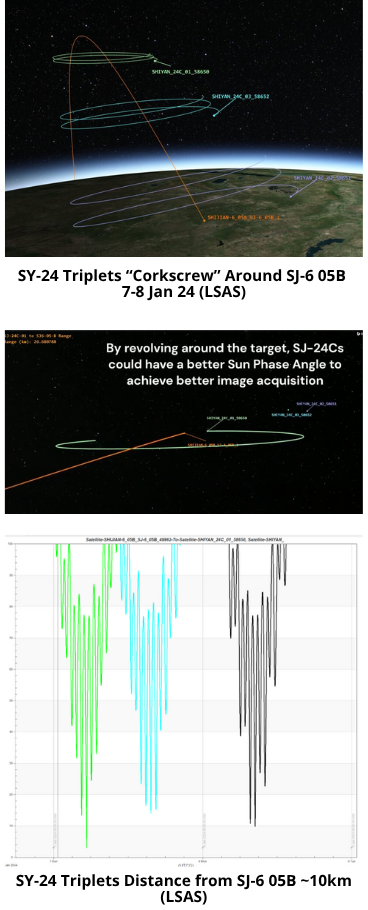
– Between 7 – 8 Jan 2024, the SY-24 triplets executed sequential close approaches to the SJ-6 05B satellite, employing a corkscrew motion or safety ellipse. These maneuvers, likely conducted to minimize collision risks or acquire images from diverse perspectives, brought each SY-24 satellite within less than 10 km from the SJ-6 05B satellite.
– By maneuvering around the target satellite, the SY-24 satellites may have optimized their Solar Phase Angle (SPA), capturing images with favorable lighting conditions. The SPA is the angle between the vectors from the target to the Sun and from the target to the observer, enabling imaging while the target reflects sunlight – without the Sun directly impacting the sensors.
16 Jan: Newer Flash readers may not be aware that for a few months in 2022 we had Jack Anthony as a contributing author. I sent Jack a head’s up on what we saw with the SY-24 triplets and SJ-6 05B in early January, and he was nice enough to give us his thoughts on what was going on. More on that below. I also want to recommend the following articles Jack wrote for the Flash covering the Classic Orbital Elements:
Many thanks to Jack for coming out of retirement to help out our Flash readers (and editor).
I’m baaaaack! Remember all those “Jack’s Astro Corner” articles I wrote? Hope so! We covered a lot of topics that can help you understand threat astrodynamics that confront us these days. The preceding “Shiyan-24A/B/C & Shijian-6 05B: A Closer Look” article gives me a chance to illustrate some astro rules of thumb. I particularly wish to look at the 24A, B and C trio “fly-by” of 6-05-B that occurred 7 – 8 January 2024. I’ll call the trio the Chasers, and the SJ 6-05-B satellite the Target for my discussion. When I watched the LSAS prepared video, I saw an opportunity to explain the 10:1 rule, plus expand on the explanation of the out of plane motion (both crosstrack and radial). This 10:1 rule of thumb is applicable to Low Earth Orbits. If you have not watched the video, please do so. Pretty cool video to learn from! Watch it several times… start and stop it and try to formulate how YOU would narrate it to a fellow US Space Force Guardian. All Guardians should seek to learn and be able to step up and be the astro hero, and say with confidence “let me explain what we are seeing here.”
10:1 Rule: What you talking about, Jack? In his 1999 book Space Power Theory, James Oberg introduces the concept, based on his many years as a NASA Flight Controller at Johnson Space Center. Jim is an space expert of the highest order, and one of the best “explainers of astro stuff.” Here’s a pdf of the section of his book. Note he uses the term “Orbitology”, which is a term I hate, with one exception… when Jim Oberg uses it. His explanation of the 10:1 Rule is on the third page. Give it a read, in its entirety – you’ll learn a lot.
I called upon my astro and RPO dynamo friend Jason Westphal, who leads a company named TenOne Space. Wow, Jason named his company after the 10:1 Rule! He spelled it out “TenOne.” That’s pretty cool! His team are RPO experts, and the 10:1 Rule is a key concept used by RPO mission teams as they seek to get their Chaser close to a Target (for example, getting into position to dock for servicing).
Here’s how Jason explains it:
“The majority of missions we undertake involve spacecraft rendezvous with other objects, so it seemed appropriate to name our company after the 10:1 rule. The 10:1 ratio enables us to estimate the timing for the convergence of co-elliptic drift phasing orbits. To illustrate, if we’re trailing a target spacecraft by 10 km with the objective of reaching the target inserting into a safety ellipse in close proximity after one orbit, we know our spacecraft needs to attain an orbit with a semi-major axis 1 km below that of the target to achieve the desired drift rate using the 10:1 rule.”
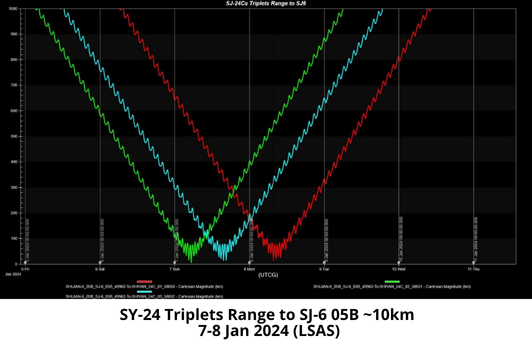
Let’s dive into the recent RPO situation involving the trio drifting by the Target. I want to draw you attention to what’s being shown in the video at T+ 4 to 22 seconds, as well as the three Chasers Range to Target over Time plot, at T+33 sec.
You see a lot of zig-zagging, up-down and sideways; I’ll talk about that in a second. But, did you see how the Chaser trio are in a row, moving forward relative to the Target? That’s what excited me to shout out “that’s the 10:1 Rule!” The zig-zagging ellipse is moving forward. If you study the range vs time plot, and measure the distance moved in one orbit (a sine wave cycle), you maybe be able to figure out it moves about 35 km per orbit (the orbit period is ~95.6 minutes). I grabbed the TLEs for these spacecraft from Celestrak (thank you TS Kelso), and calculated their mean orbit altitudes. My calculator tells me the Target’s mean altitude is 544 km, and the trio each is at ~540.5 km. The difference is 3.5 km. OK, get ready for the 10:1 Rule. If we multiply the 3.5 Km difference in mean altitude by 10, we get 35 km. So, since the trio is below the Target, they advance on it 35 km per orbit. See that, the 10:1 ratio works. Clark Keith (1952-2013), the RPO legend from the XSS-11 days, called it linear drift when we did it a lot in the 2005-2007 pioneering AFRL RPO experimental space mission.
They also employed a safety ellipse in their linear drift approaches to their target. More on that next. So here’s a thinking question: what if the Chaser trio was above the Target by 3.5 km? “Bueller, Bueller, Bueller…..who knows?” Of course you know: the Chaser trio would be moving back relative to the target, and at 35 km per orbit. Pretty cool stuff!
So, what is all the zig-zagging going on? It’s a repetitive ellipse. There’s relative motion happening in both crosstrack and radial, as you can see in the video. There is an ellipse repeat going on here. China launched the trio into the orbit plane of SJ 6-05-B, but not exactly. So you are seeing the effects of their orbit having a slightly different orbit tilt (inclination) and twist (Right Ascension of the Ascending Node). Again mathematically monkeying with the TLE data, I mashed my calculator excitedly and found the trio had close alignment in inclination (I got 0.0109°) and not as close in RAAN (My estimate 0.6567°). You can see the out of plane “zig- zagging.” indicative of the offset in inclination and RAAN. There are also some big differences between the Target’s Argument of Perigee and the Chasers’. This is wise, in that it helps set up this drifting ellipse, and ensures as the Chasers go by the Target such that they don’t collide. This is the safety ellipse concept that all of us RPO enthusiasts use to keep it safe out there, as we get close to others (with permission of course). In the preceding “A Closer Look” article they talk about setting up where the Chaser is in the safety ellipse, to get the Sun in a good position for imagery. Wow, this RPO and fly-by activity requires some orbital element thinking. Do YOU know all about orbital elements? (I wrote a six part series a while ago in the Flash… a fun read. Go find it if you need a tune up.)
Now, go explain the 10:1 rule to some General officer, or your kids, or your neighbor. They will declare YOU ARE AN ASTRO DYNAMO… maybe invite you to parties to wander around explaining astro! I hope you enjoyed my “I’m baaaack” return, and sharpened your astrodynamics understanding and awesomeness. Thank you, Jason Westphal of TenOne Space, and Jim Oberg, NASA mission control pioneer and astro “explainer of stuff.” Stay awesome for America in space!
11 Jan 24: Orienspace successfully launched its first solid rocket, Gravity-1, carrying three satellites to orbit, and setting a new Chinese record for payload capacity on a commercial vehicle. Having only begun operations in 2020, they have rapidly developed a launch vehicle capable of delivering cargo to Low Earth Orbit (LEO) at a cost of ~US $5,000-6,000/kg. Orienspace claims to have signed contracts to launch hundreds of satellites in the coming years. Launch Video.
– Gravity-1 consists of three stages and four boosters. It boasts the capability to lift around 6,500 kg of payload to LEO, or 3,700 kg to 700 km Sun-synchronous orbit, when using a kerosene-liquid oxygen third stage.
– The booster’s initial launch used the Defu-15002 mobile sea platform, in the Yellow Sea. The rocket’s ignition produced large plumes of exhaust, with debris visibly falling into the sea as the vehicle lifted off (images below).
– On-board were three Yunyao-1 (18-20) weather satellites. These spacecraft are currently in 478 x 499 km orbits with inclinations of 49.99°.
– Orienspace CEO Yao Song has stated that the firm has already secured orders for the launch of hundreds of satellites, and been shortlisted in plans for a number of satellite constellations. Orienspace is planning two additional Gravity-1 launches in 2024.
– Gravity-1 is capable of carrying more than twice that of the previous largest Chinese solid rockets, CAS Space’s Kinetica-1, and China Rocket’s Jielong-3 (1,500 to 500 km SSO), respectively. Both are spinoffs from state-owned enterprises. Notably, Gravity-1 is more powerful than Europe’s Vega-C.
– Orienspace is looking to launch its first liquid propellant rocket in 2025. The upcoming Gravity-2, a 60 m tall launch vehicle, will have a core stage and solid boosters.


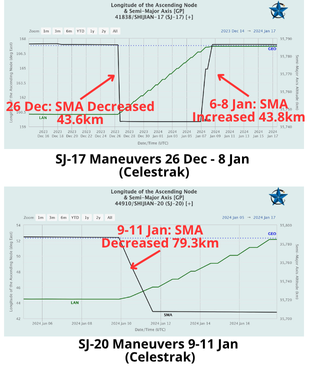
17 Jan: See below for latest positional updates on some of China’s GEO objects of interest. SJ-17 and SJ-20 have recently maneuvered to new locations. SJ-17 lowered its orbit, and drifted 7.2° east to 167.2°. SJ-17 has since rejoined the GEO belt, and is no longer drifting. SJ-20 also decreased its orbit and has drifted 7.6° east. As of 17 Jan SJ-20, is continuing to drift eastward.
– SJ-17: After having resided at 160.3°E from 13 September – 25 December, China decreased SJ-17’s semi-major axis (SMA) by 43.6 km on 26 Dec. SJ-17 drifted east from 26 Dec – 8 Jan, before increasing its SMA 43.8 km and rejoining the GEO belt at 167.2°E.
– SJ-20: After residing at 44.6°E from 25 Sep – 9 Jan, SJ-20 decreased its SMA 79.3 km and initiated an eastward drift. As of 17 Jan, the satellite is continuing to drift eastward at ~1° per day.
– SJ-21: Last maneuver observed 9 Jul 2023. On that date, SJ-21 lowered its SMA and is currently 34.8 km lower than the GEO belt. The satellite is continuing to drift eastward at ~ 0.4° per day. SJ-21 is the satellite which captured a derelict Chinese COMPASS satellite, and hauled it to graveyard orbit in January 2022.
– SJ-23: Last maneuver observed 3 Dec 2023, when SJ-23 increased its SMA 44.6 km, and initiated a
westward drift. SJ-23 has drifted across much of the GEO belt, heading east from 19.8°E in Apr 2023 to 174.2°E in Oct 2023. The satellite is at 145.0°E with a westward drift of ~0.5° per day.
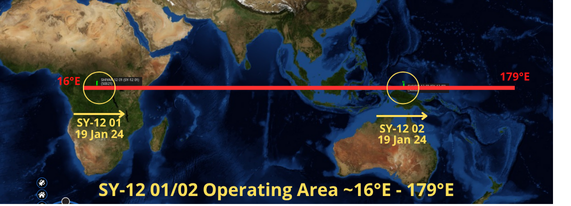
-SY-12 01: Most recent maneuver was 10 – 14 Jan 2024 when SY-12 01 decreased its SMA 91.2 km, reversing an eight month westward drift. The satellites are now orbiting ~45.3 km beneath the GEO belt and moving eastward ~0.5km per day. Interestingly, on 19 Jan 24 SY-12 01 passed <90 km from Russia’s RADUGA 15 military communications satellite.
– SY-12 02: Maneuvers may be ongoing. SMA appears to have changed 18 Jan. After drifting westward from Nov 2022 to late Jun 2023, SY-12 02 decreased its SMA 98.9 km and initiated a 1° per day eastward drift. From Jul 2023 to Jan 2024, the satellite has moved from 16.7°E to 131.9°E. On 19 Jan 24 SY-12 02 passed ~94 km from Russia’s Express AT2 broadcast satellite.
The officially announced purpose of the Shiyan 12 satellites is-spatial environment detection and testing. There has been open source comparison with the US GSSAP mission. The pair appear to cover the area between 16°E and 179°E approximately every 6-7 months.