


Analysis of Developments in the Space Domain
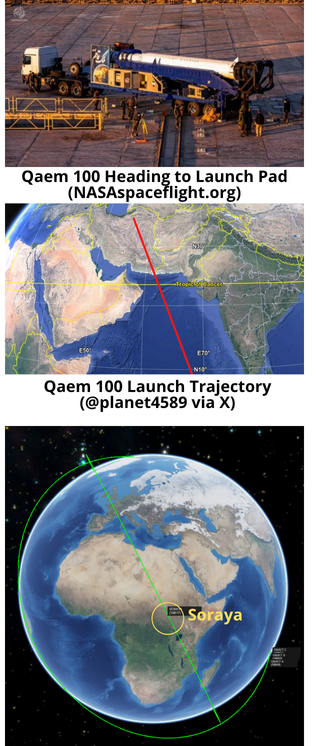
20 Jan: Iran successfully launched its Sorayya satellite into orbit using a Qaem 100, a three-stage solid-fuel rocket built by Iran’s military Revolutionary Guards. Launch Video.
– Iran successfully placed the Sorayya satellite into a ~750km orbit with a 64.5° inclination. At the time this was the highest orbit successfully reached by Iran.
– Iran launched the Qaem 100 from the Shahrud space center in Northeaster Iran. The Qaem 100 was developed by IRGC and was first tested on sub-orbital flight on 5 Nov 2022, and its first orbital mission failed on 4 Mar 2023.
– The Qaem-100 is the IRGC’s latest carrier rocket, based on the older Qased, a proven rocket that has successfully launched satellites into space at least three times in the past.
– Like the Qased, the Qaem-100 is also a three-stage solid-fuel rocket, but has twice the payload capacity of Qased and can reach an apogee of 750km (Qased could reach only ~500km).
– The IRGC announced the successful testing of the Qaem-100 engine two years ago, explaining that it has a thrust of 68,000 kg, higher than older models with 30,000 kg.
– Iran’s information and communications technology minister, Issa Zarepour, confirmed the reception of the satellite’s first signal via a post on the Iranian social media platform Virasty. He detailed that Soraya’s ground satellite tracking stations received signals and telemetry data, indicating the satellite’s subsystems were functioning correctly and that the satellite was in good condition.
– The Soraya satellite weighs 47kg and is designed for research and telecommunication purposes, and has an expected lifespan of three years. Soraya is the fourth satellite launched by the IRGC aerospace division, as well as their first civilian satellite.
– According to the Iranian Ministry of Communications and Information Technology, Soraya is a research satellite and was developed by the Iranian Space Research Center (ISRC).
– Since 2020, in parallel with the civilian Iranian Space Agency (ISA), the IRGC has been developing its own space program with solid-fueled carrier rockets and the Shahrud Rocket Site as its base.
– In April 2020, March 2022 and October 2023, the IRGC’s military satellites Nour-1, Nour-2 and Nour-3 were sent into space by Qased carrier rockets, respectively.
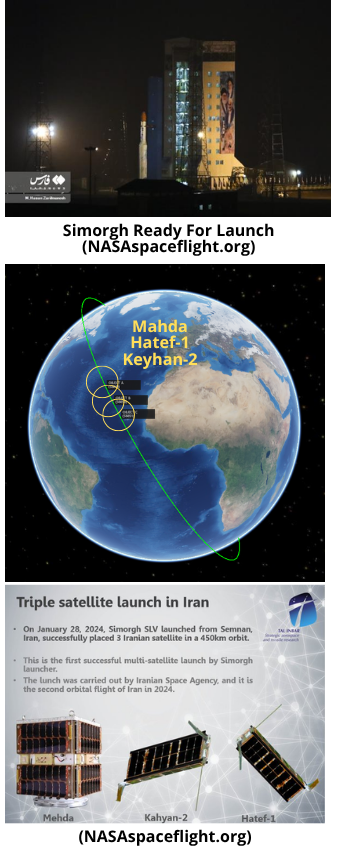
28 Jan: Iran launched 3 satellites using the using the Simorgh (Phoenix) satellite carrier rocket developed by the Iranian Space Agency. This was the Simorgh’s first successful orbital flight and was also Iran’s first multi-satellite launch, placing all three satellites in 1,100km orbit. Launch Video.
– Iran launched the Mahda, Hatef-1 and Keyhan-2 satellites into an 1,100 x 450km orbit with a 58.7° inclination. The 1,100km apogee was a new record for Iran surpassing the Qaem 100 record set 8 days earlier.
– The launch was also Iran’s first successful launch of multiple satellites.
– The Simorgh is the largest and most powerful Iranian rocket in terms of dimension and capabilities, and is the replacement for the older Safir rocket.
-Irand began Simorgh development in 2010 and conducted the first test flight in 2016. Iran conducted four more tests in the following five years. The launches all encountered problems, but Iran made progress with each new flight. The system appears to now be fully operational.
– Mahda is a research satellite designed, manufactured, assembled and tested at the Iranian Space Research Center (ISRC), a subsidiary of the Ministry of Communications and Information Technology.
-Mahda is the largest of the three satellites with a mass of 32kg. The Defense Ministry described its objectives as testing advanced satellite subsystems, and assess the performance of the Simorgh carrier in multiple launches.
-Hatef-1 and Keyhan-2 are nanosatellites with a mass <10kg. They designed and developed for launch by Iran Electronics Industries (IEI), a state-owned subsidiary of the Defense Ministry.
– Keyhan-2 was developed for space-based positioning and it has status determination and control subsystems to aim stably and precisely toward the Earth.
– Hatef-1 seeks to prove the use of narrowband communication technology in the Internet of Things (IoT).
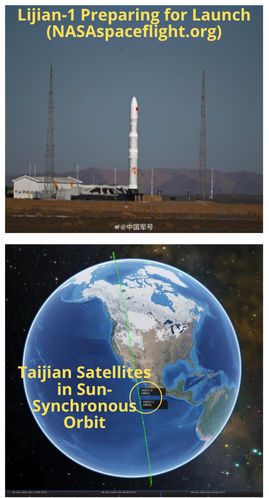
23 Jan: China launched the third Lijian-1 launch vehicle with 5 remote sensing satellites from the Jiuquan Satellite Launch Center. Lijian-1 (also known as ZK-1A and Kinetica-1) is a four-stage solid-propellant launch vehicle jointly developed by the Institute of Mechanics of the Chinese Academy of Sciences and CAS Space. Launch Video.
– The five satellites, Taijing-1C, 2B, 2D, 3B and 4C, are all in 539 x 520km sun synchronous orbits with an inclination of 97.5°.
-The Lijian-1 is a four-stage, solid-fuel rocket that stands 30m tall and can lift 1,500kg of payload into a sun-synchronous orbit. All three Lijian-1 launches have been successful.
-CAS Space, a Beijing-based commercial launch service provider, developed the Lijian-1 under the auspices of the state-owned Chinese Academy of Sciences (CAS).
-Lijian-1’s debut flight was in August 2022 and briefly set a national rideshare record with its second outing, which sent 26 satellites to orbit.
-All of the satellites have earth observation missions. The Taijing-1C, 2B, 2D and 3B are electro-optical imagery while the 4C is a phased array synthetic aperture radar (SAR) satellite operating in the Ku-band portion of the electromagnetic spectrum.
-The launch doubled the number of on orbit Taijing satellites to 10. The first launched in 2021, four launched in 2022. All appear to have been launched on ride-share type missions and some have yet to be confirmed.
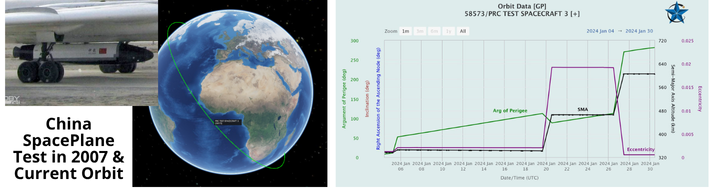
30 Jan: China raised the orbit of it re-usable spaceplane 76% from 19-27 Jan. In just over a week the spaceplane’s altitude increased from 344km to 606km. The first maneuver was observed on 19 Jan and resulted in an increase of 123.6km. The spaceplane remained at its new altitude (465.6km) for ~6 days before again increasing its altitude, this time 140km to its present (30 Jan) 606km SMA. China has not altered the vehicle’s inclination which is a fuel intensive maneuver. The spaceplane launched on 14 Dec 2023. Its intended mission duration and objectives remain unknown.
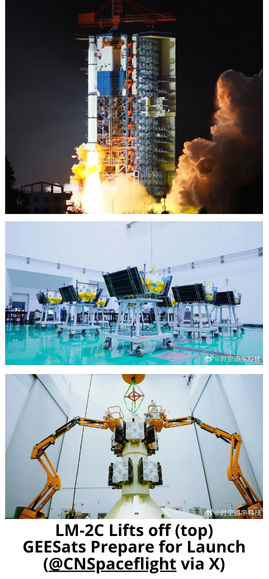
2 Feb: China launched a Long March-2C from Xichang just before midnight on 2 Feb. On board were 11 “GEESats” which are the second group of satellites intended to support autonomous vehicles. . With this launch there are now 20 GEESats in orbit, and GeeSpace plans to launch 72 GeeSats in phase-1 constellation by 2025 and 168 in phase-2.
Launch Video.
– Geely Holding Group is a Chinese conglomerate that is working to develop autonomous vehicles. The GEESats are intended to expand the companies capacity to provide more accurate navigation. See Geely Project Video.
– Orbit confirmation is ongoing. One object from the launch has been cataloged in 594 x 607 km x 50.0° orbit.
– Geely launched its first 9 satellites in June 2022. All are coplanar at 600x617km and also 50.0° inclined.
– Geespace says the satellites will provide centimeter-level accuracy positioning and connectivity support. In addition to delivering navigation support the satellites have AI remote sensing, providing 1-5m resolution images.
– Geely aims to offer Precise Point Positioning and Real-Time Kinematic (PPP-RTK) services.
– Per Geespace CEO & Chief Scientist: “By establishing the Geely Future Mobility Constellation, Geespace is positioning itself to meet future user demands for high-precision positioning, space-based communication, and remote sensing services.”
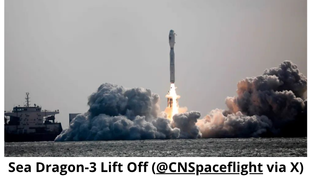
3 Feb: China launched a Smart Dragon 3 off the coast of Yangjiang in Guangdong province. There were 9 remote sensing satellites on board, including Egypt’s NExSat-1. Launch Video. Also check out awesome Dongfang hour Video.
– The Sea Dragon-3 is operated by the China Academy of Launch Vehicle Technology (CALT), a major state-owned civilian and military space launch vehicle manufacturer in China.
– Smart Dragon 3 made its maiden flight in December 2022 from a ship in the Yellow Sea, placing 14 satellites into orbit. Its second mission took place in December 2023 off Yangjiang, becoming the first sea-based rocket launch from the South China Sea.
– China has now performed 10 sea-based launches — five by the Long March 11 rocket model, three by the Smart Dragon 3, one by the Ceres 1, and one by the Gravity 1. Seven of those took place in the Yellow Sea while three in the South China Sea.
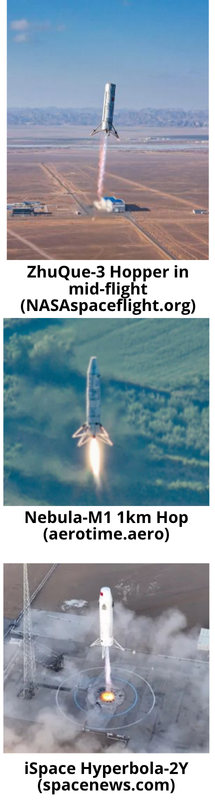
18 Jan: Chinese commercial company Landspace successfully hopped its ZhuQue-3 hopper prototype. The pathfinder hopper was announced after the conclusion of the third ZhuQue-2 launch campaign, as a demonstrator technology for the company’s upcoming ZhuQue-3 rocket. The hop itself went to 350 meters and performed a small translation maneuver to the landing pad. Landpace confirmed the landing precision with 2.4 meters, with a landing speed of 0.75 meters per second, at a pitch angle of roughly 0.14 degrees, and a roll angle of 4.4 degrees. The hopper survived the test. Hop Video.
– Landspace intends to learn from the hopper program for eventual use in its ZhuQue-3. ZhuQue-3 is a medium-to-heavy lift launch vehicle, powered by methane, and constructed out of stainless steel. The rocket will use the updated TQ-12A engines and plans a reusable first stage, that can support up to 20 flights. The full size of the rocket will be 76.6 meters, with a diameter of 4.5 meters. The debut of this rocket is planned for 2025.
Other Notable Reusable Rocket Testing:
In order to increase its launch capacity and decrease costs there are several Chinese initiatives underway to develop an operational reusable rocket. All are ramping up to be a part of China’s deployment of their Guowang Mega-Constellation. Great Overview Video from Dongfang Hour (June 2023). In addition to Landspace, here is a look at the commercial leaders:
27 Jan: Article in Business Insider takes a look at Ukraine’s continued use of Starlink and Russia’s unsuccessful attempts to deny service. Russia has been using jamming systems to try to deny Ukrainian forces access to commercial satellites. Russia’s jamming has become increasingly better at disrupting Ukraine’s most advanced weapons, hindering Ukraine’s fighting capacity.
But Russia’s efforts to cut off Ukraine’s access to Starlink satellites have failed thus far.
– Russia has included Electronic Warfare (EW) since the beginning of its invasion of Ukraine. It has attached jammers to its tanks to interfere with satellite signals and disrupt exploding drones, jammed Ukraine’s GPS-guided bombs, and jammed Ukrainian drones, forcing Ukrainian operators to move closer to their targets on the front lines.
– In-spite all of their EW equipment and expertise, Russia has yet to find success against Starlink. Per Brian Wheedon (Secure World Foundation) “Russia absolutely would like to find a way to negate Ukraine’s use of Starlink. But that is much easier said than done because of the architecture of the constellation.”
– Starlink’s signals are stronger and more concentrated because its satellites operate at a far lower altitude than geostationary satellites.
– There is “very little” open data about Russia’s electronic attacks on Starlink, Weeden said its efforts don’t appear to have yielded much success.
– Kari Bingen, the director of the Aerospace Security Project, said: “They keep trying, but they don’t seem very successful.”

– She said Starlink satellites are both “resilient” and “agile,” with Starlink operators constantly updating their software to overcome Russian attacks.
– Starlink first came under attack in April 2022, but SpaceX engineers fought off Russian jamming attacks by updating the system’s software.
– No other Russian jamming or hacking attacks against Starlink have been reported.
– Russia has deployed its full arsenal of EW systems to Ukraine. This includes the Krasukha-4 mobile EW system, which can counter airborne early warning and control systems and other airborne radars within a range of about 186 miles.
– According to a leaked US classified-intelligence document obtained by the Washington Post last year, Russia has been testing its Tobol electronic-warfare systems for several months, hoping to obstruct Starlink’s signals.
– Ukraine has been targeting Russian EW systems. Special forces appeared to destroy a Tirada and a “Leer-2” electronic system with drones in a video shared by the command of the forces. Ukraine’s military reported destroying multiple Russian systems including a “Pole-21” electronic-warfare system and a Svet-KU. The same special forces said they helped destroy a Russian Tirada-2 that was blocking satellite communications in eastern Ukraine.
23 Jan: Belgium signed the Artemis Accords in Brussels, making it the 34th country to do so. “Joining the Artemis Accords reflects our logic of cooperation and enables Belgium to join the working group of states that have already signed,” said Thomas Dermine, Belgium’s state secretary for economic recovery and strategic investments. His responsibilities include leading Belgium’s science policy.
