issue 99 | 16 june 2024
The integrity flash
Analysis of Developments in the Space Domain
in this issue
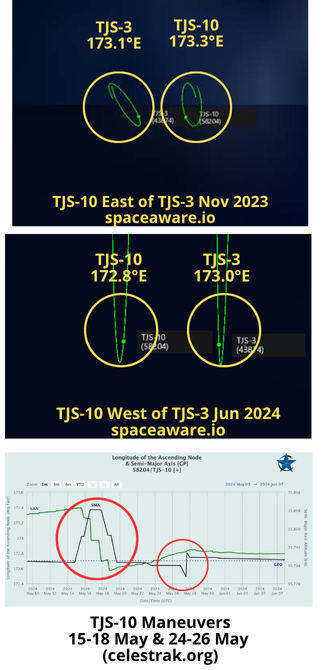
8 Jun: In late May 2024 China re-located its TJS-10 satellite to the West of TJS-3. Since arriving in GEO in mid-November 2023 TJS-10 remained in the vicinity of TJS-3 with TJS-10 being just to the East of TJS-3 (TJS-10 at 173.3°E and TJS-3 at 173.1°E). With slight variation the two satellites remained in the same position until ~15 May when TJS-10 raised its altitude and began drifting West until it arrived at 172.6°E on 18 May. About 10 days later TJS-10 maneuvered to decrease its distance to TJS-3 and is now at 172.8°E. TJS-3 has conducted only minor maneuvers which appear to be station keeping 173.0°E. The missions of the two satellites remains unknown. China has stated TJS-10 was being “mainly used for multi-band and high-speed communication technology experiments.” Based on the proximity of the two satellites it is likely that TJS-10 is conducting these experiments with cooperation from TJS-3.
– It appears all maneuvers were in-track with the first happening on ~15 May when TJS-10 raised its orbit ~23km, initiating a westward drift. TJS-10 remained above the GEO belt until 17 May when it returned to its original altitude where it remained until 22 May where it settled at 172.6°E.
– On 22 May TJS-10 decreased its altitude a mere 1km initiating a slow eastward drift and back towards TJS-3. On 26 May it again decreased altitude another ~5km increasing its eastward driftrate until it arrived at 172.8°E. TJS-10 has made additional maneuvers to remain at that location.
– TJS-3 did maneuver during this time as well but these appear to be related to station keeping and remaining in its geostationary box located between 172.9-173.1°E.
– Looking at TJS-10 location history, the satellite stayed well within a box of 173.2 to 173.4°E from Nov 2023 – May 2024, then suddenly dropped to 172.5 degrees and then slowly approached TJS-3 from the West.
– As of 8 Jun 2024, both TJS-3 and TJS-10 are at approximately the same altitude and maintaining their current distance separation. Both satellites are also inclined 0.6°.
– We do not know the mission of either TJS-3 or TJS-10. TJS-3 launched in late-2018 (another holiday special) and was identified as a GEO belt “inspector sat,” and exhibited unusual behavior after launch, interacting with its apogee kick motor (watch COMSPOC Video).
– Chinese news media reported TJS-3 will test “double satellites co-position communications” as well as “multi-frequency and high speed comms.”
I felt the continued proximity between two Chinese test satellites at GEO was worth a closer look, so I turned to frequent Flash contributor, Robin Planell. Using his orbital mechanics skills as well as the LSAS orbital analysis tools here’s what he found. Thanks again Robin! Watch Video.
– From 15-29 May, TJS-10 executed a series of 4 medium to large Maneuvers ranging from 0.14m/s to 0.9m/s including corrective maneuvers to modify its longitude slot.
– COMSPOC data suggests TJS-10 maneuvers were performed to safely approach TJS-3.
– Using the latest COMSPOC ephemeris data on 16 May TJS-10 had a conjunction with TJS-3 of ~24.7km. Interestingly, the solar phase angle during this conjunction was below 20° which is optimal for imaging as it allows the inspector to capture the secondary satellite reflecting the sun on its surface while being significantly hidden itself.
-COMSPOC data indicates that had TJS-10 not maneuvered it would have had conjunctions with TJS-3 of approximately 14km and 6km on 16 May and 29 May respectively.
– Comparing the intrack curve compared to the longitude curve shows how TJS-10 slowly settled into a stable closer position to TJS-3. The longitude graph clearly shows TJS-3 maintained its position between 172.92 and 173.04° throughout the period.
-By contrast TJS-10’s longitude shifts to get closer to TJS-3. This indicates that TJS-10 is the active satellite maneuvering to approach TJS-3 and settle in a closer longitude box between 172.79 – 172.801°.
-It is possible we will see other closer rendevous in the future between these two assets as they are now in extremely close proximity and Allied.
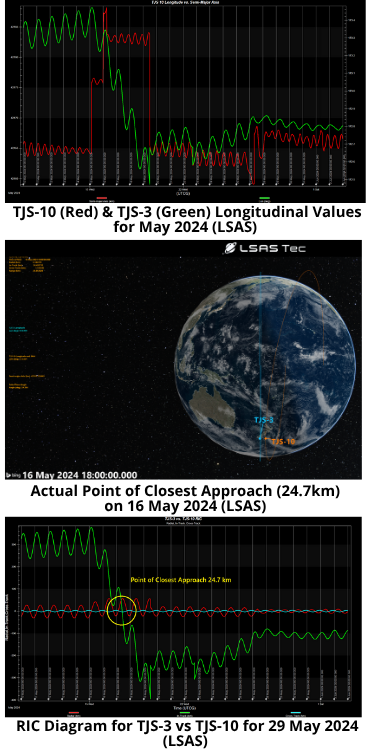
In summary: TJS-10 executed a series of 4 medium to large maneuvers, ranging from 0.14 m/s to 0.9 m/s, including corrective maneuvers, to modify its longitude slot. By dropping its longitude TJS-10 now has a new GEO slot between 172.79 and 172.801°, during transit TJS-10 crossed paths with TJS-3 and then stabilized its orbit in close proximity to TJS-3. Throughout the scenario TJS-3 maintained its orbital slot between 172.92 and 173.02°.
Jack’s Take: GEO Maneuvering
Of course I couldn’t let Robin have all the fun…in interesting cases like this I have found it very helpful to consult with our Orbital Mechanics Guru Jack Anthony. Many are familiar with Jack’s articles in the Flash answering all of the orbital mechanics questions you were afraid to ask. Here’s his take on TJS-10 and TJS-3…and GEO maneuvering in general. Thanks Jack!
TJS-10 has been moving relative to TJS-3 and changing its position on the GEO belt quite a bit. The Celestrak plot of altitude, semi-major axis and longitude is an excellent depiction of what’s going on and from it you can see that altitude above or below the TJS-3 holding its position is the key to determining how fast TJS-10 is “drifting” (that’s not a astro word, but it is used often in chit chatting about movement of GEO satellites.) So, let’s have a quick lesson on how this occurs. The “magic” number is 78…78 kilometers that is. If you maneuver to 78 Km above Geo reference altitude (which is 35,786 KM, but remember when doing astro calculations, the radius is key to use…and it’s 42,164 km) and re-circularize at the new altitude you will drift 1 deg/day west per day. One degree in GEO arc is about 736 km in distance along the orbit path. I bet you know what happens if you maneuver to 78 Km below the GEO reference altitude. “Bueller, Bueller, Bueller?” You will get 1 deg/day east drift. So let’s say you boost up and re-circularize at 39 Km above GEO. What’s the drift rate? Well, it’s west and we simply take 39 divided by 78 and get 0.5 deg/day. Go back to the Celestrak plot and play with this rule of thumb. Quiz question: you are circular and 312 Km below GEO reference. Which was and at what rate? (east, 4 deg/day).
OK, on more thing. How do you get to your new “drift” orbit? Well, I bet you all know who Walter Hohmann is. That whiz kid from Germany who in 1925 wrote a paper on the minimum energy transfer between two circular orbits (he was a visionary; he knew someday soon human-made satellites would be out there). I bet you are well aware of the Hohmann Transfer. So, it involved 2 positive In-Track Delta-V’s. To climb & re-circularize 78 Km higher all it takes is two 1.4 m/s Delta-Vs , separated by 11 hours 58 minutes, thus 2.8 m/s total. If you want to descend, well, make the Delta-V negative. Down ya go!
I’m sure TJS-10 will continue to entertain us as it dances with TJS-3, and armed with this basic review above you’ll be more “in the know” as they move around relative to each other and the position on the GEO belt.
TJS-3 Two Line Element Set (TLE)
1 43874U 18110A 24161.76367480 .00000001 00000+0 00000+0 0 9991
2 43874 0.6363 88.9008 0001447 54.5022 203.0600 1.00272505 20086 257.5
TJS-10 Two Line Element Set (TLE)
1 58204U 23169A 24161.76353244 .00000000 00000+0 00000+0 0 9996
2 58204 0.6322 88.6861 0001118 286.4253 331.1645 1.00272749 2278 257.5
This orbital element compare is time synchronized, the epoch times are about the same. So we can now compare orbital elements. What do we see here? Well, the yellow heighted compare shows these two spacecraft are Orbit Plane Matched” … essential to rendezvous and proximity ops. We see the eccentricity (blue highlight) is somewhat circular and equal. So far, so good. Now, this next step is a wee bit tricky, but if you add argument of perigee and mean anomaly you get the position of the satellite relative to the right ascension of the ascending node. We see in adding them and then converting to be less than 360, they pretty much match. Sooooo, just by doing a orbital element compare when the epoch times are the same we see they are “matched up”…cozy near each other. Hooray for taking the time to do a orbital element compare to see “what’s going on.”
6 Jun: China’s commercial launch company Galactic Energy launched a CERES-1 rocket from the Jiuquan Satellite Launch Center with three small satellites on-board (TEE-01B, Naxing-3A and Naxing-3B). CERES-1 is a small solid propellant launch vehicle capable of delivering a 350kg payload to low Earth orbit (LEO). The upper stage of the CERES-1 rocket for this mission was equipped with an orbital test platform designed to provide low-cost on-orbit testing for new technologies, devices and products. Launch Video.
– On board were the TEE-01B (Earth Eye 1) imaging satellite & two other nanosats. All three were successfully placed into a 545km sun synchronous orbit. This is also for the first time CERES-1’s upper stage (A Shen orbital test platform) stayed in orbit as an experimental platform.
– TEE-01B has a maximum resolution of better than 0.52 meters and an image width greater than 14.8kms. – TEE-01B was developed by Changguang Satellite on behalf of Beijing Mumei Star Technology Co., Ltd. and is the first commercial satellite cooperation project between the two companies.
– TEE-01B is based on Changguang Satellite’s 3rdgeneration satellite design and manufacturing technology. It’s design is simlar to “the world’s lightest high-resolution business satellite, the ’Jilin-1′ high-resolution 04 series satellite.”


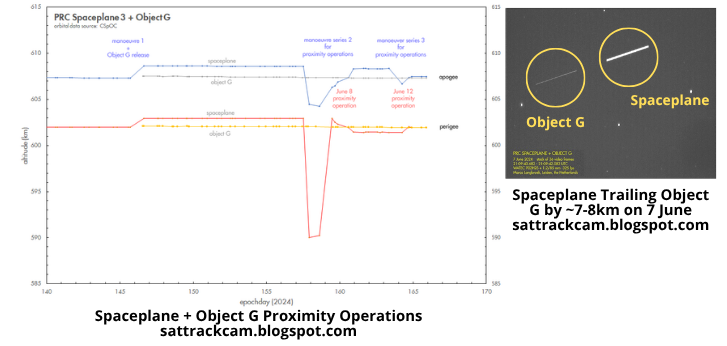
14 June: After releasing an object (affectionately cataloged as “Object G”) on 24-25 May, China’s Shenlong spaceplane initiated a series of maneuvers. Observations from Dr Marco Langbroek indicate the Spaceplane adjusted its orbit to make several close approaches with Object G between 5-7 June and again on 11-12 June. It is not known if the spaceplane re-captured Object G and then released it again. Watch Video.
– Excerpts from Dr Langbroek’s Blog:
- Object G was first catalogued on May 25. My analysis shows that it was ejected from the Spaceplane on May 24 near 18:40 UTC, during a pass over China.
- Directly after ejecting it, the spaceplane made a maneuver, raising its orbit by about 1 kilometer. This likely was an avoidance maneuver, i.e. a maneuver to avoid hitting the object it just ejected.
- It appears that Object G does not noticeably maneuver. Its parent the spaceplane did: between June 5 and June 7, starting eleven days after it ejected Object G, the space plane made a series of (phasing) maneuvers (top diagram right). It first lowered its orbit, and then raised it again a day later. The result is an orbit at similar altitude and orbital period as Object G, but slightly more eccentric.
- The maneuvers brought the spaceplane and Object G in close spatial proximity again, with a separation of only a few kilometers…It is possible that the spaceplane did briefly retrieve Object G or attempted to do so, and then let it go again, but this cannot be unequivocally confirmed from the orbital data. Some combinations of the orbital data for epoch 24160 do suggest that a potential very close approach at kilometer level or even less might have happened on 8 June near 14-15h UTC. The rapid maneuvering evident from the clear orbital changes in successive ELSETS from June 8-9 makes it however difficult to validate true distances involved.
- On June 11 near 9 UTC and June 12 near 10 UTC, the spaceplane again made phasing maneuvers, followed by a series of smaller orbit adjustments that have now brought apogee and perigee altitudes (and with that eccentricity and orbital period) very close to those for Object G.
- The June 11 and 12 maneuvers caused another very close approach (to a km or less), i.e. another proximity operation, between the spaceplane and Object G on June 12 near 13 UTC.
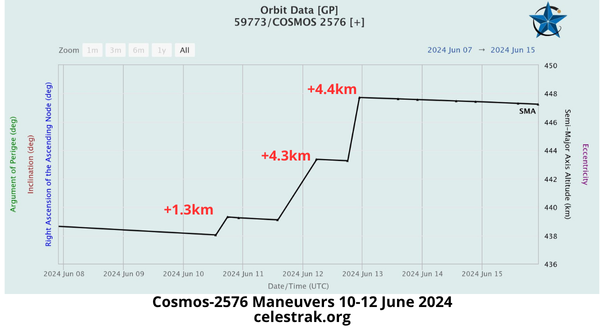
15 Jun 2024: Nearly 1 month after arriving on orbit, Russian space operators began maneuvering Cosmos-2576, raising its altitude/semi-major axis (SMA) nearly 10km in a series of maneuvers conducted 10-12 June. Recall that Russia launched Cosmos-2576 into a co-planar orbit with USA 314 and the Pentagon mentioned Cosmos-2576 was in “the same orbit” as a US Government satellite. This is the third time Russia has launched one of its satellites to be nearly co-planar with a US high-value asset. We do not know if USA 314 has maneuvered.
–Here’s a breakdown of the maneuvers:
- Cosmos-2576 gradually decreased in altitude (appears to be natural) 5.4km from 17 May – 10 Jun (443.4 to 438.0km).
- On 10 Jun Cosmos-2576 increased its altitude ~1.3km (438.0 – 439.3km).
- On 11-12 Jun Cosmos-2576 increased its altitude another 4.3km (439.1 – 443.4km).
- Again on 12 Jun Cosmos-2576 increased its altitude another 4.4km (443.3 – 447.7km).
- As of 16 Jun Cosmos-2576 has naturally decreased its orbit by .5km (447.2km).
– We lack the orbital information for USA 314 to make any assessment of how Cosmos-2576’s maneuvers have changed its orbital relationship with USA 314. We also do not know if USA 314 has made any maneuvers and Cosmos-2576 was reacting.
– Additional information on Cosmos-2576 from Bart Hendrycx:
- Cosmos-2576 is not a particularly conspicuous object, becoming no brighter than magnitude +3.5/+4 even during favorable passes with high elevation.
- Cosmos-2576 is not any brighter than the three satellites that can be positively identified as 14F150/Nivelir (Kosmos-2519, 2542 and 2558).
- Purely based on its reflectivity, there are no reasons to believe that it is bigger or of another type than those three satellites. But it’s dangerous to draw too many conclusions solely from its brightness in the night sky.
- The earlier 14F150/Nivilir satellites were launched by the Soyuz-2.1v/Volga combination, so if Kosmos-2576 (which used a Soyuz-2.1b) is indeed another satellite of that type, the military swapped the Soyuz-2.1v/Volga for the Soyuz-2.1b/Fregat just for the sake of orbiting the smaller civilian passenger satellites. All this is quite unprecedented, not only the mix of military and civilian satellites, but also the fact that the choice of the launch vehicle is dictated by the passengers rather than the main payload.
Pics o’ the Fortnight!