


Analysis of Developments in the Space Domain
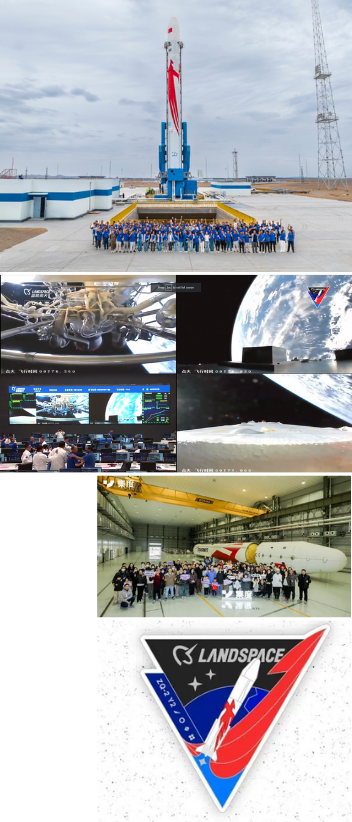
12 Jul 2023: Chinese company LandSpace launched its methane-based ZhuQue-2 rocket. This was the rocket’s second launch after its failed maiden flight in December 2022. Initial claims from the company noted a mission success, marking the first methalox rocket to reach orbit. Watch video. Watch 5min Video on Chinese commercial launch development.
– Landspace and Chinese state media announced that the second Zhuque-2 reached orbit, making it the world’s first methane-fueled rocket to do so. U.S. Space Force tracking data later verified the claim, showing an object in a 431 by 461 kilometer Sun-synchronous orbit, with an inclination of 97.3 degrees.
– The payload for this launch remains unknown. It is unclear if LandSpace integrated another payload after the initial maiden flight, or if they are flying a dummy payload for this mission.
– Zhuque-2 flew in a comparable configuration to a normal operational flight, with the payload faring in place.
– The rocket’s first stage was not recovered.
– Zhuque-2 beats a range of other methalox rockets, including SpaceX’s Starship, the ULA Vulcan, Blue Origin’s New Glenn, Rocket Lab’s Neutron and Terran R from Relativity Space, in reaching orbit. These other launch vehicles will be much larger, and feature much greater payload capacity.
-Future Zhuque-2 launches with upgraded second stage engines will be capable of delivering a 6,000-kilogram payload capacity to a 200-kilometer low Earth orbit (LEO), or 4,000 kilograms to 500-kilometer sun-synchronous orbit (SSO), according to Landspace.
-Landspace has already begun assembling its third Zhuque-2 (“Vermillion Bird-2”), indicating that another launch could come before the end of the year. Space Pioneer says it has multiple orders for launches for the Tianlong-2, and aims to launch the Falcon 9-class Tianlong-3 in the first half of 2024.
A methane-liquid oxygen propellant mix offers advantages in performance and reduces issues of soot formation and coking for purposes of reusability. According to the LandSpace website, the price of propellant was 50-90% less than similar Chinese launchers.
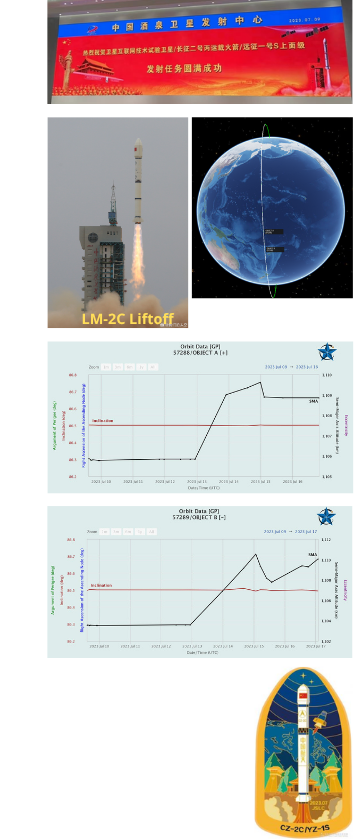
9 Jul 2023: Official Chinese news sources reported that China launched a Long March-2C with a new test satellite from the Jiuquan Satellite Launch Center in northwest China. China has released very little information regarding the payload, only saying the satellite “will carry out test missions for satellite internet technologies.” US space observers have noted 2 objects were actually placed into orbit, a conclusion supported by the presence of 2x satellites on China’s Big Red Board announcing launch success. Launch Video.
– The LM-2C was equipped with a larger than normal fairing, raising suspicions regarding the number of satellites on board.
– The Chinese named the satellite(s) Weixing Hulianwang Jishu Shiyan which translates to “Satellite Internet Technology Demonstration Satellite,” or something similar.
– The 18 Space Defense Squadron (SDS) is reporting 2 objects in 1095 x 1117 km x 86.5, and 1095 x 1112 km x 86.5 deg orbits, respectively.
-Subsequent observations confirm both objects are maneuvering.
-The LM-2C was also equipped with the YZ-1S upper stage. This is the 5th time that particular upper stage has been used. The YZ-1S seems to be used to place payloads in higher energy orbits.
–There were 2 similar launches in August 2021 & May 2022.
– The August 2021 launch was for the Yaogan-32A/B satellite pair, while the May 2022 launch placed 3 communications satellites into Low Earth Orbit (LEO). China also released very few details regarding either launch.
-The fairing size, use of the YZ-1S and the higher orbit likely indicates the satellites are more like the heavier
OneWeb or Iridium proliferated LEO spacecraft.
-OneWeb and Iridium satellites also orbit much lower than these Chinese test satellites, both at ~750km.
-China recently launched a Starlink-like satellite on 8 June 2023. The 18 SDS cataloged the Longjiang-3 in a 490 x 500 km x 49.1 deg orbit. This is less than half the altitude of the satellites launched on 9 July, and closer to the Starlink operational orbit of ~570km.
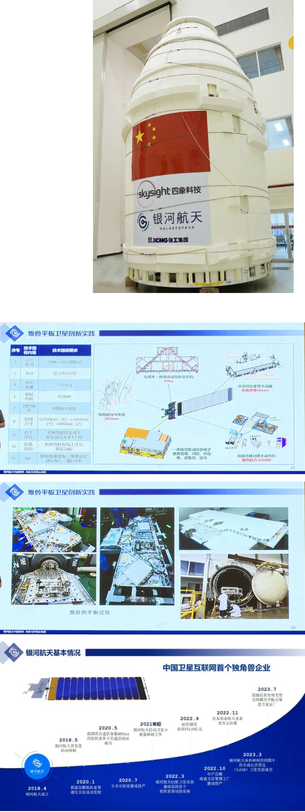
22 Jul 2023: China launched a Long March 2D from Taiyuan Satellite Launch Center. Onboard were 4 satellites including GALAXY-SPACE’s first flat-panel LEO communication satellite, the Lingxi-03. The three other satellites, designated A-01/02/03, are Skysight satellites. Launch Video. Watch CCTV report on Galaxy-Space stackable launch.
– Orbital data was not yet available as of 22 July 2023.
– Galaxy-Space is reportedly planning to launch 1,000 LEO satellites & deliver 5G from space.
– Galaxy-Space has said it wants to extend China’s 5G coverage around the world, to compete with Starlink in the market for high-speed internet services in remote areas.
– Despite its smaller size, the 1,000-satellite Chinese network will be the first of its kind to use 5G technology.
– Scientists involved in the project say this will ensure download speeds of more than 500 megabits per second with low latency, a critical advantage in some demanding applications such as financial trading.
– China’s government reported there were 730 million 5G subscribers in China at the end of 2021, over half the total population. As a result, GalaxySpace’s 5G services will
likely be offered primarily to overseas companies as well
as Chinese government and military activities.
– Assessed Skysight satellite capabilities are as follows:
1) AS-01 = SAR; 2) AS-02 = Optical; and
In 2021, Zhu Kaiding, a space engineer from the China Academy of Space Technology, which is working with GalaxySpace on the project, wrote in an academic article that the rise of Starlink had caused a Chinese satellite production line to increase its productivity by more than a third.
In addition to commercial LEO satellite Internet service rivalry, China has identified Starlink – which has signed multimillion dollar contracts with the U.S. military – as a threat to China’s national security.
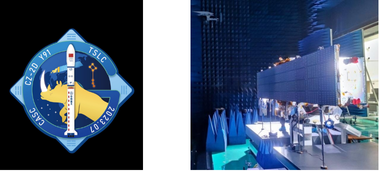
19 Jul 2023: China launched a Kuaizhou (KZ)-1A rocket from the Jiuquan Satellite Launch Center with 4 Tianmu 1 weather satellites. This brings the number of Tianmu-1 satellites to 10, all launched in 2023. Launch Video.
-The 18 SDS detected the satellites in orbits with an altitude of roughly 524 km, and an inclination of 97.4 degrees.
– The Tianmu 1 constellation is intended to provide global commercial meteorological data services, including numerical weather forecasting, typhoon monitoring and forecasting, and climate change research.
-Tianmu satellites 03-06 were also launched on a KZ-10 back in March 2023.
–Tianmu 01 and 02 were launched in January 2023 on a GalaxySpace CERES-1 rocket.
– All Tianmu launches have been from Jiuquan.
– Tianmu satellites detect changes to signals transmitted by navigation satellites such as GPS and Beidou as they pass through Earth’s atmosphere.
– “Some navigation signals are transmitted through different atmospheric layers or different media, and there will be attenuation and differences between these signals. We can obtain valuable information from the medium it penetrates, from its characteristics and density, or other features,” Gao Wei, strategic operations director of the Tianmu 1 constellation, told CCTV+.
– “By 2025, our Tianmu 1 system will be basically completed and will provide stable service for various user categories. At the same time, through the integrated construction and operation of the constellation, we can better serve the national strategy and improve the national economy and people’s livelihoods,” Gao said.
– The KZ-1A for the launch was provided by Expace, a rocket-making company spun off from CASIC. It can carry a payload of 440 pounds (200 kilograms) to a 345-mile-high (700 km) sun-synchronous orbit.
– The KZ-1A has now flown 21 times and registered 19 successful launches.
-Interestingly, this launch was sponsored by Dongfeng Motor, a Chinese automaker (image on right).

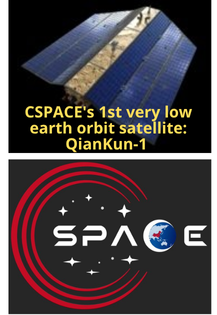
22 Jul 2023: Galactic Energy, a Chinese commercial launch company, sent Gushenxing-1 (CERES-1) Y6 to orbit, deploying the first Qiankun (QK)-1 VLEO imaging sat for CSPACE and the XSD-16 imaging sat for ADA Space. Launch Video.
– 18 SDS added one object to the publicly available catalog with quoted orbit parameters 486 km x 502 km x 96.6 deg. SSO for this inclination is ~285km (VLEO is defined as <300km). So, this object may decrease down below 300km in the future.
– CERES-1 is a small-scale solid-propellant carrier rocket capable of sending micro-satellites into orbit. The launch was the 6th CERES-1 mission. There are 5 more launches planned in the next 2 months.
– One of the satellites reportedly on board was the CSPACE QianKun (QK)-1, also assessed to be a VLEO satellite. It weighs ~200kg, and is equipped with electric thrusters.
– In early 2022, CSPACE, received 100+ million ¥ angel round funding. CSPACE is developing QK series satellites for remote sensing, communication, scientific and technical demonstration.
– CERES-1 also carried a hyperspectral remote sensing satellite developed by ADASpace.
13 Jul 2023: Chinese State Owned Enterprise, China Aerospace Science and Industry Corporation Limited (CASIC), announced the official start to the construction of an ultra-low orbit satellite constellation. This follows a previous announcement in late March and added new details and schedule information.
– CASIC said the first satellite of the ultra-low orbit satellite constellation will be launched in December (previously they had announced September) 2023, carrying payloads such as an optical remote sensing camera, spaceborne intelligent processing equipment, and an atomic oxygen detector.
– An ultra-low orbit is an orbital altitude of less than 300 km. This complex, dynamic environment requires space operators to offset the effects of the rapid orbital decay, due to heightened atmospheric drag.
– Ultra-low orbits have potentially high value. With lower orbit altitudes, Earth observation can shift from remote sensing to near observation, which has lower costs, higher resolution and shorter transmission delays.
– The ultra-low orbit satellite constellation will achieve 0.5-meter spatial resolution and transmit spatial information to users within 15 minutes, according to Zhang Nan, chief designer of the constellation.
– The CASIC plans to complete the launch of a nine-satellite cluster in 2024, and complete an orbital network of 192 satellites by 2027.
– By 2030, CASIC expects 300 operational satellites, providing diversified and real-time remote sensing services, and realizing global 15-minute response capabilities.
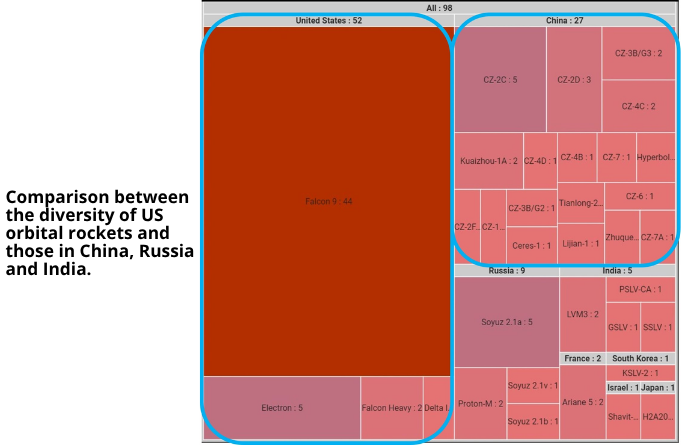
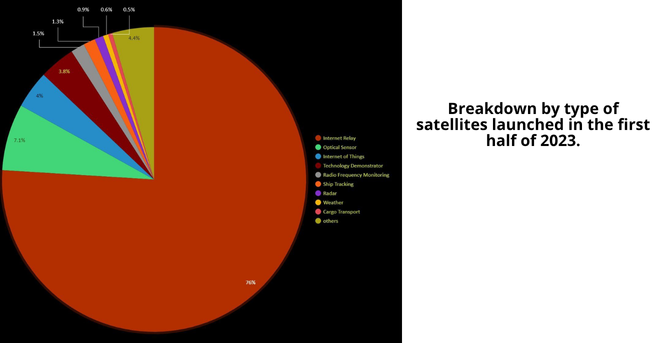
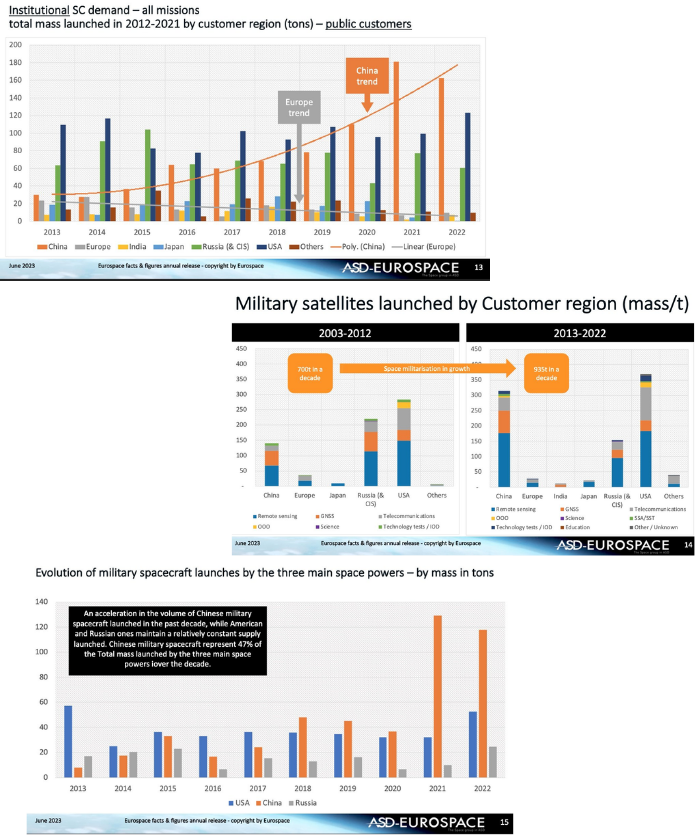
12 Jul 2023: Eurospace releases its annual facts & figures report, providing ‘tons’ of interesting and useful information on space development and investment. Three graphics caught the Flash Editor’s attention, and do a fantastic job capturing the rapid rise of China’s space capabilities.
6 Jul 2023: Saudi Arabia’s Space Agency has held a number of meetings with Chinese government agencies and businesses to discuss enhanced cooperation and collaborations in the fields of technology, industry and space exploration.
– Abdullah Al-Swaha, chairman of the board of directors of the Saudi Space Agency, met his counterpart from the China Aerospace Science and Technology Corporation, and other leading figures from the space sector in Beijing to discuss common interests and explore opportunities for strategic cooperation.
– According to a press release from Saudi Arabia, the meetings are the latest initiative in efforts to boost

political ties and enhance bilateral relations to further the space exploration agenda.
– The Saudis aim to learn from Chinese successes in the field, and facilitate the Kingdom’s efforts to enhance transfer of key knowledge, localization, and achieve strategic goals.
– In June 2023, Saudi Arabia elevated the status of its space organization to that of agency from commission, to better align with the country’s ambitious vision for the future of space exploration.
-In May, Saudi astronauts Ali Al-Qarni and Rayyanah Barnawi joined two Americans on the crew of the Axiom Mission 2, which successfully docked with the International Space Station. After an eight-day stay, they returned safely to Earth on a SpaceX Dragon capsule. Barnawi, a scientist, became the first Saudi woman in space.
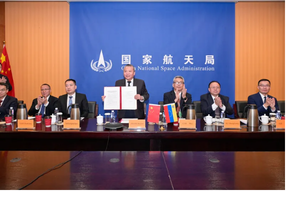
18 Jul 2023: Venezuela became one of the first countries to formally join the China-led International Lunar Research Station (ILRS) project. ILRS is seen as a China-led, parallel project to the NASA-led Artemis Program. 27 nations have signed the Artemis Accords.
– Venezuela will make its satellite control ground station infrastructure available for lunar missions, and will also engage in collaborative design, technical and operational cooperation, plus data management and exchange.
– Previous Chinese and Venezuelan space cooperation includes the 2008 launch of the CASC-built VeneSat-1 communications satellite, as well as later remote sensing satellites in low Earth orbit.
–Trade growth between the two nations averaged over 14 percent annually since 1995. Venezuela has also been an enthusiastic recipient of Belt and Road Initiative funding.
–China has a large stake in Venezuelan oil, and oil exports could offset the countries’ trade balance. Venezuela provides an alternative to relying on Russia.
–Russia, Pakistan, the United Arab Emirates and the Asia-Pacific Space Cooperation Organization (APSCO) have signed ILRS engagement agreements, with more than ten other countries and organizations currently negotiating similar deals.
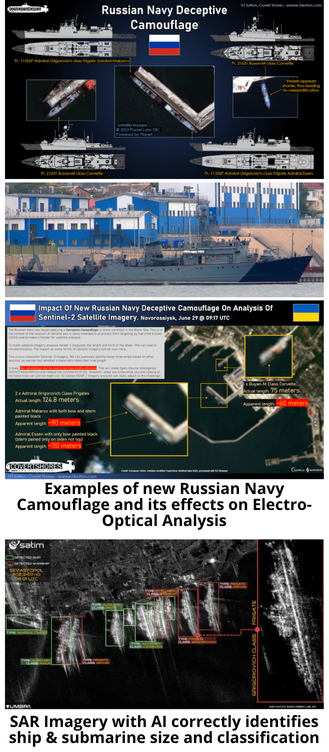
12 Jul 2023: Russia is attempting to hide important warships in the Black Sea by painting them in a new deceptive camouflage scheme, making it difficult to judge their length and shape in satellite imagery. Initial checks in some satellite images confirmed the viability of the camouflage. Imagery analysts have begun using artificial intelligence (AI) to identify classes of ships in radar (SAR) satellite imagery, an approach unaffected by the camouflage.
– Reports of the new camouflage scheme emerged in late-June 2023. The flagship of the Black Sea Fleet, Admiral Grigorovich-class frigate Admiral Makarov, has had a more extreme camouflage applied. This includes ‘blacking out’ the helipad and the bow of the ship. Further, all three of Buyan-M class missile corvettes, the minesweeper Ivan Golubets and the anti-submarine corvette Muromets, have the camo.
– The camouflage is intended to hide the overall length and form of the ship when viewed from the surface, such as by a maritime drone. However the larger factor is likely from above: intending to make it harder to identify the ship in satellite imagery.
-AI is used with many electro-optical satellite images to determine a ship’s identity through length and shape. Such auto-identification may be more vulnerable to these types of camouflage than a human imagery analyst.
– Additionally, AI trained on SAR imagery was able to recognize distinct classes of warships and submarines with over 90 percent accuracy.
-Combining SAR images from an Umbra Space commercial satellite with AI from Satim Inc clearly identified ships known via other sources to have the new Russian camo scheme.
Combined with other satellite imagery and other forms of open source intelligence (OSINT), AI interpretation of SAR imagery can help unmask the camouflaged ships.
Russia will likely continue to experiment with efforts to deceive satellite monitoring. Last year, the Russian Navy attempted to disrupt imaging of ports and bridges by placing barges with radar reflectors nearby. This is generally agreed to have not worked, and Russia abandoned the practice.
July 2023: Maj Gen Greg Gagnon, USSF Deputy Chief of Space Operations for Intelligence (S2), published an article in Joint Forces Quarterly. The article describes how the Chinese Communist Party’s military, the People’s Liberation Army (PLA), is planning both to leverage space capabilities to hold our allied forces at risk and to attack our ability to use space for military purposes. Excerpts below (you really should read the whole thing!)
– Space and cyberspace are known as the “commanding heights” in China’s warfighting doctrine. The PLA intends to extend warfare into those domains. In fact, according to China’s 2019 defense white paper titled China’s National Defense in the New Era, the PLA Strategic Support Force (PLASSF) has “made active efforts to integrate into the joint operations systems. It has carried out confrontational training in new domains and trained for emergencies and combat.”
-This new PLA threat affects all facets of U.S. military planning. It is a change requiring the United States and our allies to plan for and build forces to challenge and defeat PLA desires in space and cyberspace. Like cyberspace, space can be the great enabler of long-range fighting capabilities, or it can be the Achilles’ heel.
-The PLA established the PLASSF 7 years ago to seek advantage from the changing character and complexity of warfare. The PLASSF comprises space, cyberspace, and electronic warfare forces. Integration of these functions enables the PLA to both modernize and advance intelligence-led, joint-power-projecting warfare.
-In 2022, China placed 200 satellites into orbit. Slightly more than 50 percent of these satellites conduct remote sensing, which can be used to gain intelligence on adversary military forces far from China’s shores. Moving into 2023, China had more than 700 operational satellites in space, indicating a 385 percent growth rate since the establishment of the PLASSF in December 2015. Today, these space activities are predominantly national security focused, supporting China’s goal of owning the “commanding heights.” On-orbit Chinese satellites are on average only 3 years old; it is the newest of technology, designed and built in our digital age.
– We [the US and allies] must protect our space-enabled capabilities from defeat. We must be able to disable the adversary’s ability to use space-enabled capability to its advantage in times of war to maximize protection of our fielded force.
-Both USSPACECOM and USSF work collaboratively to achieve these goals with other organizations across the U.S. Government and with allies. Combatant commanders plan, direct, and assess joint operations for the Department of Defense. USSPACECOM works to ensure that we never have a day without military space advantage. USSF builds space forces that prepare for war and maintain readiness, and presents those forces to combatant commands to achieve space advantage…the USSF also builds and presents the command and control capabilities necessary to synchronize joint operations in support of gaining and maintaining space advantage.
– Combatant commanders across the globe will soon have a dedicated USSF component. The priority will initially be on the pacing challenge [China]. We must prepare for an adversary with more surface combatants, more surface-to-air missiles, more military intelligence satellites, and more troops. We must prepare for a war very different from the battles of the last two decades…The USSF space components to the combatant commanders will deliver and integrate cutting-edge space capabilities into land, sea, air, and cyberspace operations.
As we prepare for the next battle, we must accept that space advantage must now be gained. We must organize, prepare, and field combat-ready forces in all domains of warfare. These forces must also habitually train to fight together. These are unified actions, joint operations, and multi-domain operations. This is how we win a future war that will look very different from the wars of our recent past. And, if we organize and prepare for it, perhaps we’ll never have to fight it.
11 Jul 2023: The ever-awesome team at Secure World Foundation released several counter-space related fact sheets. Please see below for select list of links and a short overview of each. Definitely good reference material!
– Chinese Direct Ascent Anti-satellite Testing: China has at least one, and possibly as many as three, programs underway to develop direct ascent anti-satellite (DA-ASAT) capabilities, either as dedicated counterspace systems or as midcourse missile defense systems that could provide counterspace capabilities. Chinese DA-ASAT capability against LEO targets is likely mature, and potentially operationally-fielded on mobile launchers.
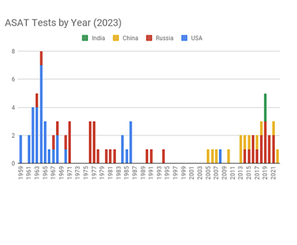
Chinese DA-ASAT capability against deep space targets (MEO and GEO) is likely still in the experimental or development phase
– Russian Co-orbital Anti-satellite Testing: Russia appears to be testng new systems that could revive its historical co-orbital anti-satellite (ASAT) capability. Since 2010, Russia has been testing technologies for close approach and rendezvous in both LEO and GEO that could lead to a renewed co-orbital ASAT capability. Some of these new efforts have links to the Cold War-era ASAT programs, including the creation of orbital debris during on-orbit testing. Additional evidence suggests this new program may be called Burevestnik, potenially supported by a surveillance and tracking program known as Nivelir, and may involve an air-launch rocket system.
– Chinese Military and Intelligence Rendezvous and Proximity Operations: Since 2008, China has conducted multiple tests of satellite technologies for robotic rendezvous and proximity operations (RPO), to support surveillance and inspection of other space objects in both low Earth orbit (LEO) and geostationary Earth orbit (GEO). Most of these are related to military or intelligence operations. While China publicly acknowledges some of these missions, most have few public details and a few remain shrouded in secrecy. None of the programs listed here have strong evidence to link them to co-orbital ASAT testing or deployment.
– Commercial and Civil Rendezvous and Proximity Operations: Several countries have begun developing rendezvous and proximity (RPO) technologies for nonmilitary purposes, such as satellite inspection, refueling, repairs, on-orbit assembly, and debris removal. In addition to government-funded programs, companies have also begun developing, testing, and operationalizing capabilities to provide commercial on orbit satellite servicing capabilities such as life extension, repair, refueling, and inspection. In January 2020, the first commercial satellite servicing mission successfully docked with and repositioned a commercial communications satellite in the geosynchronous region. In early 2022, China successfully removed a dead satellite from GEO to the graveyard region. Several additional commercial/civil demonstrations and operational missions are planned over the next few years.