



Analysis of Developments in the Space Domain
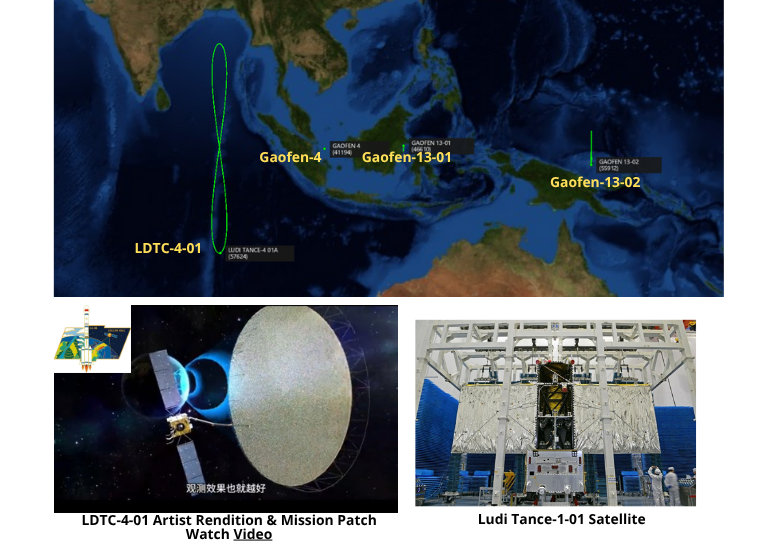
12 Aug 2023: China launched the world’s first GEO based Synthetic Aperture Radar (SAR) imaging satellite (Ludi Tance-4-01 <LDTC-4-01> or LSAR4-01) on a Long March 3B rocket from Xichang. The LDTC-4-01 gives China a permanent view of nearly one-third of the Earth’s surface, and provides “all-day, all-weather observation of China and surrounding areas.” The series is separate from the China High-resolution Earth Observation System (CHEOS), which consists of Gaofen (“high resolution”) satellites. SAR at GEO, while providing much lower resolution than satellites in low Earth orbit, offers advantages such as a short observation revisit periods and wide imaging width. Launch Video1 and Video2. Watch mission rendition Video.
– On or about 23 August, Ludi Tance (translates as Land Exploration)-4-01 circularized its orbit and is now in geostationary orbit at 89.6° East longitude with an inclination of 16.1°.
– The (01) designation suggests China could launch other SAR satellites into GEO.
-On 21 Aug Chinese news sources announced LDTC-4-01 entered its operational orbit, that the satellite was in sound condition with the SAR antenna successfully deployed, and will carry out in-orbit testing as a follow-up task.
-LDTC-4-01 entered the preset orbit after four orbital maneuvers, said Meng Lingjie, deputy chief designer of engineering at CNSA’s Earth Observation System and Data Center. Meng said unfurling the large circular SAR antenna was “very critical,” as only after that can meticulous in-orbit testing be carried out. He further stated China will put the satellite into service after fully completing in-orbit testing.
– LDTC-4-01 is in line with China’s 2015-2025 medium and long-term development plan for civilian space infrastructure, which lists the Ludi Tance satellite series and high-orbit SAR technology.
– In early 2022, China sent a pair of Ludi Tance 1-01 satellites to LEO (~600 km). Each weighed about 3.2 tons and was equipped with an advanced SAR payload, for a total antenna area of 33 square metres (355 sq ft), and operating in the L-band.
– China Aerospace Science and Technology Corporation (CASC) developed LDTC-4-01 and stated the satellite also worked in the L-band. CASC’s “blue book” outlining plans for 2023, released in January, noted the launch of a “high-orbit 20-meter [resolution] SAR satellite.”
– CASC has released few details about the satellite’s configuration. Stephen Hobbs, space systems and sensors professor from England’s Cranfield University, said the device was likely to have a 20 meter-wide circular, deployable antenna – much larger than those used on Ludi Tance 1-01A and 1-01B.
– Hobbs said LDTC-4-01 might also be equipped with 10-20 square meters of solar arrays to generate several kilowatts, as radar satellites usually require higher electrical power levels. He also noted the satellite’s 20 meter spatial resolution “is actually quite good for geosynchronous radar.”
– A major challenge in developing geosynchronous SAR satellites is the long range, which results in weak signals. Hobbs said high transmitter power, large antennas, and relatively long signal integration times were needed to compensate for this.
LDTC-4-01 is located West of China’s other Geostationary based imagery satellites, Gaofen-4, Gaofen-13-01, and Gaofen-13-02. Having a GEO base SAR capability allows for all weather monitoring of large areas (think South Pacific and Taiwan Straights) and the ability to cross-cue with other platforms (LEO or airborne) with higher resolution sensors, for positive identification (PID).
21 Aug 2023: China launched the Shiyan 25 (SY-25) experimental satellite into the lowest orbit of any previous Shiyan satellite on 20 June 2023. With a 307 x 321 km orbit, the satellite was just beyond the defined VLEO altitude of 300 km. In its first 60 days on orbit, SY-25 has lowered to what is now technically a VLEO object, with a 289 x 284 km orbit.
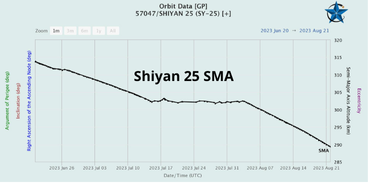
China has recently announced its intention to develop a VLEO constellation, and SY-25 may be testing flight characteristics at the lower altitudes. VLEO altitudes require propulsion to counter the relatively rapid orbital decay, due to much higher atmospheric drag. But they offer cost and performance incentives in the form of reduced power needs for data transmission, lower-latency data transfer, lower solar power-generation requirements, and higher resolution observation.
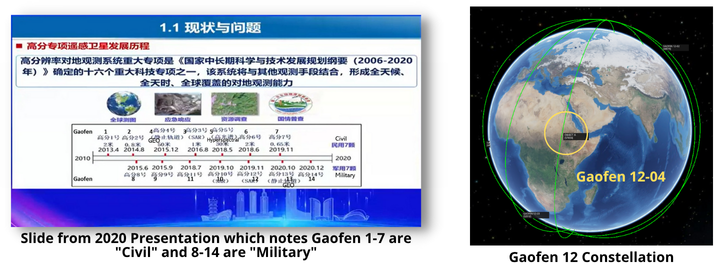
20 Aug 2023: China launched a Long March-4C from Jiuquan carrying the Gaofen (GF) 12-04 synthetic aperture radar (SAR) imaging satellite to sun-synchronous low earth orbit (LEO). The new satellite joins a series of Gaofen remote sensing satellites forming the China High-resolution Earth Observation System (CHEOS). Launch Video.
-GF 12-04 is in a 594 x 600 km orbit with an inclination of 97.90°. GF 12-04 will likely raise its orbit in the coming weeks to match the other three GF 12 satellites. All of the GF-12 satellites are in Sun synchronous orbit.
-GF 12 is reportedly equipped with a high-resolution Earth observation system using a microwave remote sensing system, with ground resolution up to the sub-meter level. Primary uses are: land census, urban planning, land rights, road network design, crop estimation, and disaster prevention and mitigation, as well as other fields. GF-12 may possibly be a civilian version of the Yaogan 29-type satellite.
– Background on the CHEOS program: As noted in the Eleventh Five-Year Plan, CHEOS aims to build an Earth observation system with high spatial, temporal and spectral resolution in an all-round way, and actively meet the major national strategic needs of China’s national defense, natural resource survey, disaster response and prevention. CHEOS has promoted the continuous maturity of high-resolution Earth observation technology in China, and the wide application of high-resolution images.
– According to Li Deren, a top Chinese remote sensing scientist, China has invested ¥50 billion in the China High-resolution Earth Observation System (Gaofen) program, and the resolutions for civil and military use have reached 0.3m and 0.1m, respectively. Interestingly, Li presented a slide that explicitly mentioned the Gaofen-8-14 Satellites were “military satellites.”
-In a 7 November 2020 interview, Li Dereng noted of the Gaofen satellites: “a total of 14 satellites…are what we now call high-resolution earth observation satellites, of which 1-7 are civilian satellites, and 8-14 are military satellites… These 14 stars can be said to be “military-civilian integration.”
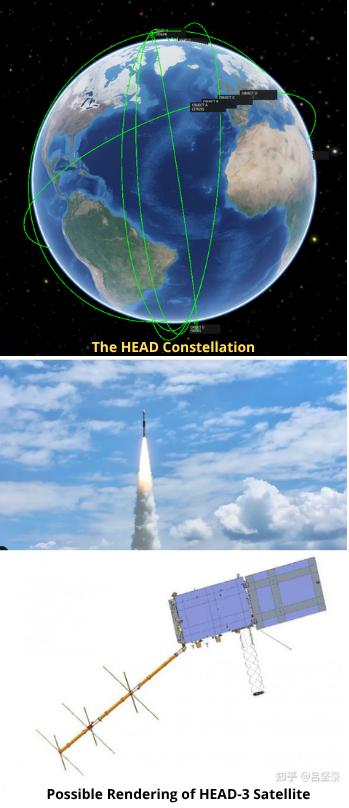
14 Aug 2023: China launched a Kuaizhou-1A (KZ-1A) light-lift solid rocket from Xichang.
The launch contained 5 HEAD (or HEDE)-3 satellites (A-E) which will join earlier satellites designed to obtain and transmit data for shipping and other maritime industries. Expace, a commercial spinoff from the China Aerospace Science and Industry Corp. (CASIC), provided the KZ-1A. Launch Video.
– The KZ-1A placed the 5 satellites in a 694 x 704 km orbit with a 45° inclination.
-With this latest launch, China has placed a total of 14 HEAD satellites on orbit, 10 of which remain active.
-The HEAD-3 A-E satellites are the first in the constellation not to be in a polar orbit.
– HEAD are Chinese commercial satellites produced by HEAD Aerospace for their Skywalker constellation, to provide data collection services and to track ships receiving their AIS (Automated Identification System) signals.
– The three-axis stabilized satellites are built by SAST (Shanghai Academy of Spaceflight Technology) and feature a high performance AIS-receiver able to process two million AIS short messages every 24 hours, and to identify 60,000 ships.
– Future satellites will feature VEDS and ADS-B payloads for global ship detection and aircraft monitoring services.
-HEAD-2H, launched in December 2022, was to conduct functional and performance tests of the VDES, ADS-B and remote sensing payload.
– Analysts do not know if the HEDE-3 satellites have VDEA or ADS-B capabilities.
– The Skywalker constellation is planned to consist of 48 satellites, 12 in Sun-synchronous orbits. The remaining 36 will form a Walker constellation, with 6 different orbital planes in 700 km 50° LEO, and a 60° orbit phase difference.
-China has launched HEAD satellites on a wide variety of launch vehicles: LM-4C, KZ-1A, LM-2D, LM-4B and Jielong-3.
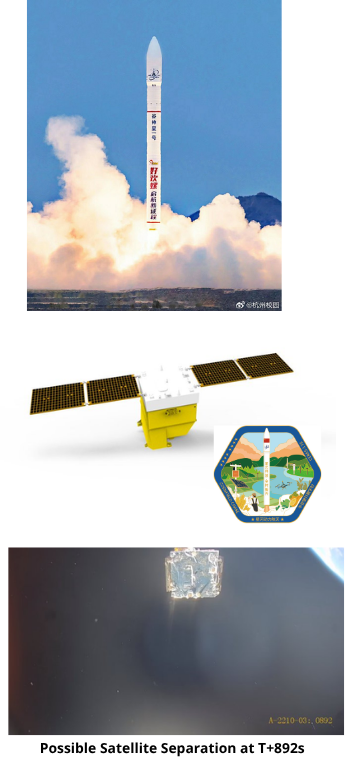
14 Aug 2023: China launched a Ceres-1 carrying the Jilin-1 Kuanfu-02A satellite from the Jiuquan Satellite Launch Center. Ceres-1 is a small solid propellant launch vehicle developed by Galactic Energy to carry a payload of up to 350 kg to low Earth orbit (LEO). According to official sources, the Jilin-1 Kuanfu-02A satellite, also known as “Hong Kong University of Science and Technology XiongBin-1, is a “large, wide, high-resolution multispectral optical remote sensing satellite” and was placed into the planned orbit. Launch Video.
-Jilin-1 Kuanfu-02A is in a sun synchronous orbit at 547 x 529 km and 97.6° inclination.
– The satellite weighs ~230 kg, notably reduced from from KF01’s ~1200 kg. Maximum resolution is 0.5 m, with a 150 km swath width.
-China media noted the satellite’s capabilities were 20 times the resolution of the European Space Agency’s Sentinel-2 optical satellite, and the width is similar to the latest generation US of land satellites.
–Hong Kong University of Science and Technology (HKUST) announced it was cooperating with Chang Guang Satellite Technology Co., Ltd.
-Jilin-1 Kuanfu-02A is the first satellite created by HKUST.
-The Changguang constellation consists of 108 Jilin-1 satellites in orbit and claims to be the world’s largest sub-meter-level commercial remote sensing satellite constellation.
– This was the 8th flight mission to use the CERES-1 rocket, and the 3rd such launch in 35 days. Galaxy Space is preparing for another CERES-1 launch on 5 September, this time from the sea.

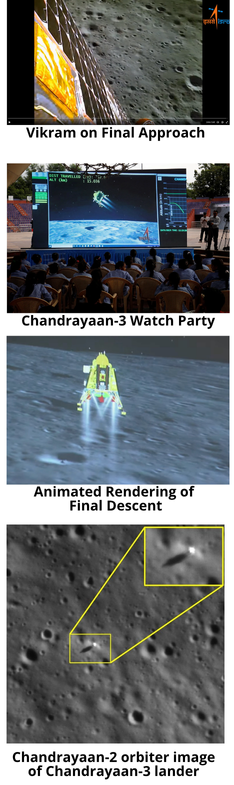
23 Aug 2023: Chandrayaan-3‘s Vikram (Sanskrit for “valor”) became India’s first successful moon landing, and the world’s first landing near the lunar south pole. Less than a day after the historic touchdown, its Pragyan (Sanskrit for “wisdom”) rover rolled from the lander and onto the lunar surface. Landing Video. India is only the fourth county to achieve a soft landing on the Moon.
– The solar powered Pragyan will spend two weeks exploring the vicinity of the landing site, studying the chemical composition of Moon regolith, the loose blanket of rock, dust, and gravel covering the surface.
-The Moon’s south pole has become a focus of attention for the global lunar science and exploration community in recent years because this region is believed to hold substantial quantities of water ice in the rocks of its permanently-shadowed polar craters.
– The solar-powered Pragyan and its companion Vikram are not expected to last beyond the next lunar night, a frigid two-week period without sunshine.
– Chandrayaan-3 was India’s second try at landing near the Moon’s south pole. The mission’s predecessor, the Chandrayaan-2 lander, crashed on 6 September 2019, due to a software glitch. The Chandrayaan-2 orbiter remains operational.
– Chandrayaan-3 orbited the Moon for several days before an engine burn on 19 August pushed the lander into an elliptical orbit that passed within 15 miles of the surface.
– On 23 August, as the spacecraft approached the low point of the orbit, moving at more than 3,700 mph (5,955 km/h), a preprogrammed sequence of maneuvers commenced.
-After 11.5 minutes, the lander was just over 4.5 miles (7.2 km) above the surface and started rotating from a horizontal to a vertical position while continuing its descent.
-The spacecraft stopped to hover ~150 yards (137 m) above the surface for a few seconds, then resumed its downward journey until it settled gently on the surface, about 370 miles (595 km) from the lunar south pole. The landing sequence took about 19 minutes.
– The Chandrayaan-3 landing coincided with Indian Prime Minister Modi’s trip to South Africa for a meeting of the group of nations known as BRICS. Mr. Modi’s face beamed into the control room in Bengaluru during the landing’s final minutes.
–India’s private space sector is also surging. A younger generation of space engineers, inspired by SpaceX, have started going into business on their own. While ISRO’s budget in the past fiscal year was less than US $1.5 billion, the size of India’s private space economy is already at least $6 billion, and is expected to triple as soon as 2025.
19 Aug 2023: After a problem with Luna-25’s propulsion system, instead of entering a low orbit around the Moon, it crashed into the lunar surface. Roskosmos reported an orbital maneuver to transfer the spacecraft to a “pre-landing orbit”, encountered anomalies and “an emergency situation occurred on board… which did not allow the maneuver to be performed with the specified parameters.” One source claimed claims a computational error led to the final engine firing lasting 1.5 times longer than required, resulting in the
deorbit and crash. Luna-25 was the most recent spacecraft
in the Luna-Glob program. Launch Video.
– Roskosmos announced spacecraft communications were interrupted at 14:57 Moscow Time on 19 August, during the orbit correction.
-On August 21, Roskosmos Director General Yuri Borisov blamed engine failure for the Luna-Glob crash. According to Borisov, the engine fired for 127 seconds instead of planned 84 seconds. According to unofficial sources at the time, all the commands radioed to the spacecraft ahead of the fateful maneuver were found to be correct, including the one for the timing of the engine cutoff. But for yet unknown reasons, the propulsion system kept firing, and was shut down by the emergency timer, when it was too late.
-The official Russian media quoted IKI scientist Natan Eismont as saying problems with the spacecraft had been discovered well before the fatal orbit-lowering maneuver, which would have to be postponed to deal with the problem.
– This mission controllers “managed to cope with it successfully until the last maneuver,” Dr. Eismont said. But the last burn, to move Luna-25 to an orbit ahead of landing that passed within 11 miles (18 km) of the surface, required a big push that did not go as planned. “Most likely the braking thrust was either too strong or it was in a wrong direction.”
– Russian coverage of Luna-25 had been muted, and remained that way after the spacecraft’s apparent crash. Meant to mark the reopening of Russia’s interests on the Moon, it was a relatively modest mission, with a mass of about 1 metric ton – far smaller than Soviet Luna spacecraft of a half century ago. As the nation’s first trip back to the Moon in 47 years, Russia planned to celebrate the reinvigorated program.
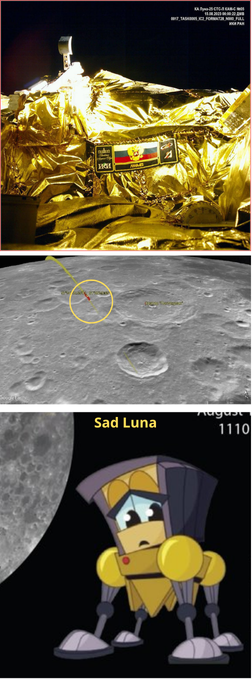
Unlike NASA, China, India, and several companies in the United States and Japan, the Luna 25 effort does not presage the coming of a golden era of exploration for Russia. Rather, it is more properly seen as the last gasp of a dying empire, an attempt by the modern state of Russia, and President Vladimir Putin, to revive old glories. Since the dissolution of the Soviet Union in 1991, every deep space probe—intended for Mars, the Moon, or Venus—has either failed or been delayed long enough such that it almost certainly will never fly. The Russian civil space program is in shambles.
23 Aug 2023: North Korea failed in its latest attempt to put a spy satellite in orbit, after encountering a rocket stage-separation issue. The Chollima-1 rocket carrying its Malligyong-1 satellite suffered an anomaly during the third stage of flight. The country’s National Aerospace Development Administration announced it will make a third attempt in October 2023, after it analyzes this latest failure. Launch Video.
– North Korea’s space agency said it used the new-type carrier rocket Chollima-1 to put the reconnaissance satellite Malligyong-1 into orbit. It said the flights of the rocket’s first and second stages were normal, but the launch eventually failed due to an error in the emergency blasting system during the third-stage flight.
– South Korean officials said they began work to retrieve the launch wreckage.
– The launch came three days after the U.S. and South Korean militaries kicked off annual military drills that North Korea calls “an invasion rehearsal.”
-A spy satellite is among an array of high-tech weapons systems Kim Jong-Un has publicly vowed to acquire. Others weapons on his wish-list are: a multi-warhead missile, a nuclear-powered submarine, a solid-propellant intercontinental ballistic missile, & a hypersonic missile.
-North Korea successfully placed a satellite into orbit in 2016 to coincide with the 74th birthday of the nation’s second Supreme Leader, Kim Jong-Il, who ruled from 1994 to 2011. The spacecraft, an Earth-observation satellite called Kwangmyongsong-4, decayed and fell from orbit on 30 June 2023.
-Since 2017, North Korea has performed a slew of intercontinental ballistic missile tests, demonstrating its potential ability to send missiles anywhere in the continental U.S. Experts say North Korea still has some technological hurdles to clear before obtaining functioning nuclear missiles.

18 Aug 2023: A mysterious “cyber incident” at a National Science Foundation (NSF) center coordinating international astronomy efforts has knocked major telescopes in Hawaii and Chile out of commission since the beginning of August. Officials have halted all operations at 10 telescopes, and astronomers can only conduct in-person observations at a few others.
– With no clear resolution to the shutdown in sight, research teams are uniting to figure out alternatives as critical observation windows spin out of reach.
– With remote control of many telescopes no longer available, some groups may rush graduate students to Chile to relieve exhausted on-site staff. Astronomers have spent the past two weeks directly operating instruments there.
– NOIRLab, the NSF-run coordinating center for ground-based astronomy, first announced the detection of an apparent cyberattack on its Gemini North telescope in Hilo, Hawaii in a 1 August press release.
– NOIRLab powered down all operations at the International Gemini Observatory, which runs the Hilo telescope and its twin, Gemini South, on Cerro Pachón mountain in Chile. (The latter was already offline for a planned outage.)
– NOIRLab’s computer systems let astronomers remotely operate a variety of other optical ground-based telescopes. But on 9 August, the center announced it had also disconnected its computer network from the Mid-Scale Observatories (MSO) network on Cerro Tololo and Cerro Pachon in Chile. Additionally, this action made remote observations impossible on the Víctor M. Blanco 4-meter and SOAR telescopes. NOIRLab has also stopped observations at eight other affiliated telescopes in Chile.
– The center declined to specify whether the incident was a ransomware attack.
– The episode is another wake-up call for the astronomy community. In November 2022, the Atacama Large Millimeter Array radio telescope in Chile also went dark for nearly two months, as its staff scrambled to respond to a cyberattack.

15 Aug 2023: A team of Italian computer experts, “mHACKeroni,” won the Hack-a-Sat 4 competition, the first to test competitors on an operational satellite. mHACKeroni bested four other international team, who all took aim at the Moonlighter satellite which launched on 5 June 2023. Contest Overview/Results Video.
– The teams competed in nine different challenges, seven of them involving hacking into the Moonlighter CubeSat which was designed to serve as an on-orbit cybersecurity testbed.
-Moonlighter will continue to serve as a future DoD cybersecurity testbed.
-For Hack-a-Sat 4, the five hacking teams — selected from more than 700 — competed in “two ground-based challenges and seven on-orbit challenges, testing their space-relevant skills including: spacecraft operations, radio frequency communications, and reverse engineering.”
-In this year’s competition, teams were tasked with hacking into Moonlighter in order to bypass the satellite’s restrictions on which targets on the ground it can observe, command it to take a picture of that target, and then download that image to a ground station.

18 Aug 2023: The National Counterintelligence and Security Center, the F.B.I. and the U.S. Air Force issued a new advisory to American companies. Chinese and Russian intelligence agencies are targeting American private space companies, attempting to steal critical technologies, and preparing cyberattacks aimed at degrading U.S. satellite capabilities during a conflict.
– The broad warning to industry said that foreign intelligence services could be targeting space firms, their employees, and the contractors that serve those companies.
-Intelligence agencies are increasingly dependent on the private-sector space industry, and U.S. officials are worried about the interest Chinese & Russian spy services have shown in those companies.
-Security measures vary greatly from company to company, and some U.S. officials believe the space industry needs to tighten protections against infiltration attempts by Chinese and Russian intelligence agencies.
-Since 2017, the Justice Department has charged Chinese, Russian and Iranian nationals in various schemes to steal space-related technology.
-In 2020, United Launch Alliance (ULA) suggested a Chinese firm had tried to infiltrate its supply chain. The attacker did not succeed in extracting critical intelligence.
-The warning advises companies to track anomalous incidents on their computer networks to look for potential breaches, develop protocols to identify potential foreign agents inside the business, conduct due diligence on potential investors, and prioritize most important intellectual property protection.