issue 80 | 10 sep 2023
The integrity flash
Analysis of Developments in the Space Domain
in this issue
China: Yaogan 39-01 Triplets Launched
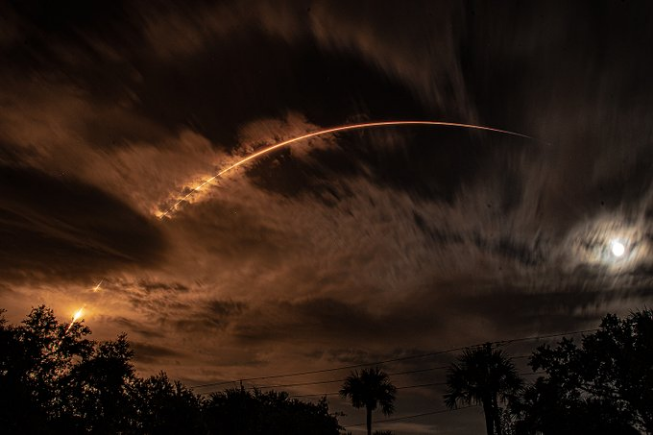
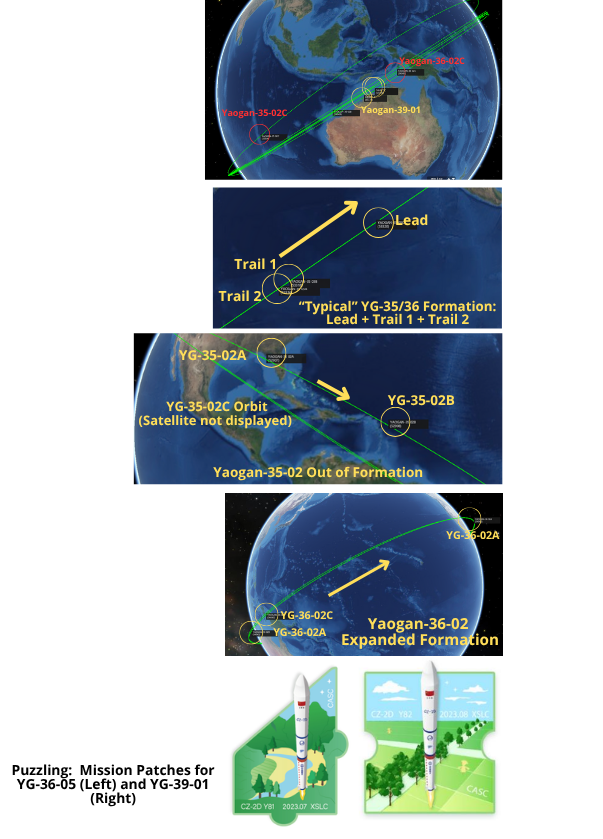
31 Aug 2023: China launched a Long March 2D from Xichang carrying a trio of Yaogan (YG)-39 satellites. This is the first instance of the YG-39 family. Orbital parameters closely align with those of the Yaogan-35 and Yaogan-36 constellations with identical inclination and altitude. YG-39-01’s orbit is similar to YG-35-02 and YG-36-02 and may be a replacement for the YG-35-02 which had one of its three satellites fall out of formation last year. The YG-36-02 formation may also be struggling.
Launch Video.
– YG-39-01’s launch vehicle (LM-2D) and location (Xichang) matches all 10 previous YG-35 and YG-36 launches.
– The YG-39-01 orbit also matches those of YG-35 and 36 satellites with an apogee of 506kms, a perigee of 495kms and an inclination of 35 degrees.
– As with YG-35 and YG-36 triplets, YG-39-01 is matched with other YG-35 and YG-36 satellites.
– The YG-39-01 triplet (A/B/C) is grouped with YG-35-02A/B/C and YG-36-02A/B/C.
– Here are the other pairings: 1) YG-36-01 & YG-35-01; 2) YG-36-03 & YG-35-05; 3) YG-36-04 & YG-35-03; and 5) YG-36-05 & YG-35-04.
– YG-35-02 is no longer operating in formation and it
appears YG-35-02C is no longer maneuverable.
– YG-36-02 is is far more spread out than other triplets but all satellites continue to maneuver.
– YG-39-01 is continuing to develop its formation. It is likely a replacement for the failing YG-35-02 triplet.
– More broadly it appears that China is continuing to experiment with various spacing alternatives for the YG-35/36/39 satellites while also grappling with anomalies
– 4 of the 10 triplets remain in the “typical” formation (35-03/04/05 & 36-05).
– 2 of the 10 triplets (36-03 & 04) have their 3 satellites ~equally spaced with all systems maneuvering.
– 1 of the 10 (36-02) has expanded spacing between the lead vehicle and 2 trailers.
– 3 of the 10 (35-01/02 and 36-01) appear to be having problems with one of their spacecraft no longer maneuvering (35-01A, 35-02C, & 36-01B).
Constellations in Trouble? A Graphic Look at YG-35 & 36
China began launching its formation orbiting Yaogan-35 satellites in June 2021. Over the past 26 months it has launched 10 other sets of Yaogan-35, Yaogan-36 and now Yaogan-39 satellites each orbiting in a Lead, Follower 1 and Follower 2 formation. China seems to have encountered issues with 3 of 10 formations. In each instance “Follower 1” has failed to maintain its position. Two of the Yaogan-35/36/39 satellites were built by DFH Satellite (Beijing) and SAST (Shanghai) built the third. There is no reporting to confirm the “Follower 1” manufacturer. Below are the altitude graphs of 3 “nominal” (left) formations as well as the three troublemakers (right). Thank you to Robert Christy of Orbital Focus for the graphs!

China: Yaogan 33-03 Launched
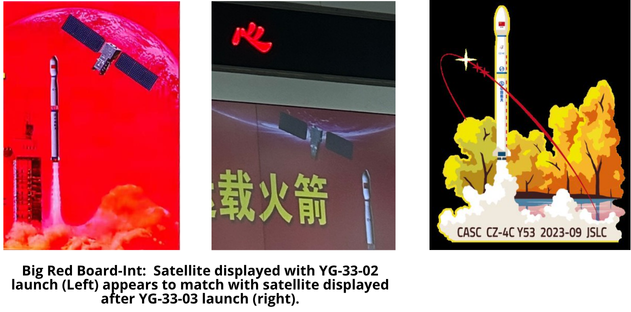
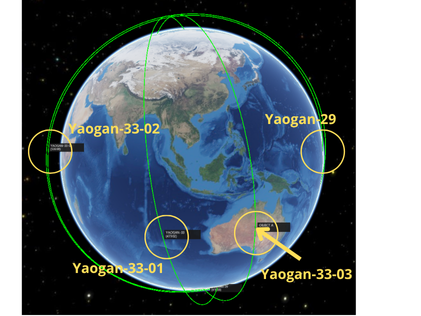
6 Sep 2023: China launched its third Yaogan-33 Synthetic Aperture Radar (SAR) imaging satellite. As with the other 2 operational YG-33 satellites the launch used a Long March 4C from the Jiuquan Satellite Launch Center. China released little information regarding the mission or capabilities of the satellite. Launch Video.
-The 18 SDS tracked YG-33-03 in a near-polar, 618 x 688kms orbit. These orbital parameters are a close match with the other 2 operational YG-33 satellites (an earlier satellite expected to be named Yaogan 33 was lost on a failed Long March 4C launch in 2019.)
-Earlier reporting suggests the spacecraft is likely part of a series of space-based synthetic aperture radar (SAR) satellites. Yaogan-33 is likely a follow on to the Yaogan-29 satellite which was launched in 2015 and is still cataloged as “active.”
-This launch occurred one year and one day after China launched YG-33-02 (5 Sep 2022).
-YG-33-03 is in a sun-synch orbit with a Local Time of Descending Node (LTDN) of 00:30 which is a new slot for China
China: CERES-1 Conducts 1st Sea-Based Launch
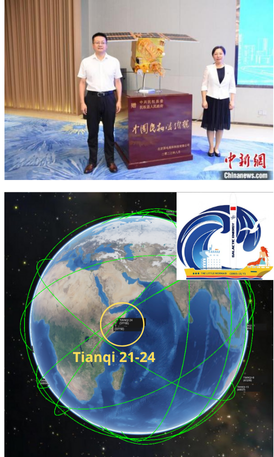
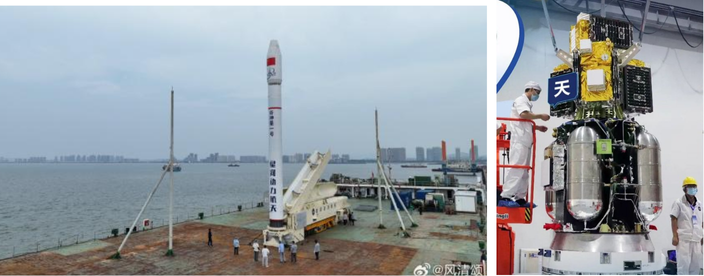
5 Sep 2023: China’s Galactic Energy conducted its first sea launch (nicknamed “The Little Mermaid”) and its ninth successive successful launch. The Ceres-1 solid rocket lifted off from a transport erector launcher on a mobile sea platform off the coast of Haiyang, Shandong province. Aboard were four satellites for Guodian Gaoke, a commercial firm constructing its Tianqi low-Earth orbit narrow-band Internet of Things constellation. With this launch there are now 13 operational Tianqi satellites on orbit. Launch Video.
– The launch placed Tianqi satellites 21-24 into an 800kms orbit with an inclination of 50°.
– The satellites are equipped with chemical propulsion systems allowing orbital maneuvers.
– Ceres-1 has a diameter of 1.4 meters, a length of about 20 meters, a mass at take-off of about 33 tons and a liquid propellant upper stage. It can deliver 400 kg to low Earth orbit (LEO) or 300 kg to a 500-kilometer-altitude sun-synchronous orbit (SSO). This was the first launch to 800 kilometers.
– China’s Eastern sea launch spaceport in Haiyang facilitated the launch. Haiyang has now supported launches of state-owned Long March 11 solid rockets and the spinoff Jielong-3 rocket. Another startup, Orienspace, is currently targeting December for its first ever launch, using Haiyang.
-China’s commercial launch sector has grown in terms of launch rate and diversity in 2023. Six firms — Galactic Energy, iSpace, Landspace, Space Pioneer and state-owned spinoffs CAS Space and Expace have all reached orbit this year. This group have already launched 11 times this year, surpassing the total of 10 missions in 2022.
Analysis: A Look at China’s Launch Capacity
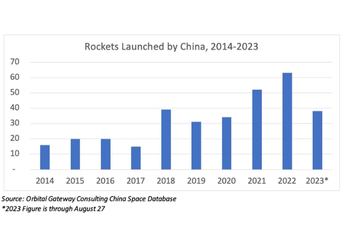
30 Aug 2023: Another interesting article courtesy of the China Space Monitor. In 2014 China launched 24 satellites on 16 rockets. By 2022, the figure was 182 satellites on 63 rockets, and in 2023 we are on pace for at least 70 launches, likely sending some 225 satellites or more into orbit. This growth has been driven by scaling up of production by state-owned launch companies CALT and SAST, and more recently, by a plethora of some 20 commercial launch companies. However, in spite of the additional space launch vehicles in its inventory, China’s launch capacity remains tight.
– Driving Factors: 1) State Mission Demand; and 2) Shackled Commercial Launch Companies
– State Mission Demand: despite a big increase in state-built launch vehicles, most of these launch vehicles are spoken for by state-run missions.
– Examples: From 2015-2020, China launched ~40 large BeiDou navigation satellites. In 2021-2022, China launched a combined 52 Yaogan
remote sensing satellites, most launched in groups of 3. Add to this the various Chinese Space Station launches, crewed and supply missions, and a whole host of space science missions, technology verification satellites, and more.
– If a Yaogan, BeiDou, or other state-run mission has a few hundred kgs of excess launch capacity, CASC has very little incentive to fill the rocket with additional satellites, because 1) it could be a sensitive mission where other satellites are not allowed, and also 2) if the other satellites add any layer of complexity, it might lower reliability.
-This is beginning to change in several ways. First, the commercial companies have become bigger, and this means they represent bigger customers for China’s State Owned Enterprises (SOEs) CASC, CALT, and SAST. The SOEs have started to take commercial companies more seriously, in some cases highlighting commercial demand as a growing market during conference presentations. Second, the SOEs have actually started to cater some of their services to commercial companies, including putting more rideshare launches. Most recently, we saw CASC auction off capacity on a LM-6C in July, while also highlighting 9 additional rideshare opportunities later in 2023 and into mid-2024.
– Hurdles for Commercial Launch: all 4 of China’s launch sites are controlled by the People’s Liberation Army (PLA). This makes securing access to launch sites very difficult.
– Historically there have been very few customers willing to buy launch capacity, which has made it difficult for launch companies to bring in revenues, and also creating zero incentive for them to develop bigger rockets, at least in the short-term.
– Labor capital shortage: many of the nation’s top graduates are opting for stabler, lower-stress government or SOE jobs. In this new reality, going to work for a high-risk space industry startup is somewhat less appealing than it was before, making it harder for commercial space companies, including launch firms, to recruit the nation’s best and brightest.
The current launch bottleneck is likely to unclog in the next few years due to more commercial launch firms coming to market with new rockets, and potentially state-owned launch companies ramping up production to create excess launch capacity.
China Criticizes US Efforts to Ban ASAT Missile Tests
23 Aug 2023: China accused a US proposal to ban anti-satellite weapons testing in space of promoting “fake arms control” and “real military expansion”. The statement came after the European Union said it planned to join a US proposal to prohibit the destructive testing of direct-ascent anti-satellite missiles (ASAT). The endorsement by the 27 EU member nations – most of them Nato allies – brings the total number of supporting countries to 35.
-Chinese foreign ministry spokesman Wang Wenbin said that the US commitment was deceptive since it “sets no substantial limit to US military forces in outer space”, and Washington had already carried out enough direct-ascent missile tests and developed other types of anti-satellite weapons.
-Wang said Washington’s purpose was to “maintain and enlarge its unilateral military superiority by means of multilateral commitments” and “achieve real military expansion under the guise of false arms control”.
– China has argued that the US commitment did not address the real security threats in outer space, and the ultimate solution should be a legally binding total prohibition on the deployment of weapons in space, the use of force and the threat of force against space objects.
– “We hope that the countries concerned would … abandon the Cold War mentality, stop making and implementing offensive military policies in outer space, and return to the right track of negotiating legal instruments for arms control,” Wang said.

Russia Blocks UN Norms effort to reduce space threats
1 Sep 2023: The UN working group attempting to develop norms to constrain threatening military activities in space today ended with Russia blocking forward motion against the clear wishes of a majority of participating countries.
-Russia, which voted against the original establishment of the working group — officially, the UN Open Ended Working Group (OEWG) on Reducing Space Threats Through Norms, Rules and Principles of Responsible Behavior — made it clear it would not allow the group to issue a formal report to the UN General Assembly detailing the proposals discussed.
-Russian also quashed a procedural report to mark the group’s two years of work.
-The head of Russia’s delegation, Konstantin Vorontosov, asserted that Russia’s positions had been “discriminated against and ignored.”
– Vorontosov further argued the very concept of responsible behavior in space is not just internationally divisive, but illegitimate, and thus should not be an item on the UN’s agenda. A small number of nations, including Venezuela, Iran and China, supported Russia’s objections, especially its rejection of responsible behavior as a foundation for norms.
-A majority of nations pushed back and made detailed statements designed to put the group’s progress on the record, and further supported the chair’s decision to submit an informal summary of the discussions to the UNGA.
Secure World Foundation’s Brian Weeden: “While Moscow likely sees this as a victory , I think it spells the end of Russia’s historical leadership on space security diplomacy”
Another Orbital Collision
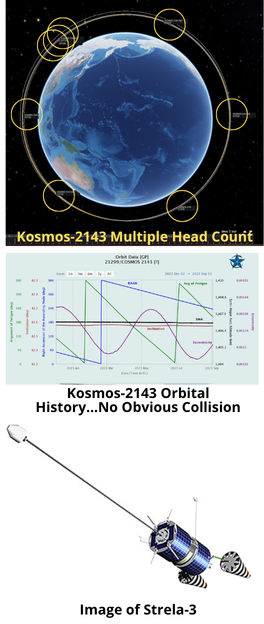
30 Aug 2023: A three-decade-old Soviet satellite has disintegrated in orbit some 1,400 kilometers above Earth, likely following a space debris strike. The disintegration of the satellite, either the Kosmos-2143 or Kosmos-2145 spacecraft, highlights the precarious situation in Earth’s orbit where old objects accumulated throughout the more than 60 years of space exploration and utilization are now posing threats to new, still functioning satellites.
– Per Johnathan McDowell, “7 debris objects cataloged from a defunct Soviet communications satellite launched in 1991…Debris appears to be from either Kosmos-2143 or Kosmos-2145, two of 8 Strela-1M sats launched on the same rocket.” (Editor’s note: believe Kosmos-2143 was a Strela 3).
-As of 2 Sep 2023, the publicly available space catalog has 1 object associated with Kosmos-2143 and 7 new objects listed as Kosmos-2143 debris. (Nice work 18 SDS!)
-There was no immediate change to Kosmos-2143’s orbit. It is currently cataloged with an apogee of 1413.7kms, perigee of 1394.8kms and an inclination of 82.6 deg.
-Apogee values for Kosmos-2143 debris ranges from 1643.2 – 1391.6kms. Perigee values range from 1348.4-1394.8kms. At these values the debris will remain on orbit for decades.
–Old Soviet satellites and used rocket stages left at altitudes above 500 miles (800 km) are of great concern to space sustainability researchers. Floating too high to be taken down by the natural decay of their orbits caused by the drag of Earth‘s residual atmosphere, these objects have already been involved in several incidents.
-Researchers don’t know and will likely never learn what caused the Kosmos-2143 fragmentation. Earth-based radars only track objects larger than 4 inches (10 centimeters). About 34,550 such objects are currently known to exist in Earth’s orbits, according to the European Space Agency (ESA).
Researchers have been sounding alarm bells for years because of the growing amounts of space junk in Earth’s orbit. Some fear the situation is slowly approaching a scenario known as the Kessler Syndrome. Named after retired NASA physicist Donald Kessler, the scenario predicts that the growing number of fragments generated by orbital collisions will eventually make the area around Earth unusable as every space debris crash will trigger a chain of subsequent collisions.
Silent Barker: Another Set of Eyes in GEO
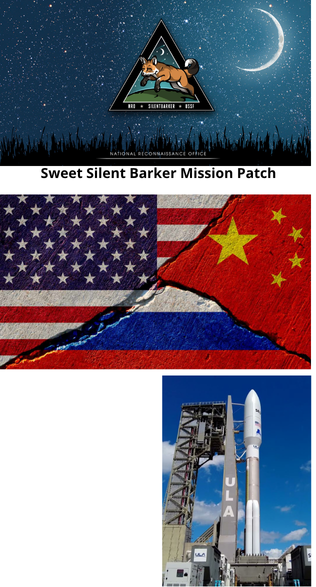
28 Aug 2023: Ars Technica publishes on-line article about upcoming SILENT BARKER launch. The National Reconnaissance Office (NRO) is preparing to launch multiple satellites—officials won’t say exactly how many—on a United Launch Alliance Atlas V rocket as soon as Cape Canaveral weather conditions permit. Their destination is geosynchronous orbit, a belt of satellites positioned more than 22,000 miles (nearly 36,000 kilometers) over the equator. The Silent Barker satellites will detect and continually track other objects in geosynchronous orbit, a capability that military leaders have prioritized over the last decade.
– US officials have highlighted several occurrences of Russian inspector satellites approaching US spy satellites flying in low-Earth orbit in recent years. Higher up in geosynchronous orbit, another mysterious Russian military satellite has roamed near numerous commercial communications satellites and a French-Italian military spacecraft, raising concerns that it may be trying to intercept radio signals.
-The US military already has its own satellites capable of approaching other objects in geosynchronous orbit. These satellites, part of the Space Force’s Geosynchronous Space Situational Awareness Program (GSSAP), were part of an orbital dance with two Chinese military satellites last year.
-The US military dispatched one of the GSSAP satellites to get a closer look at the two Chinese spacecraft, but the Chinese satellites took off in opposite directions. Then one of the Chinese spacecraft settled into a position to get a sunlit view
of the Space Force surveillance satellite that had been chasing it.
– A key difference between the Silent Barker and GSSAP programs, according to military officials, is the ability of the Silent Barker satellites to continually monitor the position, or “maintain custody,” of other objects in geosynchronous orbit.
– The military currently relies primarily on ground-based radars to scan geosynchronous orbit. Silent Barker follows up on a dedicated military surveillance satellite that launched in 2010 with an optical sensor to look up at geosynchronous orbit from low-Earth orbit, just a few hundred miles above Earth.
– Ground radars come with limitations because they can only see part of the sky at a given time, and there are factors like the weather to consider. The radars also can only detect an object about the size of a basketball or larger. Silent Barker will see smaller objects and won’t be subject to terrestrial limitations.
-While the raw data from the Silent Barker satellites will likely remain classified, the tracking information will feed into the military’s catalog of space objects, which is publicly available and used by commercial and international satellite operators to avoid collisions and interference.
-US officials plan at least one more launch with additional Silent Barker satellites in the coming years, allowing the multi-spacecraft constellation to be fully operational in 2026
Jack’s Back! Taking out the Trash
13 Aug 2023: This is a two pager astro lesson using the International Space Station (ISS) disposal of a big trash bag back in July 2022. I prepare these “astro lessons from Jack” now and then for the great folks serving in the National Space Defense Center. They truly “enjoy” my blurbs and sharpen their astrodynamics understanding! This is a relative motion related problem for the ISS and mission control team. First step is to watch two on-line videos (very short and pretty cool videos). I recommend you send it home and gather your family and friends as you take part in this short astro lesson. Let’s “take out the trash.”
Here are the links to 2 short videos of the deployment of a 172 lbs big bag (5 ft diameter, 4 ft tall) of trash from ISS.
https://www.digitaltrends.com/space/iss-trash-disposal-nanoracks/
https://www.youtube.com/watch?v=pyldo8pngV8
The first video (38 sec) is focused on the jettison of the trash bag and the second video (1:42) is multiple camera views of the trash bag jettison. Pretty cool!
Perhaps you could tell which direction the trash bag was jettisoned. It was loaded into the Nanoracks Airlock (NRAL) system. Nanoracks in Houston built the airlock/deployment system for ISS. This jettison took place 2 July 2022. They aimed the trash bag backward and down. Why? Let’s look at the relative motion astrodynamics of this “back and down” jettison.
The trash bag was sent away from ISS via the NRAL at 1.34 m/s aimed away from the direction of spaceflight and tilted down 45 degrees. Let’s look at my drawing of this jettison direction in the Radial-InTrack-Crosstrack (RIC) coordinate frame you all are familiar with.
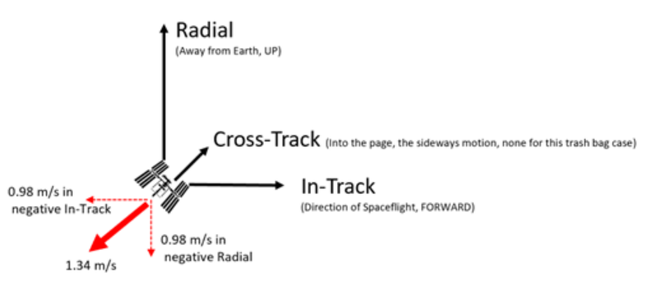
I calculated “how much backward” and “how much down” Delta V was imparted on the trash bag. So the next question might be “so where does the trash bag go?” Hopefully NOT coming back to whack the station somewhere. Let’s look at the resultant relative motion of the trash bag relative to the ISS. Here’s a drawing to help understand “where does it go?” The RIC coordinate frame is fixed on ISS.
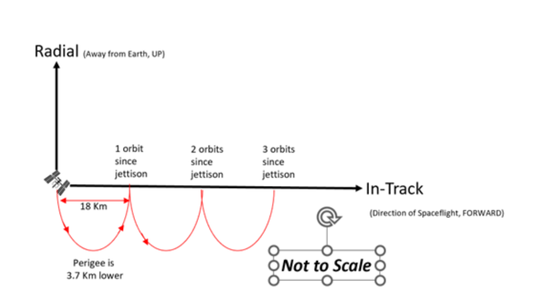
What you see is while the bag was tossed back and down, the resultant Delta V lowered the perigee of the trash bag’s orbit relative to the ISS by about 3.7 Km. That jettison took some energy out of the orbit that is now the trash bag orbit. That means it will advance ahead. The apogee or high point of the trash bag orbit it still at the ISS altitude, but after one orbit (about 94 minutes, but a wee bit less than ISS) it crosses about 18 Km ahead. For each orbit it “scallops” it’s way 18 km more distance. The bag is departing ahead and below. Yay! Let’s look at a bit of astro good news regarding where the NRAL is relative to ISS’s center of gravity. See next paragraph.
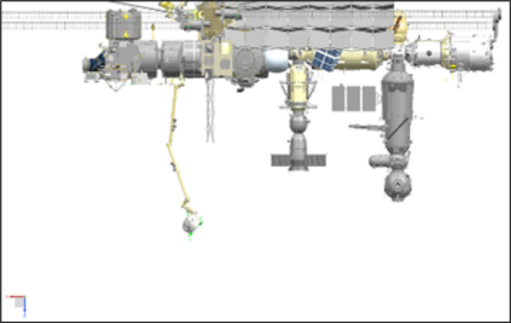
The NRAL deployment took place 22 meters below the center of gravity of the ISS (see NASA illustration below). This is good news since by that difference, even if the astronauts just “let it go” (you might say they just “put it on the curb”), it would be at a different altitude of ISS and would scoot ahead 800 meters per orbit (94 minutes). It’s lower, the trash bag would advance ahead in a linear drift manner.
There’s even more good news I wish to share. The trash bag will be affected by the atmosphere way up there and that force will make it start to descend and eventually decay into the Earth atmosphere and burn up. ISS periodically maneuvers to maintain it’s orbit of about 425 Km. The trash bag decayed 22 December 2022, 172 days since it was heaved overboard in this “back and down” manner. Hooray for Space Force, especially the 18th astro experts and the sensor sites for keeping track of this trash bag.
What would have happened if the trash bag was jettisoned “UP” only?
What would happen if the trash bag was jettisoned forward and up?
THANK YOU’S: Special thanks to Mr Ulisses Hernandez who is a NASA/JSC ISS Flight Dynamics expert for sharing his analysis that enabled me to create this fun filled lesson. I appreciate his great boss Lark Howorth and Bill Foster who are always so helpful vectoring my curiosity to the right person on their team. They tolerate me nicely and I am very grateful. 😊