issue 81 | 24 sep 2023
The integrity flash
Analysis of Developments in the Space Domain
in this issue
China: Yaogan 40 Triplets Launched into New Orbit
10 Sep 2023: China launched a LM-6A Y5 from Taiyuan Satellite Launch center with 3 Yaogan 40 satellites. Chinese sources stated only that the purposes of the satellites was for “electromagnetic environment probing.” The satellites are in a ~800km orbit with 86 degrees inclination. Launch Video.
– YG-40-01A/B/C orbit is significantly different than those of other recent Chinese launch trios (YG-35, YG-36 and YG-39).
– As of 16 Sep 2023 all three satellites are continuing to maneuver and their positions relative to one another will change. Currently YG-40-01A & B have nearly identical semi-major axis (SMA) 847.6 and 849.4kms respectively. These two satellites have increased SMA since arriving in orbit. YG-40-01C’s SMA is ~60kms less than A & B at 787kms. All three share the same inclination of 86 degrees.
– YG-40-01 is the first of the Yaogan satellite family to operate in this orbit and appears to be in a unique orbit to all other Chinese satellites.
– Shiyan 20A/B and C orbit at similar altitude (SMA) but are inclined 60 degrees.
– The Fengyun-3 environmental monitoring satellites also operate at a similar altitude but again the inclination is different (98.8 degrees for FY-3s).
– There are no Gaofen or Shijian satellites operating in anything similar to this orbit.
– Taiyuan Satellite Launch Center has hosted 22 separate Yaogan launches. All were for imagery satellites (either Electro-Optical or Synthetic Aperture Radar). The Yaogan-40-01 launch was the first Yaogan launch from Taiyuan since 2015.
– YG-40-01 is the first Yaogan launch to use a LM-6.
– The LM-6A is a two-stage rocket loosely based on LM-6 but modified in many ways. It can lift 5 metric tons into a polar orbit and is usually 50 meters tall with a diameter of 3.35 meters. This specific launch used the Y5 variant which appears to be closer to 55 meters in total length.

Yaogan 40: Similar Profile as YG-31 ELINT Triplets?
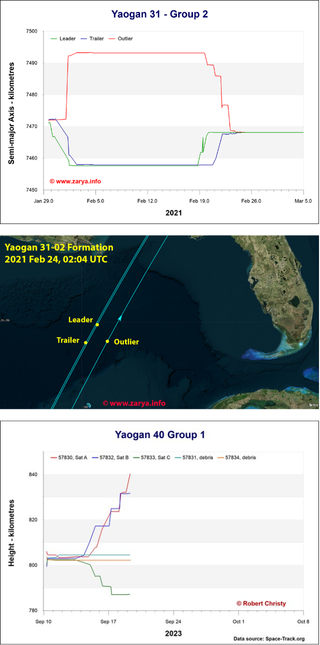
19 Sep 2023: Robert Christy of Orbital Focus noted similar characteristics between the deployment of Yaogan-40A/B/C and Yaogan-31A/B/C satellites. If the pattern holds and the YG-40 triplets assume a similar formation as YG-31, it will be a strong indicator that the YG-40 are designed to intercept radio signals & calculate their point of origin.
– Yaogan-31 satellites were launched between 2018 and 2021. There are 12 YG-31 satellites flying in 4 orbits with 3 satellites in each orbit, operating in a precise triangular formation.
– The Yaogan-31 triplets closely resemble the architecture of the original version of the U.S. Naval Ocean Surveillance System (NOSS). Using three satellites in a precise formation allows them to intercept radio signals from the ground and so calculate and track the position of warships in the world’s oceans while also studying their activity based on their radio emissions.
-Shortly after YG-31-02A/B/C launched in 2021, one satellite moved to a higher orbit and the other two dropped by a similar amount. The singleton in the higher orbit started falling back from the other two. After the pair lapped the singleton twice, the YG-31-02A/B/C satellites then slid into formation for the active part of the mission.
-The effect of being at two slightly different orbit heights is that the two orbit planes move at different rates with the lower orbit moving faster. By the time the three YG-31 satellites came together, the orbit of the singleton was about 110 kilometers to the east of the pair.
-By spacing the pair about 125 km apart from each other along the same track and having the outlier travelling at the same speed, the three vehicles will spend most of their life travelling in a near-equilateral triangular formation.
– YG-31-01A/B/C had a pair of satellites that went
to the higher orbit with the singleton moving lower taking it ahead of the others and coming up on them from behind. The on-orbit ‘catchup’ process for that mission took the ‘usual’ four weeks to perform before the three vehicles settled into close formation.
YG-40 appears to be following the same pattern as YG-31/01A/B/C with two satellites maneuvering to higher orbits with the third decreasing its altitude. In their current altitudes YG-40-01C, operating at an altitude ~49kms lower, will “lap” YG-40-01B & C for the first time on 28 Sep 2023. It will lap them a second time on ~ 3 Oct 2023.
Yaogan-39-01 Takes Shape
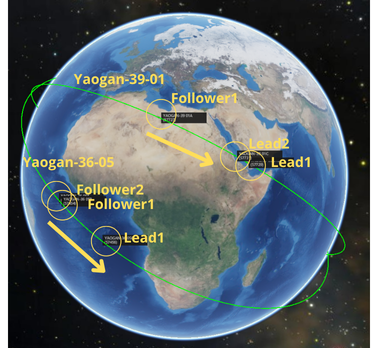
16 Sep 2023: After its 31 August launch, YG-39-01 A/B/C appears to be operating in formation. The formation appears to differ from the previous YG-35 and YG-36 triplets in that YG-39-01 has 2 satellites in “Lead” position (Lead1 and Lead2) and one in Trail (Follower1). YG-35 and 36 typically (but not always) have a single “Lead” and 2 in Trail.
Here is a graphic displaying the formation of YG-39-01 and YG-36-05 which was launched on 26 July 2023.
This is an initial analysis and will likely change over time. We’ll likely learn more if China launches additional YG-39 triplets…oh wait, this just in…
That was Fast: China Launches Yaogan-39-02 Triplet
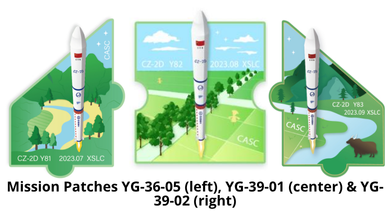
17 Sep 2023: Less than 3 weeks after launching it initial batch of 3 Yaogan-39 satellites (YG-39-01 launched 31 August) China launched YG-39-02 from Xichang also on a LM-2D. As with its predecessor as well as the 30 YG-35/36 satellites, the YG-39-02 trio is in a ~500km orbit with 35 degrees inclination. Launch Video.
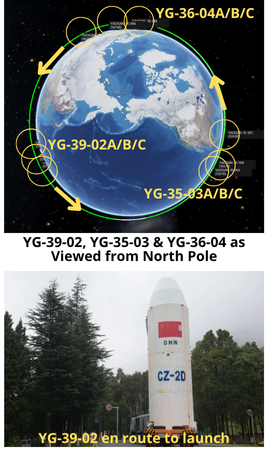
– YG-39-02A/B/C satellites are co-planar with YG-35-03 and YG-36-04. All of the YG-35/36 and 39 satellites are co-planar with other satellites of this family.
– YG-39-02A/B/C are still conducting initial maneuvers and it is too early to assess formation.
– The YG-39-01 triplet (A/B/C) is grouped with YG-35-02A/B/C and YG-36-02A/B/C.
– Here are the other pairings: 1) YG-36-01 & YG-35-01; 2) YG-36-03 & YG-35-05; 3) YG-36-04 & YG-35-03; and 5) YG-36-05 & YG-35-04.
US: Sandia Labs Researching Teaming Satellites
27 Sep 2023: Iran (specifically the Iranian Revolutionary Guard Corp <IRGC>) successfully launched its third reconnaissance satellite, the Noor-3, using the three-stage Qasem rocket from Shahroud. Noor-3 is in a similar orbit with its predecessor, Noor-2. The IRGC’s Space Commander praised the Noor-3 satellite’s image accuracy, claiming it had twice the image accuracy of Noor-2. Launch Video.
– Scenario: a satellite observing ships on the ocean. As it takes pictures of each ship, an algorithm decides what kind of vessel it is. But one sneaky sailor paints a pattern on the deck that confuses the satellite, so it can’t decide what it’s looking at.
-Solution: The confused satellite could communicate its problem to others in the network, which could straight away point their sensors to the same spot, combine their data and make a positive identification.
-Current research aims to connect up to about a dozen satellites, researchers say that further development could lead to connecting much larger networks.
-“The ultimate idea is to scale up to constellations that might cover virtually the entire globe — and to potentially coordinate data collection even with non-space assets,” like sensors on the ground or on planes, said Sandia’s Drew Woodbury, a senior manager in Sandia’s space programs.
-Sandia has been heavily involved in the project, developing machine learning and autonomy algorithms, radar sensors, computer models, communications protocols and flight software. Researchers have been building specialized hardware for space, where budgets for size, weight and power are commonly tighter than on the ground. They have adapted distributed software to operate on multiple satellites without conventional, land-based communications.
<Editor’s Note/Rant: Collaborating constellations is the future of space operations. China has announced intentions of moving in this direction. Please read an interview with Li Dereng, a Professor at Chinese Academy of Sciences and Engineering. The title is “From Earth Observation Satellite to Earth Observation Brain” where Li describes how China is moving to an integrated PNTRC concept (Position, Navigation, Timing, Remote sensing, Communications). The US DoD acquisition community is organized around specific weapon system capabilities (Comm, PNT, EO Imagery, SAR, SIGINT) which has a chilling effect on its ability to rapidly develop a multi-phenomenology constellation.>

LEO Labs Reports Near Miss
13 Sep 2023: A derelict Soviet-era payload (Cosmos 807) had a conjunction with a Chinese rocket body. The miss distance was 36 m (± 13 m) and the probability of collision was 1E-3 (i.e., 0.1% or 1/1,000). Cosmos 807 and CZ-4C had a combined hard body radius (HBR) of 5.6 m. This contributed to the relatively large probability of collision (PC) value. If these two objects had collided, the number of resulting cataloged fragments would have likely been ~3,000. By comparison the 2021 Russian ASAT test resulted in ~1,800 total cataloged fragments over time.
– Cosmos 807 is a 400 kg payload launched into an elliptical orbit in 1976. It’s likely Cosmos 807 has had many close encounters with other objects over time.
-Cosmos 807 has an apogee of 1,126kms and a perigee of only 366kms…it is regularly traversing 760kms of trafficked space.
– In the last 20 months, LEO Labs has observed 50 high-PC (i.e., PC > 1E-6) conjunctions involving Cosmos 807. While the majority were with operational payloads, 14 included fragments — 6 of which were from the fragment cloud generated after Russia’s 2021 ASAT test.
-The Chinese CZ-4C Rocket Body (R/B) is a 2,000 kg object abandoned five years ago — and it’s already been involved in 141 high-PC conjunctions, split almost equally between fragments and operational payloads.
-The CZ-4C R/B has an apogee of 682kms and a perigee of 553kms.

US DoD Releases a Plan for Protecting Space Assets
15 Sep 2023: The United States Department of Defense (DoD) released an unclassified whitepaper, “Space Policy Review and Strategy on Protection of Satellites.” The 19 page document <editor’s note: recommend reading this yourselves as well> provides a review of space policy and describes the Department of Defense’s approach to protecting and defending space systems and protecting the Joint Force from adversary hostile use of space.
– The 2022 and 2023 National Defense Authorization Acts (NDAA) mandated the review of the US space policy and the report. The report itself outlines the United States’ preparations to defend its space assets from attack if war breaks out in space.
-DoD Assistant Secretary for Space Policy John Plumb noted that releasing the report in an unclassified format is “a key step towards normalizing space as an operational domain.”
– The report identifies DoD’s key priorities in regards to space systems:
- Assure critical space-based missions by accelerating the transition to more resilient architectures and by protecting and defending critical systems against counterspace threats
- Strengthen the ability to detect and attribute hostile acts in, from, and to space (improve Space Domain Awareness)
- Protect the Joint Force from adversary hostile uses of space.
– The report identifies China as the strongest adversary and risk to US operations in space, followed by Russia. Both nations have extensive counterspace capabilities, including direct-ascent anti-satellite (ASAT) weapons and jamming technology.
– Importantly, the report also addresses adversary use of their own space systems to threaten allied forces operating in other domains.
– As potential adversaries increase their use of space-based services to support their combat capability, operations to deny hostile use of space could reduce an adversary’s ability to conduct attacks against the United States and its allies and partners.
– Specific to China the report notes: The PRC is building a space architecture to enhance its ability to fight and win a modern military conflict. The PLA owns and operates roughly half of the world’s space-based intelligence, surveillance, and reconnaissance (ISR) satellites. Recent improvements to the PLA’s ISR fleet enhance its ability to monitor forces across the globe, including U.S. expeditionary forces, increasing the PLA’s ability to conduct long-range strikes against U.S. and allied forces. The PRC likely intends to leverage these advancements to challenge the U.S. military’s ability to conduct joint operations in the Indo-Pacific region.
– Joint Force space operations could deny an adversary’s space and counterspace capabilities and services using a variety of reversible and irreversible means, reducing the effectiveness and lethality of adversary forces across all domains. Operations to deny adversary hostile use of space could originate in any domain and target on-orbit, ground, cyber, and/or link segments to reduce the full spectrum of an adversary’s ability to exploit the space domain
-The report states, “DoD will leverage a breadth of options across all operational domains to deter aggression and, if deterrence fails, to prevail in conflict.”
Germany Signs Artemis Accords
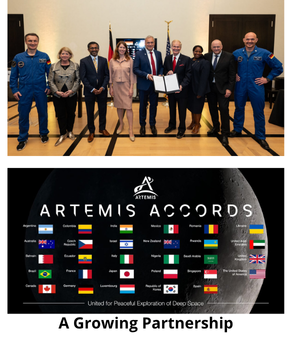
14 Sep 2023: Germany signed the Artemis Accords, adding one of Europe’s largest space powers to a document outlining best practices for sustainable space exploration. Germany became the 29th country to sign the accords during a ceremony at the German ambassador’s residence in Washington attended by U.S. and German officials. The document was signed by Walter Pelzer, director general for the German space agency at the German Aerospace Center (DLR).
– Germany is also one of the biggest European space nations. It committed 3.5 billion euros ($3.7 billion) to the European Space Agency at last November’s ministerial summit, more than any other member. Five of the six largest contributors to ESA — Germany, France, Italy, the United Kingdom and Spain — have now signed the accords, along with several other members.
– German officials did not publicly state why they waited until now to sign the accords. In a statement, DLR said that the accords “reaffirm” their commitment to the Outer Space Treaty and related international agreements. Backers of the accords have long argued that the document is intended to “operationalize” the Outer Space Treaty by explaining how certain principles contained in it should be carried out.
-DLR added that it continued to support work to develop new binding space treaties, potentially on the issue of utilization of space resources, one of the topics covered in the Artemis Accords.