issue 85 | 19 nov 2023
The integrity flash
Analysis of Developments in the Space Domain
in this issue
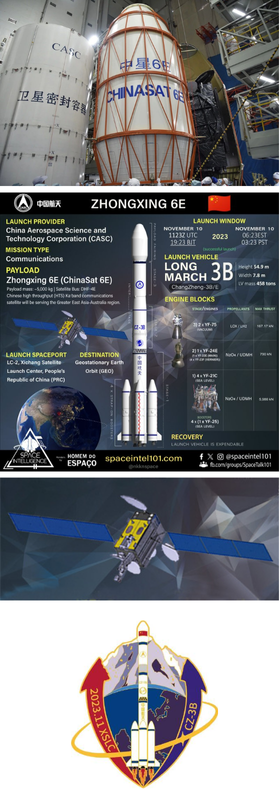
China Launches Chinasat-6E Communications Satellite
9 Nov 2023: China launched a Long March 3B/E from Xichang Satellite Launch Center. Chinasat-6E (Zhongxing-6E) was in geosynchronous transfer orbit (GTO) until 17 Nov when it circularized it’s orbit at 129.8°E near Chinasat-6C. Chinsat-6E will provide radio and television broadcasting service. Launch Video.
– China is replacing its older communication satellites. Chinasat-6D replaced Chinasat-6A in April 2022.
-CASC stated ChinaSat-6E will mainly cover China, Southeast Asia, Australia and other regions. It was also stated to be part of space-based infrastructure for China’s Belt and Road initiative and construction of the “digital China” strategy.
-ChinaSat-6E is based on the DFH-4E bus, an enhanced version of the established DFH-4 geostationary platform developed by CASC’s China Academy of Space Technology (CAST). Its expected lifespan is 15 years.
– Chinasat-6E will primarily broadcast in the C and Ku bands. It supports the new #8K ultra-high definition communication services.
-The modernized Chinasat constellation consists of Chinasat-6C (launched in 2019 and located at 130.5°E), Chinasat-6D (located at 125.1° East) and now Chinasat-6E. It is possible China will maneuver one of the newer satellites to replace Chinasat-6B which was launched in 2007.
-Up next Chinasat-9C is expected to launch in 2025 to replace Chinasat-9, launched in 2008.

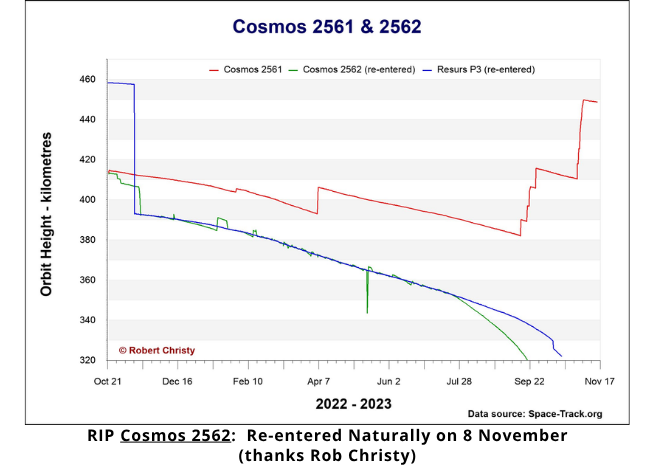
China: Yaogan-40-01 Now in Formation
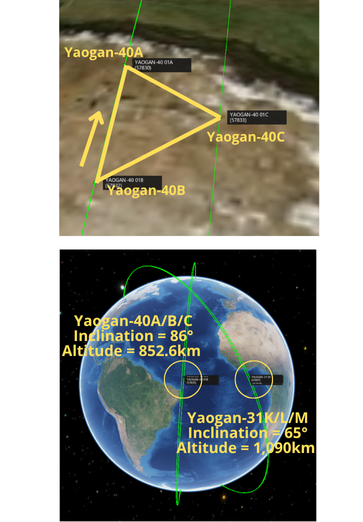
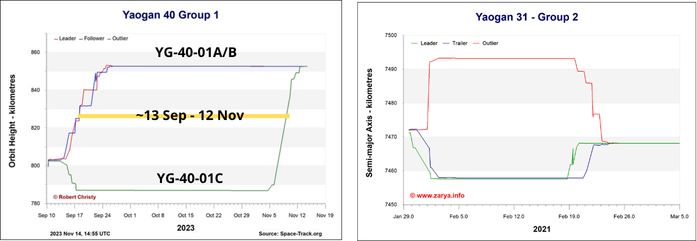
13 Nov: China increased the altitude of Yaogan-40C to match that of Yaogan-40A and 40B. The three satellites are now in formation and likely performing their radio collection and geolocation mission. China launched all three satellites on 10 September and shortly afterward increased the altitude of 40A and 40B while decreasing the altitude of 40C. As noted by Robert Christy, this maneuver pattern is similar to the deployment of the Yaogan-31 satellites.
– The effect of having satellites orbit at two slightly different orbit heights is that the two orbit planes move at different rates with the lower orbit moving faster. By the time the three satellites come together, the orbit of the singleton will have moved to the east of the pair at the higher altitude.
-While the results of the maneuver were similar, there were some differences between the YG-31 and YG-40 deployments. It appears China is continuing to try slightly different deployment techniques.
- For YG-40-01 only one satellite maneuvered to create the formation. The singleton, YG-40-01C, increased its altitude to match YG-40A & B. In the case of YG-31D/E/F, all three satellites maneuvered, the pair lowered their altitude initially and then increased their altitude. The singleton also decreased its orbit to match the pair.
- YG-40 spent 60 days to complete its maneuvers and begin operating in formation. YG-31 took about half that time.
- YG-40 is operating in a new orbit (852km altitude and 86° inclination) for Chinese ISR satellites. YG-31 satellites orbit at ~1,090km and 65°.
– China’s use of the Yaogan-40-01 designation is a possible indicator of more missions in the future. Total size and timeline for developing this constellation are unknown. Yaogan-31 consists of 12 satellites (operating in 4 groups of 3 satellites).
China: TJS-10 Settles In...with TJS-3?
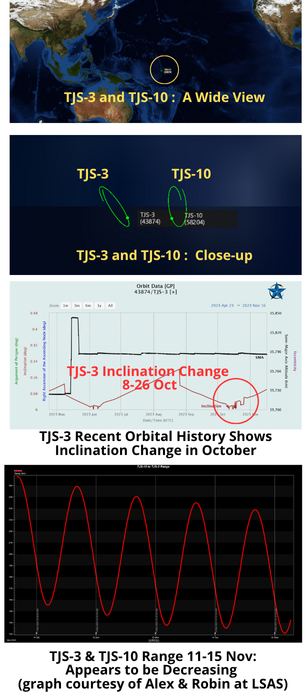
15 Nov: Predictably, China has not released any additional information regarding its newly launched TJS-10 technical demonstrator. Launched on 3 Nov 2023, TJS-10 circularized its orbit into GEO on 9 Nov. The satellite is located at 173.3°E longitude and is .1° inclined. Interestingly, another TJS satellite, TJS-3 is nearby at 173.1°E. TJS-3 arrived at this location in late-May 2023. It appears TJS-3 made several maneuvers in early Oct 2023 and increased its inclination from 0° to .1°…identical to TJS-10. From 11-15 November the satellites appeared to be gradually moving closer to one another. Unknown if these satellites will have future interactions. Recall TJS-3 has been inspecting other countries’ assets in geostationary orbit.
– TJS-10 was the first TJS satellite to be launched by the LM-7A and the Wenchang launch facility. The LM-7A can lift 22% more mass to GTO (7,000 kg) as compared with the LM-3B/E (5,500 kg), suggesting TJS-10 may have significantly more mass than previous TJS satellites.
– Chinese state media outlet Xinhua described TJS-10 as being “mainly used for multi-band and high-speed communication technology experiments.”
– TJS-3 was launched in 2018 and immediately engaged in unusual behavior for geostationary satellites and performed several RPO events with its Apogee Kick Motor (see video.)
– Chinese news media reported TJS-3 will test “double satellites co-position communications” as

China Moves TL-1-02 & 1-03 to Graveyard Orbit
In early November 2023 China moved its two oldest Tianlian (“Skylink” in Chinese) relay satellites (TL-1-02 & 1-03) into graveyard orbits. On 1 Nov TL-1-03 (launched in 2012) increased its altitude 381.7km and is now in GEO graveyard orbit and drifting westward. Two days later, on 3 Nov, TL-1-02 (launched in 2011) also increased its altitude, this time by 351.8km and is now also in graveyard orbit drifting westward.
– China’s current satellite relay constellation consists of 3 second generation TL-2 satellites and 2 remaining first generation TL-1 satellites.
-Both of the remaining TL-1 satellites are considerably younger than TL-1-02 and TL-1-03 and are not likely to be taken out of operation in the near term.
-TL-1-03 had an eventful final year on orbit and was visited by SJ-23 back in March. Closest approach between the two satellites was estimated to be <4km.
-China’s first TL relay satellite, TL-1-01 was launched in 2008 and moved to graveyard orbit on 20 Feb 2022. On average the TL-1 satellites have a lifespan of ~12 years.


SJ-23 & TL-2-02 Update
Further analysis reveals that SJ-23 conducted a maneuver on 19 October that placed it ~30km from the Tianlian-2-02 (TL-2-02) relay satellite. Since that time SJ-23 has has settled into GEO at 171.5°E and remains in the neighborhood with TL-2-02 which is at 171.0°E (and yes this is in the vicinity of the recent TJS-3 & TJS-10 maneuvers.) As noted above, TL-2-02 is the second relay satellite to have a close approach with SJ-23.

China Launches Haiyang-3A Ocean Monitoring Satellite
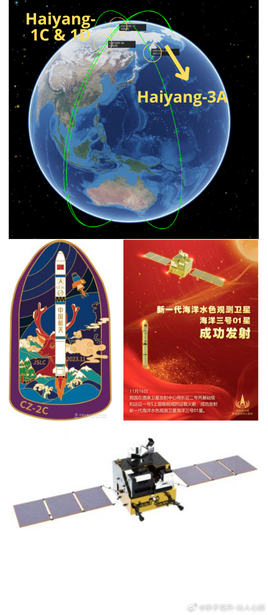
16 Nov 2023: China launched a Long March 2C from the Jiuquan Satellite Launch Center carrying the Haiyang-3A (Haiyang translates to “ocean”) ocean observation satellite. The satellite is in a sun synchronous orbit and will provide all-weather ocean observation using an X-band SAR imager. Planned lifespan is 8 years. Ocean monitoring satellites are valuable for providing data for weather models for forecasting and monitoring climate change. They also deliver information helpful for tracking pollution and marine navigation and safety. Launch Video.
– HY-3A is in a 778km orbit with a 98.6° inclination. These are comparable parameters to the Haiyang-1C and 1D satellites. In the launch announcement Chinese media noted that HY-3A will form a network with Haiyang-1C and Haiyang-1D.
– The China Aerospace Science and Technology Corporation (CASC) noted HY-3A was a new high-precision ocean water color observation satellite that will target various water bodies around the world using multiple detection methods, providing insights into various environmental and biological processes. HY-3A will be able to provide continuous dynamic monitoring of water color, water temperature, sea ice and other variables.
-There are currently 8 Haiyang “active” satellites listed in the space catalog. However, Haiyang-1B, launched in 2007, is likely no longer functioning. Aside from HY-1C, 1D and 3A, there are 4 Haiyang-2 satellites in the constellation.
-Compared with HY-1 and HY-3 spacecraft, the Haiyang-2 satellites operate at an increased altitude, 940×954 km, and lower (66°) inclination. The HY-2 satellites instrument suit consists of an altimeter (dual-frequency in Ku and C-bands), a scatterometer and a microwave imager.
-The Haiyang-3 series will complement the Haiyang-2 satellites with SAR observations. The earlier series focus on variables including wind speed, sea level and sea surface temperature.
Putin: Russia & China Should Cooperate on Military Satellites
8 Nov 2023: Russian President Vladimir Putin told a senior Chinese military official that Moscow and Beijing should expand their cooperation on military satellites and other prospective defense technologies— a statement that signaled increasingly close defense links between the allies.
– Putin spoke in televised remarks at the start of his meeting with Gen. Zhang Youxia, who is China’s second-ranking military official and vice chairman of the Central Military Commission.
-Putin emphasized the importance of developing closer military links, noting that cooperation in high-tech spheres now takes priority.
-Here is Putin’s statement: “I mean space, including high-orbit assets, and new prospective types of weapons that will ensure strategic security of both Russia and the People’s Republic of China.”
-He also emphasized that while “Russia and China aren’t building any military alliances based on Cold War patterns,” their cooperation is a “serious factor in stabilizing the international situation.”
-For his part Zhang hailed Moscow for resisting Western pressure, saying that “the Russian Federation under your leadership is standing firm in the face of Western sanctions, showing that you and Russia won’t be bent by any difficulties.” “The Chinese side expresses its respect for you for this,” he said.
-Speaking during a meeting with Russian Defense Minister Sergei Shoigu earlier in the day, Zhang said that the relations between Russia and China are “at the highest level in the new epoch,” adding that the two countries “invariably support each other on issues of fundamental interest and key concerns.”
-Shoigu said that defense ties between Russia and China aren’t aimed at third countries and invited Zhang to discuss “further steps to expand cooperation in the sphere of defense and international issues.”

China Believes Russia & US have Space Based Jammers
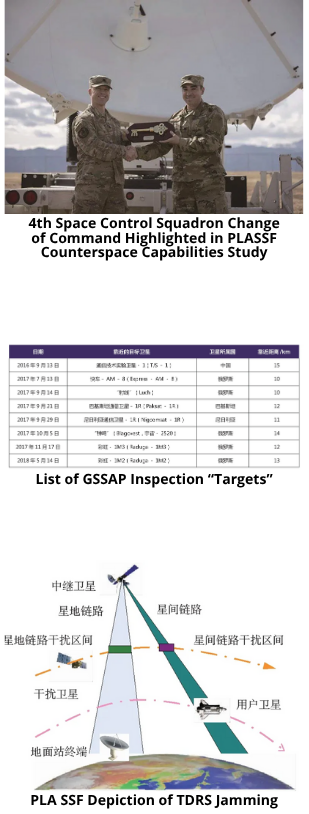
13 Nov 2023: Analysis from Kristen Burke of China Aerspace Studies Institute (and friend of the Flash) reveals that members of the Chinese military believe space-based jamming is a common practice among space powers (notably Russia and the United States). As a result, China claims to have developed an experimental spacecraft to practice signal interference between satellites from geosynchronous Earth orbit. See 2020 China Assessment of US counterspace capabilities.
– The People’s Liberation Army (PLA) researchers described their experimental jammer as targeting communications satellites. Depending on the location and power capacity of the jammer, it could interfere most easily with other nearby communications satellites, or those at lower orbits.
– At least some in the People’s Liberation Army Strategic Support Force perceive that the United States and Russia already have on-orbit spacecraft capable of jamming satellite downlink and crosslinks.
– In 2019, a People’s Liberation Army unit under the Strategic Support Force (PLA SSF) published an academic assessment of Russia’s LUCH-Olymp satellite, noting that they could not rule out that the satellite was carrying an attack payload, probably referring to an electronic jamming payload given the frequency with which it approaches non-Russian communications satellites.
– In 2020 another PLA SSF unit published a paper on American electronic satellite jamming systems, and included what they perceived to be U.S. systems in geosynchronous Earth orbit capable of jamming other satellites. The authors judged that the U.S. Geosynchronous Space Situational Awareness Program (GSSAP) satellites and other national security satellites were capable of space-based jamming.
– China’s perception that other leading countries already have on-orbit jammers, and their commitment to weakening the U.S.’s ability to use satellites in any potential conflict with China, may have driven them to develop their own experimental on-orbit jammer.
– According to PLA SSF technical reports, by 2020 they had tested an experimental on-orbit jamming system, and concluded they needed to develop Ka-band capability.
– In late 2022, the PLA SSF received an invention patent for a method to evaluate if a satellite’s on-orbit jamming capability and electronic reconnaissance capabilities were working.