issue 86 | 10 dec 2023
THE FINAL FRONTIER FLASH
in this issue
China Launches Test Internet Satellites
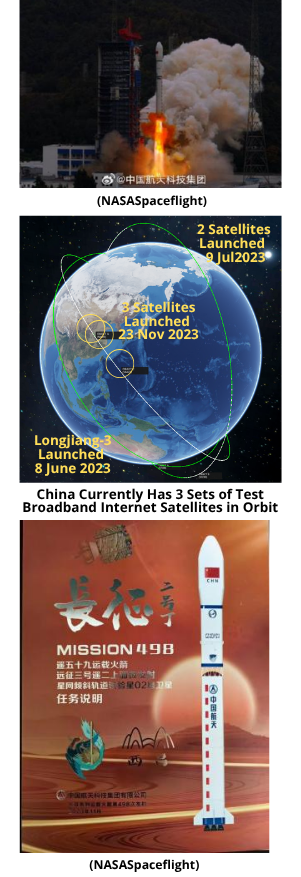
23 Nov 2023: China launched a Long March-2D with what appears to be three new “Satellite Internet Technology Test Satellites” from Xichang. According to official sources, the spacecraft successfully entered the planned orbit and “will carry out the mission of testing satellite internet technologies.” Launch Video.
– The launch announcement described the payloads as Weixing Hulianwang Jishu Shiyan Weixing (Satellite-internet technology test satellite). A similar launch took place on 9 July.
– There is some naming confusion. The satellites are also being called Xingwang Qinxie Guidao 02 zu A/B/C xing (StarNet Inclined Orbit Group 02 Sats A,B,C) and as Chuangxing-20 01/02/03. The satellites are built by the Shanghai Engineering Center for Microsatellites.
– Chinese media provided no details, but described the launch as carrying a single “experiment satellite for satellite internet technologies.”
– The current space catalog shows three objects, one listed as “active” and the other two as “unknown.”
– The most likely application for the satellites is testing for China’s national satellite internet megaconstellation project, Guowang. Analysts expect this program will consist of 13,000 satellites, and compete with other proliferated Low Earth Orbit constellations such as Starlink.
– This is at least the third Chinese launch to test internet technology satellites. It appears China is testing satellites at similar altitudes as western pLEO constellations.
- China announced it launched a single satellite for both the 23 Nov (LM-2D) and 9 Jul (LM-2C) launches. However, both launches used very capable upper stages (YZ-3 and YZ-1S, respectively). As noted, the 23 Nov launch may have delivered three satellites to orbit, while the 9 July launch carried two payloads. Satellites from these launches are operating at ~1,100km altitudes.
- By comparison, OneWeb satellites operate in at a similar altitude, ~1,200km.
- On 8 Jun, China launched a KZ-1A with the Longjiang-3 experimental stackable communications satellite, jointly developed by a commercial satellite company and its parent entity, the Harbin Institute of Technology (HIT). Longjiang-3 is in a considerably lower orbit, 480km.
- Starlink satellites operate at a similar altitude of ~550-570km.
China: Jielong-3 Launches Satellite from Yellow Sea
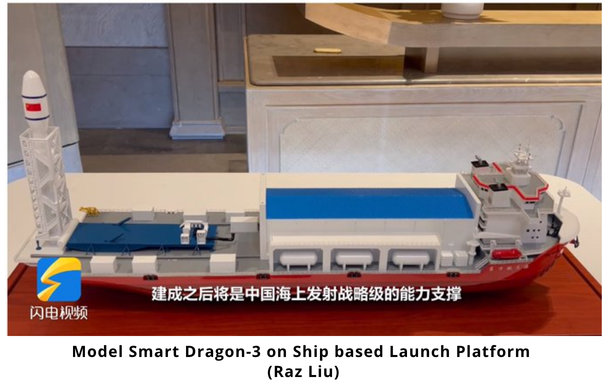
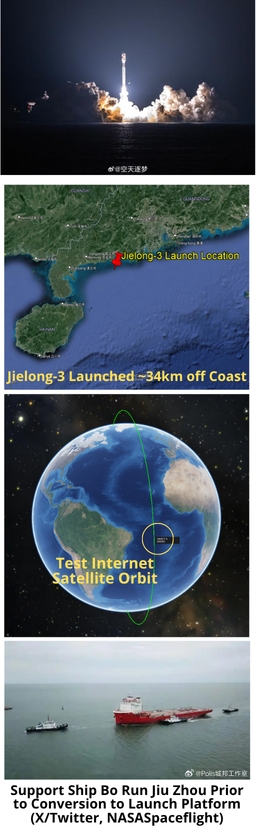
5 Dec 2023: China Rocket Corp conducted its second Jielong-3 (Smart Dragon-3) sea-based launch from the ship Bo Run Jiu Zhou ~34 km off the coast of Guangdong. The payload was another test internet technology experiment satellite. It is in in a 904 x 922 km x 86.5° orbit. No further details regarding the satellite and its capabilities have been released. Launch Video.
– The China Academy of Launch Vehicle Technology (CALT), with funding support from China Rocket Corp (a CALT spin-off), developed the Jielong-3.
– The Jielong-3 is a four-stage solid-fuel rocket that can carry 1,500 kg of payload into a 500 km SSO.
– Jielong-3 has close similarities in terms of lift capacity, length and diameter (2.65 m), payload fairing (3.35 m) and mass at liftoff as the ZK-1A rocket. CAS Space, a commercial rocket arm of the Chinese Academy of Sciences, developed the ZK-1A.
– In contrast to other Chinese solid rockets such as Chang Zheng 11 (Long March 11), this rocket is not “cold launched” from the barge. For Jielong-3, the ignition happens on the barge itself. It produces 2,000 kN of thrust at liftoff. It is launched on a grid, directly over the sea, using ocean water as a suppression system for the booster.
– The rocket sailed aboard Bo Run Jiu Zhou 1,300+ nautical miles over 5 days to the designated launch location in the South China Sea ~34km off the Guangdong Province coast. This was China’s first long-distance sea-based launch.
– Bo Run Jiu Zhou departed from sea launch facilities near Haiyang in the eastern coastal province of Shandong, on the Yellow Sea.
– The ship is equipped with a thermal tent to provide temperature and humidity stability for the Jielong-3 during transit. China Rocket Corp stated the rocket is capable of being transported even in sea state 4.
– The Jielong-3’s initial launch occurred nearly a year ago, on 9 Dec 2022. Also a successful launch, this one carried 14 satellites to orbit.
-With its second successful launch, China Rocket Corp announced Jielong-3 can now be produced via batch assembly of the rocket body, significantly reducing mission response time, compressing the compliance period, and meeting high-frequency launch demands.
– Jielong-3 is designed to complete satellite-rocket technical preparations, and launch within a week. CALT stated the system could launch up to 20 satellites at one time, and will help with rapid constellation deployment.
– CALT also announced their intent to conduct 5+ Jielong-3 launches in 2024.
China: Launches MISRSAT-2 for Egypt
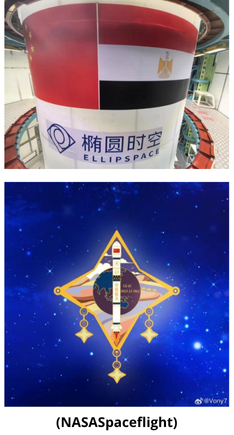
4 Dec 2023: China launched a Long March 2C from Jiuquan, carrying Egypt’s MISRSAT-2 remote-sensing satellite. This spacecraft will deliver imagery with 2 m resolution in panchromatic mode, and 8 m for multispectral images. There were two additional satellites aboard; all are in a 642 x 627 km orbit, with a 98° inclination. China had previously launched two remote sensing satellites for Egypt: Horus-1 and 2. Launch Video.
– According to the China National Space Administration (CNSA), the satellite will assist Egypt’s work on land and resource utilization, water conservancy, agriculture and other fields.
– Part of an international collaboration, China provided Egyptian personnel with satellite design and final assembly test operations training, and supported Egypt in building a satellite assembly and test center.
- This LM-2C launch also carried Starpool 02-A and 02-B remote-sensing satellites, developed by the Chinese company Elliptical Space and Time (EllipSpace).

Egypt Signs Space Cooperation Agreements with China
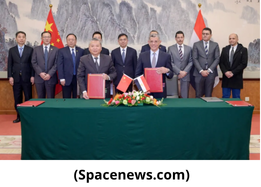
6 Dec 2023: Just days after launching MISRSAT-2, Egypt and China signed a series of space agreements in Beijing. Zhang Kejian, China National Space Administration (CNSA) administrator, and Sherif Sedky, Chief Operating Officer of the Egyptian Space Agency (EGSA), signed a cooperation agreement between the CNSA and the EGSA on the International Lunar Research Station (ILRS). The representatives also signed a memorandum of understanding (MoU) between their respective governments on space cooperation.
– Egypt is the first Arab country to join ILRS, and the second on the African continent to sign up. South Africa joined in September. This effort appears to be part of a wider Chinese space engagement strategy.
-China is making a concerted effort to attract international members to its ILRS project this year. Venezuela, South Africa, Pakistan and Azerbaijan are among the countries which joined in 2023.
China: Space Investments in Africa
In September 2023 the United States Institute for Peace published a report by Julie Michelle Klinger and Temidayo Isaiah Oniosun, regarding China’s increasing use of space science and space cooperation as an incentive for African states to form closer ties with Beijing. The authors look at multiple case studies: financing and training, building satellites and ground stations, and cooperating on satellite navigation and climate monitoring.
– As recognized by the United Nations Development Program, the World Bank, and other major multilateral development organizations, space capacity is crucial for low- and middle-income countries to achieve an array of national development goals.
– African governments have pursued both the development of their own space programs, and international partnerships with established and emerging space actors.
– China makes space science and space cooperation one of the range of incentives — including investment deals, medical assistance, cultural & educational exchanges, and military assistance — all offered to form closer ties to Beijing.
– African governments are investing mainly space capabilities to assist with counterterrorism, and natural disaster preparedness and monitoring.
– The China Great Wall Industry Corporation (CGWIC), a CASC subsidiary, provides commercial space services to other countries. Over the last 30 years, CGWIC has won contracts to build and launch satellites for space programs around the world, in particular those with new and developing space programs.
– Since 2005, African nations have spent US $4 billion to acquire and manufacture satellite technologies. Of this, $2.6 billion worth of contracts went to France, $871.5 million went to China, $587 million to Russia, $101 million to the United
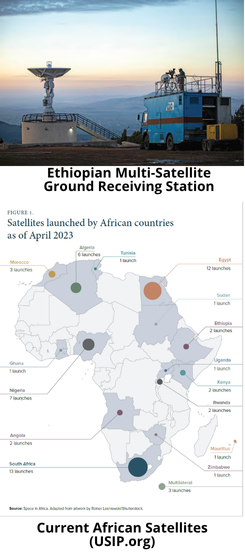
Kingdom, and $250 million to the United States.
– More than 20 African countries now have space programs, fueling an industry that generated $19.49 billion in 2022 and is expected to generate over $22.64 billion by 2026. As of May 2023, 15 African countries had launched a total of 55 satellites.
– The report provides four case studies as examples of China’s efforts in Africa: 1) the role of Chinese finance in Nigeria’s satellite development; 2) China’s role in ground station development in Ethiopia; 3) China’s multilateral cooperation on satellite navigation and positioning; and 4) China’s multilateral cooperation on climate monitoring and disaster management.
China combines space science and cooperation in Africa with investment deals, medical assistance, cultural and educational exchange, arms deals, and military assistance. China has also demonstrated strategic flexibility: space cooperation in Nigeria is accompanied by Chinese investment in telecommunications, while cooperation in Tunisia has been part of a comprehensive infrastructure construction package.
Exit Stage Left: SJ-23 Heads West
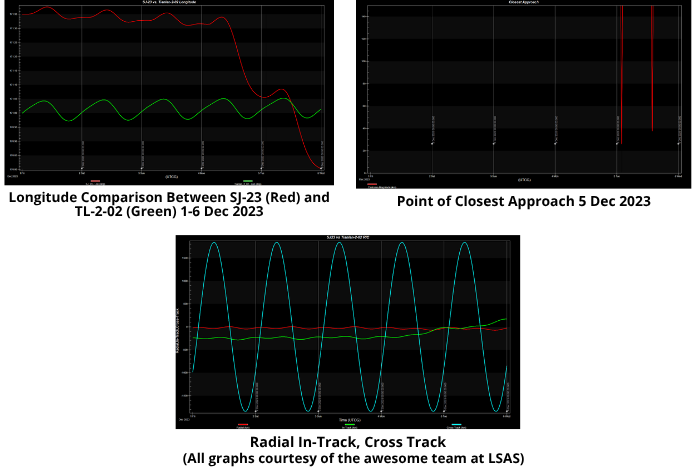
2 Dec 2023: SJ-23 increased its altitude ~45 km and initiated a westward drift. SJ-23 had been located at 171.4° E, just to the East of the Chinese Tianlian-2-02 Data Relay Satellite (which has been located at 171.0° E since it arrived at GEO in Jan 2022). As SJ-23 moved westward there were two “close” approaches on 5 Dec 2023; the first the two satellites came within ~25 km, the second resulted in the satellites came within ~40 km of one another. Chances of collision were minimal and there does not appear to be additional maneuvering other than the altitude change. As of 8 Dec SJ-23, remained at its higher altitude, was at 168.9°E and continuing to move westward at ~0.6° per day. Watch LSAS Video recreation.
Other China Notes:
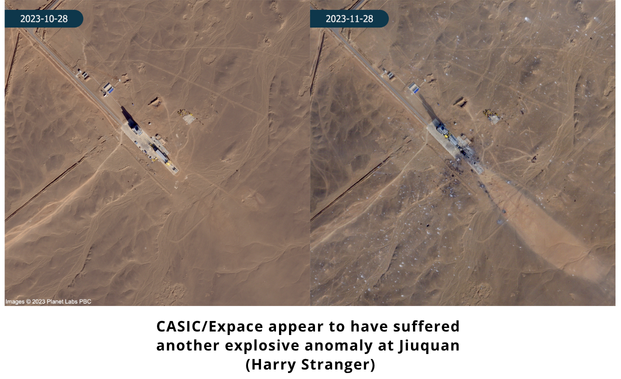
29 Nov: Commercial imagery revealed an explosion at Jiuquan. China made no announcement, but it appears likely to have involved CASIC/Expace, and either a KZ-1a or KZ-11 rocket.
4 Dec: Galactic Energy had a successful return to flight of its CERES-1 SLV. The rocket launched from Jiuquan & carried two satellites: Tianyan 16 (meteorological) & Starpool 1A (remote sensing.)
8 Dec: After operating at a test location of 128.7°E from 17-24 November, Chinasat-6E increased its altitude 107 km on 24 Nov, and drifted West until 5 Dec when it returned back to GEO at 115.5°E. It is now to the West of both Chinasat-6C and 6D.
8 Dec: TJS-3 and TJS-10 continue to operate in the same vicinity, 173.0°E and 173.5°E respectively, both with 0.1° inclination. TJS-10 increased altitude ~3.5 km on 28 Nov, to reverse Eastward drift.
Kingdom, and $250 million to the United States.
– More than 20 African countries now have space programs, fueling an industry that generated $19.49 billion in 2022 and is expected to generate over $22.64 billion by 2026. As of May 2023, 15 African countries had launched a total of 55 satellites.
– The report provides four case studies as examples of China’s efforts in Africa: 1) the role of Chinese finance in Nigeria’s satellite development; 2) China’s role in ground station development in Ethiopia; 3) China’s multilateral cooperation on satellite navigation and positioning; and 4) China’s multilateral cooperation on climate monitoring and disaster management.
China combines space science and cooperation in Africa with investment deals, medical assistance, cultural and educational exchange, arms deals, and military assistance. China has also demonstrated strategic flexibility: space cooperation in Nigeria is accompanied by Chinese investment in telecommunications, while cooperation in Tunisia has been part of a comprehensive infrastructure construction package.
Russia Launches New Imagery Satellite
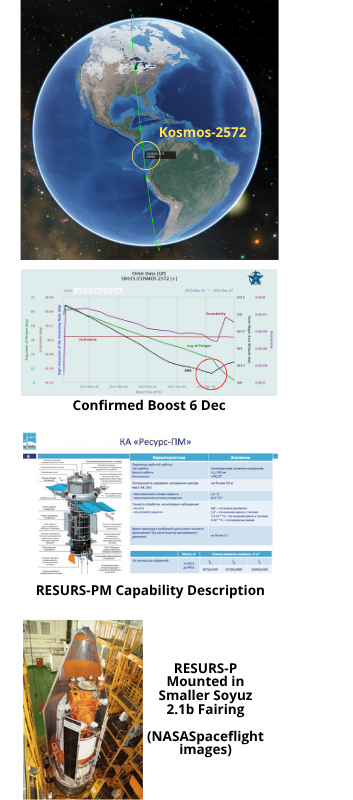
25 Nov: Russia launched a Soyuz-2-1b rocket from Plesetsk. but did not provide any description of the payload. Cataloged as Kosmos-2572, analysts initially believed it to be a new Bars-M imagery satellite. Yet there is growing evidence this is the first phase of the Razdan project. As of 3 Dec, Kosmos-2572 is in a 309 x 290 km orbit with an inclination of 96.6°. At its current altitude, Kosmos-2572 is likely capable of high resolution imagery, perhaps <0.3m. The satellite appears to be settling into its operational altitude after an
initial decrease. Launch Video.
3-5 Dec Analysis from Bart Hendrickx:
– Use of a smaller fairing on this launch points to Kosmos-2572 being a Razdan satellite with a 1.5 m mirror. There is evidence the Razdan satellite is very similar to the planned Resurs-PM — the next-generation Resurs-P satellites.
– Russia has not launched a Resurs-PM satellite, but plans to use the smaller payload fairing. If Razdan has the same design as Resurs-PM (as now looks fairly likely), it could fit inside the fairing used for the November 25 launch.
– It appears there are two phases to the Razdan program:. The first phase satellites have a 1.5 m mirror, and the second will have a 2.35 m mirror (similar to a KH-11 class spy satellite).
– There is evidence the LOMO telescope believed to be on Kosmos-2572 is very similar or identical to the 1.5 m telescope the company is building for Resurs-PM.
– The Resurs-PM project underwent significant changes in late 2018. The launch of the satellite was moved from Vostochnyy to Plesetsk, a clear sign that the project was being partially militarized.
– Resurs-PM is supposed to be placed into a circular orbit at an altitude of around 700 km (although orbits as low as 450 km are also being considered). From an altitude of 700 km, the maximum resolution of the panchromatic and multispectral channels (at nadir) are 0.4 m and 1.6 m, respectively. Assuming Razdan has the same telescope, its resolution from 300 km could be close to what is generally considered the maximum achievable theoretical resolution for a remote sensing satellite: 0.15 m.
– Resurs-PM’s optical payload is also designed to observe other orbiting satellites, so Razdan may be used for space situational awareness tasks as well.
Russia’s Secretive Eavesdropping Satellites
20 & 27 Nov 2023: The Space Review published two articles from the aforementioned Bart Hendrickx. The first article details the background and activities of Russia’s two GEO-based collection satellites: Olimp (aka Luch or Olymp-K 1); and Yenisei-2 (aka Luch-5X or Olymp-K 2). The second article describes the Russian Federal Security Service (FSB) leadership role in the Olimp program, and the ground infrastructure likely supporting the eavesdropping satellites. Following are excerpts from both articles.
-After Luch went into orbit on September 27, 2014, it first drifted to 54.0°E and remained there for three months, seemingly undergoing in-orbit checkouts. It then began moving across the geostationary belt, regularly stopping close to other satellites, something it continues to do nine years after launch.
-The first satellites it visited were the Russian communications satellites Express-AM22 and Express-AM33 — the only Russian satellites it ever approached.
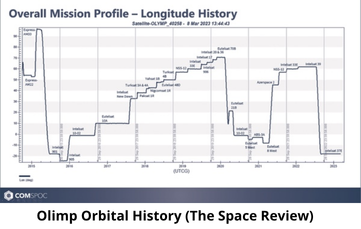
-Since then, it has parked near more than two dozen commercial communications satellites, for periods ranging from weeks to months.
-Currently, Luch is loitering near Intelsat-37e, which it has been shadowing since the summer of 2022, longer than any satellite it visited before. The distances between the two satellites continuously change, with Luch coming as close as 4 km to the Intelsat satellite on 31 October 2022.
– Even though Olimp is essentially a signals intelligence (SIGINT) satellite, it does not need to carry the huge antennas traditionally needed to pick up faint transmissions from the ground. All it has to do is tune its equipment to match the channels in use, record the signals for as long as needed, and then relay them to the ground like an ordinary communications satellite.
– After launch, Luch-5X slowly drifted to 78.7°E and then began moving backwards, finally coming to a stop at 58.0°E. This is where it appears to have undergone its initial orbital checkout, maintaining a normal distance of 0.5° from neighboring satellites.
– Unlike Luch/Olimp, Luch-5X did not stop by any Russian satellites first, and on 22 May settled at 8.9°E, right next to two satellites: Viasat’s KA-SAT (formerly known as Eutelsat KA-SAT 9A); and Eutelsat-9B.
– Luch-5X parted company with the two satellites on 27 September, and one week later arrived at 3.2°E, right next to Eutelsat-3B at 3.1°E. All this undoubtedly is just the beginning of a long voyage through the geostationary belt that will see Luch-5X visit multiple satellites over the coming years. From 3-5 Dec, Luch-5X maneuvered to a new Eutelsat target (53765).
– Available information suggests that Luch-5X uses some of the same payload components as Olimp, but is not identical to it.
– The FSB is not the most obvious organization to lead an effort to eavesdrop on foreign satellites. The FSB (roughly comparable to the FBI) is primarily a domestic security and counterintelligence agency that evolved from the KGB’s internal security departments.
-Currently, there is no evidence more eavesdropping satellites are under construction. The nearly nine-year gap between the launch of Luch and Luch-5X indicates these are not satellites that Russia plans to launch on a regular basis.