issue 75 | 18 jun 2023
The integrity flash
Analysis of Developments in the Space Domain
in this issue
China: New Booster Places 26 Satellites In Orbit
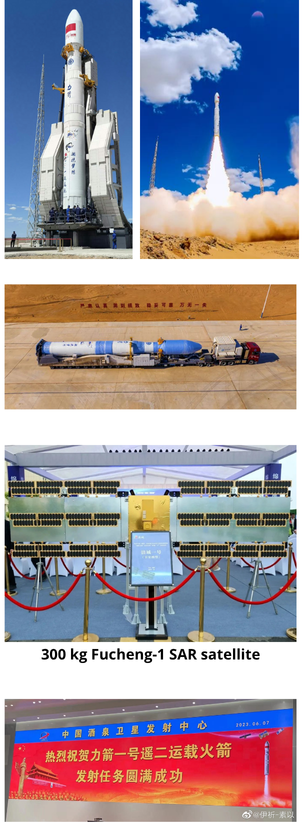
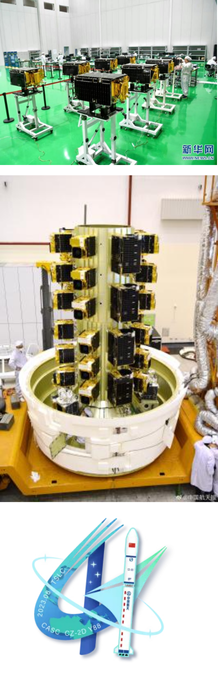
2 Jun 2023: CAS Space’s second Lijian-1 solid rocket lifted off from Jiuquan Satellite Launch Center. Aboard were the Shiyan-24A and Shiyan-24B experimental satellites. The other payloads were described as technological demonstrations and commercial remote-sensing by Chinese state media reports. The 26 payloads aboard the flight surpassed the previous national record of 22 satellites launched by the much larger Long March 8 rocket in February 2022. The new national record short-lived as less than 2 weeks later China launched 41 satellites aboard a LM-2D (see next article). Launch Video.
– Orbital data not available as of 18 June 2023.
-Shiyan series satellites are often classified and understood to be used to test new technologies and payloads for Chinese space systems. These are usually developed and launched by CASC, China’s main, state-owned space contractor.
-Beginning in 2004, China has launched 29 Shiyan satellites, 21 have been launched in the past 3 years.
-China’s Shiyan satellites operate in LEO, GEO and HEO. Most of the missions are unknown.
-China has launched 5 pairs of Shiyan satellites: 1) Shiyan-7A/B (LEO, 2013); 2) Shiyan-12A/B (GEO, 2021); 3) Shiyan-16A/B (LEO, 2022); 4) Shiyan-20A/B (LEO, 2022); and 5) Shiyan-24A/B (LEO, 2023).
– Other payloads known to be on the flight included Xi’an Hangtou-8 for Xi’an Aerospace Investment, and Xingshidai-16 and Tianyi-26 for commercial satellite firms ADA Space and Spacety respectively. Also aboard was Fucheng-1, an interferometric imaging synthetic aperture radar (SAR) remote sensing satellite for the six-satellite Mianyang constellation.
– This launch was the second flight of Lijian-1 rocket, which is China’s largest operational solid propellant launch vehicle. Its inaugural mission launched in July 2022.
-The Lijian-1 is a four-stage, solid-fuel rocket that stands 98 feet (30 meters) tall and is capable of producing 400,000 pounds (181,437 kilograms) of thrust at liftoff.
-On its debut launch last year, the Lijian-1 carried six satellites to orbit. The 2 Jun 2023 mission featured a total payload mass nearly triple that of the first Lijian-1 mission.
China Launches 41 Jilin Imaging Satellites
15 Jun 2023: Less than 2 weeks after setting a new national record for satellites launched by a single rocket, China again broke its own national record. China launched a Long March 2D rocket from Taiyuan carrying a total of 41 small satellites. These were a variety of Jilin-1 imaging satellites, specifically: 30x Jilin-1 GF06A0, 8x Jilin-1GF03D, 1x HEGS-1, & 2x Jilin-1 PT02A01/02. All are owned/operated by Changguang Satellite (CGST).
Launch Video and satellite deployment Video.
– Orbital data not available as of 18 June.
-The 41 satellites add to CGST’s Jilin-1 commercial remote sensing constellation. CGST aims to put more than 300 satellites in orbit by 2025, more than doubling its earlier plan of launching 138 Jilin-1 satellites by the end of that year. Good Video of Jilin satellites being loaded for launch.
-Chinese media reported that all of the satellites launched will have sub-1m resolution.
– The launch consisted of the following 41 satellites: 1) Jilin-1 Gaofen03D19; 2) Jilin-1 Gaofen03D20-26; 3) Jilin-1 Gaofen06A17-18 (Jinzijing37-38); 4) 27x Jilin-1 Gaofen06A; 5) Jilin-1 Pingtai02A01-02; 6) Heerguosi-1; and 7) Hace Nongyao-1.
-The Jilin-1 Gaofen 06A17-18 satellites are small, light, high-resolution optical remote sensing satellites also known as Golden Bauhinia satellites 37-38. They’re part of the Golden Bauhinia constellation planned by the Hong Kong Aerospace Science and Technology Group.
– HEGS-1 is a satellite jointly developed by CGST and Aerospace (Xinjiang) Science and Technology Research Institute Co., Ltd. It’s the first satellite for a constellation focused on aiding the social development of Xinjiang and the construction of the Belt and Road project.
-The PT02A01 and 02 satellites are described by CGST as being low-cost, high-capacity, high-resolution remote sensing satellites carrying the company’s self-developed laser communication loads. They’ll be used to verify high-speed inter-satellite and satellite-to-ground communication technologies.
– With the addition of 41 new satellites the “Jilin-1” constellation is up to 108 spacecraft. The constellation can now achieve 35 to 37 revisits to any place in the world every day.
China Launches Starlink-like Satellite
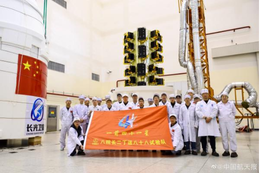
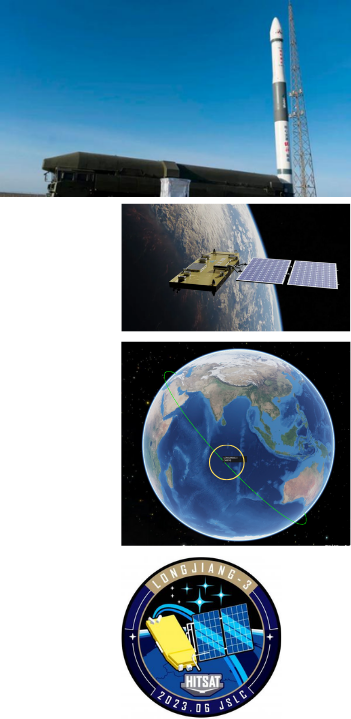
8 Jun 2023: China launched a Kuaizhou-1A solid rocket lifted off from a TEL at the Jiuquan Satellite Launch Center. The China Aerospace Science and Industry Corporation (CASIC) confirmed launch success a short time later. Aboard the flight was the Longjiang-3 experimental stackable communications satellite, jointly developed by a commercial satellite company and its parent entity, the Harbin Institute of Technology (HIT), in Northeast China. Launch Video.
– Longjiang-3 has been cataloged in a 490 x 500 km x 49.1 deg orbit. The satellite will test communication technologies including signal regeneration and network slicing, and provide technical support for China’s satellite Internet construction.
– HITSat was established in December 2020 and is developing a number of small satellite platforms. The SATware-CS200 Ka-band satellite platform, on which Longjiang-3 is
based, is capable of downlink speeds of 600 Mbps and 500 Mbps uplink.
– The platform is designed for mass production, automatic assembly and stacked launches. The configuration makes it similar to SpaceX Starlink satellites.
-Separately, private firm GalaxySpace is expected to launch its first flat panel satellites with flexible solar arrays in the second half of 2023. The country has in recent years greatly increased its small sat production capabilities.
-China is currently developing plans to build its own low Earth orbit satellite megaconstellation that would provide its own answer to Starlink. It would provide satellite internet infrastructure for China and potentially rival Starlink and other systems, while also positioning China as a provider of global infrastructure.
– Known as “Guowang,” or national network, the constellation is expected to eventually consist of 13,000 satellites, according to filings with the ITU. It is not known if HITSat will be involved in the project. Watch Guowang background Video.
-China is at the same time looking to boost its launch capacity to get its Guowang satellites into orbit. Measures being taken include adapting the Long March 5B to use an upper stage to insert numerous satellites into orbit, ramping up production of the expendable Long March 8, and possibly leveraging the emerging commercial launch sector.
China's Use of Lasers for Dazzling & Their Basing
12 Jun 2023: Kristen Burke of the China Aerospace Studies Institute (CASI), published a report detailing China’s intent to use of laser dazzling and other reversible counterspace laser effects. Burke notes it is highly likely the PLA has a mobile laser dazzling capability, and observing these vehicles would be extremely useful and it is time to shift focus from collecting on the Bohu laser development facility.
– People’s Liberation Army (PLA) media and academy theorists more often discuss the benefits of laser dazzling and other reversible counterspace laser effects.
– The operational effectiveness of satellite dazzling is a repeated PLA priority to slow the ‘opposing side’s’ information acquisition cycle. The PLA’s Academy of Military Sciences 2013 textbook on space operations says, “[S]oft kills…such as [with] low power lasers…can achieve the effects needed in operations without producing other collateral damage.” The text further explains that reversible counterspace attacks, or “soft kills,” with lasers are an important means of “commanding space” because “they are not easy to discover, and it is hard to trace their source, so that it is possible to conceal operational intentions fairly well.”
– PLA media in January 2021 stated that “laser blinding weapons have entered the golden age,” and included dazzling satellites as one of the many operationalized uses.
– The SSF conducted a technical study on the use of ground-based laser dazzling “stations” to carry out camouflage and concealment

operations. They determined that in order to prevent a low Earth orbit satellite constellation from imaging a sensitive military operation for one hour, they would need anywhere between 17-27 laser dazzling stations to achieve the minimum of a 72% imagery suppression rate.
-PLA units are working on laser weapons for multiple uses and it it difficult to determine what PLA papers are talking about anti-satellite weapons versus anti-UAV, anti-missile, anti-ship, and anti-tank laser applications.
– It is possible the PLA already has mobile laser ranging capabilities capable of and used for dazzling satellites. CASI flagged the TROS1000 vehicle for the Arms Control Wonk and the Middlebury Institute of International Studies based on their extensive commercial imagery analysis and recent publications. They found a similarly looking domed truck in August 2022 at what is thought to be the Xinjiang facility supporting the PLA’s direct assent anti-satellite missile tests (41.53666, 86.35573). CASI pursued this lead and determined that this truck is camouflage green in color imagery, and was parked at the facility, with the dome closed between July 23, 2022 and September 14, 2022.
Hack-a-Sat Goes to Space: Moonlighter Launched
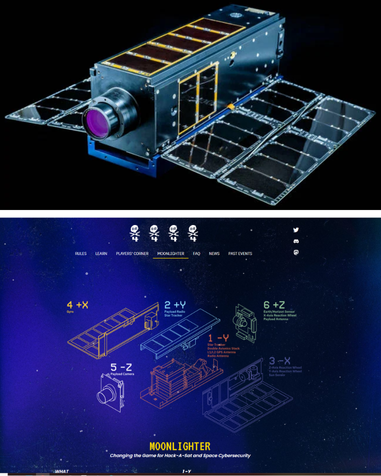
5 Jun 2023: A SpaceX Falcon 9 carried Moonlighter, a new 3U cubesat, among other spacecraft to LEO as part of an ISS re-supply mission. Moonlighter will be part of Hack-A-Sat 4, an annual space security challenge timed with DEF CON that’s hosted jointly by the US Air Force and Space Force. This is the first year that finalists can target a real satellite in orbit rather than a simulation. Watch Moonlighter Overview Video. SpaceX Launch Video.
– Moonlighter will be used as an experimental “hacking sandbox.” Security researchers will use that sandbox as part of a competition taking place at the annual DEF CON hacking conference in Las Vegas later this year. Teams will attempt to infiltrate it all in the service of identifying vulnerabilities in satellites to improve cybersecurity in space.
– Moonlighter is a 3U CubeSat with stowed outer dimensions of 34x11x11cm and flight configuration outer dimensions of 50x34x11cm. Deployable solar panels extend off the long axis of the spacecraft and each deployed array has dimensions 34×20 cm.
– Its mission orbit will be circular between 465km and 500 km altitude and it will be inclined 51.6°.
-Moonlighter is meant to bolster operational security of space objects (as opposed to the data they transmit). It has a dedicated cyber payload with a firewall to isolate the onboard subsystem, along
with a “fully reprogrammable payload computer that behaves like a flight computer, according to an announcement (PDF) from Aerospace Corp.
-A working satellite designed to help improve cybersecurity for space systems by providing a real-time, real-world target for pen testers is an important step forward, given that satellite hacks are hardly theoretical. Early in 2022, the FBI and CISA warned that attacks against satellite ground-based and space-based infrastructure could become a reality. Soon after, in the wake of Russia’s invasion of Ukraine, nation-state cyber operations targeted communications in the region via Viasat and SpaceX’s Starlink satellites.
Transporter-8 Lifts Off with 72 Satellites
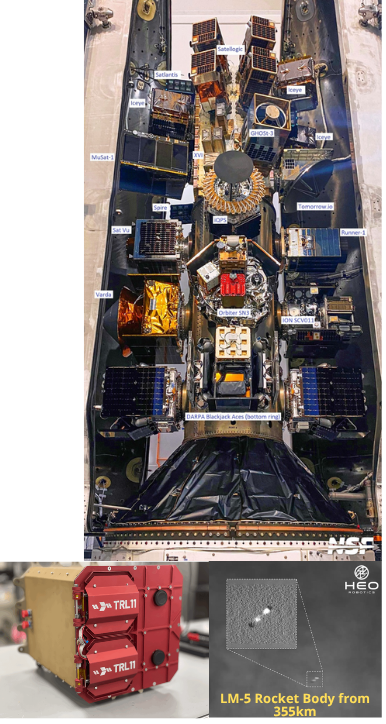
12 Jun 2023: SpaceX launched a Falcon 9 from Vandenberg Space Force Base. Transporter-8 carried 72 payloads including orbital transfer vehicles with satellites that will be deployed later. The satellites were deployed in a 525-kilometer sun-synchronous orbit starting an hour after liftoff. Launch Video.
– The U.S. military used the Transporter-8 mission to launch several satellites. Four satellites for DARPA’s Blackjack program to test satellite constellation technologies were on the launch, as well as three satellites from the Space Force’s Space Systems Command that are part of the Defense Department’s Space Test Program. Two of the satellites, called Modular Intelligence, Surveillance, and Reconnaissance, are imaging cubesats, while the third, XVI, will test the use of Link-16 military communications in space.
– There were several very interesting commercial payloads as well. In particular were 2 spacecraft dedicated for non-earth imaging missions.
– Increasing commercial capabilities to characterize objects in orbit is a critical component to space traffic management and spaceflight safety in the increasingly congested lower orbits where there will be tens of thousands of satellites in the not too distant future.
– High Resolution Satellite-to-Satellite imagery and (even better) video could identify potential threats and monitor suspicious activity in space.
– As part of Launcher’s Orbiter SN3, TRL11 is testing components necessary to capture and stream full motion video for space applications. Transporter-8 is its second mission to space.
– Over the next several weeks, TRL11 will attempt to capture and stream high quality video of partner satellites’ maneuver and docking. This is the first step towards enabling real-time video production and transmission in areas of space where it has been historically limited or unavailable.
– This technology, when developed, can significantly enhance situational awareness, earth observation, and spacecraft monitoring (think Ring for Space) applications. It can also be tremendous tool for anomaly analysis.
– Also flying on Transporter-8 was a dedicated non-earth imaging camera from HEO
Robotics. HEO Robotics’ Holmes Imager is
the world’s first commercial camera
dedicated to non-Earth imaging.
There is currently one more Transporter mission
scheduled for 2023, launching no earlier than
October.
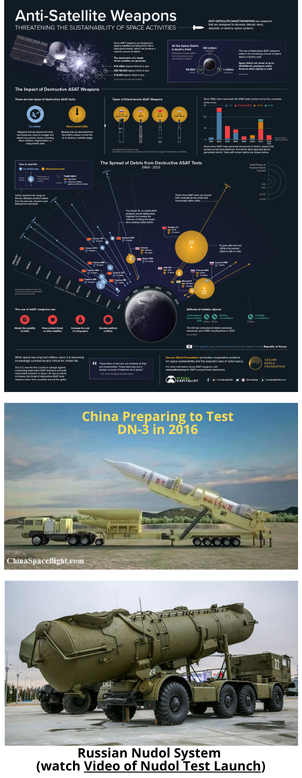
ASAT Generated Debris Creating "Bad Neighborhoods"
16 Jun 2023: A report from Breaking Defense highlights that a trio of satellite breakups — two caused by anti-satellite (ASAT) missile tests — are responsible for a large percentage of dangerous debris in the ever-more popular real estate of low Earth orbit, creating an especially “bad neighborhood” there, according to space traffic observers at LeoLabs.
– A disproportionate number of conjunctions are due to 3 events: 1) the destruction of China’s Fengyun-1C satellite in a 2007 ASAT missile test; 2) Russia’s similar destruction of the Cosmos 1408 in 2021; and 3) the non-deliberate collision of Cosmos 2251 with an Iridium satellite in 2009.
– These three on-orbit breakups account for 15 percent of debris cataloged in all near-Earth orbits since the US military started keeping tabs in the late 1950s.
– The space junk pile up has created what LEO Labs analyst Bhatia called a “bad neighborhood” in the 700 to 900 kilometer band of LEO. That orbital altitude is also being used by the Space Development Agency for its planned Transport Layer of 300 to 500 high-speed, high-volume communications birds.
–Secure World Foundation hosted its 5th Summit for Space Sustainability in early June. At the event, Eric Desautels, deputy assistant secretary of arms control, verification and compliance at the State Department, noted the Russian and Chinese tests are responsible for “pretty much 20 percent” of “conjunction” warnings, that is predictions that two space objects are likely to collide, in 2022.
– Space Command data shows that there were 1,486 conjunctions involving the International Space Station in 2022, which Desautels noted “was a 233 percent increase from 2021. And that increase was largely conducted because of the debris from the anti-satellite missile tests, and also required us to maneuver the International Space Station two times last year.”
-Desautels also stated “that debris is going to reduce the life of satellites because they’re using fuel to maneuver. It’s going to increase the cost to companies and to governments. … That is something obviously we want to avoid.”
-The US government is pushing a voluntary moratorium on destructive ASAT missile tests, putting forward a UN General Assembly resolution calling on states to individually commit that passed in December with 155 of the UN’s 193 member states voting yes.
-There were 9 “no” votes: Russia, China and then their close allies, [including] Cuba, Iran, Syria, Nigeria.
-13 nations have joined the US in formally pledging themselves to the testing moratorium.
China-Egypt Cooperate on Satellite Monitoring Facility
8 Jun 2023: Egypt plans to establish the world’s second largest (after China) satellite and space debris monitoring station according to Rasha Ghoneim, the head of the Space Research Laboratory at the Egyptian National Research Institute of Astronomy and Geophysics (NRIAG).
– Egypt is building a new station which will use laser beams to monitor satellites and space debris. Work is underway to install the dome of the station, in which the telescopes will be placed. Egyptian officials also noted that the station is being built with cooperation with China.
– China started work a month ago on the dome, which will take two months to be established. Another dome will be constructed at the station after the first one is completed.
– The station will have two telescopes – the first with a diameter of 120 cm, and the second with a 70cm diameter.
– Egypt expects to receive the first telescope from China within the next month and a half. The trial operation phase will take place after receiving the first telescope, with the

trial operation phase to start within two months from now (in Aug).
A Chinese delegation of experts will train Egyptian engineers and technicians to operate the station, in the trial operation phase. The larger telescope will be for space debris, while the second telescope will monitor space debris and satellites.
– The smaller telescope is expected to be dispatched in August.
– In addition to the telescopes, the station will be equipped with two laser devices for monitoring, as well as optical monitoring.