issue 69 | 26 mar 2023
The integrity flash
Analysis of Developments in the Space Domain
in this issue
Russia Launches Olymp-K-2 Military Satellite
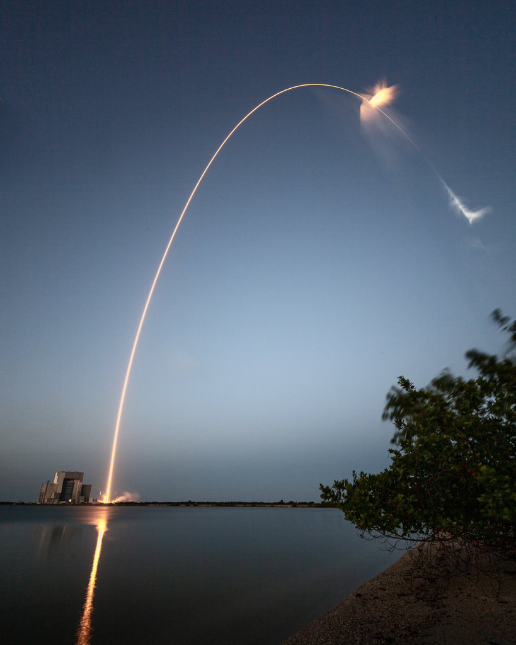
12 Mar 2023: Russia launched a Proton-M rocket from the Baikonur Cosmodrome, carrying the Olymp-K-2 satellite, also referred to as Luch-5X (catalog 55841 or 2023-031A) . The Olymp-K satellites are Russian geostationary satellites built for Russian military and intelligence use. Russia has not released any Launch Video.
– The Proton launched the Olymp-K-2 satellite directly into geostationary orbit (GEO).
– As of 14 Mar Olymp-K-2 was at 57.3°E, ~240km under the GEO belt and drifting eastward. Reporting indicates the satellite will park at 167°E.
– Given current drift rate of 3.1° per day, Olymp-K-2 should arrive at 167°E on 18 Apr 2023.
– The Olymp-K satellites, also referred to as Luch, are Russian geostationary satellites built for the Russian Ministry of Defense as well as the Russian intelligence agency FSB.
-Russia did not disclose the purpose of the satellites, however they are believed to serve two purposes. The first is conducting signals intelligence (SIGINT) and the second to provide secure communications lines for government use.
–Early unofficial reports about plans to launch the second Olymp-K payload on a Proton rocket surfaced in 2020. At the time, the launch of what was officially identified as the Luch-5 data-relay satellite was expected during 2021.
-The previous Olymp satellite, Olymp-K-1, was launched in Sept 2014 by a Proton-M/Briz-M and moved into a position at 18.1° W seven months after launch. This positioned the satellite directly between the Intelsat 7 and Intelsat 901 satellites, which are located within half a degree of each other in geostationary orbit.
– As recently as Dec 2022 Olymp-K-1 operated in the
vicinity of Intelsat 37E, it has since moved on and is not in proximity with any active satellite (it is near an old Russian SL-12 Rocket Body.) Information courtesy of Palski SDA Reports (2 Dec 2022 & 17 Mar 2023)
-Normally Russian military satellites are given “Kosmos” designators, as US military satellites are listed as “USA.” Olymp-K-1 didn’t get a Kosmos designation; supporting the idea that it is owned not by the MoD, but by the FSB.

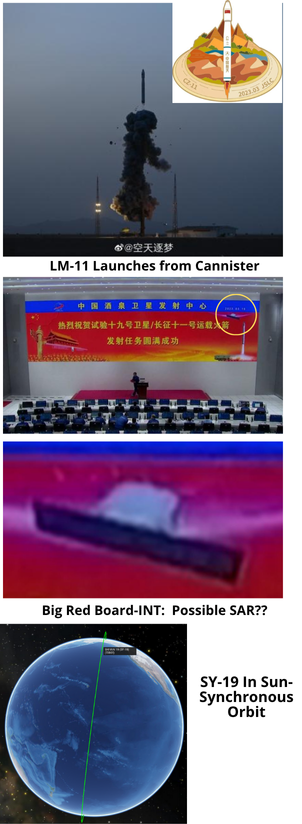
15 Mar 2023: China launched a Long March (LM)-11 from Jiuquan carrying the Shiyan-19 satellite, into a Sun-synchronous orbit. China officially described the mission as “land census, urban planning, and disaster prevention and mitigation.” This description has been given to multiple satellites in the past, and a more exact purpose is unclear. Launch Video. (note “cold-boost” phase of the LM-11 is not displayed in launch video for some reason.)
-Shiyan-19 is currently in a 492x511km, 97.5° inclination…sun-synchronous orbit.
-Shiyan-19 is in a unique orbit compared to other Shiyan, Shijian, Yaogan and Gaofen satellites.
-The Shanghai Institute of Satellite Engineering (509th institute) of the Shanghai Academy of Spaceflight Technology (SAST) developed the satellite. SAST stated the mission uses a platform providing low-cost miniaturized, lightweight, and high-functional density satellites. SAST itself is a major space launch vehicle and satellite maker under CASC.
-While not releasing any specific statements on Shiyan-19’s mission or capabilities, the image on China’s Success Announcement appears to be a synthetic aperture radar (SAR) satellite. <huge grain of salt>
-Shiyan are understood to be a series of test satellites, with the first launched in 2004. Shiyan satellite numbers are often non-sequential and sent into a variety of orbits.
– This is the second Shiyan payload the LM-11 has placed into orbit, The LM-11 most recently launched the Shiyan-21 satellite from Xichang in southwest China. There have been 4 LM-11 launches of Gaofen satellites.
-The LM-11 is a silo-launched rocket, which is ejected from a tube on a truck before igniting its engines in the air. It is designed to be a short-notice rocket that can be launched quickly and flexibly. This is also why it is based on solid propellants, and makes storing the rocket in an already readied configuration easier.
-In a second configuration, CZ-11H, it can be launched from sea assets in the Yellow Sea. It can lift up to 700kg to LEO and 350kg to SSO and is more for the smaller payloads of the Chinese fleet.
– This is the first LM-11 launch of 2023, but Chinese officials hinted in the past that a few more LM-11 launches could be flown this year. So far, the rocket has a perfect track record.
13 Mar 2023: China launched a LM-2C from Jiuquan. The payload was the second of two Horus satellites (likely imagery) and is now in a 489×502 km orbit with an inclination of 97.5°. The Horus-2 satellite is co-planar with its predecessor. Launch Video.
– Horus 2 is an Egyptian satellite partially built by the China Academy of Launch Vehicle Technology (CALT). Horus-1 launched in February of this year, just weeks ago, on the same rocket configuration. Besides the fact that it is an Earth observation satellite, very little is known about the payload, including mass, size, and detailed purpose.
-The Egyptian Space Agency (EgSA) confirmed the satellite would help with sustainable development goals with “high-resolution imaging cameras.”
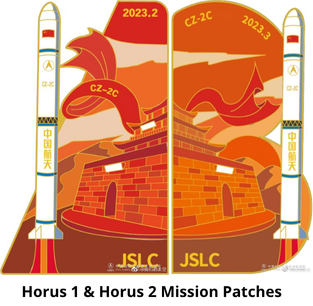
– The design of the mission patch mentions the “One Belt One Road Initiative,” referring to the Chinese initiative to build transportation and trade links throughout Asia, Europe, Africa, and the world.
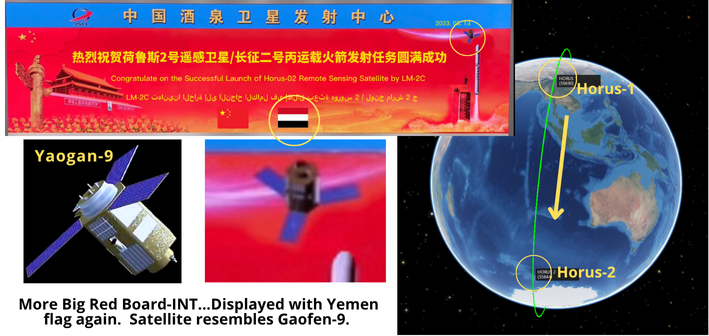
– IF the satellite on the launch announcement is
accurate (big IF) it resembles the Gaofen-9.
– China launched the 1st GF-9 in 2015, then another 4 launched in 2020.
-The orbits of the Horus satellites do closely resemble those of the GF-9 satellites China launched in 2020 (GF-9 02/03/04 & 05). All have SMA values within 2.5km and identical inclinations.
– The GF-9 satellite provides sub-meter class resolution optical images for city planning, road network design, land ownership determination purposes.
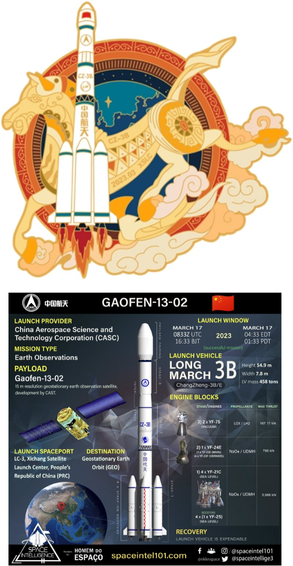
17 Mar 2023: China launched a Long March 3B from Xichang and successfully sent the Gaofen-13 (02) satellite into geosynchronous transfer orbit. CASC announced only that GF-13-02 was a high-resolution, high-orbit optical optical remote sensing satellite with great significance to the development of China’s space technology. GF-13-02 joins Gaofen-13-01 (2020) and Gaofen-4 (2015) as other optical satellites in GEO. Launch Video.
– The Gaofen-13 (02) (gaofen means high resolution) satellite is nominally part of the civilian China High-resolution Earth Observation System (CHEOS). Land surveys, crop yield estimation, environmental governance, meteorological early warning and forecasting, as well as comprehensive disaster prevention and mitigation are noted as the main uses of the satellite, according to Chinese state media.
-CHEOS started in 2010 to provide all-weather, all-day coverage with optical and synthetic aperture radar satellites. The constellation includes a range of optical and synthetic aperture radar satellites in Low Earth Orbit. Prior to Gaufen-13, the Gaofen-4 was previously the only CHEOS GEOSAT.
-The first Gaofen-13 satellite was launched in Oct 2020, also using a Long March 3B rocket. The pair are thought to be more capable versions of the Gaofen-4 geostationary optical satellite launched in Dec 2015. Gaofen-13 is expected to have a resolution of 15m. Gaofen-4 has a reported ground resolution of 50m.
-As of 25 Mar Gaofen-13-02 was still listed in Geostationary Transfer Orbit (GTO). Last updated orbit in Spacetrack.org was from 18 March. Check back in a couple of weeks to see where 13-02 settles in GEO.
-It may replace Gaofen-4 which has been on orbit for nearly 8 years, or the potential to move westward to increase surveillance of the Central Pacific.

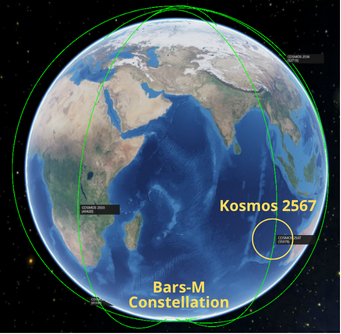
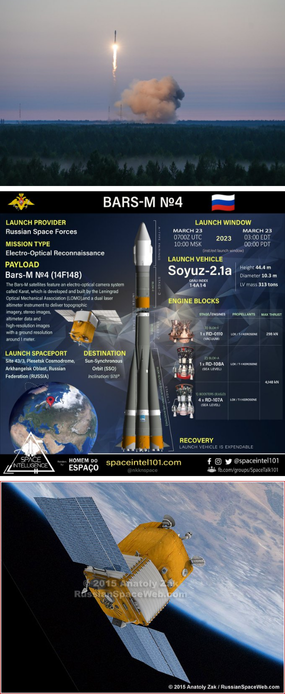
23 Mar 2023: Russia launched a Soyuz-2.1a rocket with likely a Bars-M reconnaissance satellite (now renamed Kosmos 2567) into Sun-synchronous orbit. The Soyuz lifted off from the Plesetsk Cosmodrome. Launch Video.
– The orbit into which Kosmos 2567 has been deployed is consistent with the Bars-M series of satellites, which carry out electro-optical surveillance.
–Kosmos 2567 is in a 338 x 499km x 97.64° orbit, similar to the initial one for previous one identified as Bars-M (Kosmos 2556 last May).
-Previous Bars-M satellites were initially launched into orbits with apogees about 40-60km higher than this, however Kosmos 2556 was moved into its lower orbit last year. The likely intent allows satellites to take higher-resolution images, although the increased fuel consumption required to maintain orbit at these lower orbits could also shorten their operational lifespan.
– It is not clear whether the first and second Bars-M satellites are still operational, and they have not been maneuvered into the new, lower, orbit.
-Bars-M is one of several series of reconnaissance satellites that Russia introduced in recent years in attempts to fill the gap left by the retirement of its obsolete film-return Kometa and Kobal’t-M satellites. Other imaging satellites included the now-ended Persona series and the smaller EMKA. Thursday’s launch has placed the fourth Bars-M satellite into orbit.
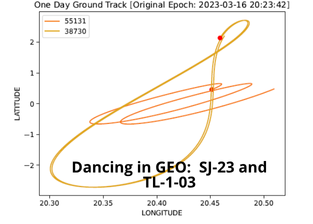
March Madness: SJ-23 comes within 4km of TL-1-03
18 Mar 2023: It appears SJ-23 had a Point of Closest Approach (POCA) of 3.537kms with the Chinese Relay Satellite TL-1-03: 3.537 km on 18 Mar 2023 at 16:38:42 UTC. Information courtesy of the Palski Space Domain Awareness Report.
After orbiting in vicinity of AEHF-6 for about 6 weeks, TJS-3 lowered its orbit 57kms and has begun drifting eastward at ~ .8° per day. It has re-located 11.4° east since 24 March 2023.
SJ-17 has re-joined the GEO belt at 115.3°E as of 6 April 2023. SJ-17 decreased its orbit 42.9kms from 25-26 February 2023 and relocated nearly 21° east of its former 94.2° GEO slot. SJ-17 had been at 94.2° since 6 September 2022.
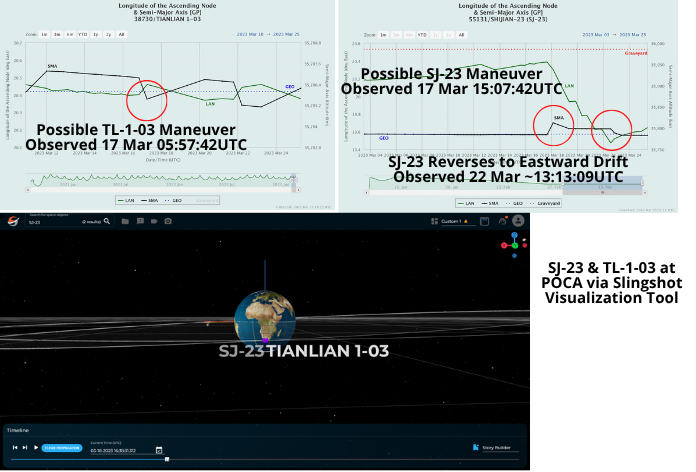
the two operators were not talking and conducted a maneuver to increase miss distance.
– It is possible that the observations were mis-associated due to the proximity.
-SJ-23 continued to drift West until it was .9° away from TL-1-03. On 22 Mar ~13:13:09UTC, SJ-23 decreased SMA 15.6km reversing it’s drift. SJ-23 is now 3km beneath the GEO belt and slowly drifting eastward back toward TL-1-03. At current SMAs the two spacecraft will again be in proximity on 9 Apr.
–China launched Shijian-23 on 9 Jan 2023 from Wenchang using a LM-7A. Launch Video.
–Shijian-23, released a small object on ~19 Jan 2023. SJ-23 was initially thought of as a likely follow-on to SJ-13, a communications satellite. However, the release of a sub-payload is more indicative of SJ-17, TJS-3 and SJ-21.
19 Mar 2023: An opinion article written by Air Marshal Anil Chopra, the Director General, Centre for Air Power Studies argues Space superiority is key for modern information-centric wars and then describes developing Chinese capabilities and posits China is in a position to dominate the future of space and replace the US as the number one space nation in the world. He argues that while India has a successful space program there is much more to be done.
-China invests heavily on spy satellites, dozens of which snoop around the world at any given time. The Yaogan series and JianBing satellite constellations can accurately pinpoint signal emissions and provide surveillance. They cut down revisit time, and will eventually give continuous coverage. China is also developing a series of data relay satellites.
-China continues to improve its counter-space weapons capabilities. The PLA routinely incorporates jamming and anti-jamming techniques against multiple communication, radar systems, and GPS satellite systems in exercises. PLA will target space-based C4ISR assets. China continues to develop jammers to target SAR aboard military reconnaissance platforms, including LEO satellites, and to

target SATCOM over a range of frequency bands.
-China is pursuing space and ground based laser weapons to disrupt, degrade, or damage satellites and their sensors. China is developing on-orbit satellite inspection and repair capabilities, some of which could be used to remove an adversary satellite. PLA already has operational ASAT units. They are working on ASAT to destroy GEO satellites.
-China is well on its way to becoming the world leader in space technology through its new “Space Silk Road”. China claims to have shipped millions of BeiDou receivers to nearly 120 countries. These systems include microchips and modules which could give China information access.
-India has a robust space program and is among the top four space faring nations. But clearly China is pulling way ahead.
-The Indian military has dedicated ISR, ELINT and communication satellites. These also support network-centric warfare capabilities. India needs many more satellites with high resolution sensors and cameras to reduce revisit time, have continuous coverage of specific areas, and redundancy,
-There is a need to enhance space-based, jam-resistant ISR, ELINT, and EW capability. As military requirements for space capability increased, India set up the Defence Space Agency, now headquartered in New Delhi. It may upgrade to a Space Command in the future.
-Indian Regional Navigation Satellite System “NavIC” currently has 8 of the 11 satellites in place. It reportedly covers the whole of China, Pakistan and most of the Indian Ocean. Global Indian Navigation System (GINS) with 24 satellites is still a work in progress. ISRO proposed to expand the constellation for global coverage by initially placing twelve satellites in Medium Earth Orbit (MEO).
China’s space program requires a close watch. It has serious implications for its adversaries, including India. The high investment is difficult to match. India would need to keep pushing its space program to not let the gap grow too large.
21 Mar 2023: An Ars Technica article describes how Kazakhstan’s seizure of equipment and material at the Baikonur Cosmodrome may further delay a $1 billion development project.
– The Soviet Union created the Baikonur Cosmodrome in 1955 to serve as a test site for intercontinental ballistic missiles. It later became the world’s first spaceport with the launch of the historic Sputnik 1 and Vostok 1 missions. The sprawling cosmodrome was a mainstay of the Soviet space program.
-Since the early 1990s Russia has leased the spaceport from the government of Kazakhstan and currently has an agreement to use the facilities through the year 2050. Russia pays an annual lease fee around $100 million.
-Russia began developing the Soyuz-5 rocket in 2017. The Soyuz-5 is a three-stage rocket powered by RD-171 engines that burns kerosene fuel. Russia is counting on this vehicle to replace its aging Proton-M rocket and be more cost-competitive with commercial rockets such as SpaceX’s Falcon 9 booster.
-Russia plans to launch the Soyuz-5 rocket from the “Baiterek” launch pad at Baikonur and intended to initiate preliminary construction work on the site in 2022. But those plans now face significant uncertainty.
-In early Mar 2023, the Republic of Kazakhstan seized TsENKI’s (a subsidiary of Roscosmos) Center for Utilization of Ground-based Space Infrastructure, in Kazakhstan.
-TsENKI is responsible for launch pads and ground support equipment for the Russian space corporation.
-Russia has spent nearly $1 billion on the development of the new Soyuz-5 rocket as well as plans for its launch site and ground services originally slated to debut in 2021. Now it is unlikely until at least 2024—and given the current dispute with Kazakhstan, it will be delayed even further.
-Russia’s invasion of Ukraine appears to have changed the calculus of the Russia-Kazakhstan relationship. Kazakhstan’s president, Kassym-Jomart Tokayev, apparently sees Russia’s preoccupation with Ukraine as a window of opportunity to assert greater autonomy for Kazakhstan.
-Kazakh Communications Minister Bagdat Musin spearheaded the dispute over TsENKI’s assets in Kazakhstan, and sees political value in asserting their independence from Russia. Musin said his government needed to seize the assets, in part, because of a lack of communication with Yuri Borisov, the Roscosmos Chief, regarding payments.

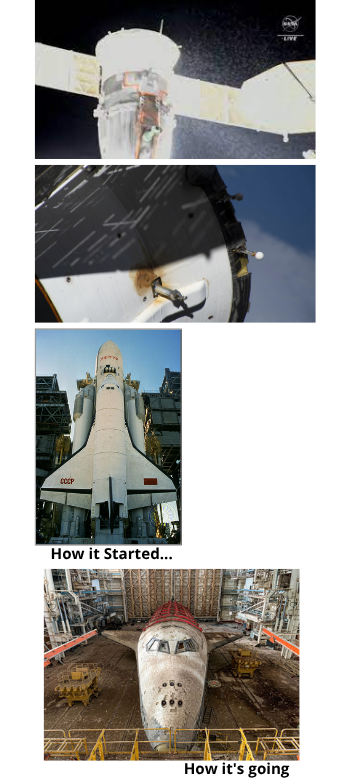
20 Mar 2023: A Wired article describes Russia facing evidence that its already-struggling space program is falling apart. In the past three months alone, Roscosmos scrambled to resolve two alarming incidents. First, one of its formerly dependable Soyuz spacecraft sprang a coolant leak. Then the same thing happened on one of its Progress cargo ships. Russia’s space agency is staring into the abyss.
– Russian signals-intelligence equipment likely pinpoints the devices by scanning for suspect transmissions.
– Ukrainian drone operators also report prolonged jamming that kept them from using Starlink units…the jamming began two to three months ago, and that its intensity varied from place to place.
– Starlinks are particularly vulnerable to GPS jamming. Each terminal uses a GPS unit to determine which passing satellite should provide an internet connection.
– Fortunately for Ukraine, GPS jammer signals are low power. This means that dirt or concrete can block the jammer signal. As long as a Starlink device has a barrier between it and the Russian jamming signal, it can continue to function
-Another countermeasure is to place a cheap GPS-receiver device outside jamming range and then manually enter its location into their Starlink terminal, offset by their distance to the GPS receiver.
-Ukrainians began to experience Starlink uplink degradation near Bakhmut in Jan to the point that units often couldn’t make audio calls. Instead, the device could only send and receive text messages. The Starlink terminal also took longer to find satellites.
– These problems were likely due to advanced jamming systems that attack the uplink of information to a satellite. Russia typically keeps these systems in reserve to defend Russian territory itself. They are theoretically vulnerable to Ukrainian strikes as they must be deployed near their target and are not highly mobile.
– Other Ukrainian units report no issues with Starlink connectivity.
– Russian forces could be rotating jamming operations across the front, focusing on high-priority areas. Ukraine may also be targeting Russian electronic-warfare units. Ukraine regularly shoots down Russia’s Orlan drones, for example, which can carry electronic-warfare payloads.
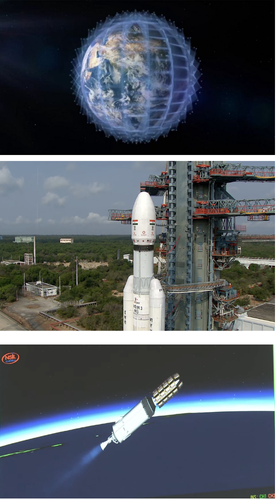
25 Mar 2023: BBC reports on the completion of the OneWeb proliferated Low Earth Orbit (pLEO) constellation. India successfully launched the 36 OneWeb satellites on 26 Mar. The launch take the in-orbit constellation to more than 600 and will enable OneWeb to deliver broadband internet to every corner of the Earth. Launch Video.
– The 36 spacecraft rode on India’s biggest rocket, the LVM3, in the latest launch from Sriharikota Spaceport. The launch brings the number of satellites from 582 to 618. Another 15 spares will launch in May and be joined by technical demonstration spacecraft.
– It will take some months to test the satellites and move into the right part of the sky, but when they are in position OneWeb will have the capability to deliver a global service.
– OneWeb is not selling broadband connections direct to the individual user. Its principal clients are internet service providers. Additionally, they might also employ the increased connectivity to supplement, or expand, their mobile phone network infrastructure.
-The system requires ground infrastructure for satellite command and control and link them to the internet. This should be fully up and running by the end of 2023.
– OneWeb spacecraft operate from 600-1,200km, about twice the altitude of Starlink.
– OneWeb plans to expand its network in the coming years to include bigger, more powerful spacecraft. But contrary to earlier indications, the constellation will probably be kept under 1,000 satellites.