issue 72 | 7 may 2023
The integrity flash
Analysis of Developments in the Space Domain
in this issue
Russian GPS Jamming Effects on UKR HIMARS
6 May 2023: CNN report details Russian Electronic Warfare, specifically GPS Jamming, effects on the accuracy of the 83km range HIMARS rocket system. One drone pilot on the Eastern front described the jamming of the mobile HIMARS as “significant,” and something he hadn’t seen in his area before last November, several months after the HIMARS first arrived in Ukraine at the beginning of the summer.
– Russia has been thwarting US-made mobile rocket systems in Ukraine more frequently in recent months, using electronic jammers to throw off its GPS guided targeting system to cause rockets to miss their targets.
– Ukrainian military officials, with US assistance, have had to come up with a variety of different workarounds
– Ukraine has received 18 American HIMARS to date and the US has committed to sending 20 more. Other NATO allies have donated 10 Multiple Launch Rocket Systems, according to the State Department.
– The US has also helped the Ukrainians locate the Russian jammers and destroy them – a “high priority” effort, according to a secret Pentagon document that was part of a trove allegedly leaked by Airman Jack Teixeira. “We will continue to advocate/recommend that those jammers are disrupted/destroyed,” the document says, “to the maximum extent possible.”
– GPS jamming can affect other “smart” US munitions like the precision-guided Excalibur artillery shells fired from Howitzers and air-dropped bombs called JDAMs.
– Four of nine extended-range JDAMs used by Ukraine missed hitting Russian targets, possibly due to jamming.
– Depending on the location and strength of the jamming, a rocket can still successfully hit with significant damage. In addition to GPS guidance, the rockets have inertial navigation systems that are not susceptible and remain accurate, though not as precise
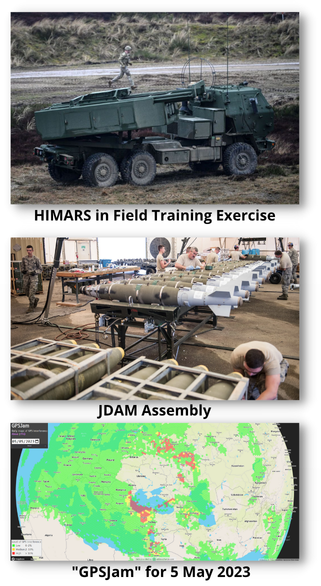
as when guided by GPS coordinates.
– As of Feb 2023, Ukraine had expended approximately 9,500 HIMARS rockets.
– Russia’s use of electronic warfare has not been nearly as widespread as expected but they have made use of it since the beginning of the war.
-With Russian units largely stalled on the Ukrainian frontlines and stuck in defensive positions, Russian forces have made increasing use of their jamming systems to counteract the HIMARS.
-More broadly, Russia has been employing GPS jamming more frequently in its own cities, likely as a result of successful long range Ukrainian attacks. GPS issues were first spotted by the monitoring system GPSJam, which uses data from planes to track problems with the satellite navigation system.
ASAT Development Activity at China's Korla Facility
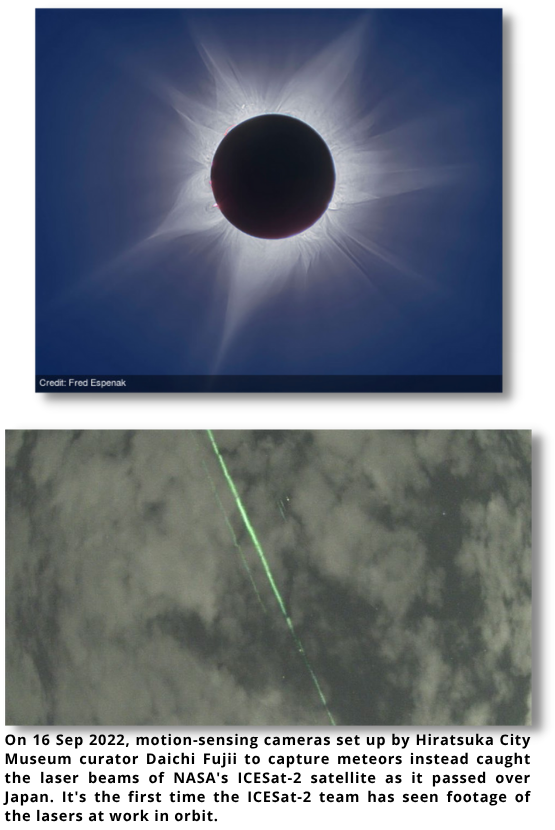
1 May 2023: Black Sky released a report showing a pattern of engaging foreign satellites with directed energy weapons at Korla East Test Site.
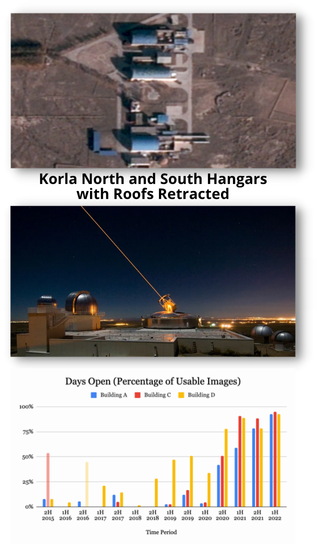
– Satellite imagery from geospatial intelligence company BlackSky has uncovered a pattern of behavior at the Korla East Test Site that is consistent with China’s development of technology to disrupt, destroy or hijack foreign satellites.
– Satellite images of Korla East Test Site featuring two laser gimbals with supporting infrastructure, housed within separate hangars with retractable roofs, to the north and south of the compound, reveal that this site holds ASAT weapons. The evidence suggests a pattern of opening the hangars to operate the ASAT lasers around solar noon, the time when foreign imaging satellites are most active.
– According to satellite tracking data for a sample of days within the observation period, a large number of satellite companies orbited within line of sight of the Korla facility during active ASAT periods, including SpaceX’s Starlink communications satellites, and constellations of commercial geo-imaging satellites that include the companies Spire and Planet Labs. National military satellites may also have been in the region during this time.
-The ASAT located at Korla East Test Site are laser
– Satellite imagery from geospatial intelligence company BlackSky has uncovered a pattern of behavior at the Korla East Test Site that is consistent with China’s development of technology to disrupt, destroy or hijack foreign satellites.
– Satellite images of Korla East Test Site featuring two laser gimbals with supporting infrastructure, housed within separate hangars with retractable roofs, to the north and south of the compound, reveal that this site holds ASAT weapons. The evidence suggests a pattern of opening the hangars to operate the ASAT lasers around solar noon, the time when foreign imaging satellites are most active.
– According to satellite tracking data for a sample of days within the observation period, a large number of satellite companies orbited within line of sight of the Korla facility during active ASAT periods, including SpaceX’s Starlink communications satellites, and constellations of commercial geo-imaging satellites that include the companies Spire and Planet Labs. National military satellites may also have been in the region during this time.
-The ASAT located at Korla East Test Site are laser
China Commercial Sea Launch Coming 2023
28 Apr 2023: Chinese rocket startup Orienspace is moving towards a debut launch from a sea platform in 2023. The Gravity-1 rocket will launch from a mobile sea platform developed as part of sea launch facilities developed at Haiyang in Shandong province before the end of 2023. Watch Orienspace Promotional Video.
– Gravity-1 consists of three solid stages and four side boosters. The rocket will have the capability to lift a payload of 6,500kg to low Earth orbit (LEO), or 3,700kg to a 700km sun-synchronous orbit (SSO).
-When completed, Gravity-1 will be China’s and the world’s most capable all-solid orbital launch vehicle. Gravity-1 will also have the greatest lift capacity of operational rockets in China’s budding commercial space sector so far.
– Space Pioneer’s Tianlong-2—China’s first privately operated liquid propellant rocket to reach orbit—set the current commercial record earlier this month. Tianlong-2 is capable of carrying 2,000kg to LEO.
– Orienspace signed a contract with Changguang Satellite Technology Co. Ltd., (CGST) April 17 for the launch of a number of Jilin-1 Gaofen-05 series spacecraft. The series will be the fourth generation of remote sensing satellite for CGST.
– At the end of 2022 CGST announced that it planned to expand its under-construction Jilin-1 constellation from a planned total of 138 satellites to 300.
-Orienspace also signed a strategic cooperation agreement 22 Apr with Aerospace Hongtu, under Piesat Information Technology Co. Ltd. Aerospace Hongtu is building a synthetic aperture radar satellite constellation and recently saw four of its satellites reach orbit aboard a Long March 2D.
-Orienspace’s Medium and Large-scale Launch Vehicle Assembly Integration Test Center is expected to come online mid-year. It will eventually be capable of producing a total of 20 medium and large launch vehicles per year.

Long March 9 Development Update
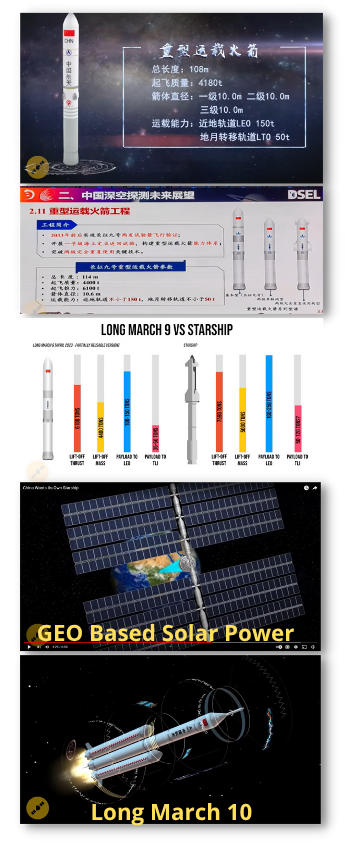
21 Apr 2023: China is planning to make a fully reusable version of the Long March 9, a rocket designed to launch infrastructure and deep space missions. Presentations at events marking China’s national space day in the city of Hefei, Anhui province revealed plans for a fully re-usable version similar to the SpaceX Starship. Watch great LM-9 update video.
– China is now targeting 2033 for first flights of a three-stage Long March rocket powered by numerous full flow staged combustion methane engines on the first stage, capable of carrying 50 tons to lunar transfer orbit, or 35 tons when the first stage is recovered.
-The initial version will be 114m long, have a mass at liftoff of 4,400 tons and generate 6,100 tons of thrust.
-This will be followed by a two-stage variant capable of carrying 150 tons of payload to low Earth orbit (LEO), or 100 tons when landing the first stage. A fully reusable, 80 tons to LEO variant will be the ultimate objective, expected to fly in the 2040s.
-China had previously aimed to debut an expendable Long March 9 rocket using 500-ton-thrust kerosene-liquid oxygen engines around 2028-2030.
-The Long March 9 project has evolved in the last couple of years from an initial expendable, more traditional Long March-style rocket kerosene-fueled rocket featuring a 10-meter-diameter core and four 5-meter-diameter boosters presented in the early 2010s, to a single stick versions powered variously by kerosene or methane engines. CALT announced late last year that plans for an expendable version had been scrapped and that the structural design had been finalized.
-The future Long March 9 has been touted as useful for launching components for a space-based solar power station in geostationary orbit. Reusable super heavy-lift rockets could make the related launch costs much more manageable.
-China is also developing the Long March 10 which could have a first flight around 2027 and could, with a pair of launches, be able to send a crew to the lunar surface before the end of the decade.
India Releases New Space Policy
24 Apr 2023: Namrata Goswami posted an article on the Space Review in which she provides highlights of India’s recently released national space strategy. Spoiler alert: the primary focus is on the commercialization of space, and ensuring that it is the private sector that takes the lead in building end-to-end space systems. Here is the entire policy document (11 pages).
– The new strategy directs ISRO to “undertake studies and missions on in-situ resource utilization, celestial prospecting and other aspects of extra-terrestrial habitability.” ISRO will move out of manufacturing of space systems, and instead focus only on the R&D side. Manufacturing and operations will be turned over to the private space sector.
-ISRO will make access to remote sensing data widely available, and the agency will concentrate on developing human spaceflight technologies as well as support a sustained human presence in space.
-The Indian National Space Promotion & Authorisation Centre (IN-SPACe) will function as the single-window authorization center for both public and private sector space activities. It will include launch, operation, in orbit slots, re-entry of space objects, and the dissemination of Earth observation data.
-The major gamechanger is India’s stand on space resources. India will encourage its private sector to engage in the extraction of space resources by creating the enabling policy and regulatory structures for it.
-The 2023 space policy document offers no in-depth details on India’s national security space architecture.
-The role of commercial space in augmenting space warfare capabilities was specified by Chauhan (India’s Chief of Defense Staff) when he stated that “as seen during the Russia-Ukraine conflict by SpaceX and Maxar, had unfolded a new area in the war on convergence…This combined with the intense race towards militarization of space has resulted in the battlespace becoming expanded and the very nature of warfare is at a major cusp of transformation.”
-The 2023 Indian space policy is a response to these calls for a greater role of the private sector in developing India’s civilian and defense space capabilities. It clarifies the role and authority structures of institutions like IN-SPACe, NSIL, ISRO, and DoS. A future space policy document should clarify India’s long-term space goals, the capacities being developed to meet those goals, and its military space posture.
On Orbit Updates: Kosmos-2568 Descending
Kosmos-2568 Update: Russia launched Kosmos-2568 on 29 Mar 2023, and analysts suspected this was the fourth instance of an EO MKA satellite. The previous 3 (Kosmos-2551, 2551 & 2560) all re-entered the Earth’s atmosphere 19, 41 and 56 days respectively after launch. After 38 days on orbit it appears Kosmos-2568 is headed towards a similar fate. There have been no known maneuvers and the spacecraft’s SMA has declined ~11km (from 336 to 326km).

On Orbit Updates: Chinasat-6C
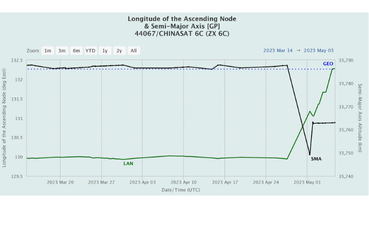
Based on limited observations it appears Chinasat-6C made two maneuvers, first between 27-30 Apr decreasing its SMA 38.4km and initiating an eastward drift and then between 1-2 May increasing its SMA 13.4km. It is currently drifting eastward .23°/day and has moved 2.3° from its previous 130°E location.Chinasat 6C provides commercial communications services with twenty-five C-band transponders and supports high-quality and reliable uplink and downlink transmissions of programs for the radio and TV stations and cable TV networks.
On Orbit Updates: SJ-23 & SY-12-01
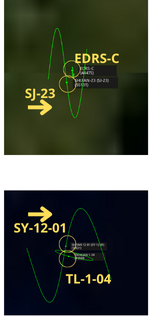
SJ-23: On 5 May 2023 SJ-23 had a point of closest approach of less than 100kms with the European EDRS-C satellite. SJ-23 has been drifting eastward since 16 Apr 2023. SJ-23 was initially thought of as a likely follow-on to SJ-13, a communications satellite. However, the release of a sub-payload is more indicative of SJ-17, TJS-3 and SJ-21. EDRS C (European Data Relay Satellite C) is one component of the European data relay system.
SY-12-01: SY-12-01 had a point of closest approach less than 29kms with the Chinese Tianlian-1-04 relay satellite. SY-12-01 frequently maneuvers and has been drifting east at varying rates since late November 2022. There has been open source comparison with the US GSSAP mission.
On-Orbit Updates: Luch/Olymp-K2
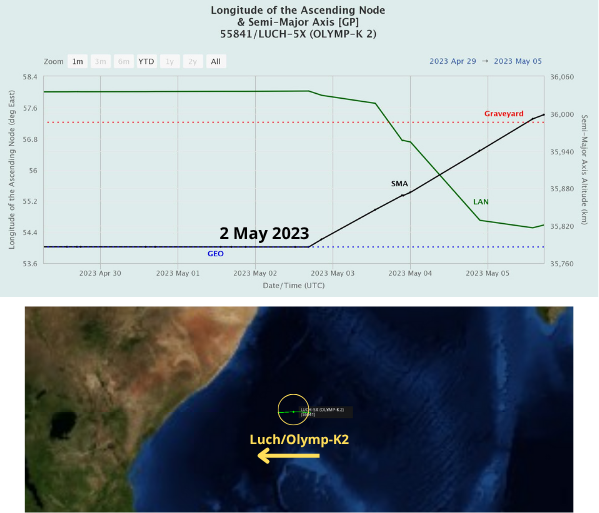
Luch/Olymp-K2: Between 2-5 May 2023, Olymp-K2 raised its orbit over 200km and is now drifting west. More to follow in coming weeks.