issue 73 | 21 may 2023
The integrity flash
Analysis of Developments in the Space Domain
in this issue
Report: GSSAP "Spying" on Chinese GEO Assets
7 May 2023: Chinese researcher stated USSF’s GSSAP satellites repeatedly approached some of China’s satellites in geostationary orbit in 2020-21. The study suggests China hasten development of a situational awareness network integrating space and ground-based sensors.
– According to the study, from Feb 2020 to Dec 2021 the USSF’s Geosynchronous Space Situational Awareness Program (GSSAP) satellites repeatedly approached some of China’s most valuable and advanced satellites in the geostationary orbit (GEO) and came alarmingly close.
– The authors allege a GSSAP satellite conducted a fly-around targeting Tianlian 2-01, a satellite that is part of China’s Tianlian space tracking and data relay system on February 26, 2020,.
– Two days later, the same satellite approached BD-2 G8, a satellite in the BeiDou Navigational System (BDS), according to the report.
– Different GSSAP satellites approached SJ-20 four

times over an 11-month period. In the closest encounter on 4 May 2021, the Chinese and US satellites came within a record 9.54km (5.9 miles), the study said.
– The study also alleges US satellites spied on other Chinese targets, including TJS-2, TJS-3, and TJS-5, which are part of China’s Tongxin Jishu Shiyan (TJS) experimental communications satellite series.
-GSSAP satellites are equipped with high-resolution optical cameras and advanced electronic surveillance equipment that allow them to take pictures and listen in on radio signals from other satellites, according to the Chinese study.
– The GSSAP satellites use the position of the sun relative to the target satellite and the observer to determine their approach strategy. It would be favorable for GSSAP satellites when the target satellite is in the “down-light observation area”, meaning the sun is behind the GSSAP satellite and shining directly on the target satellite. This allows for better imaging and reduces interference from scattered light.
-The Chinese study said the US spy satellites usually chose to approach their targets from a favorable position.
– As a GSSAP spy satellite approached the SJ-20 satellite in 2021, another Chinese satellite moved into a favorable position to closely examine the US satellite, according to news reports.
-The report estimated GSSAP camera resolution is ~1.3cm from a 10km distance.
– The two newest GSSAP satellites launched in 2022 might have major optics upgrades that afforded them new abilities, such as making observations from an unfavorable position, they added.
The study said through a sequence of tests focused on space attack and defense technologies, the US military has unmistakably demonstrated both their capability and intent to interfere with China’s use of space. “Due to the intense competition for space security in high orbits, it is urgent for China to research and develop key technologies, such as high-precision rendezvous and proximity operations, real-time orbit anomaly detection, target characterization under complex lighting conditions, and multi-mode active protection”.
China Concludes 276 Day Space Plane Mission
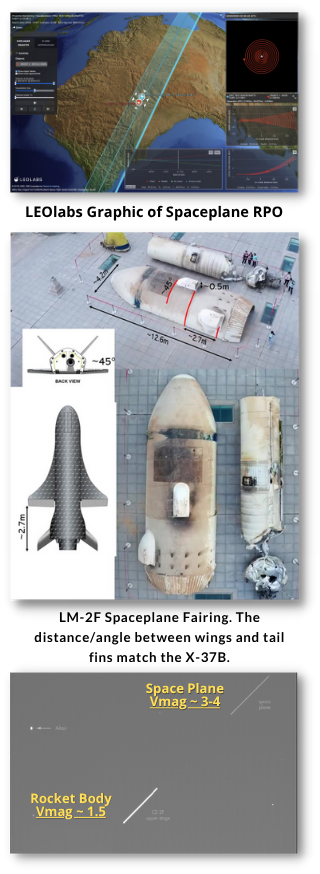
8 May 2023: LEOlabs released a series of tweets detailing possible on-orbit operations and concluded China’s spaceplane may have performed multiple recaptures of an object it released into orbit. The spacecraft landed at Lop Nur military base in Xinjiang May 8. Leolabs states that their observation data indicated the landing window to be likely between 0018 and 0020 UTC.
– LEOlabs analysis found evidence of what appeared to be at least two, and possibly three, capture/docking operations with a co-orbiting object.
– China’s clandestine spaceplane launched 4 Aug 2022, embarking on its second flight, two years after its firs, four-day-long mission. The second flight ended with a horizontal landing 8 May, after 276 days in orbit.
– “Analyzing data from our global radar network, we’ve determined that the Test Spacecraft2 has propulsive capability and engaged in proximity operations with Object J, including what appeared to be at least two and possibly three capture/docking operations,” a Leolabs statement said.
– Leolabs’ assessment of on-orbit activities highlights three periods of RPO. Between 25 Nov-24 Dec 2022 the two spacecraft were either docked or spaced very closely, with a possible docking performed on 25 or 26 Nov. A second docking occurred 10 Jan2023, in a second phase of operations.
– Between 20 Feb and 29 Mar “featured what appeared to be apparent forced separation, followed by rendezvous and formation flying. 54218 [companion satellite] was once again observed to maneuver independently of the parent craft.”
-Leolabs notes that, on a minimum of five occasions, the companion satellite demonstrated what appeared to be independent propulsive capabilities.
-China’s first spaceplane mission also generated multiple (7) trackable objects.
– One of the seven was a Banxing inspector satellite released from the main payload. The Banxing-3 was not catalogued as separate object until the spaceplane departed from orbit 6 Sep 2020. Satellites with a similar task were deployed from Shenzhou 7 and Tiangong 2.
-Capabilities of the companion satellite for China’s second spaceplane mission remain unknown.
China Launches New Beidou Satellite to GEO
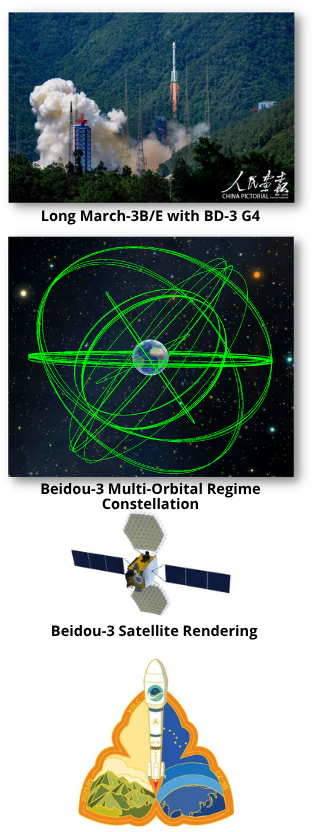
17 May 2023: China successfully launched a Long March-3B/E from Xichang carrying the Beidou (translates to Big Dipper)-3 G4 navigational satellite. After operational check out, the Beidou-3 G4 will serve as the first-ever backup for the BeiDou-3 Navigation Satellite System (BDS-3). Watch launch Video. Then there’s this video from a mere 260m away!
– BD-3 G4 is the 56th BeiDou satellite China has launched to date, and the first since Jun 2020.
– Per Chinese state-media, “The satellite will expand the communication capacity of the system’s regional short-messaging function, enhance positioning accuracy and promote the network’s availability and stability.”
– The Beidou-3 is China’s first global PNT constellation and followed Beidou-1 and Beidou-2 which provided only regional coverage.
– Beidou has been operating globally since 2020 and provides private users with an accuracy of 4.4m. It can also support timekeeping with an accuracy of at least 20 nanoseconds and determine pace with a minimum accuracy of 20 cm/s.
– Since Dec 2018, the system has been working under the designation of Beidou-3, supported by the previous Beidou-2 satellites and the already launched Beidou-3 satellites that started operation in Nov 2017.
-BD-3 G4 was most likely a spare satellite out of the initial launches for the third generation, which was also now deployed. These satellites will be part of a reserve that can start operation whenever needed.
Beidou has become a cornerstone of China’s international outreach program, the Belt and Road Initiative (BRI) and often described as the “digital glue.” BRI is the reincarnation of the ancient Silk Road, which was a trade route connecting China to Europe through land and sea routes. China began developing Beidou in 1996 after the Third Taiwan Strait Crisis. China fired three missiles to locations on the Taiwan Strait as a warning signal against Taiwan’s moves for independence and full internationally recognized statehood during the crisis . While the first missile hit about 18.5km from Taiwan’s Keelung military base as a warning, China lost track of the other two missiles. China asserts the United States cut off the GPS signal to the Pacific, on which China was dependent at that time for missile tracking.
North Korea Preparing New Launch Site
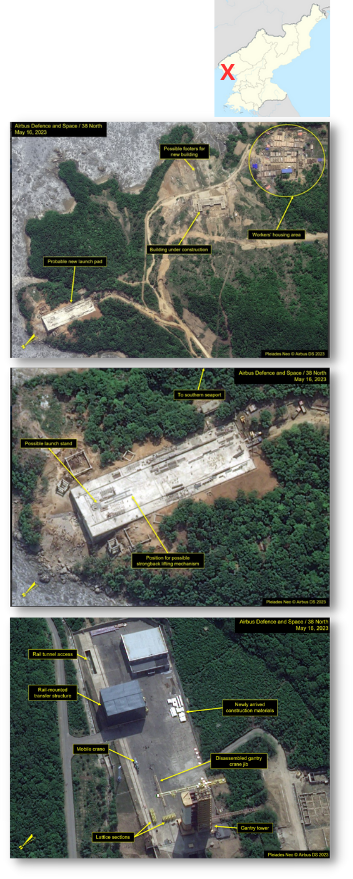
16 May 2023: Recent commercial satellite imagery of North Korea’s Sohae Satellite Launching Station indicates construction is progressing rapidly at several of the key facilities within the complex, and a probable new launch pad is being built at the coastal construction site. Watch amazing CSIS video of Sohae development.
– The new construction site is located on the east coast approximately 1km north-northwest of the new seaport and was first observed in imagery on 30 Apr.
– North Korea has laid a new large concrete pad—approximately 135x40m—which could be a new launch pad. At the north end of the pad, there appears to be a possible launch stand and two parallel bars, suggesting where a strongback might
be installed to raise a horizontally placed rocket body into a vertical position. Based on this configuration, it is unclear whether this pad is meant to accommodate solid or liquid-fueled rockets or both.
– No flame bucket has yet been constructed. However, such a feature would not be required if the launch stand hangs over the pad or if launching a mobile missile from a transporter-erector-launcher (TEL). There is sufficient space to add such a structure as construction continues.
– Additionally, construction on the main launch pad continues. The reassembly work on the exterior of the rail-mounted transfer structure, which was ongoing on 12 May, is now completed. While almost all materials had been removed from the pad just days ago, new materials are now present.
-In the 12 May image, a new, larger tower crane had been erected alongside the launch tower, but the former, smaller crane remained in place. It appears the latter has now been removed, and its supporting jib arm is lying on the pad alongside the launch tower. Two lattice sections, a mobile crane and numerous personnel are nearby.
– Closer to the final assembly building, stacks of light-toned material and a probable additional mobile crane are present.
In 2018 Kim Jong-un promised that North Korea would destroy a missile engine test stand at Sohae. On 31 Oct 2018, South Korean officials visited the site and confirmed it was being dismantled and ready for an upcoming inspection. However, in early 2019, after a summit between North Korea and the U.S. ended without an agreement, North Korea began rebuilding of the site. Construction obviously continues.
Space Surveillance Arms Race
10 May 2023: SpaceNews published an article examining DoD and commercial initiatives to improve awareness of Chinese and Russian spacecraft in orbit that are viewed as potentially threatening. The Space Force 2024 budget proposal includes $584 million for space domain awareness programs, or $100 million more than what was allocated in 2023.
– U.S. military leaders called out Russia for deploying so-called inspector vehicles in close proximity to American spy satellites, raising suspicions about their intentions. And they expressed concern when a Chinese spacecraft equipped with a robotic arm towed a defunct geostationary satellite to a graveyard orbit, raising the specter of a future system that could be used to seize U.S. assets.
– US Military officials have called for improved capabilities to conduct intelligence, surveillance, and reconnaissance in orbit, also known as space domain awareness.
– The military looks forward to the deployment of SilentBarker, a space surveillance satellite co-developed by the Dept of the Air Force and the National Reconnaissance Office to improve situational space awareness in GEO.
– SilentBarker is scheduled to launch later this year, will supplement the coverage provided by six Geosynchronous Space Situational Awareness Program (GSSAP) satellites that have been in orbit for several years. The two newest GSSAP satellites launched to orbit in Jan 2022.
– In response to the military’s demand for maneuverable surveillance systems, the commercial space industry is also working on new products.
– For its part, France is also planning to launch mini surveillance satellites into LEO to enhance the protection and defense of French satellites.
– French convictions of the need to strengthen defense capacities in space were strengthened when a Russian satellite attempted to intercept transmissions from a Franco-Italian satellite in 2018.
– France recently announced it would amend its Military Planning Law to include starting the development of a new generation of sovereign SATCOM, creating demonstrators for a LEO patroller satellite and an hyperspectral imaging satellite.
On Orbit Updates: TJS-3
TJS-3 increased its SMA ~120km on 13-14 May reversing its eastward drift. The satellite is now 56kms above GEO and heading westward. Observers noted TJS-3 conducted its maneuvers near 175° east, close to USA 263 (Wideband Global SATCOM 7).
Prior to increasing its SMA, TJS-3 had been drifting eastward from 25 Mar – 13 May 2023 changing its GEO position from 137.8° to 177.9°. The satellite is currently drifting west at a rate of .73° per day.

On Orbit Updates: Chinasat-6C
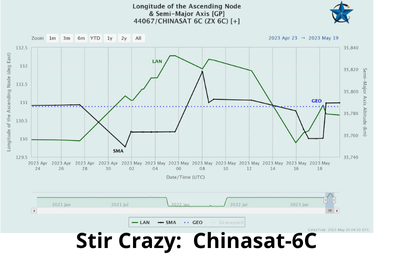
Chinasat-6C continues its unusual maneuvers. After operating at 130° E for nearly 11 months, Chinasat initially decreased 38.4km between 27-30 Apr. The satellite drifted 2.3° to 132.3°E when it increased its SMA 13.4km between 1-2 May. On ~5 May Chinasat-6C again increased its SMA 55km, and began drifting west until it returned to 130.0°E. Observations from 8-17 May showed the satellite again reduced SMA ~61 km and again began a drift eastward. Finally, on ~18 May Chinasat-6C increased its SMA ~32km and is now operating just beyond GEO with a slow westward drift. As of 19 May the satellite is located at 130.6°E.