issue 64 | 15 jan 2023
The integrity flash
Analysis of Developments in the Space Domain
in this issue
China Launches Shijian-23
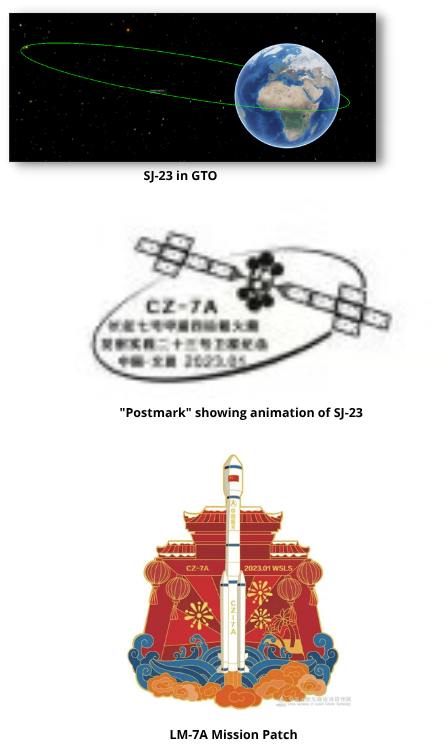
9 Jan 2023: China launched Shijian-23 from Wenchang using a LM-7A. SJ-23 is currently in a Geosynchronous Transfer Orbit (GTO). Shijian, “trial” or “pilot” in Chinese, satellites typically have classified missions and the nature of SJ-23 capabilities and mission are unknown.
Launch Video.
– SJ-23 is currently in a 884 x 35,807km orbit
and inclined ~14.5°. Look for SJ-23 to maneuver to join the Geostationary belt in the next few weeks.
– There are unverified clues that SJ-23 may be a high-throughput satellite (HTS) similar to SJ-13 which was launched in 2017.
– This is based on a blurry “postmark” for “launch day mail covers” of this launch, and may show the SJ-23 with a DFH-4S Bus which was the same bus used on SJ-13.
– The DFH-4S bus masses about 2,700kg and can operate for up to 15 years in orbit via its onboard propulsion system.
– SJ-23 was reportedly manufactured by SAST while the SJ-13 was a CAST product.
– SJ-23 is the first Shijian satellite to be launched on a LM-7A Space Launch Vehicle (SLV).
– In addition to SJ-23, Wenchang has been the launch facility for Shijian-17 (2016) and Shijian (2019).
– When SJ-23 arrives in GEO it will be the fifth SJ satellite in that orbital regime joining SJ-13, SJ-17, SJ-20 and SJ-21.
-Chinese media reports the satellite will be used for for scientific experiments and technical verification.
– The launch was the fifth of the Long March 7A, a three-stage version of the standard Long March 7 used to launch cargo missions to the Tiangong space station. It was also the fourth consecutive successful launch of the rocket, following the failure of the first launch in 2020.
-Initial Chinese media reports stated that Shiyan-22A and 22B were launched with SJ-23. Days after the launch Chinese state media corrected that the Shiyan 22A/B payloads were not launched on the LM-7A mission on Jan. 8, but rather on a subsequent LM-2D launch on Jan. 13 (see next page).
9 Jan 2023: A few hours after the Shijian-23 launch from Wenchang, Gushenxing-1 — “Ceres-1” in English — launched from the Jiuquan Satellite Launch Center (JSLC). The Ceres-1 SLV carried 5 satellites to sun-synchronous orbit. Launch Video.
– One of the five satellites was Tianqi-13, part of the Tianqi constellation started in 2018. Tianqi is a constellation of Chinese low Earth orbit (LEO) communication satellites that will provide internet services to Chinese commercial customers. The complete constellation is planned to feature 38 LEO satellites.
– Two other payloads on this rideshare are part of the Tianmu Meteorological Constellation, which did not release further details about their exact purpose and usage. One more payload was from the Nanton Middle School and is called “Nantong Zhongxue Satellite.” The final payload is the SciTech-1 satellite, with no further details released.
– Ceres-1 consists of three solid-fueled stages, with a fourth stage based on hydrazine for the final orbital adjustments. It can launch up to 400 kg into low Earth orbit.
-Ceres-1 can launch from a barebones platform and is designed to be available quickly, with as little required launch preparation as possible.
– This mission was its fifth flight, with all previous flights also being successes.

12 Jan 2023: China launched a LM-2D with three classified satellites, Yaogan-37 and Shiyan-22A and 22B. The orbit for all three satellites appears to be unique from previous Yaogan and Shiyan missions. It is too early to know if the 3 satellites will operate in formation or gradually separate over time. Launch Video.
– All three satellites are inclined 43.2°. The altitudes of the two suspected Shiyan-22 satellites are within 1km (~524km apogee x 510km perigee). Yaogan-37 has an identical apogee (524km), but its perigee is 4km greater (514km).
– Without additional maneuvers Yaogan-37 will increasingly trail the two Shiyan satellites.
– No other Chinese Yaogan or Shiyan satellites operate at the altitude and inclination of Yaogan-37 or Shiyan-22A/B. The closest I could find was the recently launched SY-21 which operates at 494x486kms & 36°.
– The mission and capabilities of all three satellites and if they support one another remains unknown.
– Officially the mission for the trio is “on-orbit verification tests
of new technologies such as space environment monitoring,”
which China often uses as a description for these classified
payloads.
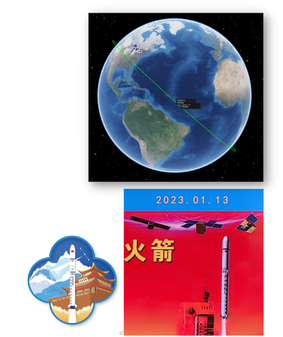
12 Jan 2023: China launched a LM-2C from Xichang carrying the APStar-6E communications satellite to a geostationary transfer orbit (GTO). AP stands for “Asia-Pacific,” as the satellites are designated to provide high-throughput broadband communication services for Southeast Asia. Launch Video.
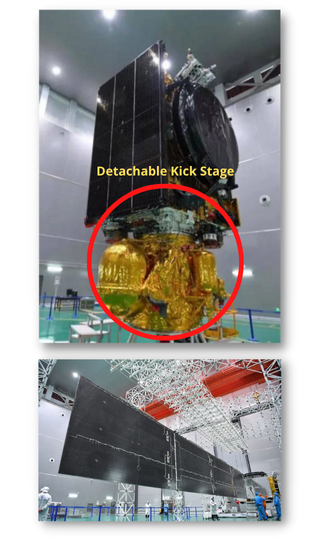
– APStar-6E is based on the DFH-3E bus. The LM-2C delivered the satellite into a 209x483km orbit. From there the satellite will be raised to higher orbit by its detachable kick stage. After the stage separation, Apstar-6E will rely on its electric propulsion system to reach its final parking position in GEO.
– The APStar-6E telecommunications satellite launched today weighs 4.3 tons. It is the heaviest satellite ever launched into orbit by the LM-2C rocket. To accommodate the LM-2C capabilities, the payload adapter was redesigned and reduced mass launch more than 20%.
– There are currently 4 active APStar satellites in GEO, APStar-7 (2012), -9 (2015), -6C (2018), and -6D (2020). They are advertised to have a 15-year lifespan.
-APStar-6E may join -6C and -6D over Indonesia or operate near the aging APStar-7 south of India.

12 Jan 2023: The East African country of Djibouti just signed a partnership with Hong Kong Aerospace Technology Group for the construction of a spaceport in the country. The deal allows Hong Kong Aerospace Technology Group to build a launching site for satellites and rockets in the country. The project which is estimated to cost around $1 billion will also involve the construction of a port and highway in the northern Obock Region. The project is set to be completed in the next five years.
– Djibouti is relatively close to the equator, making it an attractive destination for the launch of satellites which can take advantage of the Earth’s rotational speed.
– Construction could be completed as early as 2027 and infrastructure will be handed over to Djibouti upon the completion of a 30-year co-management contract with Hong Kong Aerospace Technology. Editor’s comment: 😉

Update: Shiyan-20A & 20B Settle In
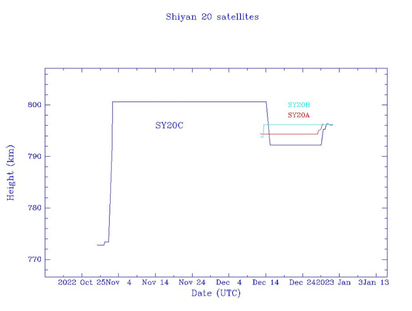
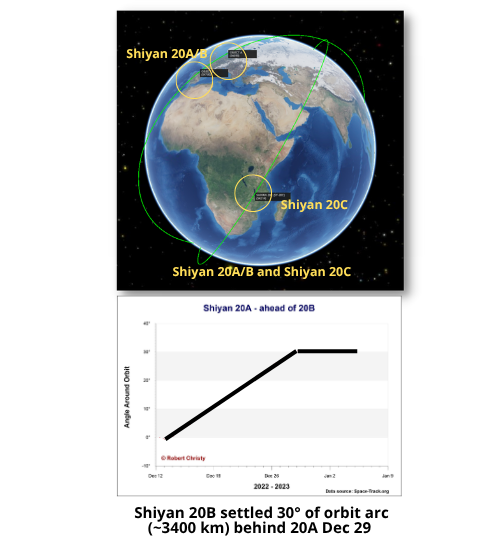
5 Jan 2023: China has maneuvered Shiyan-20A and Shiyan-20B into a lead-trail formation with Shiyan-20A 30 degrees ahead of 20B. The maneuver appears to have concluded on or about 29 December, 10 days after the pair’s 19 December LM-4C launch. The satellites began maneuvering on 14 December but on Dec 29 SY20A synchronized period with SY20B. The capabilities and mission of both satellites remains a mystery. For its part, Shiyan-20C is “twisted” 60 degrees from SY-20A/Bs’ orbital plane.
12 Jan 2023: China and the Philippines Beijing and will discuss cooperation on areas like weather forecasting and space tracking, and set up a notification system for rocket launches following a diplomatic row over Chinese debris found in Philippine waters.
– Chinese space rocket debris has been found in Philippine waters in recent months and in the past, adding to tensions between the two countries over a long-standing territorial dispute in the South China Sea.
-The Philippines lodged a diplomatic protest with China after an incident in Nov 2022, when the Philippine military said the Chinese coastguard had “forcefully” seized floating rocket debris being towed by a Philippine naval vessel in the South China Sea.
– The Philippine military said the Chinese coastguard ship
-China continues to improve its counter-space weapons capabilities. The PLA routinely incorporates jamming and anti-jamming techniques against multiple communication, radar systems, and GPS satellite systems in exercises. PLA will target space-based C4ISR assets. China continues to develop jammers to target SAR aboard military reconnaissance platforms, including LEO satellites, and to

had twice blocked its vessel before it forcibly took the debris.
– China’s foreign ministry confirmed that the debris was from a Chinese rocket launch but claimed it had been handed over by the Philippine navy after a “friendly consultation”.
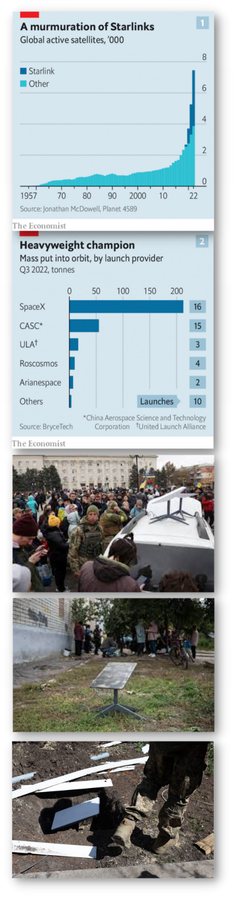
5 Jan 2023: Excellent article in The Economist detailing how Ukrainian forces are using Starlink based communications in their war against Russia. The article also discusses Starlink’s greater resiliency to non-kinetic and kinetic threats and what it may mean
for the future of military command and control.
– The Starlink constellation currently consists of 3,335 active satellites; roughly half of all working satellites are Starlinks. In the past six months new satellites have been added at a rate of more than 20 a week, on average.
– Starlink is is shaping how Ukraine fights back, revealing the military potential of near-ubiquitous communications.
– Starlink has become the linchpin of what military types call C4ISR (command, control, communications, computers, intelligence, surveillance and reconnaissance).
– Ukrainian soldiers upload images of potential targets via a mobile network enabled by Starlink. These are sent to an encrypted group chat full of artillery-battery commanders. Those commanders then decide whether to shell the target and, if so, from where. It is much quicker than the means used to co-ordinate fire used up until now.
– Starlink also makes drone warfare much easier. In September a Ukrainian naval drone washed up in Sevastopol, the Crimean headquarters of Russia’s Black Sea Fleet with what looked like a Starlink terminal attached to its stern.
– In late October seven similar drones were used to mount a successful attack on the port. Ukraine published a video of the attack shot from the boat’s bow. “Ukrainian military operations are hugely dependent on having access to the internet,” says Mr Gady, “so Starlink is a most critical capability.” A Ukrainian soldier puts it more starkly. “Starlink is our oxygen,” he says. Were it to disappear “Our army would collapse into chaos.”
-Russia’s armed forces have lots of electronic-warfare equipment that can locate, jam or spoof radio emissions. But the Starlink signals are strong compared with those from higher flying satellites, which makes jamming them harder.
-the way that the dishes use sophisticated electronics to create narrow, tightly focused beams that follow satellites through the sky like invisible searchlights provides further resistance to interference.
-Cyber attacks against Starlink appear to have been ineffective, in part thanks to SpaceX’s ability to quickly update the system’s software. Dave Tremper, director of electronic warfare for the Office of the Secretary of Defence, has said the speed of the software response he witnessed to one attack was “eye-watering”.
– Kinetic anti-satellite attacks would also be a lot less useful against a constellation like Starlink than against older systems. Knocking out a single Starlink would achieve more or less nothing. If you want to damage the space-based bit of the system, you need to get rid of lots of them.
19 Dec 2022: Bart Hendryckx published another fantastic article in The Space Review…this time providing open source insight into three potential GLONASS secondary payloads. Russia’s Glonass navigation satellites are being used for a number of little publicized secondary objectives. Instruments to detect nuclear explosions have been flown on Glonass satellites since early this century and two new payloads are expected to be introduced on the next generation of satellites in 2023. One will help locate and rescue military personnel in distress and the other likely is part of a signals intelligence system that will provide targeting data for sea-launched cruise missiles.
Nuclear Detection:
-Nuclear detection sensors became a standard payload for Glonass satellites with the introduction of the Glonass-M series in Dec 2003. The Glonass-M payload is called BAL-M and modified versions called BAL-K and BAL-K2 designed for the Glonass-K and K2 satellites.
-The exact location of the BAL-M instruments on Glonass-M is not known. It is worth noting, however, that an object attached to the lower part of the satellite has been intentionally blurred in some video footage of Glonass-M, indicating that it is considered a secret payload…little has been revealed about the upgraded payloads for Glonass-K and K2.
KSPS-MO: Rescuing Military Personnel
-A secondary payload that will be introduced on the Glonass-K2 satellites is designed to pick up and relay distress signals from military personnel in emergency situations.
-The new payload will have a search-and-rescue payload intended exclusively for military users. The system contains beacons transmitting distress signals in the 400–410 MHz frequency range at a rate of at least 250 bits per second.
-A feature of both the civilian and military Glonass-K2 search and rescue systems is that they can send a return message to the emergency victims, notifying them that their distress signal has been received and help is on the way.
Ruveta: Collecting Targeting Data for the Russian Navy
-Ruveta is a signals intelligence system that will furnish target location data on NATO surface vessels to Russian naval forces to support engagement with long-range anti-ship missiles such as the 3M-54 Kalibr.
-Ruveta appears to be part of the larger Tsiklop program which seems to be a reconnaissance system that collects targeting information for Russian Navy vessels from a variety of assets. One of those would then be Ruveta, which presumably includes a signals intelligence payload installed on Glonass satellites.
-Ruveta was planned for launch on Glonass-K2, which is the

platform that will carry the Ruveta payload according to theGlonass-K2 is significantly heavier than Glonass-K (1,645 versus 935 kilograms), has double its height (six versus three meters) and a significantly higher power supply (4.37 versus 1.6 kilowatts), making it easier to accommodate secondary payloads.