issue 65 | 29 jan 2023
The integrity flash
Analysis of Developments in the Space Domain
in this issue
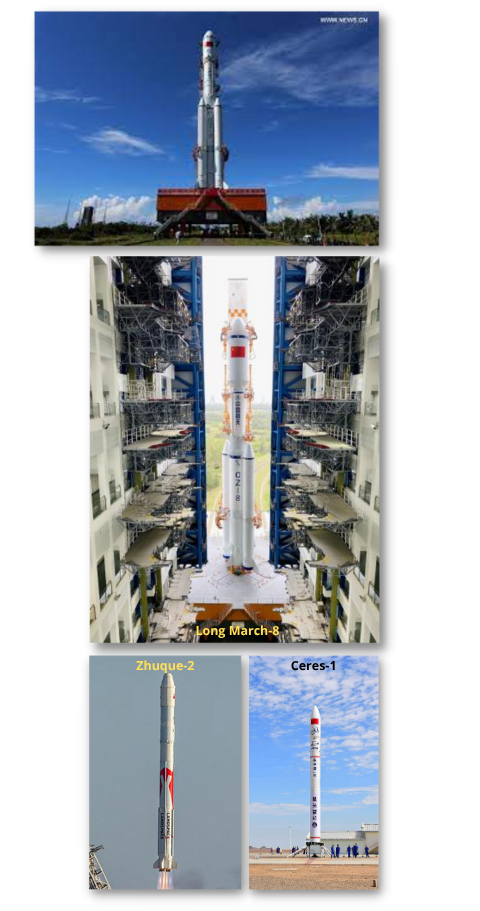
17 Jan 2023: China’s state-owned and commercial space sector actors are planning a total of more than 70 launches across 2023 as the country’s space activities continue to expand.
– The Long March rocket series will again aim for more than 50 launches this year, according to an announcement from an early Jan meeting.
– China is expected to grow its Earth observation and reconnaissance capabilities further, continuing a high rate of launches of Yaogan and Gaofen satellites, while also launching replacement satellites for the Beidou GNSS constellation. Communications, meteorological and ocean observations satellites will also be part of the manifest.
– The older hypergolic Long March 2, 3 and 4
series rockets will be active, as will the newer, kerosene-liquid oxygen Long March 7, 7A and 8 rockets. CASC recently announced a new production line for kerolox engines. The solid Long March 11 and Jielong-3 will also launch from land and sea.
– CASIC, and its subsidiary Expace, plan numerous launches of its solid Kuaizhou-1A and larger Kuaizhou-11 solid rockets following their return to flight last year. The launchers will likely carry satellites for CASIC’s Xingyun Internet of Things constellation and mainly commercial payloads.
– Galactic Energy completed its first launch of the year in early Jan and, following a string of five successes from five attempts, looks to launch 8-10 Ceres-1 solid rockets this year, including a possible inaugural sea launch in the second half of the year.
-Landspace could attempt a second launch of its Zhuque-2 methane-LOX launcher, after an issue with second stage vernier thrusters brought about the failure of the first launch last month.
-Deep Blue Aerospace plans to build on a kilometer-level hop test conducted last year with a 100-kilometer-altitude test in 2023.
China launched 64 times in 2022. Combined launch plans of CASC and commercial actors could see the country top 70 launches this year from three inland spaceports, the coastal Wenchang spaceport, and sea launches from Haiyang spaceport.
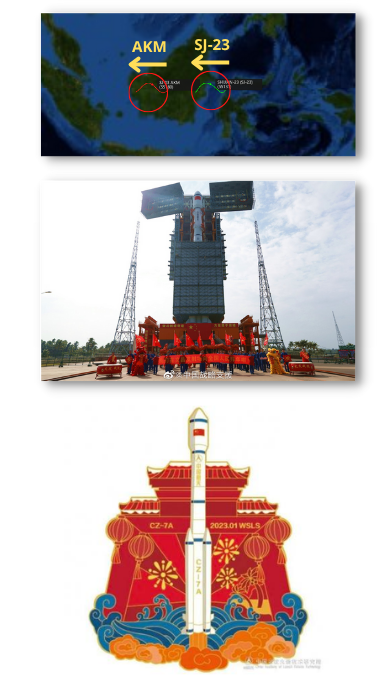
19 Jan 2023: Shijian-23, a Chinese experimental satellite operating in geostationary orbit (GEO), released a small object. SJ-23 was initially thought of as a likely follow-on to SJ-13, a communications satellite. However, the release of a sub-payload is more indicative of SJ-17, TJS-3 and SJ-21. Shijian-23 and its apparent subsatellite could be conducting technology verification tests.
– China launched SJ-23 (SCN 55131) to GEO on a Long March 7A rocket on 8 Jan.
– Space Force‘s 18th Space Defense Squadron (18 SDS), which focuses on space domain awareness, tracked SJ-23 reaching geosynchronous orbit around 15 Jan and drifted toward its intended position in the GEO belt.
– 18 SDS revealed SJ-23 released an object (SCN 55180) on 16 Jan, now labeled “SJ-23 AKM”.
-“AKM”, or apogee kick motor, helps a satellite reach its destination orbit. However, it is possible the object is a subsatellite, possibly used together with the parent satellite for on-orbit testing.
-The SJ-23 AKM is currently west of SJ-23, both drifting westward at roughly the same rate.
– China’s Shijian-21 satellite, launched in 2021, also reached GEO and released a satellite, which was then used for tests. Shijian-21 then proceeded to dock with the defunct Chinese navigation and positioning satellite Beidou-2 G2 and towed it to an orbit out of the way of active spacecraft in GEO.
– In Jan 2019, China’s TJS-3 also conducted maneuvers with its Apogee Kick Motor shortly after arriving in GEO. (Video)
– In Nov 2016 Shijian-17 performed test maneuvers with its upper stage. SJ-17 later went on to conduct RPOs of other Chinese GEO satellites. (Video)
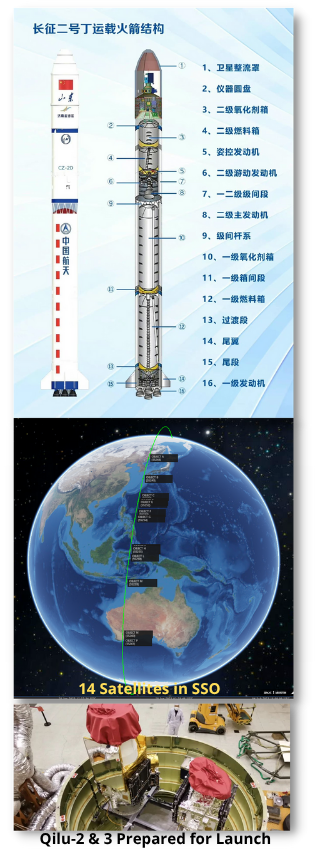
15 Jan 2023: China launched a LM-2D with 14 satellites from Taiyuan. This was a rideshare launch primarily for China Great Wall Industry Corporation (CGWIC), a CASC subsidiary. Payloads included Jilin Earth Imaging satellites and several Earth Imaging technical demonstrators. All satellites were placed into a Sun-Synchronous orbit. Launch Video.
– All 14 satellites are inclined at 97.4° with perigees ranging from 476-484km and apogees from 488-495km. As a result of the different altitudes the satellites will gradually separate over time.
– The launch contained the following satellites:
- Qilu-2 & 3
- Luojia-3-01
- Jinzijing-3/4/6
- Jilin-1 MF-02A 03/04/07
- Jilin-1 GF03D 34
- Haihe-1
- Wofuman
- Beiyou-1
- Tianzhi-2D
– Of interest: Luojia-3 01, a remote sensing satellite, will be operated by Wuhan University enabling customers to stream pictures taken from orbit to a mobile device within 10 minutes of imaging.
-The Luojia spacecraft will process imagery data into user-friendly visuals, a step normally done on the ground. Once the images are processed, Luojia-3 01 will downlink them using a high-frequency microwave transmitter via Chinese communication satellites for onward sharing.
– The Qilu satellites are high-resolution optical Earth observation satellites mainly collecting data relating to the Shandong Province. They have a resolution of 0.7m and are also equipped with thermal infrared imaging capabilities.
-The Jilin-1 spacecraft included the Jilin-1 Gaofen 03D-34 remote sensing satellite, Jilin-1 Mofang 02A-03, 02A-04, and 02A-07, and the infrared-imaging Jilin-1 Hongwai 02A-07 and 02A-08 spacecraft.
-CGWIC began launching Jilin satellites in 2015, and since then have placed 80 on orbit including multispectral satellites that can analyze specific wavelengths and high-resolution satellites to provide Earth imagery.

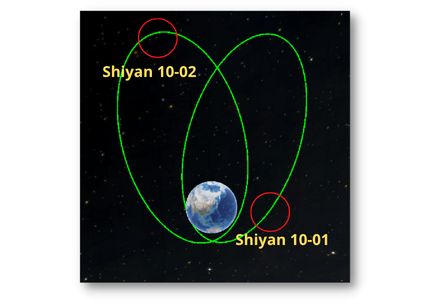
26 Jan 2023: After disappearing from observations between 29 Dec 2022 and 25 Jan 2023, China’s Shiyan 10-02 is now cataloged in a Molniya orbit. The satellite likely conducted a large maneuver shortly after 29 Dec which included a 12° inclination change. A LM-3B initially placed SY-10-02 into a 51° orbit. As of 26 Jan the satellite is now in the Classic Molniya orbit of ~63.33°.
– Shiyan 10-02’s orbital plane is 103° away from its predecessor, Shiyan 10-01. In this configuration at least one of the satellites has a continuous view of the Earth from the North Pole down to 40-45° latitude.
– It is unclear why China launched the satellites into their original 51° orbit. Both satellites launched from Xichang so it is possible there are flight restrictions preventing China from launching directly into a 63° inclined orbit.
– Shiyan 10-02 transitioned far more quickly to Molniya than its predecessor. Shiyan 10-01 spent nearly 6 months in its transition orbit. Chinese media reported that the SY-10-01 launch proceeded normally, but the satellite operating
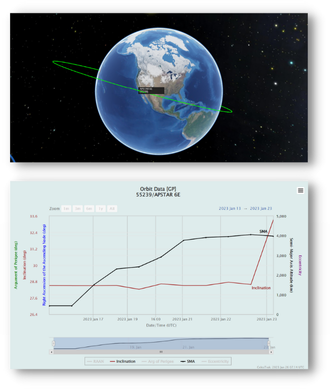
25 Jan 2023: China’s APSTAR-6E telecommunication satellite, launched on 13 Jan 2023 into LEO, separated from its independent propulsion module, and is now using its electric thrusters to transit to GEO.
– CASC, APStar-6E’s manufacturer stated APSTAR-6E is China’s first satellite to change its orbit entirely autonomously. After separating from its independent propulsion module, the satellite will be transferred to GEO by its two electric propulsion systems.
– Apstar-6E raised its orbit from 229 x 642km to 1022 x 7095km x 28.6° between Jan 13 and Jan 22.
– Another TLE on Jan 23 shows a further orbit change to 554 x 7401km x 28.5°.
-No tracking data is available for the presumably discarded detachable kick-stage.
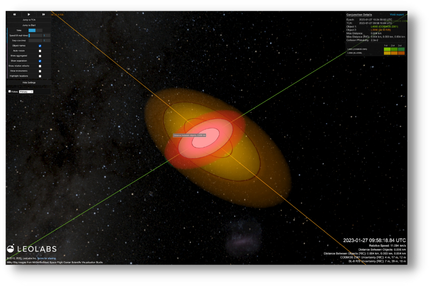
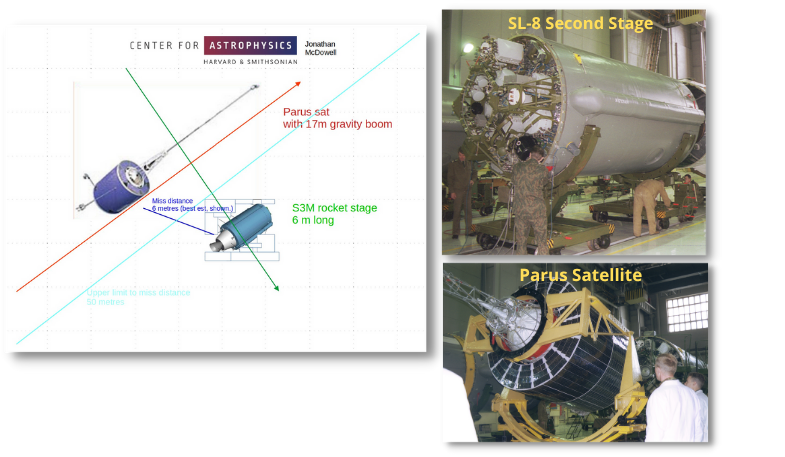
27 Jan 2023: LeoLabs reported two pieces of Russian space debris came within ~6m of colliding in orbit. Both uncontrolled objects are in a particularly dangerous LEO altitude (between 950-1050km). One object is an SL-8 rocket upper stage used to launch a Tsikada navigation satellite in 1986. The other debris is a Parus data relay satellite launched by a Kosmos-3M in 1998.
– Two large, defunct objects in LEO narrowly missed each other — an SL-8 rocket body (16511) and Cosmos 2361 (25590) at an altitude of 984km.
– Based on LEOLabs radar tracking data, the computed miss distance was 6m with an error margin of a few tens of meters.
– Cosmos 2361 has a 17m long gravity gradient boom.
– LeoLabs says the incident was very close to being a “worst-case scenario” that could have generated thousands of more pieces of debris in a ripple effect.
– 984km is in the middle of what LEOLabs calls a “bad neighborhood”.
– This region, 950-1050km, has significant debris-generating potential in LEO due to a mix of breakup events and abandoned derelict objects.
– This region hosts ~160 SL-8 rocket bodies along with ~160 payloads deployed over 20 years ago.
– There were 1,400 high-Probability of Collision conjunctions involving these rocket bodies between Jun-Sep 2022 alone.
– Had the SL-8 rocket body and Cosmos 2361 collided, it likely would’ve resulted in thousands of new debris fragments that would have persisted for decades.
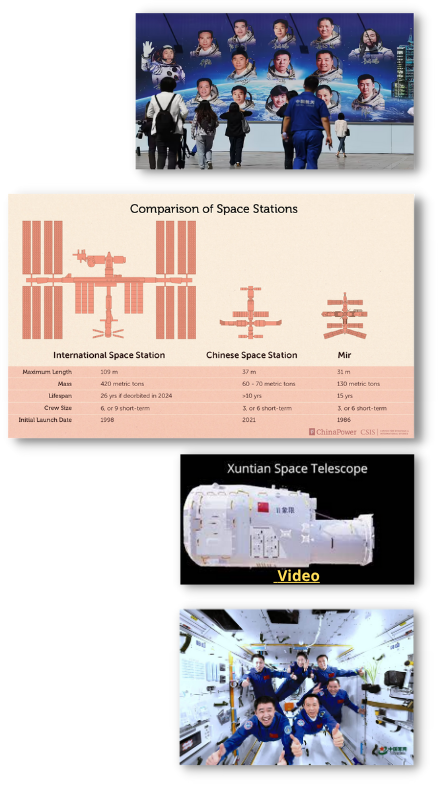
16 Jan 2023: Space Review article on China’s space station accomplishments and ambitions. With the launch of the Shenzhou 15 mission, China became only the third nation to operate a permanently crewed space station. China’s space station, Tiangong, is entirely built and run by China. The successful opening of the station is the beginning of some exciting science. But the station also highlights the country’s policy of self-reliance and an important step for China toward achieving its larger space ambitions.
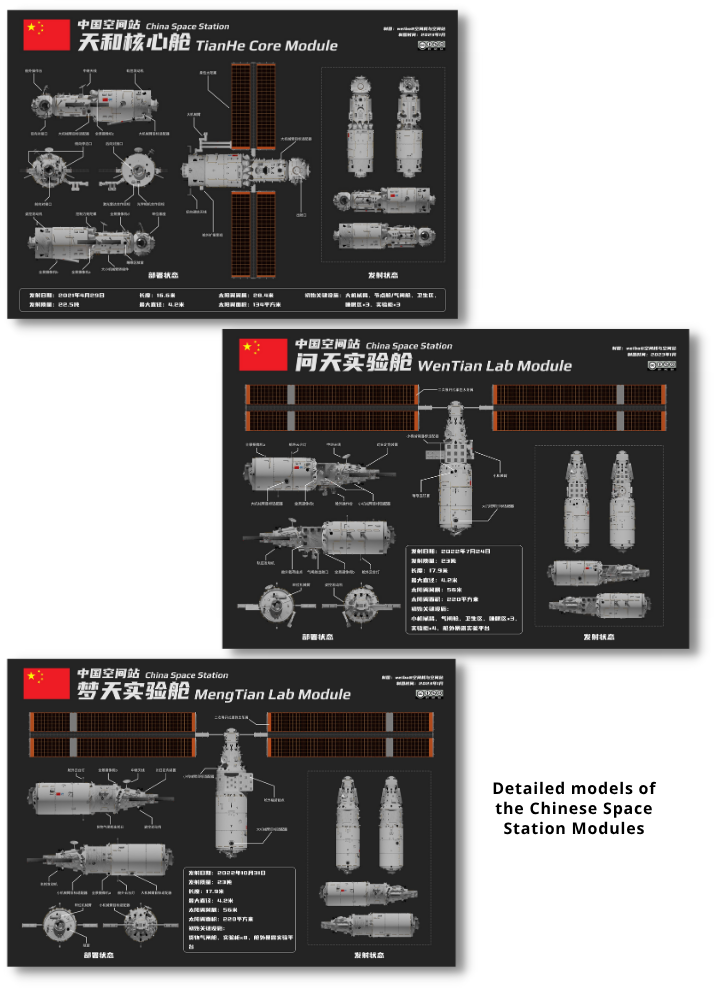
– Tiangong is 55m long and is comprised of three modules launched separately and connected in space. The Tiangong core module can support up to six taikonauts and two experiment modules which combine for a total 110 cubic meters of space (about one-fifth the size of the International Space Station).
-Tiangong is based on a Soviet-era design is a near copy of the Soviet Mir space station from the 1980s. However, the Tiangong station is heavily modernized and improved.
– The Chinese space station is slated to stay in orbit for 15 years, with plans to send two six-month crewed missions and two cargo missions annually. Science experiments underway include a planned study involving monkey reproduction commencing in the station’s biological test cabinets. Whether the monkeys will cooperate is an entirely different matter.
– Tiangong is made and managed by China, but they have an open invitation for other nations to collaborate on
experiments aboard Tiangong. So far, China selected nine projects from 17 countries.
– In Dec 2023, China is planning to launch a new space telescope called Xuntian. This telescope will map stars and supermassive black holes among other projects with a resolution about the same as the Hubble Space Telescope…but with a wider view. The telescope will periodically dock with the station for maintenance.
– It remains to be seen how space collaboration will change in the coming years. The US-led Artemis program aims to build a self-sustaining habitat on the Moon and open to all nations with more than 20 countries already partnering. China also recently opened its joint Moon mission with Russia to other nations. This was partly driven by warming Chinese-Russian relations but also because Sweden, France, and the European Space Agency cancelled planned missions with Russia over Ukraine.