issue 66 | 12 feb 2023
The integrity flash
Analysis of Developments in the Space Domain
in this issue
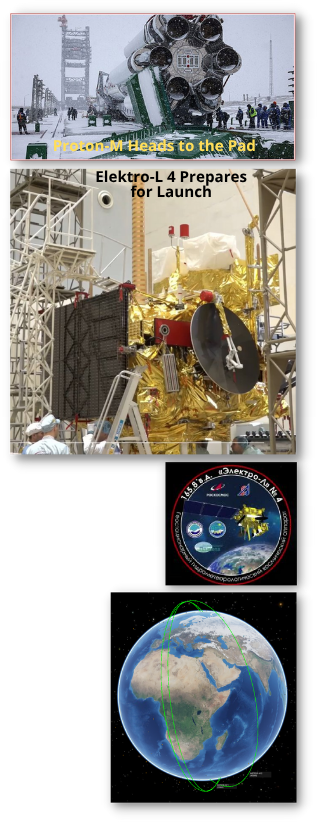
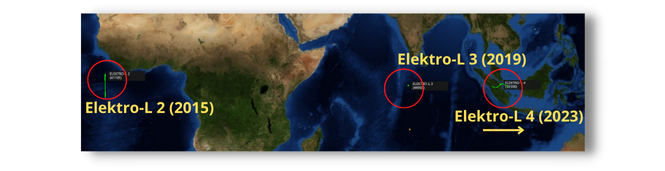
5 Feb 2023: Russia launched a Proton-M from Baikonur with its newest environmental monitoring (EM) satellite, Elektro-L #4. The satellite is now in geostationary orbit and maneuvering to its operating location (165.8° E). This increases Russia’s Active GEO-based EM satellites to three. Launch Video.
– Elektro-L is a series of meteorological satellites developed for Roscosmos, the Russian Federal Space Agency. These are the first Russian meteorological satellites to operate in a geostationary orbit, and only the second operational series of Russian weather satellites.
– Each satellite has a mass of around 1,620kg and a design life of 10 years. They are capable of taking images of a full hemisphere of the Earth in both visible and infrared spectra, providing data on climate change, ocean monitoring, and weather forecasting data.
– The Elektro-L satellites operate in conjunction with the Meteor-M series of polar-orbiting weather satellites. There are currently 3 active Meteor-M satellites on orbit.
– The Russians distribute data gathered from the satellites to their Scientific Research Center of Space Hydrometeorology “Planeta” and the Federal Service for Hydrometeorology and Environmental Monitoring of .
-The imaging system, MSU-GS, provides a resolution of 1 km per pixel for the two visible bands, and4 km per pixel for eight infrared bands. The satellites normally image once every 30 minutes, but can take one every 10 minutes
in emergencies.
– Previously, Russia launched Elektro-L 2 on Dec. 11, 2015, aboard a Zenit-3F with the Fregat-SB upper stage. The third satellite was launched on Dec. 24, 2019, by a Proton-M with the DM-3 upper stage.
7 Feb 2023: Cosmos 2499, launched in 2014, broke apart 3 Jan and created a cloud of debris that could linger in Earth orbit for over a century. The breakup event generated at least 85 pieces of trackable debris. Cosmos 2499 was an unannounced object launched with 3x STRELA 3M LEO communication satellites. Cosmos 2499 did a series of maneuvers to bring it close to, and then away from, the Briz-KM upper stage.
– Cosmos 2499 and its debris are in a polar orbit with apogee values between 1,480-1,600km. Perigee values range between 950-1,160km. At these altitudes it will likely take a century or more to de-orbit.
–LeoLabs, Inc., analysis points toward a low intensity explosion, “due to the asymmetry of the debris cloud, magnitude of the velocity imparted to the fragments, and a known energetic source on board (i.e. the propulsion system).”
-Cosmos 2499’s liquid propulsion stage enabled the satellite to perform multiple orbital changes, specifically the Fakel K50-10.6 propulsion system powered by hydrazine monopropellant.
-Cosmos 2499 experienced its first breakup event on October 22, 2021, that event created 22 pieces of trackable debris.
– Cosmos 2491, thought to be an identical spacecraft, exploded in 2020 and attributed to an explosion of the propulsion system. 11 pieces of debris are in the catalog.
– In the months after its May 2014 launch Cosmos 2499 got within just .76km of the Briz-M on 9 Nov 2014. The spacecraft soon backed off but made an even closer approach on 25 Nov, coming within .53 km of the rocket body.
– Cosmos-2499 performed a rendezvous with its
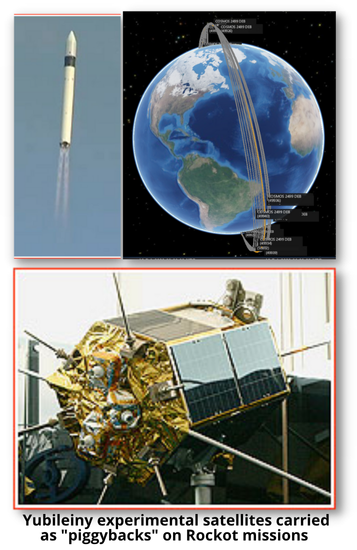
own Briz-KM rocket stage, and it continued to perform maneuvers up until 2017.
– These activities led to speculation that Cosmos 2499 and Cosmos 2491, a seemingly similar object that launched to Earth orbit in Dec 2013, were testing tech that could allow spacecraft to chase down and perhaps even disable other satellites.
-Cosmos 2499 seems related to Russia’s Nivelir project, “most probably a project to build small satellites designed to inspect other satellites in space,” according to an article from The Space Review published in May 2019. Russia has launched four of these satellites to date, two of which rendezvoused with their respective rocket stages.
30 Jan 2023: The creators of the most excellent Dongfang Hour Newsletter have re-branded and are now creating a monthly China Space Monitor. For their first monthly deep-dive, they look at the oncoming supply of new, oftentimes rideshare-focused launch vehicles in China, and what that means for the number of satellites and rockets per year we should expect to see flying out of the Middle Kingdom. You should check it out.
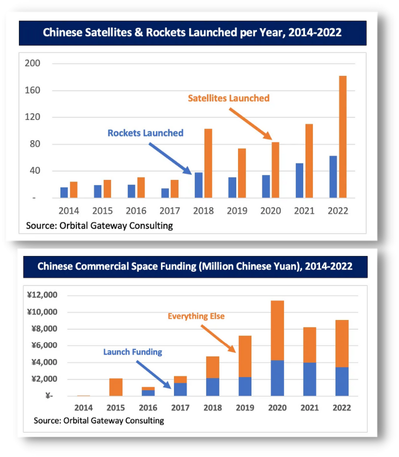
– In 2022, China completed a record 63 launches…most of the launches sent only a few satellites to orbit each, totally ~180 spacecraft. Historically rideshare offerings from China are limited, but 2023 marks a turning point for them.
– In 2023, we will likely see at least 20 rideshare launches, which we define as a launch with 5 or more satellites. This enables Chinese rockets to launch as many as 300-400 spacecraft in 2023, with possibly half be for commercial customers.
– CASC-built rockets may become more notable in 2023 including the Long March-8, which launched only once in 2022 sending 22 satellites to orbit. CASC has confirmed this month that the Long March-8 would launch again in 2023 without specifying the number of launches.
– CASIC should also contribute through their commercial spin-off Expace, now that their medium-lift Kuaizhou-11 if fully operational after its first successful launch in Dec 2022. No
less than 7 Kuaizhou (1A & 11) launches are planned in 2023.
– Chinese commercial launch startups should (finally) make breakthroughs in 2023. If we believe the announced dates, we should see the maiden launches of the Tianlong-2 (Space Pioneer), Gravity-1 (Orienspace), and Darwin-2 (RocketPi), putting rideshares at the core of their business.
– The new rockets will likely accelerate deployment of China’s plethora of semi-commercial constellation projects. The largest of these up to now is CGSTL. Since being founded, CGSTL has manufactured and launched 86 remote sensing satellites, with plans to launch 138 by end of 2023, and 300 by end of 2025.
– Other projects likely to accelerate in 2023, if launch supply develops as expected, include CASIC’s Xingyun narrowband/Internet of Things (IoT) constellation, Guodian Gaoke’s Tianqi IoT constellation, CentiSpace remote sensing constellation, and HKATG’s Golden Bauhinia Constellation.
China’s commercial space sector has grown since 2014, but it takes a little while to develop a rocket. China’s space sector – having had ~8 years and several billion dollars – is reaching an inflection point as commercial firms (or commercially-oriented state-owned ones) start to ramp up production. This is going to be felt in launch, with slots for perhaps 400 satellites in 2023, and even more thereafter. This will impact the Chinese market (lower launch costs, more slots) and eventually impact foreign markets. China’s commercial space sector has been incubating for some time and 2023 may be the year we finally see it start to take off.
27 Jan 2023: The US sanctioned a Chinese company for allegedly providing satellite imagery of Ukraine to support the Wagner Group’s combat operations for Russia. Changsha Tianyi Space Science & Technology Research Institute is among 16 entities slapped with curbs by the Treasury Department. The firm, also known as Spacety China, has offices in Beijing and Luxembourg.
– Spacety provided synthetic aperture radar (SAR) satellite imagery derived locations in Ukraine to Terra Tech, a Russia-based technology firm, according to the Treasury Department’s Office of Foreign Assets Control.
– The Treasury Dept stated, “These images were gathered in order to enable Wagner combat operations in Ukraine.”
– Spacety has so far launched two small C-band SAR imagery satellites, the Hisea-1 in Dec 2020 and Chaohu-1 in Feb 2022.
– Hisea-1 is China’s first commercial Synthetic Aperture Radar (SAR) satellite, launched Dec 2022 on China’s Long March 8 medium-lift rocket. Its expected life-span is 3 years.
– Hisea-1 is capable of imaging with a spatial resolution of 1 meter and a swath width of 100 kilometers. Spacety plans to obtain imagery with a resolution of 50cm per pixel
– Chaohu-1 is the first of the planned 96-satellite “Tianxian” SAR constellation. It also launched on a LM-8 SLV on 22 Feb 2022.
– The Chaohu-1, compared to HiSea-1, further

optimized the satellite platform and SAR payload design, significantly improving capabilities for spatial resolution, swath size, single orbit imaging duration, data downlink, orbit control, etc.
– The satellite is also equipped to continuously multi-target image, precise orbit determination, and in-orbit data processing using Artificial Intelligence (AI).
-The nature of Tianxian’s partners and capabilities make it a possible example of China’s military-civil fusion and resource optimization – potentially serving both military and economic needs in a dual-use capacity.

2 Feb 2023: The official space industry newspaper, China Space News, reported a subsidiary of the China Aerospace Science and Industry Corporation (CASIC), a giant state-owned defense and space contractor, won a bid to build an ocean observation satellite ground system. The project adds new ground station facilities at Zhongshan Station in Antarctica to support satellite data acquisition. See Video Tour of Zhongshan.
– Renders of the 43.95M yuan ($6.52M) project show four radome-covered antennas at Zhongshan in East Antarctica. It is unknown if these are new or in addition to established antennas.
– The antennas will assist data acquisition from Chinese satellites that orbit in polar and near-polar orbits. Satellites in these orbits are visible near the poles multiple times a day, allowing more frequent opportunities for downlink than stations at lower latitudes.
– The spread of Chinese ground stations internationally led to concerns, particularly over construction in South America. That network, while having clear civilian uses, could be used to spy on, monitor, and potentially even target other nations’ spacecraft, according to an Oct 2022 report from the Center for Strategic and International Studies.
– The planned construction at Zhongshang station, at 69 degrees south, could fuel concerns China could receive remote sensing, weather, surveillance, and other data faster than previously thought. Additionally, there are dual-use concerns.
– Zhongshan Station is the second Chinese research station in Antarctica, opened on Feb 26, 1989. It can accommodate 60 summering and 25 wintering personnel.
– Ground stations are key infrastructure for spacecraft, facilitating data exchange and commands. Their importance indicates another area for competition among opposing space powers.

9 Feb 2023: India successfully launched its Small Satellite Launch Vehicle (SSLV) and placed 3 satellites into circular low Earth orbit at 450km at an inclination of 37.2 degrees. The mission lasted about fifteen minutes from liftoff to the final spacecraft separation. Launch Video.
– This was a demonstration flight to prove the SSLV’s ability to reach orbit, taking three satellites along for the ride. The largest of these was Earth Observing Satellite-07 (EOS-07) for the Indian Space Research Organisation (ISRO). It was joined by the smaller AzaadiSAT-2 and Janus-1 spacecraft.
– SSLV is India’s attempt to provide lower-cost and increasingly responsive access to space for small satellite missions.
– The first SSLV launched in Aug 2022, however an issue during stage separation meant it could not achieve a stable orbit. As a result of that failure, they made changes to the rocket, giving Friday’s launch a higher chance of success.
– SSLV is a four-stage vehicle, consisting of three solid-propellant stages designated SS1, SS2, and SS3 – topped with a liquid-propellant fourth stage (the Velocity Trimming Module (VTM) which ensures a precise insertion into the planned target orbit.
– SSLV has multiple satellite mounting options for nanosatellites, micro satellites, and mini satellites. The launch vehicle can carry a single satellite weighing up to 500kg to a 500km planar orbit. It can also carry payloads up to 300kg to Sun-synchronous orbit (SSO).
– India plans to build dedicated launch facilities for the SSLV, including a pad at a new spaceport near the town of Kulasekharapatnam. This facilitates direct access to polar orbits without the need to fly complex dog-leg trajectories that can limit a rocket’s payload capacity.

3 Feb 2023: The UN Open Ended Working Group (OEWG) on Reducing Space Threats met in Geneva to discuss space security. The working group highlighted emerging international space accords and the importance of norms and data sharing. The meetings became a forum for complaints from China, Russia, and Iran – everything from US military space activities , the role of commercial firms in the Ukraine war, to the existence of SpaceX’s Starlink constellation.
– The OEWG held its third session from 30 Jan – 3 Feb. The group’s objective was to develop recommendations for new norms of behavior regarding on-orbit activities, especially those of national militaries, to reduce the risk of conflict.
– The US delegation emphasized the need for common standards and better accuracy, given the use of different software and algorithms across a variety of national and commercial space data providers.
– The Philippines and Germany proposed to establish a “permanent” communications channel for countries to share pre-launch notifications, updated notifications in changes of planned launch, reentry notifications, and warnings regarding space debris.
– Many delegations also expressed support, at least in principle, for the concept of a ban on testing of destructive, direct-ascent anti-satellite (DA-ASAT) missiles.
– The Netherlands announced its intention to formally commit to the ban, following in the footsteps of Canada, New Zealand, Germany, Japan, the United Kingdom, South Korea, Switzerland, Australia and, most recently, France.