
issue 47 | 8 may 2022
The integrity flash
Analysis of Developments in the Space Domain
in this issue
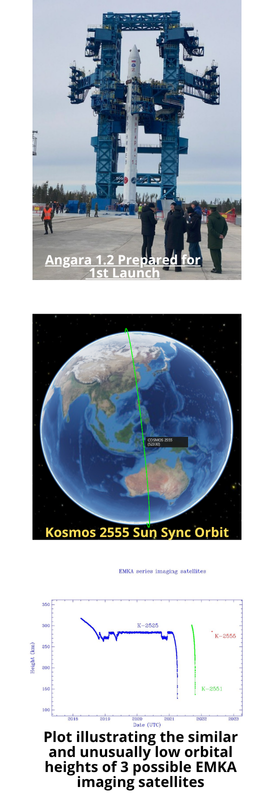
29 Apr 2022: Russia launched the Angara 1.2 rocket with an unknown payload for the Russian Aerospace Forces. The satellite is cataloged as Kosmos 2555. Launch Video. Launch Prep Video.
– The launch was the first operational flight of the Angara rocket family. Angara 1.2 can launch 3,800 kg to LEO. Russia scheduled 2 more launches for 2022. Roscosmos has one mission and the second is a commercial flight for South Korea (status unclear).
– The mission of Kosmos 2555 remains a mystery. The satellite is in a 279 x 294 km x 96.5° sun-sync orbit, typical for an earth observation mission.
– Kosmos 2555’s orbit is quite similar to the initial orbit of Kosmos 2525 launched in 2018 and Kosmos 2551 (launched in 2021).
– Kosmos 2525 was described as an “Experimental Small Satellite”, to serve as the basis for a “space-based Earth remote sensing complex.”
– Kosmos 2525 is likely the precursor of a constellation of smaller satellites to augment imagery provided by Russia’s larger Persona imagery satellites. Kosmos 2525 appears to have been operational until late 2020.
– Kosmos 2525 may be comparable to the first in a series of American commercial Earth imaging satellites called SkySat-1 with a maximum resolution of 0.9 meters in panchromatic mode.
– Kosmos 2551 did not make orbital adjustments and appears to have failed, reentering a month after launch.
– On-line posts from Russian insiders identified Kosmos 2555 as “MKA”. “MKA” is a Russian abbreviation for “small satellite” and likely not the satellite name. Later the name MKA-R suddenly showed up in NK’s Russian launch schedule, without any source.
– This post led to speculation that Kosmos 2555 was a radar imaging satellite. However, Kosmos 2555’s low altitude suggests an EO/IR remote sensing mission and not radar (radar imaging satellites typically use higher altitudes).
– Kosmos 2555 could be the latest Razbeg vehicle (a new type of optical reconnaissance satellite) or the secretive remote sensing satellite that Russia reportedly has built for Iran. The latter was expected to fly in the second quarter of 2021.
– Amateur radio astronomers in the Western Hemisphere have not detected S-band (frequency typical for satellite telemetry) signals. More collection required to draw any conclusions on Kosmos 2555 status.
– The Russian satellite manufacturer VNIIEM produced Kosmos 2555 and has been linked with both Razbeg program and the satellite Russia intends to export to Iran.
While not confirmed, Kosmos 2555 is likely a replacement for the failed Kosmos 2551 mission launched in Sep 2021 and re-entered less than a month later.
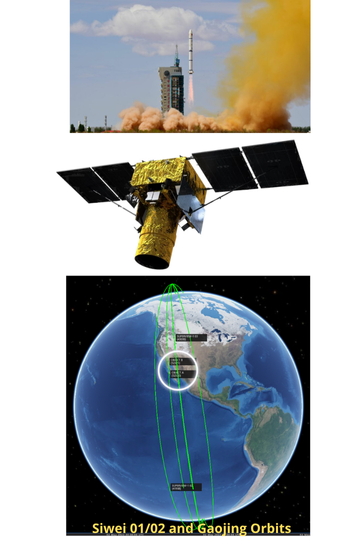
29 Apr 2022: China successfully a launched Chang Zheng 2C (CZ-2C) from Jiuquan Satellite Launch Center with a pair of Commercial Earth observation satellites to a Sun-Synchronous Orbit (SSO). The satellites are called Siwei-01/02 and are operated by the China Siwei Survey and Mapping Technology Co. Ltd. The English names of the satellites are SuperView Neo 1-01/02. 7 other unknown objects from this launch are also
being tracked. See Video.
– Both satellites weigh 540kg each and have a maximum optical resolution of 0.5m each.
– U.S. space tracking later detected the pair in 486×502 km x 97° sun-synchronous orbit.
– They support resource and environmental observation, agriculture and transportation service, emergency management, and urban planning. It is not clear if they will also serve a military purpose.
– The satellite operator, China Siwei Surveying and Mapping Technology Co., Ltd operates two pairs of co-planar “Gaojing” or Superview satellites launched in Dec 2016 and Jan 2018, delivering panchromatic 0.5m resolution imagery.
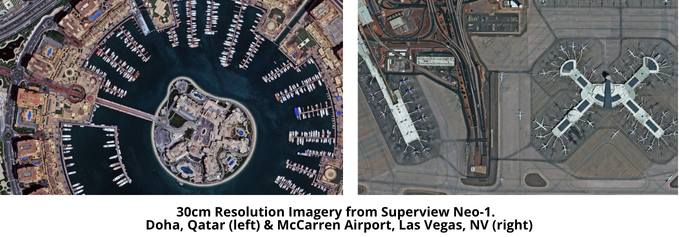
– On 6 May, China Siwei released 30cm resolution imagery from Superview Neo-1.
– In addition to the two satellites, the launch generated 7 other trackable objects 4 of which are in orbits with apogees 200km+ greater than the Siwei satellites. These are likely the separation motor covers that are ejected from the second stage when it deploys the payload. They have been seen on most CZ-2C launches.
– The remaining 3 objects are potentially part of the dual satellite dispenser, but this has not been confirmed.
– Chang Zheng 2C is a two-stage orbital rocket developed and is commonly used to launch small payloads and is the smallest and least powerful rocket of the early Chang Zheng generation.
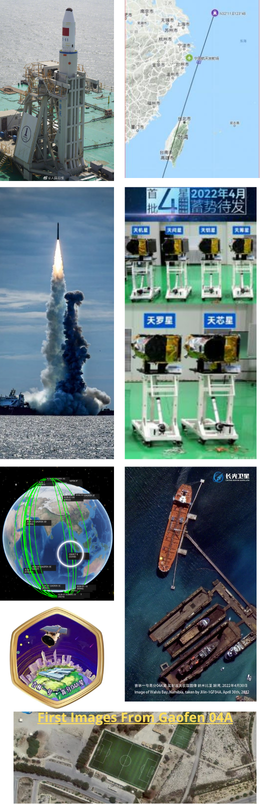
30 Apr 2022: China launched the 13th Chang Zheng (Long March) 11 (CZ-11) to deliver five Jilin-1 Gaofen Earth observation satellites to a Sun-Synchronous Orbit (SSO). This is the third CZ-11 (CZ-11H) launched from an offshore launch platform. CZ-11H Y3 launched from the Tai Rui platform at 123.8E 32.2N in the Yellow Sea. Launch Video. Launch Prep Video.
– CZ-11 is the first and only all-solid Chang Zheng rocket in operation. The rocket was developed to be a cheap, simple, and reliable vehicle to enable quick-reaction launches. Due to its all solid-based stages, CZ-11 can be put in storage and launched when needed.
– The rocket is classified as a small-satellite launch vehicle able to lift 700kg to LEO and 350kg to a 700km SSO.
– CZ-11 has a perfect record of 13 successful launches.
– China plans to launch five to eight CZ-11s, with up to three sea launches, in 2022.
– CZ-11 will soon see a major upgrade. The CZ-11A will have a new 2.4m first stage to increase its payload capability. The CZ-11A rocket will debut in late 2022.
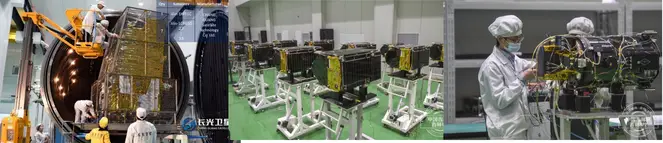
– Jilin-1 is a series of Earth observation satellites operated by Chang Guang Satellites Technology Corporation. Over 40 Jilin-1 satellites have successfully launched to orbit. The plan is to launch 138 satellites by 2030.
– This mission was named “One Arrow and Five Stars” and placed 4 Jilin-1 Gaofen (High Resolution)-03D satellites and 1 Jilin-1 Gaofen-04A satellite into SSO.
– The 43kg Jilin-1 Gaofen-03D satellites use new cameras, structures, and electronic systems to keep costs and weight low. The Jilin-1 Gaofen-03D have 0.75m resolution.
– Jilin-1 Gaofen-04A is a prototype satellite for the Jilin-1 Gaofen-04 series. This satellite will use static push-broom images with a resolution better than 0.5m. It will use onboard mission autonomous planning, real-time data transmission, and onboard AI functions. The new software and single-tracking multi-point imaging delivers rapid information return.
– Once the 138 satellites are launched, the full constellation will enable round-the-clock, all-weather, and full-spectrum data acquisition. They will provide geospatial information and services of high temporal and spatial resolution.
China Launches 8 Jilin Imaging Satellites (not a repeat!)
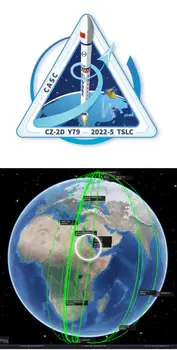
5 May 2022: China launched a Chang Zheng 2D (CZ-2D) with 8 Jilin-1 remote sensing satellites from Taiyuan Launch Center, days after an earlier batch rode to orbit via launch from a sea platform. Aboard were seven Jilin-1 Gaofen (“high
resolution”) 03D satellites, numbered 27 to 33, and the larger,
wide field of view Jilin-1 Kuanfu 01C, for Changguang Satellite
Technology (CGST). See Video.
– All 8 satellites are in ~530 x 545 km x 97.7° sun-sync orbits.
– Each of the 7 Jilin-1 satellites weighs 42kgs and return panchromatic images with a resolution of 0.75m or 3m in multispectral mode. The satellites cover a swath width greater than 17km.
– The Jilin-1KF01C also features a high resolution (UHD/4K) video capability.
– 54 Jilin-1 satellites will be in operation after adding this batch. Changguang Satellite claims its Jilin-1 constellation can revisit any spot on Earth 17 to 20 times a day.
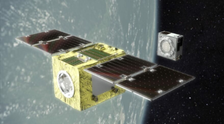
– Astroscale’s ELSA-d servicer spacecraft, a 175kg satellite designed to demonstrate orbital debris removal technologies, lost the use of four of its eight 1-newton thrusters in Jan.
– Despite the setback, Astroscale successfully commanded ELSA-d’s servicer craft to close within about 159m of the much smaller client satellite on 7 Apr.
– The servicer craft tracked the client from a starting distance of 1,700km. Previous tests started with only 30m separation.
– The rendezvous put the 17kg client craft within range of the servicer’s low power radio (LPR) sensors, enabling it to take over navigational controls from the ground.
– ELSA-d is the world’s first commercial mission to prove the core technologies necessary for on-orbit satellite servicing in LEO.
1 May 2022: RAND published blog from Bruce McClintock, RAND’s lead for the Space Enterprise Initiative. In it McClintock asserts, that the United States has set an important example others might follow and took an important first step towards a binding, international ban on destructive anti-satellite testing. This is a ban that many have recommended and been years in the making. Other excerpts below.
– U.S. thinking on a total test ban has evolved rapidly over the last year.
– In early 2021 the United States National Submission to the United Nations regarding reducing space threats through norms, rules, and principles of responsible behaviors acknowledged that “failure to mitigate generation of space debris, especially long-lived space debris, during ASAT tests or other activities, would impact the outer space environment and could negatively affect the ability of States to use space for peaceful purposes.”
– The Russian destructive ASAT test in Nov 2021 shocked the world…and appears to have catalyzed the United States to commit to a more-comprehensive ban on ASAT testing.
– In Dec 2021, Deputy Secretary of Defense Kathleen Hicks said the DoD “would like to see all nations agree to refrain from anti-satellite weapons testing that creates debris, which pollutes the space environment, risks damaging space objects, and threatens the lives of current and future space explorers.”
– The U.S. has set a good example that other nations could follow—committing to a ban on destructive direct-ascent ASAT missile tests without any caveats regarding the length of debris generation.
– The most optimistic path to a legally binding ASAT test ban is the United Nations Open Ended Working Group, schedule to meet in May.
China Conducts Successful 1km "Hop"
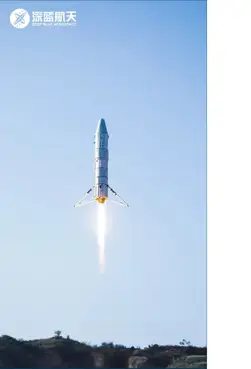
6 May 2022: Deep Blue Aerospace reported its “Nebula-M” test rocket completed the third flight recovery mission. The “Nebula-M” No. 1 test rocket completed a 1km vertical take-off and landing (VTVL) flight test. It was the vehicles’ 3rd test flight. See video.
– The Nebula-M uses a “Thunder-5” liquid oxygen kerosene engine manufactured using 3D printing technology.
– The Nebula-M is a small test vehicle uses 50kN thrust Thunder-5 engine. The full-scale Nebula-1 uses 9 200kN thrust Thunder-20, which is expected to make flights next year.
– Per Deep Blue Press release: Deep Blue Aerospace has become the second company in the world to complete all low-altitude engineering tests for vertical recovery and reuse of liquid oxygen and kerosene rockets (the first being SpaceX in the United States).
– Deep Blue announced there will be a 10km vertical recovery and orbit-level recovery but did not release target dates.
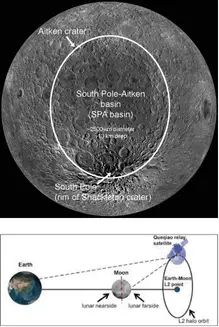
27 Apr 2022: China announced plans to set up a constellation around the moon to provide communication and navigation services for future operations on the lunar surface. The first launch for the small constellation could take place in 2023 or 2024, and China welcomed other nations to assist.
– No further details were provided, but China’s lunar exploration roadmap and mission concepts provide insight into the plans.
– The most immediate use of the communications relay and navigation services would support the Chang’e-6 sample return mission and Chang’e-7, which includes an orbiter, lander, rover and a small hopping spacecraft for investigating shadowed craters for water-ice.
– Both Chang’e-6 and Chang’e-7 are expected to target landings in the vicinity of the lunar south pole.
– China has a relay satellite stationed in a halo orbit around Earth-moon Lagrange point 2 to facilitate communications with the Chang’e-4 lander and Yutu-2 rover on the lunar far side, a different orbit would be needed to enhance communications and facilitate sending larger volumes of data between Earth and the lunar south pole.
– The first relay satellite may launch on a dedicated launcher or part of the Chang’e-7 spacecraft stack. The relay satellite is likely a first step to facilitate new, more complex activities at the lunar south pole as part of China’s long term lunar exploration plans.
6 May 2022: An article in the People’s Liberation Army Daily urged the global community to be “on high alert” as they allege the U.S. may dominate outer space via Starlink satellites. There was also concern regarding the potential for Starlink to form an independent internet, threatening “cyberspace sovereignty”.
– Li Xiaoli authored the article and stated, “The Starlink project has decided to increase the planned 12,000 satellites to 42,000, underscoring that it is widely distributed, flexible and could be reconfigured quickly. The ambition to militarize Starlink and its barbaric expansion deserve high alert from the international community,”
– The article also added that when completed, Starlink could enable the U.S. military to “gain situational awareness while keeping adversaries in the dark.” It will also provide Washington with global and around-the-clock reconnaissance and surveillance services.
– Finally, the article warned, “It can provide large bandwidth and high-speed military communication services with global coverage, allowing the U.S. military to build a powerful command communication network covering uncrewed aircraft, strategic bombers, nuclear submarines and other combat platforms.”
– Interestingly, China submitted fillings to the UN’s International Telecommunication Union explaining its intention to construct two LEO constellations totaling 12,992 satellites.



You must be logged in to post a comment.