
issue 49 | 2 june 2022
The integrity flash
Analysis of Developments in the Space Domain
in this issue
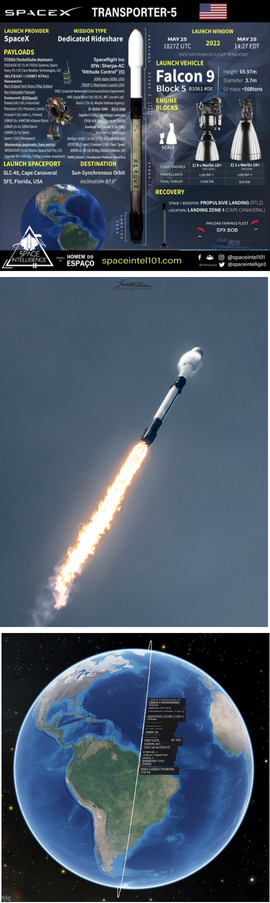
25 May 2022: SpaceX launched several 59 payloads on its fifth dedicated rideshare mission. The Falcon 9 lifted off from Space Launch Complex 40 at Cape Canaveral, Florida. The rocket’s booster, flying its eighth mission, landed back at Cape Canaveral’s Landing Zone One eight and a half minutes after liftoff.
– The satellites were delivered into a sun-synchronous orbit with apogees ranging from 531.9-535.2km and perigees from 514-523km. Inclination is 97.5°.
– Falcon 9 made a “dogleg maneuver” to reach polar orbit to avoid overflying Florida. This launch used the polar launch corridor, which has been used by SpaceX since the SAOCOM 1B mission in 2020. The corridor had previously been unused between 1969 and 2020.
– Rideshare aggregator Exolaunch accounted for 21 Transporter-5 satellites, including satellites for Iceye, Satellogic, and Spire. Smallsat manufacturer Terran Orbital flew satellites for several customers, such as Fleet, GeoOptics, and NASA.
– HawkEye 360 had a cluster of three radio-frequency intelligence satellites onboard as well: GHGSat, which launched three satellites to monitor greenhouse gas emissions; and Umbra, which launched a synthetic aperture radar imaging satellite.
– Outpost Mars Demo-1 was also onboard and will demo structural metal cutting in space – part of #Nanoracks Outpost Program’s goal to transform used launcher upper stages into uncrewed, controllable platforms.
– Xona, a commercial company attempting to build a LEO PNT constellation, launched its first in-space demo mission via Transporter 5.
– The mission carried several orbital transfer vehicles. These can help bridge the gap between pure rideshare missions where payloads have little or no control on the orbit they’re placed in and dedicated smallsat launches like Rocket Lab’s Electron, which offers greater control but at a higher price.
– Transporter-5 was SpaceX’s fifth dedicated small-sat rideshare mission and the third this year, after Transporter-3 in Jan and Transporter-4 in Apr. The next rideshare mission, Transporter-6, is scheduled for Oct.
– Demand for rideshare missions remains strong.
Go West (& East): SJ-20 and SY-12s On the Move
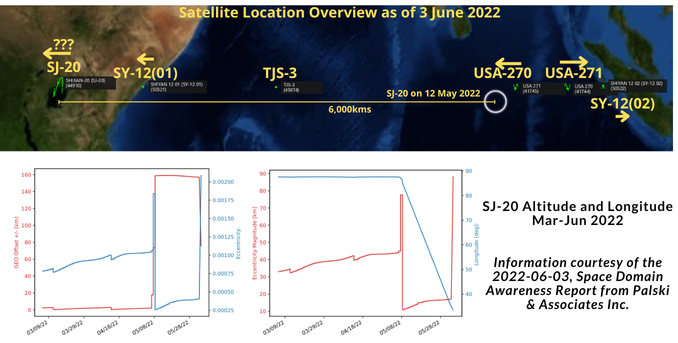
3 June 2022: China is repositioning 3 of their experimental satellites. As noted 2 weeks ago, China raised the orbit of its SJ-20 satellite and has since passed TJS-3 and continued to move west. On 3 Jun it appears to have decreased altitude, slowing its westward drift. China’s two Shiyan 12 (SY-12) geostationary satellites are also drifting with SY-12 (01) heading west, while SY-12 (02) tracks east.
– From ~13 May 2022 – 3 June 2022, SJ-20 was 157kms above the GEO belt and moving westward at 2° per day. On 13 May it was located over 87.5° E. On 3 Jun it was at 33.6°E.
– SJ-20’s inclination has increased nearly 70% in the past 3 weeks going from .77° to 1.13°.
– In its current orbit, SJ-20 will continue to drift 1° west per day. However, the vehicle may continue to maneuver and it may be settling into its new location. More to follow!
– SJ-12(01) is also drifting west, but at a far slower pace. The satellite is ~19.5km above the GEO belt and drifting .28°/day.
– SJ-12(02) is ~34.1kms lower than the GEO belt & drifting East just under .5° per day.
Background
– China launched both SY-12 satellites on 23 December 2021 on a CZ-7A launch vehicle.
– The publicly announced purpose of the Shiyan 12 satellites is -spatial environment detection and testing. There has been open source comparison with the US GSSAP mission.
– China launched the SJ-20 on 27 December 2019 on the massive CZ-5 launch vehicle. SJ-20 is China’s largest communications satellite (8,000+kg) and uses the DFH-5 bus.
– Other than all three vehicles being launched around the Christmas Holidays (thanks for that), the trio have another element in common: all have maneuvered away from approaching US GSSAP vehicles.
– In Aug 2020, USA 271, one of the US Geosynchronous Space Situational Awareness Program (GSAPP) satellites, approached SJ-20. However, the Chinese clearly detected the US satellite and rapidly moved SJ-20 away. Watch Video.
– In early January 2022, the COMSPOC noted that as USA-270 (GSSAP 3), neared Shiyan-12 (01) and (02), both maneuvered to avoid observation. See Video Recreation.
– Currently USA-270 and USA-271 are not in close proximity with SJ-20 or either of the SY-12 satellites. USA-324 & 325 (GSSAP 5 & 6) are over the Atlantic Ocean, West of Africa and heading Eastward. All locations per spacetrak.org data.
– The reason behind the continued drifts isn’t clear and bears further watching.
Together Forever? SJ-6 05 Tandem Remains Tight
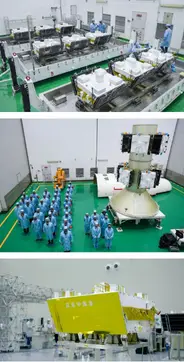
3 Jun 2022: Beginning with their launch on 9 Dec 2021, SJ-6 (05A) and SJ-6 (05B) have remained in close proximity. The pair remain in lower than expected orbits (relative to previous SJ-6 missions), and in late Dec the satellites increased their spacing between one another. Then in Feb, analysis from LEO Labs indicated SJ-6 05A and 05B had setup for rendezvous and proximity operations (RPO). LEO Labs detected ingress maneuvers over several weeks resulting in periods of apparent rendezvous mid-Mar. Orbital data from 3 Jun indicates the two satellites continue to operate in close proximity and are ~4km apart.
– The post-launch news release from CAST stated the purpose of SJ-6 (05) is the same as the 4 pairs a decade ago (detection of space environment & new technology validation).
– The orbit for SJ-6 (5) differs from previous SJ-6 missions. Inclination is nearly the same but altitude is ~130km lower. The SJ-6 (5) satellites also orbit in closer proximity to each other than previous SJ-6 missions. This separation could change as the mission progresses.
– The nature the SJ-6 05 orbits led to speculation that the mission was similar to the US Poppy program , the successor to the first American electronic intelligence satellite, known as “GRAB” (Galactic Radiation and Background). Poppy was designed to detect land-based radar emitters and support ocean surveillance.
2 Jun 2022: With only a few hours notice (via NOTAM), China launched a CZ-2C from Xichang Satellite Launch Center. On board were nine positioning and connectivity test satellites (GeeSAT 5 (01-09)), in a first step for a constellation to support autonomous driving for automaker Geely. Geespace says the satellites will provide centimeter-level accuracy positioning and connectivity support. See Launch Video. See Geely Constellation Video.
– GEESPACE has a series of GEESAT platforms weighing 10kg-3000kg. GeeSAT 01-09 were built on the GEESAT100 platform each weighing ~100kg. There are another 3 GeeSats ready for launch.
– The 9 commercial comm/nav satellites are in 600x617km x 50.0° orbit.
– The planned “Geely Future Mobility Constellation” constellation will consist of 240 satellites. The first phase of 72 satellites are planned to be sent into orbit by 2025, followed by a second phase of 168 satellites.
– Described as modular, high-resilience, high-performance, mass-produced low-orbit satellites, each will have an operating lifespan of five years. Geely aims to offer the first combined commercial Precise Point Positioning and Real-Time Kinematic (PPP-RTK) services.
– Per Geespace CEO & Chief Scientist: “By establishing the Geely Future Mobility Constellation, Geespace is positioning itself to meet future user demands for high-precision positioning, space-based communication, and remote sensing services.”
Chinese policy frameworks, including support for new infrastructures such as “satellite internet,” and localities seeking to attract high-end technology space firms have supported the emergence of hundreds of companies in areas around launch, satellite and downstream applications, leading to the formation of several space industry clusters and pilot zones in China.
22 May 2022: In a paper published in Modern Defence Technology, Chinese military researchers say the country needs to be able to disable or destroy SpaceX’s Starlink satellites if they threaten national security. According to a paper published in Apr, China needs to develop anti-satellite capabilities, including a surveillance system with unprecedented scale and sensitivity to track and monitor every Starlink satellite.
– Per the paper: “A combination of soft and hard kill methods should be adopted to make some Starlink satellites lose their functions and destroy the constellation’s operating system.”
– Researchers estimated that US military drones and stealth fighters could increase their data transmission speed by more than 100 times with a Starlink connection.
– The unprecedented scale, complexity, and flexibility of Starlink would force the Chinese military to
develop new anti-satellite capabilities, according to the authors.
– “The Starlink constellation constitutes a decentralised system. The confrontation is not about individual satellites, but the whole system. This requires some low-cost, high-efficiency measures,” said the researchers without elaborating on the methods of attack.
– This paper could be the first open call for an attack on Starlink from China.
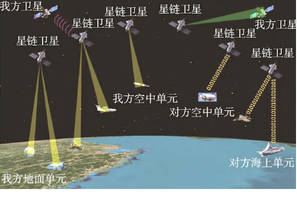
10 May 2022: When USS Harry S. Truman was heading to a strait transit drill off the coast of Long Island in New York on June 17 last year, a Chinese remote sensing satellite powered by the latest AI technology automatically detected the Nimitz-class aircraft carrier and alerted Beijing with precise coordinates.
– With AI-powered satellites, Beijing could detect and “live stream” military activities or assets of interest on the other side of the planet, according to space scientist Yang Fang and her colleagues with DFH Satellite in Beijing. Their conclusions were published in a domestic peer-reviewed journal, Spacecraft Engineering, in Apr.
– In the past, the Chinese military had to collect and analyze huge amounts of raw satellite data to understand the details of drills taking place in US home waters, with the results usually coming well after the event was over.
– The satellite that tracked the US aircraft carrier could identify a wide range of tactical or strategic targets by analyzing more than 200 frames of high-definition images per second.
– Yang’s team claimed they achieved a breakthrough on “weight reduction” for AI technology. The image recognition with the algorithm they developed for the satellite consumed just 3% of the calculation resources used by traditional algorithms when doing the same task.
– The researchers did not name the satellite in their paper.
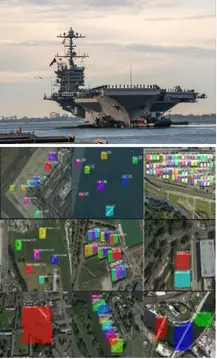
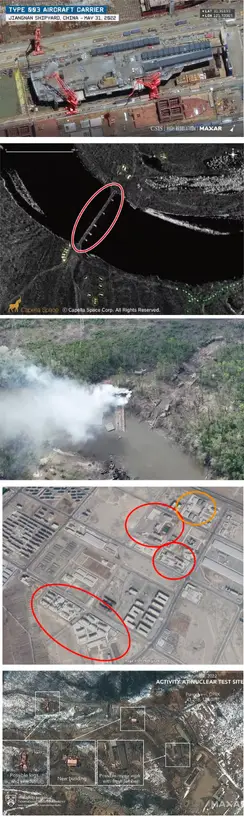
30 May 2022: Article in Foreign Affairs discusses how commercial satellites are changing conflict. Based largely on the recent experiences of the Ukraine conflict, the article reiterates its authors previous points that commercial satellite imagery is dramatically changing the information landscape, particularly when it comes to national security.
– Gone are the days when only governments could collect advanced intelligence about their rivals and when militaries could keep information about battlefield developments concealed from public view.
– Commercial imagery has documented North Korea’s expanding nuclear arsenal and exposed human rights abuses such as China’s detention of the Uyghur population in internment camps.
– Open source information revealed and verified information about military maneuvers, battlefield losses, and Russia’s targeting of civilians.
– Tracking Russian troop movements has certainly aided Ukraine’s targeting of Russian forces…commercial satellite imagery helped give Ukraine an “information advantage on the battlefield [which] is so far countering superior equipment and mass.”
– Support includes real-time data from synthetic aperture radar satellites, which allow users to track military movements occurring under cloud cover and at night.
– Commercial satellite companies will likely play an even greater role during future crises…the Ukraine conflict has underscored their importance in shaping the information environment and enabling military planning. Their consequential role in the Ukraine war will likely deepen partnerships between private firms and governments
– Example: The earliest indicators that the Russian invasion of Ukraine had begun was not from artillery firing or aerial bombardments, but from a traffic jam. Watching live traffic updates on Google Maps, analysts at the Middlebury Institute of International Studies at Monterey observed unusual congestion along a road from Belgorod, Russia, to the Ukrainian border…The increasingly yellow and red traffic patterns on Google Maps suggested to the researchers that the Russian columns were on the move.
Although states still rely overwhelmingly on covert intelligence-gathering methods, Western governments should be sure to account for the opportunities and risks this evolving technology poses as they craft foreign and national security policy.
Introducing Jack's Astro Corner
The following articles on Hypervelocity and the Skylab Repair Mission were created by Jack Anthony. Jack has served 44 years in many space research, engineering, operations, leadership, program management and education roles. This includes 26 years in the US Air Force (30 if you count AF Academy time) and retired as a Colonel in 2004. He worked in the National Reconnaissance Office (NRO) and with National Aeronautics and Space Administration (NASA) in many roles.
Notable assignments include US Air Force Academy astronautics teacher, Squadron Commander, program manager for the development and flight of space vehicles, aircraft flight test engineer, space control system operations officer. In 2003, he served as the Department of Defense liaison deployed to NASA Johnson Space Center in support of the Space Shuttle Columbia accident investigation. In 1984 he was selected to be a visiting educator at the USAF Test Pilot School for AF Shuttle payload specialist. For 14 of these 26 Air Force years, Jack was a Civil Air Patrol Mission Pilot and served in CAP squadron and group commander leadership and mission coordinator roles.
Jack has 18 years as a contractor supporting the Air Force and Space Force. He’s served as a spacecraft operations leader and technical advisor for orbit maneuvering and rendezvous and proximity operations (RPO) missions. He was the operations leader for USAF Academy FalconSAT spacecraft operations with the cadet crew force. He served in the Space Security and Defense Program (SSDP) as a technical advisor, program manager and engineer leading several space defense and satellite protection related studies and analyses.
Presently he serves as an advisor in the National Space Defense Center/Joint Task Force-Space Defense and mentor space and intelligence experts standing watch at this critical space defense operations center. In this role, he is “on-call” advisor called in when his experience and know-how are deemed helpful to current situations. He teaches military personnel understand orbit mechanics, RPO and other sometimes confusing spaceflight dynamics situations. He’s earned the call sign “Sensei” and tries to live up to its meaning as an operator, engineer and teacher. Recently he was selected to be a consultant for the Royal Australian Air Force space operations program. Jack is also on the Board of Directors for the Alaska Aerospace Corporation which operates the Kodiak Space Launch Complex.
When not doing space stuff, he’s a Colorado local history researcher, writer, presenter. He is the Palmer Lake Star historian and led efforts to get this 500-ft outdoor illuminated star designated a state historic site in 2013. In 2019, he led efforts to have the Palmer Lake Town Hall listed as a state historic site. Jack and Margo hike, camp, backpack, climb 14-ers and often take folks new to hiking on guided adventures in the forest. His grown-up daughters are Kirsten and Shannon and they have brought Mike and Rory into the Anthony family…introducing Jack to Legos! They are grandparents to Zoe and go by the call signs Pop Pop & Gigi
Hypervelocity Collisions in Space – Let me explain the “what happens”
In 2021 Jack Anthony wrote one of his many “learn space stuff” essays entitled, The “Weird Science” of Hypervelocity Collisions in Space. In it, Jack describes the physics of objects in space colliding at hypervelocity speeds.
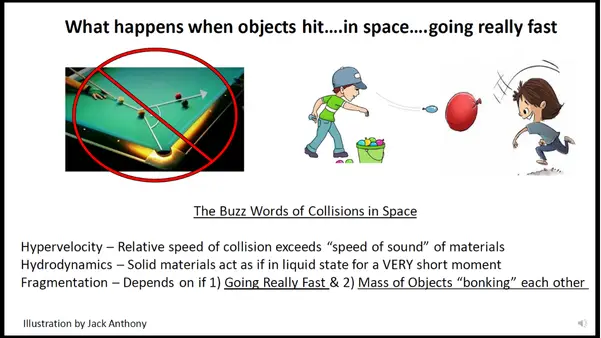
BLUF: At extremely high relative speeds of impact, solids act like liquids for a brief instant during the collision, the strength effects of materials can be neglected and the physics of hydrodynamics dominates. The result is a huge release of energy ejecting debris in all directions. There is little if any appreciable momentum exchange. You might say they blow through each other vice bounce off and change direction. Events like the F15/ASAT test of 1985, the Iridium-Cosmos on-orbit collision of 2009 and the direct ascent tests of China in 2007 and Russia in 2021 involved hypervelocity hits.
Why does Jack emphasize no or negligible momentum exchange? Well, our intuition leads to believing that hitting “down” on a target object it will deflect the resultant debris it towards earth for a more rapid decay and de-orbit – OR, hitting up will push the debris out into space and make it last longer. NOT TRUE says Jack. It’s all because of what’s hitting, the relative speed, and where we enter “the Hyper-Hydro Zone!”
– Hypervelocity is related to the speed of sound in the material being hit, in this context, the spacecraft. It can vary based on materials and can range from 3 to 6 km/sec. Yup, the specific material characteristics reveals a speed of sound of that material.
– If the impacting projectile is moving faster that the speed of sound of the materiel it is colliding with, you get a hypervelocity impact zone of hydro flow…the wave-front or shock wave of the collision energy literally shatters the material of the satellite long after the two objects have passed through each other.
– At hypervelocity speeds, an impact between two objects causes the materials to behave like fluids or liquids for a very, very short period of time.
– In the collision, there is a vaporization of the two objects, whether it be two satellites, a rocket body or a projectile.
– Analogy: Instead of water balloons hitting each other and bouncing off or sticking together, if that collision occurred at hypervelocity speeds, they would essentially “go through each other” fragmenting with the clouds of water droplets continuing along their original path, no longer contained by the balloon.
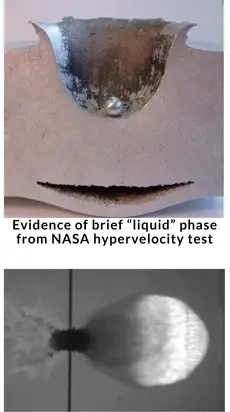
– At hypervelocity, there is a negligible momentum exchange and … the blobs of water continue on the path they were on, but now there is no balloon to contain them.
– For these reasons if you hit “down” on the target satellite or object it will NOT be deflected down for rapid de-orbit. Rather the majority of debris will continue along its original path and gradually evolve into an expanding debris cloud.
– There are rare exceptions in what engineers’ call “corner cases” where a little more momentum may be exchanged, but effectively the two objects are “flowing” through each other without influencing their original orbit paths.
– The higher the relative velocity at “hit”, the greater the velocity of the ejected debris in all directions (radial, in-track and cross track).
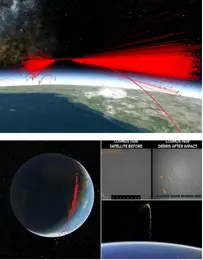
– This debris cloud is an evolving and dynamic entity; it is not a “field” which implies a static situation. It’s density at first is high, many particles in a small “ellipsoid” that over a few orbits expands and becomes less dense. It’s like a hot dog shape but ever increasing in length. There’s a lot more to the evolving of a debris cloud in space.
Jack is happy to send you his entire paper, he can be reached via jackfanthony78@gmail.com. He is also available to teach you the Orbit Element Dance in person or via Zoom – have your family and friends watch this unique astrodynamics lesson.
Jack wanted to give a shout all his mentors as far back as 1986. These folks who took time to teach him and help him explain include Don Kessler, Nick Johnson, Bob Morris, Felix Hoots, Darren McKnight, Andrew Abraham and Marlon Sorge. They helped Jack understand and convey the “weird science” of phenomenon like hypervelocity collisions and space debris.
Space History: Saving Skylab May-June 1973
“Moral of the story: Things don’t always go as planned. Really bad days may be salvaged with some out of the box thinking and “just getting on with it” — where “it” means finding new ways to reach the goal.” Paul S. Hill, former NASA Mission Ops Director, Shuttle Flight Director, author of the book “LEADERSHIP: From the Mission Control Room to the Boardroom”
(See Video).
What was the first on-orbit satellite servicing mission? The repair and on orbit maintenance of the Hubble Space Telescope is perhaps what you’ll hear most folks answer. It was a remarkable feat to send Space Shuttle crews to Hubble to correct Hubble’s “eyesight” and then over the years complete upgrades and part replacements. It’s an awesome story! However, in my mind, the first satellite servicing mission was Skylab in May 1973. Let’s learn more…it’s a story of grit, determination, creativity and a few dramatic demonstrations by the astronauts of Newton’s 3rd law….read on!
Skylab’s was launched 14 May 1973. It was America’s first space station. The modified Saturn V headed skyward and at one minute into flight an electrical glitch causes a premature deployment of the Skylab’s micrometeoroid shield. That was not suppose to happen until it reached orbit. This also ripped away one of the 2 solar arrays. In the melee, the other solar array was sprayed with debris and pinned to the side of the station. It was unable to be deployed once in space. Skylab made it to orbit and within a few orbits the Mission Control folks knew something was very wrong. Telemetry showed no electrical power being generated by the solar arrays and the internal temperature of the Skylab was HOT! The first crew of Peter Conrad, Paul Weitz, and Joe Kerwin would have to wait beyond the scheduled 15 May launch to go dock with Skylab. The next 10 days was a race against time. Skylab was ailing and they needed to get to it and help save it before the damage would make it uninhabitable. Great minds came up with plans, devices and procedures to fix Skylab.
On 25 May, the crew launched into orbit. Stuffed into their Apollo Command Module was all sorts of materials, tools, ropes and things they would use to repair Skylab. They completed a rendezvous with Skylab and did a fly around. The first views were disheartening. They confirmed one solar array was gone, the other jammed in a closed position, and the micrometeoroid shield was gone. Skylab was being cooked by the Sun, the external surface of the station was blistering from direct sun effects. Yikes, the astronauts needed to get to work.

First, they “soft docked” with Skylab. This was to connect the Command Module but not lock it into place. With the spacecraft de-pressurized, Paul Weitz stood up in the open door with Joe Kerwin hanging onto his ankles and Weitz tried to use a 4.5 m pole with something that looked like a modified tree lopper on the end. They relentlessly tried to free the remaining and very stuck solar array. No Go. A closer look showed there was a mess of shield debris that would have to be removed to deploy the array.
Then they attempted to “hard dock” with Skylab and lock the two spacecraft together. That ran into some problems, the holding device would not fire. Like Maytag repairmen, they worked on the docking system hardware in the Command Module nose section and jerry-rigged a fix. They gave it another try and eureka, they were hard docked. Time to get inside Skylab. The large workshop section inside temp was 130 degrees F.
Next, they had to get a reflective mylar-like sun shield over the part of the external Skylab where the shield was to be. The shield had many purposes, including insulation from the sun’s heat from transiting into the station. There was another section of the Skylab not as hot, so the crew did find refuge from the steaming workshop there or actually back in the Command Module. There was a way to access space via an air lock, a tunnel that enabled them to deploy things into space. So, they brought with them a parasol, a mylar reflective umbrella looking thing. They were able to push the parasol through the airlock and get the device unfolded to then protect the skin. Hooray, the temperatures in the workshop started to cool. OK, so this install and deploy parasol fix went AOK. Now to get solar array deployed.
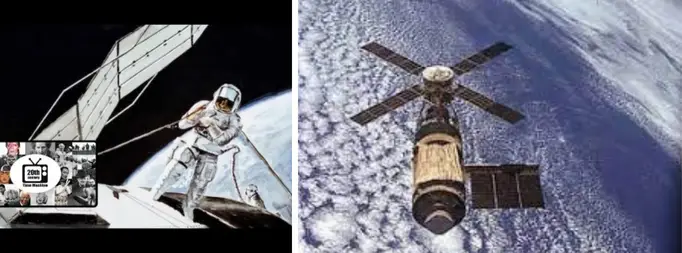
Astronauts Conrad and Kerwin performed a spacewalk. Their plan was to use bolt cutter type devices to cut straps and free the array which was pinned up against the Skylab’s side. They assembled six 1.5 m rods (made a long pole), attached cutters and Kerwin worked hard to get the cutters in place on straps that held the array and was jammed by debris from the 1-minute into launch anomaly. Kerwin diligently got everything in place but struggled. He tried to pull the lanyard to activate the cutters, No Luck. So, here’s where the repair job gets exciting. Do you remember Newton’s Third Law (Action-Reaction)? Well, Conrad went over to take a peek at the set up. Upon his arrival, the cutters suddenly fired and freed the solar array to a 20-degree deployment (they needed 90 degrees). But, the array bonked into Conrad and in his own words sent him “ass over teakettle” (my pardon, but that’s what he said). Thankfully he was tethered and didn’t go off into space. Whew.
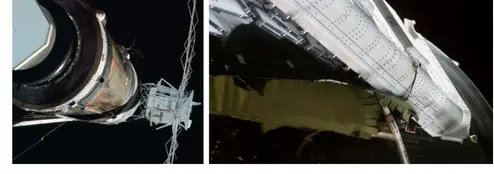
The array was deployed 20 degrees, 70 degrees to go to get it fully deployed. Conrad worked his way to stand on the hinge part, rigged a tether over his should and just like when you use a strap to help lift things, he stood up and Kerwin joined in pulling on a tether. WHAM, the solar array released and travelled to final 90 degree position. Of course, Isaac Newton had a say and both astronauts were catapulted away from the now deploying solar array. Good news, they were caught by their tethers and not propelled into space. The solar array was deployed and soon working, the overall output power from a small set of arrays that deployed OK after launch and this big array went from 40% to 70%. Yay!
Thus, Skylab was revived/saved, the temperatures inside were manageable and the power adequate for the planned year-long US space station operations. From May 1973 to February 1974, three crews of three astronauts work on the Skylab. It didn’t look exactly as planned and was a little shy on full power, had a funny gold-ish thing covering it, but the first crew saved the Skylab with this amazing first ever on orbit servicing and repair. Future crews would further help repair Skylab more so. There you have it…the first ever on-orbit repair- Skylab 1973
Skylab would eventually re-enter the Earth’s atmosphere. On July 11, 1979, with Skylab rapidly descending from orbit, engineers fired the station’s booster rockets, sending it into a tumble they hoped would bring it down in the Indian Ocean. They were close. While large chunks did go into the ocean, parts of the space station also littered populated areas of western Australia. Fortunately, no one was injured.


You must be logged in to post a comment.