
issue 57 | 25 sep 2022
The integrity flash
Analysis of Developments in the Space Domain
in this issue
12 Sep 2022: The United Nations held a second session of the open ended working group on reducing space threats through norms, rules and principles of responsible behaviors in Geneva, Switzerland. During the discussions both Japan and Germany declared they would not conduct destructive/debris generating anti-satellite tests. Watch UN Video.
– Japanese ambassador Ichiro Ogasawara declared Japan will not test anti-satellite weapons. He stated: “I have the pleasure to announce that Japan commits not to conduct destructive direct-ascent anti-satellite missile testing.”
– On 13 Sep, Germany also announced it would forgo such tests: “Germany commits not to conduct destructive, direct-ascent anti-satellite missile testing…Germany commends the United States of America for their commitment not to conduct such tests and all Nations who are joining this commitment.”
– To date five countries: the US, Canada, New Zealand, Germany and Japan pledged to refrain from such tests.
– A few days earlier, US VP Harris announced the Biden administration would introduce a resolution at the UN General Assembly to halt such tests internationally.
– The Sep 2022 meeting is the second of four, following the first one in May. It’s part of a long-term process at

the UN that began last year, showing how non-binding rules or norms—rather than a new international treaty—could be the way forward for reducing threats in space.
– To garner broad agreement, such norms focus on behaviors, not capabilities. For example, countries with ballistic missiles and missile-defense systems could develop the technology for a missile that could destroy spacecraft.
– China and Russia have long advocated for binding international agreements, like a treaty for the prevention of the placement of weapons in space, and an accord for the prevention of an arms race in outer space. (These are often referred to by their acronyms, PPWT and PAROS.) But past US administrations rejected those efforts. Until the Biden administration, they also opposed developing less formal international agreements.
– The next UN space threat meeting will take place in Jan 2023, and could provide momentum for nailing down solutions to other longstanding issues. These issues include: 1) creating clear rules for managing space traffic; 2) setting up keep-out zones near critical spacecraft; and 3) ensuring that nations are more transparent—and prompt—when submitting information to the UN’s record of objects launched into space.
Destructive anti-satellite tests have left parts of Earth’s orbit littered with debris.
– Space debris moves at more than 17,000 mph. Even paint-chip-sized bits of junk can be devastating because of their speed.
– Russia conducted an anti-satellite test in 2021, blowing up its own satellite with a missile and creating thousands of pieces of space debris. Some of that space junk threatened to hit the International Space Station.
– India, China, and the US have performed destructive anti-satellite weapons tests in the past.
16 Sep 2022: A Russian diplomat said civilian satellites could be legitimate military targets in a statement that seems to refer to Starlink providing broadband access in Ukraine. Civilian satellites “may become a legitimate target for retaliation,” the Russian official said in a statement to the United Nations’ open-ended working group on reducing space threats. <Editor’s note: Just more evidence of the Russian government’s complete inability to read the room.>
– The quote is from an unofficial English translation of the statement on 12 Sep by Konstantin Vorontsov, head of the Russian delegation to the United Nations Office for Disarmament Affairs (UNODA) working group.
– SpaceX’s Starlink division sent satellite terminals to Ukraine after Russia’s invasion of the country disrupted broadband networks, with the US providing funding for the effort. Satellite Internet access has been useful in Ukraine’s military operations against Russian forces.
-Vorontsov said uses of commercial and civilian satellite assets by the US and its allies throughout the ongoing invasion of Ukraine “constitute indirect involvement in military conflicts” whether they realize it or not and that so-called “quasi-civilian infrastructure may become a legitimate target for retaliation.”
– Vorontsov’s statement went on to claim the use of civilian satellites might violate the Outer Space Treaty: “this provocative use of civilian satellites is questionable under the Outer Space Treaty, which provides for the exclusively peaceful use of outer space, and must be strongly condemned by the international community.”
– Musk reported Starlink resisted Russian jamming and hacking attacks. Then-Russian space agency chief Dmitry Rogozin criticized Musk for helping Ukraine.
– Attacking Starlink in space would be no simple matter because SpaceX has launched more than 3,000 satellites and is seeking permission to eventually launch tens of thousands.
– Video of Starlink deployments in western Ukraine from Lviv.
– Starlink hasn’t been the only satellite operator providing important services in response to Russia’s war against Ukraine.
– In addition to Starlink, commercial satellite imagery firms such as Planet, Maxar, and BlackSky provide crucial intelligence by taking images of the conflict from above and sharing them openly, playing an unexpectedly important role throughout the Russian invasion.

13 Sep 2022: China launched a Long March 7A rocket from Wenchang and successfully inserted the Zhongxing-1E (ChinaSat 1E) satellite into geosynchronous transfer orbit. Launch Video.
– Chinese media described ChinaSat 1E as a telecommunications satellite for providing “high-quality voice, data, radio and television transmission services.”
– The vague description of the satellite matches statements for earlier Zhongxing-1 series satellites. The lack of information and images of the satellite suggests that the satellite series serves military customers.
– The satellite is also known as the Feng Huo 2E.
– The satellite was developed by the China Academy of Space Technology (CAST), a major spacecraft maker belonging to CASC.
– The previous satellite in the series, Zhongxing-1D, launched in Nov 2021. Notably, that mission used a Long March 3B, launching from the southwestern, inland spaceport at Xichang.
– The switch of launcher and spaceport for the Zhongxing-1E, along with wording in a CAST press release, suggests a larger, heavier satellite bus than earlier satellites. The satellite was also transported by ship from Tianjin to Wenchang, whereas satellites are flown to Xichang.
-There are currently 4 Feng Huo/Zhongxing/ChinaSat communications satellites on orbit. ChinaSat 1E appears to have settled in the GEO belt at 81.55°E near ChinaSat 1C.
-For its part, ChinaSat 1C increased its orbit and began a westward drift. As of 23 Sep 2022 it was at 78.07°E.
– The Long March 7A is a three-stage medium-lift expendable launch vehicle. With a capability of lofting up to 13,500 kg (29,762 lbs) into low-Earth orbit (LEO), and up to 7,000 kg (15,432 lbs) into GTO.
– China appears to be using LM-7A exclusively for military related payloads. Its 4 launches have carried the XJY-6 (2020), XJY-6A (2021), Shiyan 12A & 12B (launched together in 2021) and now ChinaSat 1E (2022).


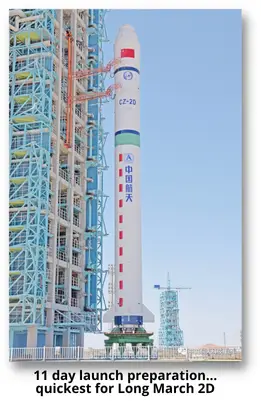
20 Sep 2022: China launched a Long March 2D rocket from Jiuquan Space Center carrying the Yunhai-1-03 payload. China labeled the satellite as an “atmospheric, marine, and space environments, disaster prevention and mitigation satellite.” While this is the stated purpose, this might be a placeholder to avoid revealing the true intention of the satellite. The weight of the payload, and technical specifications, are unknown.
Launch Video. Aerial View!
– Yunhai-1-03 was built by the Shanghai Academy of Spaceflight Technology (SAST), as was the rocket for this launch. The payload was deployed into a 754 x 776 km orbit with an inclination of 98.5°.
– The Yunhai payloads are a series of meteorological satellites that usually go to a Sun-synchronous orbit. The first Yunhai-1 was launched in 2016. The Yunhai-1-02 payload was launched on 25 Sep 2019, on the same rocket configuration as Yunhai-1-03.
– Yunhai-1-02 suffered a breakup event on 18 Mar, 2021, creating a number of pieces of debris.
– The U.S. Space Force identified the breakup was caused by an accidental collision with a small, mission-related debris object (1996-051Q) associated with the Zenit-2 launch vehicle for the deployment of the Russian Cosmos 2333 military signals intelligence satellite in 1996.
19 Sep 2022: The United Arab Emirates will fly its Rashid 2 rover on China’s 2026 Chang’e-7 lunar landing mission following an agreement between the two countries. A memorandum of understanding was signed 16 Sep by H.E. Salem Humaid AlMarri, Director General of MBRSC, and Wu Yanhua, Vice Administrator of CNSA, marking a first instance of cooperation between the two for a space mission.
– Chang’e-7 is a multi-spacecraft mission involving an orbiter, lander, rover and a small, repetitive movable lander for investigating shadowed craters. The surface spacecraft will be supported by a relay satellite operating in an inclined, highly elliptical lunar orbit.
– The mission will also carry the small UAE rover to be developed by the Mohammed bin Rashid Space Center (MBRSC) in Dubai. No specifications for the vehicle have been released.
– Chang’e-7 is currently expected in late 2026, according to Chinese reports. Earlier Chinese mission plans suggested that the mission could launch around 2024 and before the Chang’e-6 sample return.
– The spacecraft will have a combined mass of ~8 tons and launch on a Long March 5 rocket.
– The UAE is due to see its Rashid 1 rover launched later this year (November) by a Falcon 9 rocket. The 10 kg rover will be carried by the Hakuto-R lander developed by Japanese firm ispace.
– The UAE is a signatory to the U.S.-led Artemis Accords to establish shared set of principles for responsible behavior on the moon, but cooperation with other parties is not prohibited.
– International Traffic in Arms Regulations (ITAR), which restrict and control the export of technologies, could however pose different questions for the manufacture of the Rashid 2 rover.


21 Sep 2022: Maxar Technologies, an operator of high-resolution Earth imaging satellites, has received regulatory approval to use its satellites to monitor the space environment and sell that data commercially.
– Having a license to offer non-Earth imagery allows commercial remote sensing satellites to observe objects like satellites and orbital debris.
– Maxar offers to use this capability to fill growing commercial and government demand for debris monitoring and space domain awareness data.
– Maxar’s in-space monitoring services could support national security priorities that range from tracking objects, analyzing their characteristics and discriminating benign from aggressive activities in orbit.
– The US Space Force wants to augment the government’s capabilities with data and analytics tools developed by the private sector.

– Maxar’s four imaging satellites in orbit have had the capability to watch the space environment but the newly approved remote-sensing license modification by the National Oceanic and Atmospheric Administration (NOAA) allows them to do so commercially.
– Maxar has some experience with satellite-to-satellite (Sat Squared) imagery. After its WorldView-2 imaging satellite was hit by a non-tracked piece of debris the company used one of its other satellites to image WorldView-2 and determine the damage was minimal. The satellite remained operational after the event.
Leveraging commercial imagery to characterize space objects in LEO has the potential to unlock the mission and capabilities of numerous space objects with unknown/unclear missions. Future versions of the FFF just might contain annotated imagery of recently launched LEO spacecraft.
This Fortnight in GEO
Editor’s note: due to Celestrak visual tool unavailability, I could not build the normal graphic displaying position and drift of several GEO high interest objects. Just the highlights for now as reported in the ever-awesome Palski Space Domain Awareness reports.
– China’s TJS-3 increased its orbit 54km, ceasing its eastward drift. TJS-3 has settled into a new position, 88.24°E.
– ChinaSat 1C also increased its altitude ~20km and initiated a westward drift. The satellite is currently at 78.07°E and drifting. This maneuver seems to correspond with ChinaSat 1E’s arrival in the area. ChinaSat 1E is at 81.55°E.
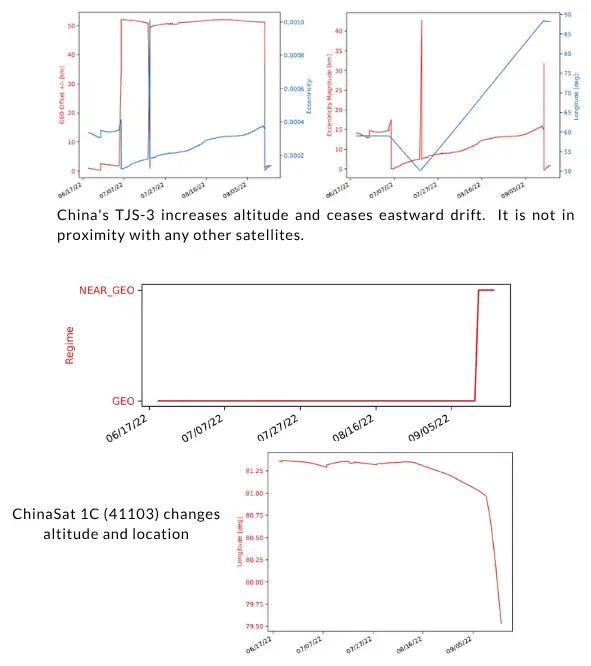
Editor’s Note: Thanks to weekly reporting from Palski & Associates Inc, we’re going to try to keep track of maneuvers of select spacecraft in GEO. For this week, orbital information is courtesy of the 2022-09-16 & 2022-09-23, Space Domain Awareness Reports from Palski & Associates Inc. Send a request to david.pierce@palski.com to get added to their distro list!
Jack's Astro Corner: Launch Windows – When to know you are GO, and which way to go!
The term Launch Window is bantered about for just about every space launch. The Artemis window varies, but for the most recent launch campaign it was a 2-hr window. Some missions have really tight windows, for example, many Space Shuttle missions to ISS were 4-minute windows. This article will introduce and illustrate just what is going on regarding a Launch Window. A launch window is when the launch site is lined up to when the launch site passes under the desired orbit plane for the launching spacecraft. As you remember from your Orbital Elements articles, that means matching Inclination and RAAN. I’m going to illustrate how the launch site in its rotation around the Earth’s axis passes under the orbit plane sought. I am going to use the case where of the inclination or the orbit we’re launching into is greater than the launch site latitude. So we’ll use Cape Canaveral as the launch site (28 degrees north latitude) and the ISS orbit (51° inclined) as our destination. With these constraints we will see that we get two launch opportunities a day to launch into that orbit.
Below is an illustration to show you just what is happening as we approach our launch window. The Earth is rotating, the launch site is moving eastward at its latitude along with that rotation (red dashed line), and the orbit plane is fixed in space (the yellow line). We’re basically waiting for the launch site to pass under the orbit plane, and when that happens it is GO time…launch the rocket! In our case, we have Cape Canaveral at 28°N latitude and we have the ISS orbit which is 51° inclined. Here is the illustration and below it is a paragraph talking you through what’s happening, it’s all about the “fixed” orbit (you’ll see why I added quotes around “fixed”) and Earth rotation and what latitude the launch site is at.
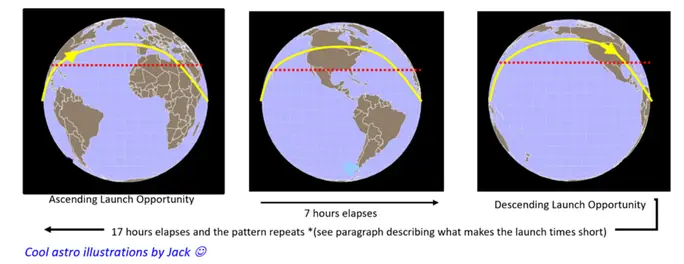
Let’s work left to right. You know the Earth rotates 15.04° per hour. So that red dotted line is the pathway of the Cape. It is moving eastward. Makes a one lap per day just like all the points on Earth. The ISS orbit is in yellow. The part of the orbit we can see is in the northern hemisphere and the southern hemisphere part is behind the Earth. It is tilted 51°. So, every time the Cape passes under the “fixed” orbit plane and we have a launch opportunity for an ascending azimuth. I’ll call this launch opportunity #1 of 2. I’ll show you a nifty equation to calculate what azimuth to program your rocket to fly later. So, there’s launch opportunity #1. Now, based on Cape being in the north hemisphere and the earth rotating 15 ° per hour, we move eastward and then about 7-hrs later the Cape again passes under the orbit plane, only this time it is a
descending pass, so we’ll fly out on a southwest azimuth or bearing. I call this launch opportunity #2 of 2. I mentioned sometimes the launch window is really wide, they may not be trying to enter a precise orbit, just a range or they may be able to execute orbital maneuvers to correct back to what they need. In the case of missions to ISS, the window may be 4 minutes long, wow, that’s a short amount of time. There is some steering the rocket can do to account for the width of the window, the Shuttle sure did have the ability to steer to precisely the orbit needed. Now, the Earth keeps rotating and 17-hrs later this pattern repeats. That’s the loop back line you see. So, now for the “why the quotes?’ around “fixed.”
If the earth was a perfect sphere and the atmosphere didn’t create a drag force on the ISS, this would be essentially a repeating pattern. Maybe a slight drift in time due to earth orbiting the Sun. BUT, the earth is not a sphere and has some interesting gravitational forces due to its shape that create a torque on the orbit and thus its twist, or RAAN, drifts. It is well modelled and thus the ISS orbit, which I said was fixed” is actually moving westward 5 degrees/day. That’s significant, so, this makes the repeat pattern shift. There are really smart astro experts always working the launch window calculations, and now that you are now armed with what you learned in this article you can chat with them and be most awesome and impressive!
One more item to know about. Which way do you launch? There is a simple equation that helps us know that. Reach back to your high school geometry because we are going to take the Cosine of 2 angles and then the arcsine of a number to get the northeast azimuth for our Cape-ISS example. Oh yes, (get ready for this, I know you remember it!) we will find that when we take the ArcSine of a number (must be less than 1) it has TWO answers. Finding that is easy, right? Its 180° minus the first answer we got. Let’s run the numbers folks, we got to understand which way to send the rocket when the launch window is open and we are GO to launch.
Here’s the equation that accounts for the launch site latitude and the orbit inclination and will give us the launch azimuth (true heading) needed to “hit” the orbit plane:
Launch Azimuth #1 = ArcSine [Cosine(Inclination)/Cosine(Latitude Launch Site)]
So for ISS we have 51° inclined orbit and the Cape is at 28° north latitude (that’s makes 28 a positive number). We run the numbers and get 45.5 degrees azimuth for the ascending launch opportunity. That looks about right! We’re heading northeast. So, what if we want to launch on the descending launch opportunity?No problem, know that ArcSine’s other solution is 180° minus the first azimuth. We get 134.5° for this launch azimuth for the descending opportunity.
Launch Azimuth #2 = 180 degrees – Launch Azimuth #1
The launch azimuth helps us “hit” the right inclination and the timing of when to launch helps us “hit” the right RAAN. Eureka, we get into the correct orbit plane and can subsequently maneuver to link up with the station. That aspect of launch window planning adds some complications to account for where ISS is in its orbit at launch time. That is a more advanced topic, but what you have learned in this article is pretty much the bulk of how launch windows work! Pretty cool stuff, now you know and can dazzle your friends and co-workers by explaining this.


