
issue 58 | 9 oct 2022
The integrity flash
Analysis of Developments in the Space Domain
in this issue
China Launches KZ-1A with Shiyan 14 & 15
24 Sep 2022: China/ExPace launched a KZ-1A four stage rocket from Taiyuan with two Shiyan experimental satellites, Shiyan 14 and Shiyan 15 on board. Both satellites were successfully delivered into a sun-synchronous orbit. Launch Video.
-Shiyan Weixing translates to “experimental satellites” in English. The spacecraft belong to a series of test satellites that launch on a variety of launch vehicles. Usually, neither the payload details nor the mass is given.
– Shiyan 14 & 15 are in a Sun-synchronous orbit (SSO) with an inclination of 97.52 degrees and an altitude of 488 by 506 km. Both payloads are listed with different purposes.
-SY-14 payload is described as a scientific research and technology validation mission. This is similar to the usual labels that the Shiyan Weixing satellites receive, based on statements for the previous missions. It is not known which company or China Aerospace Science and Technology Corporation (CASC) subordinate built the payload.
– SY-15 payload was described as a land surveyor, city planning, and disaster monitoring satellite. This is the usual description for optical satellites, which also matches the payload’s orbit. The SY-15 satellite was built by the Shanghai Academy of Spaceflight Technology (SAST), which is also referred to as the “Eight Academy.”
– This was launch number 18 for the KZ-1A rocket, with 16 successes so far. The KZ-1A can carry 200 kgs into a 700-km sun-synchronous orbit (SSO) and now launches from all three of China’s inland national spaceports.

China Launches LM-6 with Shiyan 16A/B & 17
26 Sep 2022: China launched a LM-6 from Taiyuan with three Shiyan experimental satellites, Shiyan 16A and 16B as well as Shiyan 17 on board. The three satellites were successfully delivered into a sun-synchronous orbit. Launch Video.
– Official Chinese media noted the satellites will be mainly
used for land survey, urban planning and disaster
prevention and mitigation.
– SY-16 A/B is built by SAST’s 509 institute, while SY-17 is
– The satellites are in a 512.0 x 527.6 km altitude and are inclined 97.5°.
– The Long March 6 is a liquid-fueled launch vehicle, consisting of three stages. It has only launched from Taiyuan and can lift up to 1,080 kg to a 700 km SSO.
– The launch was accidentally published early on Chinese social media about 8hrs before launch, confirming the payload.
A China Aerospace Studies Institute analysis published earlier this year suggests that Shiyan satellites play a role in the early stages in the development process of new space systems, including remote sensing.

Triplets Again? China Welcomes 1st Yaogan-36 Trio
26 Sep 2022: China launched a Long March 2D from Xichang Satellite Center with 3 Yaogan-36 satellites. This launch was very similar to the previous 5 Yaogan-35 missions with similar payloads and orbits. All have been launched from the same site using a Long March 2D. Launch Video.
– China released very little information regarding the mission of the Yaogan-36 trio of satellites.
– According to Chinese media, the satellites are used for scientific experimentation, surveying land, assessing crop yields, and monitoring disasters. However, the satellites are likely also used for reconnaissance operations by the Chinese Ministry of Defense.
– They appear to be in an orbit consistent with the previous Yaogan-35 triplets, four sets of which have been launched in the past 4 months.
– The A and B payloads were developed by CASC, while payload C was developed by SAST. The exact purpose and mass of the payload remain unknown. The structure is the same as previously flown Yaogan-35 payloads, making it likely that it is related to the Yaogan-35 triplet missions. The exact purpose of these triplet missions is not known at this point.
– Yaogan-36 is in a very similar orbit as the first trio of Yaogan 35 satellites (launched in November 2021). Altitudes are ~500kms and inclination is 35°.
– Yaogan 36 initial orbits were 3 km lower than matching Yaogan 35-01 group, probably to allow the new satellites to drift to the correct location round the orbit before moving up and into formation (this appears to have
happened).
– Yaogan 35-01 satellites continue to actively maneuver to
maintain formation so the Yaogan 36 is presumably an
enhancement to the YG 35 constellation and not a replacement
for YG 35-01.
– It is thought that the Yaogan 36 satellites are equipped with a
solar sail — a large piece of thin foil that is deployed in orbit.
By angling the sail, the satellite is able to use the solar wind to
move around, including getting velocity changes. China has
been using this technology to demonstrate quicker deorbits of some
satellites.


29 Sep 2022: Nearly two-thirds of the debris tracked from last year’s Russian anti-satellite (ASAT) test has since deorbited, but it could take more than a decade for the rest to reenter.
– Deshaun Hutchinson, an orbital analyst with the Space
Force’s 18th Space Defense Squadron, said that as of
August, there were 1,783 tracked objects associated with the
November 2021 destruction of the Cosmos 1408 satellite by
a Russian direct-ascent ASAT.
– Of those tracked objects, 1,122 had decayed and were no
longer in orbit, leaving 661 still in orbit.
– Based on modeling predictions, some of the remaining debris will remain on orbit until about 2033 although solar activity could affect that.
– While the amount of debris has dropped, it still poses a hazard to other objects in orbit.
-Of the ~300,000 conjunction data messages a day about 53,000 are Cosmos 1408-related.
– As of July 2022, there had been 560 conjunction notifications between Cosmos 1408 debris and the International Space Station, of which 15 were deemed seriously enough that NASA started planning for a potential maneuver, although only one ISS maneuver to date has been linked to debris.
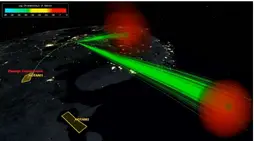
29 Sep 2022: Dutch astronomer, Dr Marco Langbroek, noted Kosmos 2558 performed a small orbit raising maneuver and further fine-tuned its RAAN precession to match that of USA 326.
– Russia launched Kosmos-2558 on 1 August 2022. The satellite is operated by the Russian Defense Ministry, with no stated mission.
– While no details about this payload are known, there is a suspicion that this payload might have been launched to match the trajectory and flight path of an American satellite, USA-326.
– On 4 Aug Kosmos-2558 came ~67kms from USA 326. Most of the distance was in altitude (~64 km of the ~67 km).
– Loaded with an engine that allows for maneuvering its orbit, the Russian spy satellite will probably get into position to watch other satellites and then move as needed.
– While this may sound like a provocative action, there is nothing illegal about it.
– As long as Kosmos 2558 does not directly interfere with NROL-87, such an action does not violate any international laws or norms.
– Kosmos 2558 actions serve as a reminder that just as nations use space to spy on one another on Earth, they also use Earth to spy on space activities. And increasingly, we’re seeing space-to-space observational activities.

26 Sep 2022: Article in the Space Review provides a non-exhaustive overview of the development and current execution of China’s satellite surveillance capabilities. The article divides satellites into civil, commercial and military categories while noting all remote sensing data from satellites is considered dual-use (civil & military).
– Civil Remote Sensing Satellites
- Fengyun meteorological satellite (FY): odd-numbered satellites (FY 1, FY 3) refer to polar-orbiting low Earth orbit (LEO) satellites, while the even-numbered satellites are geostationary Earth orbit (GEO) satellites (FY 2, FY 4). All Fengyun satellite data products are available to users all over the world and can be downloaded for free.
- Haiyang Ocean Satellite (HY): group of marine scientific remote sensing satellites. HY 1 series [2002, 2007, 2018, 2020] is China’s first satellite for surveying ocean resources (ocean color and sea surface temperature) and monitoring the environment. HY 2 series [2011, 2018, 2020, 2021], is a parallel series to HY 1. HY 2 monitors the dynamic ocean environment with microwave sensors. HY 3 satellites, still to be launched, will be used to monitor islands, coastal zones, and maritime targets to obtain ocean geodesy information with optical, infrared and microwave sensors.
- Huanjing Disaster and Environmental Monitoring Satellite (HJ): China plans to launch a total of 11 Huanjing satellites for disaster and environmental monitoring. The satellites will have visible, infrared, and multi-spectral sensors, and synthetic aperture radar (SAR). Up until now, five satellites have been launched.
- Ziyuan/CBERS Earth Resources Satellite (ZY): satellites designed for global coverage and include optical cameras and a system for collecting data on the environment. They are jointly managed by the PRC and Brazil. From 1999 to 2019, four successful CBERS missions were flown; three more ZY missions were launched in which China did not cooperate with Brazil.
- China High-resolution Earth Observation System (CHEOS): 25+ Gaofen satellites have been launched since 2013. These satellites are based on CAST satellite busses. It is known from the first seven GF series that different sensors are often used on each satellite. Resolution capabilities and other information about Gaofen satellites was published for the lower numbered Gaofen series of satellites. Information for Gaofen satellites with number 8 and higher has not been publicly released, suggesting that the satellites are (partly) for national defense purposes.
– Commercial remote sensing satellites
- Beijing series of commercial optical remote sensing satellites: first 2 generations were commercially built for China by Surrey Satellite (UK). Noteworthy, the imaging capacity of Beijing 2 was 100% leased by a Singapore based company. Beijing 3 [2021, 2022] satellites have been built by China Aerospace Science and Technology Corporation to acquire optical remote sensing satellite data and information products for the global commercial market.
- Jilin-1 series of satellites: Jilin-1 is China’s first, self-developed, commercial remote sensing satellite system and is operated by the Chang Guang Satellite Technology Corporation (CGSTC). The Jilin-1 satellite constellation is the core project and will eventually be composed of 138 remote sensing satellites covering high resolution, large swath width, video, and multi-spectrum, and a high revisit commercial service. As of the beginning of September, CGSTC has successfully launched 73 Jilin-1 satellites into space.
– Military remote sensing satellites
- Yunhai meteorological satellite (YH): meteorological satellite series [2016, 2019] in Sun-synchronous orbits (SSO) that are assessed to have military purposes. The satellites reportedly use Global Navigation Satellite System radio occultation to collect atmospheric data for weather forecasting and for ionosphere, climate, and gravity research.
- Ludi Kancha Weixing (LKW): high-resolution optical Earth observation satellite for military purposes. The two satellites appear to be connected to the Yaogan reconnaissance satellite fleet. Based on its appearance—a hexagonal satellite body with three radial fixed solar panels—the satellite is likely suitable for hosting a telescope of about 65 centimeters and thus, in a 500-kilometer orbit, achieving a possible ground resolution of up to 0.7 meters for panchromatic and better than 3 meters for multispectral and near-infrared images.
- Tianhui Yi Hao Weixing: collective name for a network of several topographical satellites, built by Dong Feng Hong and operated by the People’s Liberation Army. It includes Earth observation missions using optical, radar, gravity, and magnetism sensors to obtain geo-information about the Earth. Four satellites have been launched (2010–2021) in 500-kilometer SSO. The satellites are equipped with two different camera systems. One of them in the visible range (5 meters resolution), and the other in the infrared band (10 meters resolution).
- Tongxin Jishu Shiyan Weixing (TJS): series of Chinese satellites that have been deployed in geostationary orbit since 2015 and presented by Chinese authorities as telecommunications satellites. According to the Shanghai Academy of Spaceflight Technology, TJS 6 and TJS 7 have experimental docking stations. It cannot be said with any certainty what kind of (military) satellites the launched TJS 3 and TJS 7 (2018, 2021) are. TJS 1, 4, and 9 (2015, 2019, 2021) are assessed to be electronic intelligence (ELINT) satellites. They are sometimes also referred to as Qianshao-3 or Chang Cheng. Reportedly, TJS 1 had successfully deployed China’s first large aperture reflector antenna (about 32 meters across) after it reached GEO. TJS 2, 5, and 6 (2017, 2020, 2021) are assessed to be early warning of ballistic missiles satellites. They are sometimes also referred to as Huoyan.
– Yaogan/Jianbing Military Remote Sensing Satellites: Yaogan satellites primarily support the People’s Liberation Army and may support civil causes too. They utilize various means of remote sensing: synthetic aperture radar (SAR), electro-optical reconnaissance (EO), and electronic intelligence (ELINT) for ocean surveillance.
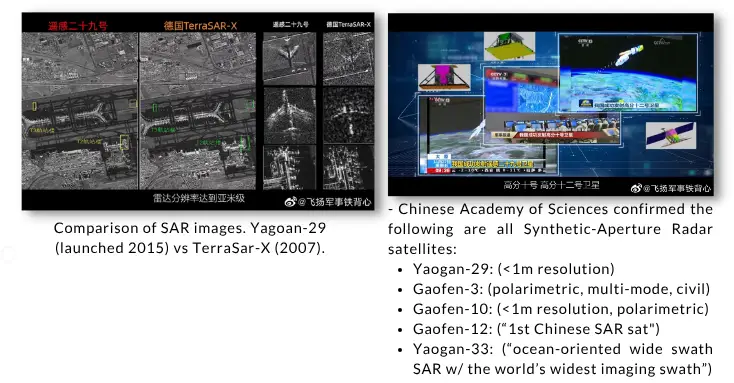
- Yaogan | Jianbing – synthetic aperture radar (SAR): Jianbing X is believed to be a new type of SAR reconnaissance satellite. Yaogan 29, 33, and 33R are associated with this name.
- Yaogan | Jianbing – Electro-optical: Jianbing 6, 9 11, and potentially Yaogan 26 satellites capable of high resolution imagery. The most recent satellites, Jianbing 11 is believed capable of delivering images with a resolution of <1m. Since 2012, two satellite missions have been launched.
- Yaogan | Jianbing – Ocean Surveillance: main objective is to put an end to the near invulnerability of US aircraft carriers. Jianbing 8 and more recent Yaogan 35 used to detect, identify, and locate radar and telecommunication emissions.
- Chuangxin 5 | Yaogan 30 – Ocean Surveillance: Yaogan 30, 32 and 34 satellites. Initially believed to be ELINT, it is now questionable whether the Yaogan 30 constellation is dedicated to ELINT. The satellites operate at a lower altitude and are not in formation. Therefore they could very well be small optical satellites that offer a high frequency of repetition. Up till July 2021, ten triplets of Yaogan 30 satellites have been put in space.
28 Sep 2022: Chinese space officials presented a range of opportunities for international cooperation in the country’s plans during a session at the International Astronautical Congress (IAC) in Paris, Sept. 21. There was no mention of their main partner, Russia.
– China is looking to build partnerships for its upcoming missions to the moon and deep ventures into the solar system, while omitting mention of Russia.
– China National Space Administration (CNSA) official noted China was open to proposals for its Chang’e-7 lunar south pole landing and orbiting mission—with a coinciding call announced by CNSA—and later Chang’e-8 in-situ resource utilization test mission.
– Chang’e-6 already features participation from Sweden and ESA in the form of a negative ion detector, an Italian retroreflector, a French radon instrument and a Pakistani CubeSat, named ICUBE-Q. The UAE will also have a small rover with a mass of around 10 kgs on board the mission.
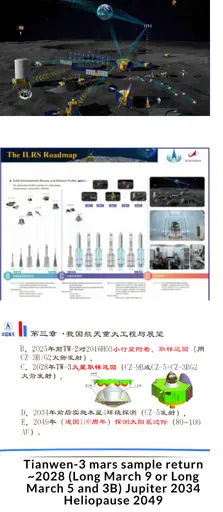
– In deep space, China is working on Tianwen-2, a near-Earth asteroid sampling mission which will also visit a main belt comet, launching around 2025. The Tianwen-3 Mars sample return and Tianwen-4 mission to Jupiter and Uranus are still at preliminary stages and open to collaboration. The Tianwen-4 mission will include a solar-powered Jupiter orbiter and a smaller, radioisotope-powered spacecraft t flyby Uranus.
– Experts noted in regards to its relationship with Russia, China “seems to be increasingly confronted with a difficult dilemma: turn the relationship into a real partnership or drop it altogether…as potential gains from partnering with Russia, previously including tapping into technological knowhow, are evaporating.”
-In the near future China is likely to “officially celebrate the importance of cooperation with Russia while in parallel pursuing opportunities that better serve its national interests.”
1 Oct 2022: With the permanent loss of the Arecibo telescope in Puerto Rico, China has taken center stage in humanity’s search for radio signals. China recently announced the start of work on a new telescope, which will eventually make it the biggest moveable one in the world.
– The new QiTai (QTT) Radio Telescope is being built in Xinjiang in Northwest China. It will have a 110 meter diameter, 10% larger than the Green Bank radio telescope in West Virginia. Construction is expected to take 6 years.
-The larger size will enable the telescope to capture more frequency data and cover 75% of the observable sky.
– China currently holds the record for the largest fixed radio telescope as well, with the static 500 m diameter FAST radio telescope.
China: LM-11 Sea Launch 2 PNT Satellites
7 Oct 2022: For the 4th time, China launched a Long March 11 from a barge in the Yellow Sea. The LM-11 carried a pair of satellites (CentiSpace-1 S5 & S6) for enhancing Beidou navigation signals. Launch Video. Better Video.
– CentiSpace-1 S5 & S6 will enhance the accuracy China’s Beidou navigation and positioning satellite system and conduct inter-satellite laser link experiments.
– China launched KZ-1A with CentiSpace-1 S3 & S4 on 6 Sep 2022.
– CentiSpace is planned to grow to a constellation of 160 LEO satellites for Beidou navigation enhancement.
– The launch took place on a converted barge stationed 3km away from the coast, much closer than previously, helping to shorten mission preparation time.

7 Oct 2022: Beginning on 26 September, signals originating within Iran have been jamming two Eutelsat satellites that provide foreign broadcasts in the country. A Eutelsate press release stated: “The interferences harmfully affect the transmission of several digital TV and radio channels broadcasting in Persian from outside of Iran, as well as other channels.”.
– The jamming is disrupting services from the operator’s Hot Bird 13C and Eutelsat 7B satellites in GEO.
– A company spokesman noted, “Eutelsat is a target because it broadcasts Farsi channels that are based abroad and therefore not under the control of IRIB,” or Islamic Republic of Iran Broadcasting, the country’s state-owned media organization.
– According to Eutelsat, it used a “specially designed interference detection system” to conclude that all uplink transmissions interfering with the two satellites originate within Iran.
–The signals directed at satellites are beamed into space from a site near Karaj, west of Tehran.
-Additionally, the hacktivist group Anonymous said it is jamming about 48 of the Islamic Republic’s radio and television networks, and will continue disrupting channels affiliated with state broadcaster IRIB as long as the Islamic Republic jams signals to Persian-language satellite channels.
-The Iranian government has not commented on Eutelsat’s jamming issues. The jamming comes amid weeks of protests in Iran following the death of a woman while in police custody. Iran’s supreme leader Ayatollah Ali Khamenei said the protests were part of a foreign plot to destabilize the country.
Intentional jamming is “explicitly prohibited” by radio regulations under the International Telecommunication Union (ITU), a United Nations agency.

This Fortnight in GEO
Relatively quiet couple of weeks in GEO, with no high interest object orbital changes noted.
– Russia’s Luch/Olymp satellite is now operating in proximity to Intelsat 7A at 18.0779°W longitude.
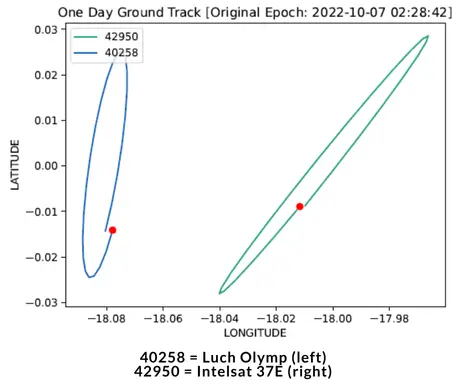
Editor’s Note: Thanks to weekly reporting from Palski & Associates Inc, we’re going to try to keep track of maneuvers of select spacecraft in GEO. For this week, orbital information is courtesy of the 2022-10-07 Space Domain Awareness Report from Palski & Associates Inc. Send a request to david.pierce@palski.com to get added to their distro list!
Jack's Astro Corner: Cislunar Explained
I’ve been teaching astrodynamics formally and informally since 1982. From Generals and Astronauts to great military folks to school kids who were curious. I would often speak of the 4 “Orbit” siblings. They are LEO, MEO, HEO and GEO. Low, medium, highly elliptical and geosynchronous orbits. Well, recently they learned their long-lost brother showed up…this sibling’s name is Cislunar. If you’ve been following space news and chatter amongst our leaders and the astro experts you’ll find ole Cislunar is getting A LOT of attention. This article will introduce you to this 5th “orbit sibling” and do so in a manner you’ll be confident enough to stop your neighbor or colleague and say “let me tell you about Cislunar orbits.” Maybe even do a group Cislunar demo…read on!
Let’s start with a video. A video I made earlier this year thanks to the willingness of 7 Advanced RPO astrodynamics students in a 2022 Palski & Associates course. Here is a human demonstration of the FIVE Joseph-Louis LaGrange points in the Earth-Moon rotating coordinate frame. I’ll orient you. We have a person as the Earth and another as the Moon. It just so happens the earth is a Space Force Major (yay William) and the Moon is a Space Force Captain (yay for Peyton). They form the primary axis of the Earth-Moon rotating frame. The Moon orbits the Earth every “how many?” days…” Bueller, Bueller, Bueller” ……27.3 days. OK, look closely, you’ll see the Moon person has two colleagues pretty darn close to the Moon. These are L1. I call that point the Earthside Lagrange point. L2 is on the other side and I call that the Far Side Lagrange point. Leading them is the L4 person, about 60 degrees of arc ahead. I’ll call this point “Lead.” L5 is trailing 60 degrees behind and I call it “Trail.” Hope these nifty call signs helps you remember the FIVE Lagrange Points of Cislunar. L4 and L5 are at Moon radius from the Earth. There’s one more, that’s L3. It is on the opposite side and at Moon radius. I call it “Opposite.” OK, so, watch this awesome Cislunar video by 7 RPO students. Be sure to watch it to completion, because this Cislunar 7 send a greeting to a great leader who is soon to retire after an amazing AF and Space Force career!
OK, maybe watch it a few times, its riveting and I hope you saw how the 5 LaGrange people stayed in the formation. As the Moon orbited the Earth, they all held their relative positions. That’s the magic of this Three-body problem that Joseph-Louis LaGrange figured out in the 1700’s It’s not magic, but with the Earth and Moon’s gravity and the third body, a satellite, there is a balancing act of ther BIG Earth gravity, the pretty big Moon gravity and the “ain’t got no gravity” satellite. So, you now have a handle on these 5 points in the Earth-Moon rotating system: L1-Earthside, L2-Farside, L3-Opposite, L4-Lead, and L5-Trail.
Let’s take a moment to look at these points and put some distances to it. In fact, the next illustration that I made for you gives some distances to give you scale. It also would make an excellent placemat for the dining table or your desk at work. Yes indeed, you will peg the “you are so cool” meter with friends and family. Simply save it as a pdf or jpeg, size it to 8 ½ by 11 inches and print it out…maybe go to a print shop since it might drain your ink cartridge, or use the General’s printer! Then laminate it, in case you spill on it. Let’s look at my “Cislunar Placemat” and see what we got.
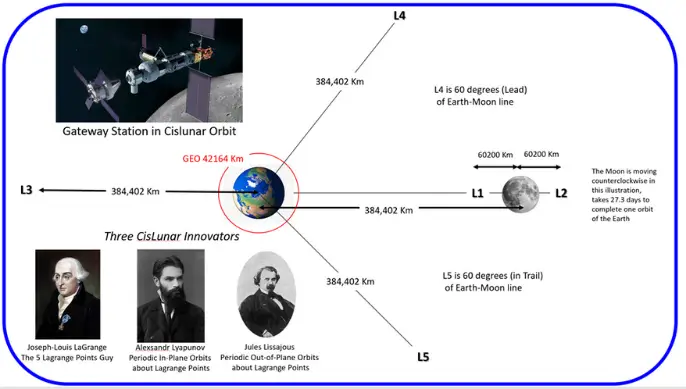
Lagrange kicked all this off with his award-winning mathematical work. He addressed the “General Three-Body Problem” in his prize-winning paper (Essai sur le Problème des Trois Corps, 1772). Way to go Joe Lagrange. Two other math smarties took it further. That is Alexandre Lyapunov, a Russian math and physics legend, and Jules Lissajous, a French mathematician. Lyapunov determines there are “orbits” around a Lagrange point in repetitive curved paths that lie entirely in the plane of the Earth-Moon system. He did this work in the late 1880’s. In the mid 1800’s Lissajous discovered orbits about the Lagrange points that are out of this Earth-Moon plane. These include the popular Halo orbits. In all cases, they are natural and periodic, they repeat.They are also unstable, but not like a train out of control, they simply need a little nudging to stay on course, not a lot of Delta-V, just a periodic maneuver. These Lyapunov and Lissajous orbits about the Lagrange points are so very useful. I see our astro neophyte Barney Fife looking a little perplexed. He understood the five Lagrange points that our Palski students so superbly demonstrated, but now we’re talking periodic orbits about those points. Yes, that’s what we are talking about. Let’s look closer at this concept.
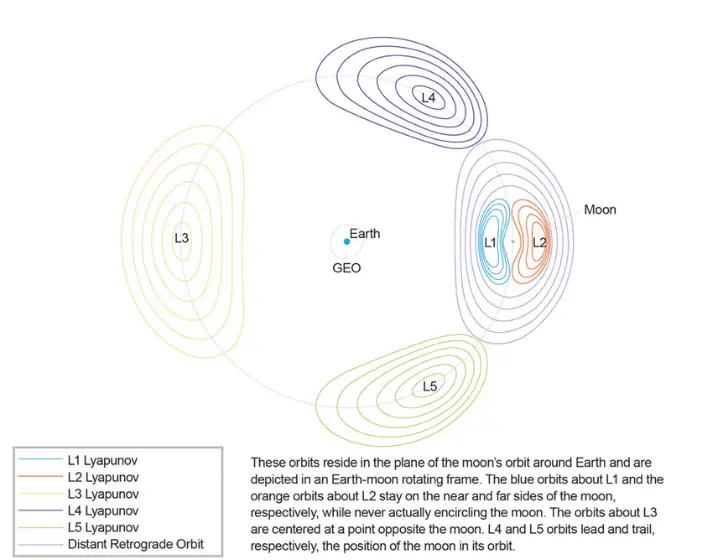
Dr George Pollock and Dr James Vedda of The Aerospace Corporation authored an excellent paper that I am going to cite as “you got to read this reference #1 of 2.” It’s called “Cislunar Stewardship” and in it they provide two excellent illustrations that help us visualize the periodic orbits about the Lagrange points in the rotating Earth-Moon system. Add this link for an excellent Cislunar reference!
Below is the Pollock-Vedda illustration of the periodic orbits in the Earth-Moon orbit plane (Reference Page 2 of Cislunar Stewardship). You see these “bean shaped” orbit trajectories about the Lagrange point.These are orbit paths about the point and their period can be as fast as 7 days or up to a month. So, think of the human demo and imagine an 8th participant circling their Lagrange point classmate in one of these bean-shaped orbits. That would really jazz up the demo, and perhaps lead to a collision of some sorts. The explanation Pollock and Vedda provide is succinct, informative and sums it up nicely.
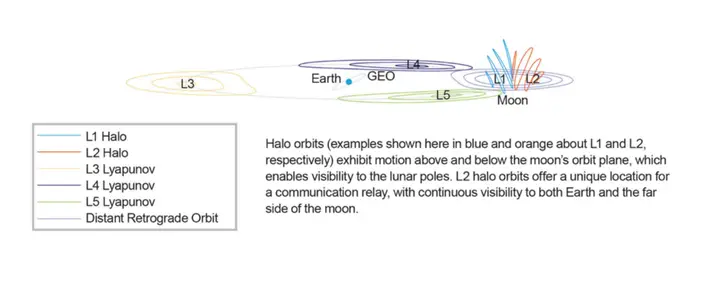
Now, in the next illustration (page 3 of Cislunar Stewardship) they provide is for the out of plane periodic orbits about L1 and L2. This out of plane motion makes for a pogo type motion up and down relative to the Earth-Moon orbit plane. I am not going to steal all their Cislunar “thunder”, you must take time to read their paper and see more illustrations and learn more about the challenges we face internationally as nation’s take advantage of these unique Cislunar orbits about the Lagrange points.
I said we have 2 awesome references, the second one is the AFRL’s “A Primer on Cislunar Space” by Holtzinger, Chow and Garretson. Here is the link.
What I like about this “primer” is they use the GEO orbit radius as a distance reference and also discuss many of the “how do we represent these orbits” discussions. Then the second half of their booklet goes into the Space Domain Awareness challenges of detecting and tracking and determining the orbits of Cislunar objects.
Let’s look at a few satellites that reside in the L1 and L2 area. The Chinese Queqiao relay satellite is in the vicinity of L2 responsible for communication with the Chinese Rover and Lander on the far side of the Moon. The satellite is not positioned directly at the Earth-Moon L2 point, but rather orbits around this point in a halo orbit. The Artemis Gateway station will reside in the vicinity of the L1 Earth-Moon area. Guess what? The Sun-Earth LaGrange points host many space vehicles too. My favorite is the Advanced Composition Explorer that is in L1. NASA’s Advanced Composition Explorer spacecraft has been operational for 25 years and is designed to study solar energetic particles from the Sun-Earth L1 Lagrange point 1.4 million kilometers) from Earth. Here’s why it is my favorite. In the late 1990’s NASA asked for Air Force help supporting communications with the ACE. “Who ya gonna call?” … the 1st Space Operations Squadron. We used AF Satellite Control Network assets to do communications relay to help NASA when needed a helping hand. What an honor.
Well, are you ready to organize a group activity to demo the Cislunar concepts? I bet you plus six colleagues could do this at a Commander’s call or in your cul-de-sac and what a hit it will be. On a serious note, understand the Cislunar orbits, environment and challenges is a must for all space professionals. I hope this Jack’s Astro Corner article ignites your interest and initial knowledge and that you check out the two excellent references. The references I cite are among the best I have seen, look them over. Then dive deeper, the 5th orbit sibling is a NEED-TO-KNOW topic. “Failure is not an Option” – let us “up our game” on Cislunar knowledge and comprehension.


You must be logged in to post a comment.