issue 59 | 23 oct 2022
The integrity flash
Analysis of Developments in the Space Domain
in this issue
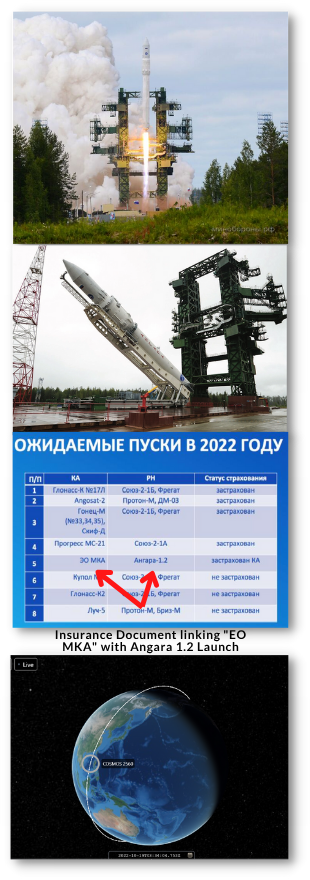
15 Oct 2022: Russia launched an Angara 1.2 rocket from Site 35/1 at the Plesetsk Cosmodrome carrying a payload for the Russian military to a Sun-synchronous Orbit (SSO). There is debate on Kosmos 2560’s mission, it is likely a small electro-optical imagery satellite or a target for the Perevest anti-satellite laser system. Launch Video.
– Russian press reported that an “Angara-1.2 light-class carrier rocket with a spacecraft in the interests of the Russian Defense Ministry”
– Kosmos 2560 is similar to Kosmos 2551 (launched Sep 2021) and 2555 (launched Apr 2022). Both of the previous satellites were non-maneuvering & re-entered weeks after launch.
–Kosmos 2560 has been cataloged in a 328 x 344 km x 96.4 deg sun-sync orbit. This is slightly higher than the orbit of Kosmos 2551 & 2555, the previous missions in the series.
– There is continued debate regarding the mission of Kosmos 2560.
-While initially suspected to be a small military optical reconnaissance satellite designated EMKA-3, new reports offer the payload is part of a different series of satellites and is designated EO MKA No. 3.
– Kosmos 2560 is also called EO MKA in a document published on September 29 by the Russian insurance company Ingosstrakh.
-“O” could stand for “optical”, in which case EO MKA would be deciphered as “experimental optical small satellite”. It can’t be “electro-optical” because the Russians literally say “optico-electronic”, in which case it would be OE MKA.
– EO MKA (written separately) is sometimes seen in technical literature in the meaning “experimental testing of a small satellite.”
– The launch of Kosmos-2560 is just the second time that Angara 1.2 rocket has launched operationally, and it was the second launch using the 1.2 variant, designed specifically for payloads launching to LEO. The first Angara 1.2 launch was Kosmos 2555.
-Russia intends to launch a third Angara 1.2 before the end of 2022, with a South Korean SAR satellite as the final payload. The status of this launch unclear as nearly all international customers canceled their launch contracts for Russian rockets as a result of the ongoing geopolitical conflict between Russia and Ukraine.
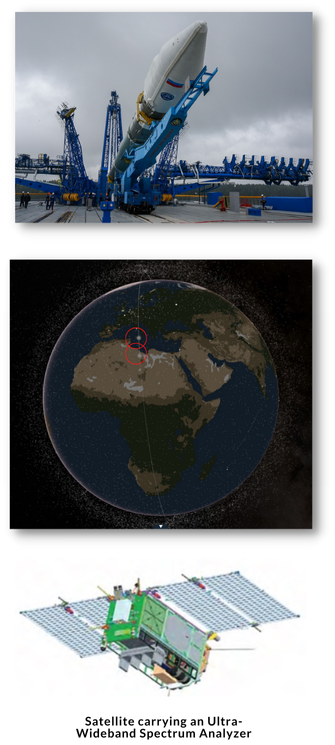
21 Oct 2022: Russia’s Soyuz-2.1v rocket launched from Site 43/4 at Plesetsk Cosmodrome, carrying 2 classified satellites (Kosmos 2561 & 2562) to a Sun-synchronous orbit (SSO). The mission was originally scheduled for launch on 18 Oct but was delayed three days for unspecified reasons. Details about the payload are unknown, but there are reasons to believe the pair of spacecraft may be Numizmat inspector satellites. Launch VIDEO.
-The official launch announcement of the Ministry of Defense was unusually terse, mentioning only the fact that the launch had taken place and the official names of the two satellites.
– Both Kosmos 2561 and 2562 are in a 407 x 420km x 97.08° orbit.
– Based on launch contracts, there is speculation that the satellites might be part of the Numizmat program (which means “numismatist” or “coin collector”).
– Numizmat is a 2014 project started by the Russia’s Central Scientific Research Institute of Chemistry and Mechanics (CNIIHM). CNIIHM specializes in small satellites and their core business seems to be ASAT/inspection missions.
– Several specialists who signed the Numizmat contracts co-authored technical papers related to radars. Some of the subsystems mentioned in the contracts are likely part of a so-called spectrum analyzer to process the reflected radar signals.
– Known payloads for Numizmat are an ultrawide band radar and a TV camera, which could be used for rendezvous and proximity operations. The actual purpose of Numizmat remains unclear.
– CNIIHM also appears to be the prime contractor for Nivelir (“Dumpy level”), which is probably a project to build small satellites designed to inspect other satellites in space.
– Initial orbital data shows that the Kosmos 2561/2562 are not in the same orbital plane as USA 326 and Kosmos-2558. Judging by the right ascension of the ascending node (RAAN), there appears to be a significant difference between the planes.
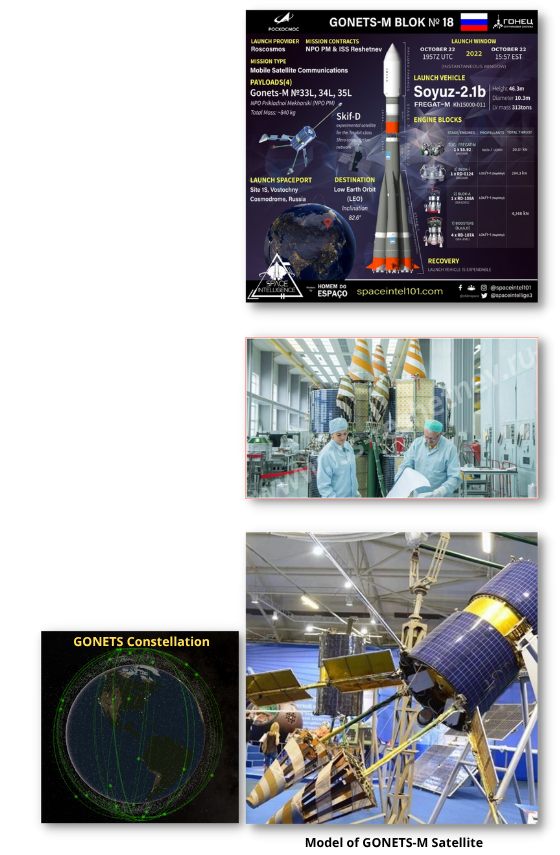
22 Oct 2022: A Soyuz-2.1b rocket carried three new satellites for the Gonests-M communications network, along with an experimental version of the new-generation Skif-D satellite on 22 Oct. It is the first mission of 2022 originating from Vostochny Cosmodrome. Launch VIDEO.
– Onboard were the Gonets-M No. 33, 34, and 35 satellites and an experimental satellite called Skif-D, the first vehicle in the new federal Sphere project.
– Gonets-M satellites use a system known as “store-and-dump.” This means the satellites will collect data as it flies over a transmitter site. It will then store that data until it is in range of a receiving station. This system is designed for use in more rural areas and includes civilian applications such as transmitting medical data.
– The “M” series is an upgrade from the original Gonets satellites, which were derived from a military satellite known as Strela-3.
– These three satellites will join 22 others already in low Earth orbit (LEO) 1,400km above the planet.
– The Skif-D spacecraft is the first in a new satellite constellation known as Sphere (see Video). According to Roscosmos, the system is designed to form a system of broadband internet access across Russia. The network is expected to be like the Starlink and OneWeb satellite constellations.
– Skif-D was placed in an orbit approximately 8,070km above the Earth.
-The mission also includes a Fregat-M upper stage, which delivered the three Gonets satellites to LEO and Skif-D to MEO. See Video.
– This marks the only launch so far this year from the Vostochny Cosmodrome with no other missions scheduled to take off from there until 2023.
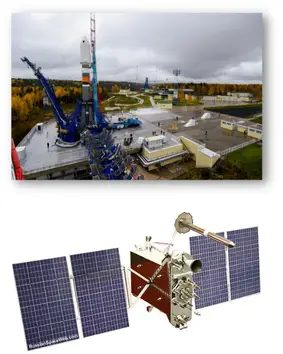
10 Oct 2022: Russia launched a Soyuz-2.1b from Plesetsk to add another GLONASS-K satellite to its current satellite navigation network. GLONASS-K No. 17 is the fifth in the K series. Launch Video.
– GLONASS-K No. 17L is the latest upgrade of Russian navigation satellites, replacing an older version, known as GLONASS-M, whose production was discontinued.
– During a typical GLONASS mission, the Fregat-M upper stage conducts three orbital maneuvers to deliver the spacecraft to its operational circular orbit more than 19,000 km above the Earth’s surface.
– After reaching its planned orbit, GLONASS-K No. 17L received a public designation Kosmos-2559.
– The K series satellites features a lighter, standardized unpressurized bus and a third L-band transmitter for civilian users known as L3, which was expected to be in wide use by the aviation industry.
– GLONASS-K satellites have a 935kg mass and are designed for a no-less than 10-year life span, considerably longer than that of its predecessors.
19 Oct 2022: U.S. Space Systems Command officials earlier this month gave an unclassified briefing to Blue Origin founder Jeff Bezos on the power competition taking place in the space domain. The briefing relied strictly on open source reporting, but contained interesting observations such as characterizing the Shiyan 12-1 and 12-2 as “inspector satellites)
Briefing Highlights:
-Counter-space weapons are here today. Russia experimenting with and operationalizing fixed site and mobile lasers.
-Co-orbital: Shijian-21 satellite docked with a defunct Beidou spacecraft and tugged it to a graveyard orbit 300km above geostationary Earth orbit (GEO).
-The takeaway is that “when you start taking a look at the actions that they’re conducting, it’s tactics development, it’s rendezvous proximity operations, they’re starting to show that they’re also
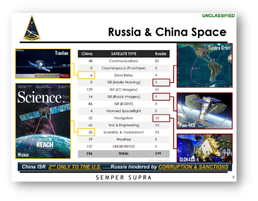
working on a lot of these … to be able to do maneuvering to potentially defeat an adversary.”
-China’s deployment of the Tianlian data relay network in geostationary orbit which is now up to eight satellites. “It does offer capability to essentially do over the horizon targeting. They have the ISR [imaging] satellites as the infrastructure and now they have the data relay satellites up there as well, to be able to basically get coordinates of maybe a U.S. aircraft carrier that’s out there.” The relay system would be used potentially to pass the coordinates off to a weapon system to strike the carrier.
Editor’s Note: I may have teared up a bit while reading this article. Great work SSC Intel Team!
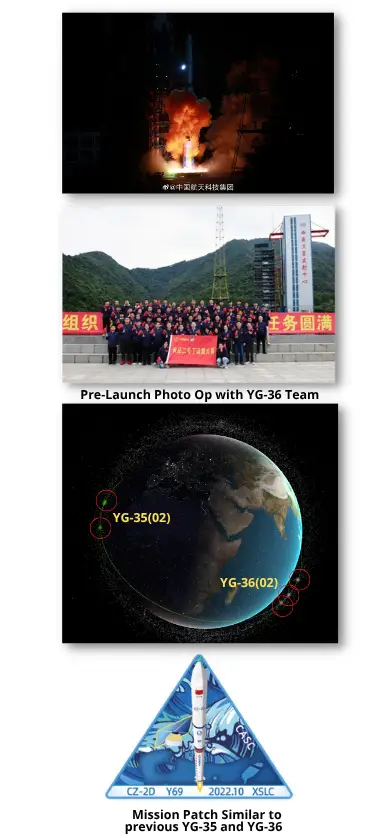
14 Oct 2022: China launched a Long March 2D from Xichang Satellite Center with 3 Yaogan-36 satellites. This launch was very similar to the previous 5 Yaogan-35 and the first Yaogan-36 mission with similar payloads, orbits and deployment patterns. Like Yaogan 36(01), Yaogan 36(02) is in the same orbital plane as a Yaogan 35 triplet. All YG-35 and 36 have been launched from the same site using a Long March 2D. Launch Video.
– While little is known about the satellites’ purpose, we do know the flight launched four objects (3 satellites and 1 likely rocket body) into an orbit inclined 35-degrees. The orbital altitudes match those of previously launched YG-35 and YG-36 spacecraft (about 500km).
– The 35° inclination orbits would cover the Taiwan Strait and the South China Sea, while the 63° orbits would also fly over the continental United States, Europe, Australia, and other areas of interest. Recent ELINT satellites in the Yaogan series that have flown to 35° inclinations have typically flown at altitudes on the order of 500 or 600km.
– YG-36(02) is in the same orbital plane as the YG-35(02) satellites launched in June 2022. China launched the YG-36(01) satellites into the same orbital plane as YG-35(01).
– YG-36(02) satellites will likely maneuver into the traditional 1 lead 2 trail formation exhibited by the other YG-35 and YG-36 triplets.
– It is thought that the Yaogan 36 satellites are equipped with a solar sail — a large piece of thin foil that is deployed in orbit. By angling the sail, the satellite is able to use the solar wind to move around, including getting velocity changes. China has been using this technology to demonstrate quicker deorbits of some satellites.
– Between 2018 and 2020 China launched 8 XJS satellites with similar orbital parameters as the YG-35/36 satellites. All are XJS satellites were 35° inclined and between 460-475km in altitude.
– Few details about the satellites were disclosed by China’s government-owned media. The country’s Xinhua news agency said the satellites will be mainly used to test “new Earth-observation technology.”
– There is also reporting that the XJS satellites would test inter-satellite link technology.

12 Oct 2022: China launched Long March 2C from the Taiyuan Satellite Launch Center carrying a 5-meter-resolution synthetic aperture radar satellite. Per CNAS Huanjing-2Ewill support “disaster prevention, reduction, relief, and environmental protection.” Launch Video.
– Huanjing-2E is a S-band S-SAR satellite with a a deployable truss antenna, similar to that on the Huanjing-1C satellite launched in 2012.
– Huanjing-2E is currently in a 498 by 763km orbit inclined by 97.65°.
– The Huanjing-2E satellite is the latest in a series. The first Huanjing (“environment”) satellites, Huanjing 1A and 1B, were launched in 2008 and reportedly had optical observation capability. Huanjing-1C, launched in 2012, was the first civilian Chinese SAR satellite, using a Russian-made instrument. Huanjing 2A and 2B, featuring optical capability, were launched in 2020.
– China plans to launch a total of 11 Huanjing satellites. The satellites will have visible, infrared, and multi-spectral sensors, and synthetic aperture radar (SAR). Huanjing-2E was the sixth satellite launched.
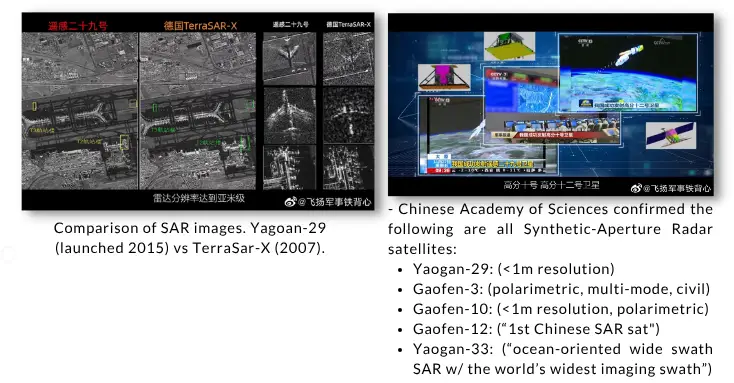
– Huanjing-2E adds to the country’s growing SAR capabilities while a series of commercial SAR constellations also appear to be in the works, some involving public-private partnerships.
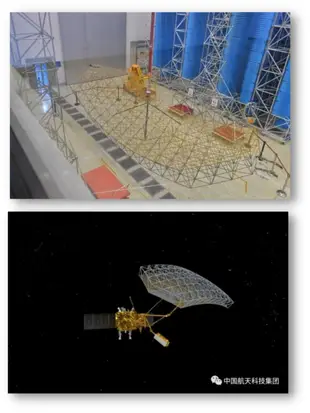
Chinese SAR Information Released
4 Oct 2022: The Center for Strategic and International Studies (CSIS) published an extensive article regarding Chinese space facilities in South America.
– The PLA Strategic Support Force (PLASSF)—which is responsible for space, cyber, and electronic warfare—has a hand in virtually all Chinese space activities. Unlike the United States and its partners, China’s main civilian space agency (China National Space Administration) is overshadowed by the military.
-Some fear that the PLA will use space projects to extend its influence to overseas ground stations dotted across the globe. Several of the ground stations used by China are located in South America to provide coverage of the skies over the Southern Hemisphere.
-Their proximity to the United States has heightened fears that they can be used to spy on U.S. assets and intercept sensitive information.
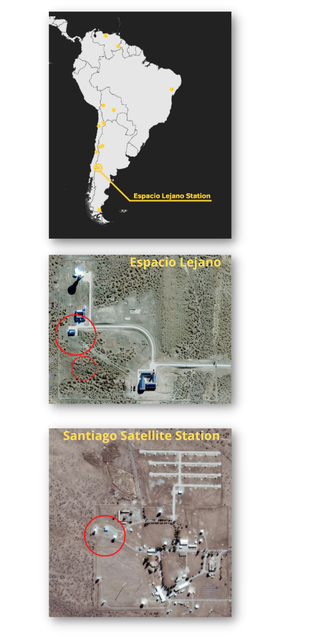
-The Espacio Lejano ground station in Neuquén, Argentina, has drawn considerable attention. The site has been shrouded in controversy since 2012, when Argentina leased nearly 500 acres of land to China for the construction of space facilities.
-Since coming on line in 2017, Espacio Lejano has been administered with little to no oversight from the Argentine government. The contract between the two governments stipulates Argentina “not interfere or interrupt” activities carried out at the station, which has amplified rumors of spying and other military activity.
-Espacio Lejano contains two primary assets: a 35m antenna (top) and a 13.5m (bottom) antenna.
– The 35m antenna operates in the S- and X-bands for sending data (uplink) and receiving data (downlink) and uses the Ka-band for receiving only.
– Espacio Lejano is run by China Satellite Launch and Tracking Control General (CLTC), a sub-entity of the PLASSF, which has heightened suspicion that the Chinese military makes ready use of the station. CLTC manages the ground infrastructure for China’s space operations and is staffed by PLA personnel.
-The capacity for ground stations for dual use applications is true for all countries with robust space programs, but China is particularly secretive about its operations at overseas ground stations.
– Three hundred and fifty miles to the north lies the Santiago Satellite Station, operated by the Swedish Space Corporation (SSC). CLTC has leased two antennas at the station, which satellite imagery suggests are located in the northwest corner of the main operations and support area.
-The Swedish Defense Research Agency found that China’s access to antennas at another SSC ground station—one near the Arctic Circle
in Kiruna, Sweden—could violate the terms of use and be used for military intelligence gathering and surveillance.
-SSC announced in 2020 that it would not renew its contract with China at Kiruna. It also chose not to renew contracts with China at the Santiago station and a third location in Dongara, Australia.
-Pushback due to accusations of spying may force China to lean on partnerships elsewhere in the region. China has been pivotal in helping Venezuela establish a presence in space.
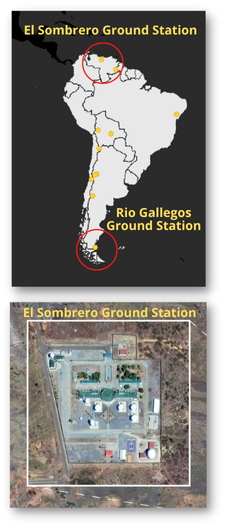
-As part of a 2005 deal between Venezuela and China’s state-owned China Great Wall Industry Corporation (CGWIC), China helped to develop the Venezuela’s first satellite. The deal also included the construction of the El Sombrero satellite ground station in Guárico.
-CGWIC is a subsidiary of China Aerospace Science and Technology Corporation (CASC), a key state-owned defense contractor that produces space launch vehicles, missile systems, and other equipment.
-CASC was included in a Nov 2020 executive order outlawing U.S. investments in 31 Chinese companies.
-Emposat, a Beijing-based firm with close ties to the influential state-run Chinese Academy of Sciences, plans to build a ground station in Río Gallegos as part of a joint venture with Argentine company Ascentio.
-When completed, the facility is expected to house four to six antennas of various sizes and provide increased coverage of Earth-orbiting satellites due to its proximity to the South Pole. The exact location has yet to be identified through satellite imagery, and additional details of the partnership are otherwise murky.
China’s space network in South America is part of a broader push by Beijing to establish itself as a leading global space power and partner of choice in space for middle-income economies. Many countries, especially those with political dynamics that curtail cooperation with the United States, stand to benefit from working with Beijing. Doing so, however, risks entanglement with opaque actors within China’s expansive space ecosystem.
Overseas stations will likely help the Chinese military further level up its operational capabilities. As the PLA extends its reach farther from China’s shores, it will need a robust suite of space capabilities to assist with intelligence gathering, situational awareness, and more. Ground stations can be called on to support all these needs.
20 Oct 2022: According to a recent computer simulation performed by a team of Chinese military scientists, a nuclear explosion in close space might produce a radioactive cloud over a region the size of New York State, disabling or killing satellites in near-Earth orbit.
– Researchers at the People’s Liberation Army-run Northwest Institute of Nuclear Technology in Xian created a model that can assess the performance of nuclear anti-satellite missiles at various altitudes and yields with unparalleled depth and accuracy.
-According to modeling results, a 10-megaton warhead, which is relatively weak by today’s standards, may pose a severe threat to satellites if it explodes at an altitude of 80km (50 miles).
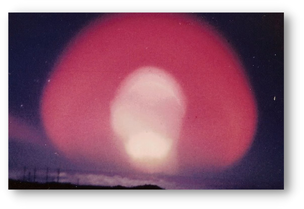
– Nuclear physicist Liu Li and his colleagues predicted that the explosion may produce a cloud that resembled an upside-down pear and convert air molecules into radioactive particles. Their findings were published on 15 Oct in the peer-reviewed journal Nuclear Techniques.
– “The strong residual radiation of the debris cloud may cause failures of spacecraft moving in it, …or even cause direct damage that can lead to destruction,” the researchers said.
– An explosion very close to space would produce a cloud with a total mass much higher than the bomb itself because of the air molecules present in the Earth’s atmosphere. “Due to the high concentration of fission products inside the debris cloud, the released gamma rays and beta particles are strong, making their effects on spacecraft and communications within the affected area stronger,” Liu’s team wrote.
– The cloud would rise straight up at a speed of up to 2.3km/s just after the explosion, creating a massive trap for target satellites. According to the simulation, the majority of the air molecules would fall back to Earth instead of staying in orbit, eliminating the radiation belt effect and drastically lowering the risk to other satellites or spacecraft.
China has not tested a nuclear weapon in near space. On August 1, 1958, the US detonated a 3.8-megaton bomb at an altitude of 77km over the Johnston Atoll west of Hawaii – an experiment known as the Teak test. Some Honolulu residents said the explosion created a fireball that turned from light yellow to red, and a huge cloud rose from the fireball and remained visible for about half an hour. Liu’s team said their computer simulation closely matched the results of the Teak test, which eventually produced a cloud more than 700km across. Check out Star Fish Prime Video.
18 Oct 2022: Eutelsat is preparing to deploy the first of two new jamming-resistant broadcast satellites over the Middle East following signal interference in Iran. Hotbird 13F launched on 15 Oct 2022, and its twin Hotbird 13G that will launch later this year, are due to replace Hotbird 13B, 13C, and 13E. Hotbird 13F and 13G promise improvements in payload capacity, power efficiency, and thermal control systems. Notably, they also have improved “uplink signal protection and resilience” to resist attempts to interfere with their services, according to Eutelsat. Eutelsat declined to comment on how Hotbird 13F and 13G would guard against signal jamming for security reasons.
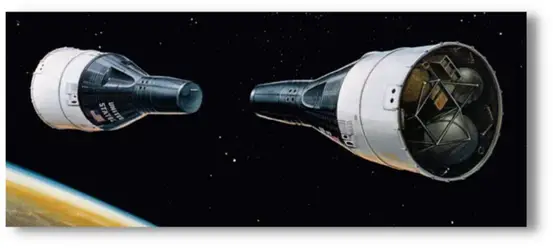
Jack's Astro Corner: The Gemini 76 Story – First-ever Rendezvous & Proximity Operations (Part 1 of 2)
AN ASTRO HISTORY ESSAY: Up to now, my Jack’s Astro Corner essays have been astrodynamics related. This article is more of an astro “history” essay capturing the year 1965. In that year the Gemini spacecraft and crew of two along with 1000’s on Earth helping them were put into action to prove out some of the key concepts needed to enable Apollo to head for the Moon for mankind to set foot, explore and return safely. Perhaps the highest priority was proving two spacecraft could rendezvous (meet up), enter proximity operations (loiter with each other) and dock (connect). I call this RPO&D. This Jack’s Astro Corner topic will be two articles, a Part 1 that will focus on the Gemini happenings in 1965 up through October. The emphasis will be on 25-28 Oct 1965, wow, that’s 57 years ago almost to the date. The second article in this two-parter will pick it up and cover Nov and Dec 1965.
TWO PART SERIES: In this Part 1 essay, we examine early efforts by Gemini 4 and 5 to accomplish some RPO basics. Spoiler alert, the RPO goals for those missions were not achieved and, in the case of Gemini 4, huge lessons were learned. October 1965 arrived with great excitement as Gemini 6 was poised for launch and the on-orbit task to chase down an uncrewed Agena target vehicle and complete an RPO and then dock. The Gemini 7 crew was assigned the December 1965 14-day endurance mission to prove the crew could function for 14 days in space, the longest anticipated Apollo mission. Allow me to go back and review Gemini 4 and 5. Then we shall experience 25 October 1965 and see what happens and dive deeper into the subsequent innovation and decision to relentlessly pursue the prize of a first-ever RPO in space.
THE GEMINI PROGRAM KICKS OFF WITH RPO GOALS: Gemini 10 & Apollo 11 astronaut Mike Collins summed up Gemini perfectly “Project Gemini served as a bridge between the rudimentary Mercury capsule and the sophisticated Apollo spacecraft, a bridge between President Kennedy’s bold statement and the national capability to execute it.” Gemini 3 proved the 2-seat spacecraft was ready and agile. Gemini 4 followed in June 1965. In this mission, the first multi-day (four days) manned mission for the US, a station-keeping exercise was added: Astronauts James A. McDivitt and Edward “Ed” H. White would attempt to close and hold station with the final stage of the Titan II which had followed them to orbit. This was essentially a short duration but good RPO first step. Gemini 4 did not carry a radar, meaning computer aided rendezvous calculations could not be made. McDivitt and White did their best to turn around and close back in on the Titan upper stage. They truly proved the non-intuitive nature of orbital mechanics is very unforgiving. McDivitt attempted to fly Gemini toward the target, thrusting directly at it. The upper stage pulled further away as they kept trying to thrust towards it. Kepler and his orbital motion laws were winning. A ton of learning took place and the flight and mission operations crews benefited a great deal. Also of significance was that astronaut Ed White did conduct the first ever spacewalk in the history of the US space program (see VIDEO). As I was finishing this article, I learned that on 13 Oct 2022 James McDivitt passed away at the age of 93. He was an accomplished AF test pilot and astronaut who besides commanding the Gemini 4 mission would go on to command Apollo 9 in early 1969 and prove the Lunar Module was ready for the Moon. Gemini 5 was next, and lifted off in August 1965. Carrying the Gemini radar for the first time, the crew ejected an RPO evaluation pod which was intended to act as a rendezvous target. You might say an RPO “dance partner.” Unfortunately, problems getting the Gemini 5 fuel cells up and running resulted in cancellation of the rendezvous with the deployed partner (see Gemini 5 mission VIDEO). RPO and docking was a critical “prove it” goal with Gemini and things were off to a terrible start. 1965 was slipping by and in the race for the Moon it seemed the Russians were in the lead.
BE A WALLY! Next up was Gemini 6 with Wally Schirra and Tom Stafford. Prior to launch day, Wally Schirra dove deep into astrodynamics to understand the aircraft test pilot skills he was gifted with would not be the way to go. He learned orbit mechanics and how to make the Gemini fly in accordance with the space nuances of the “satellite paradox” (slow down to speed up). In his autobiography book “Schirra’s Space” said “Our mission was to do a rendezvous, a difficult task. Frankly, in those days we didn’t know how to do a rendezvous.” Schirra goes on to credit fellow astronaut Buzz Aldrin who did his PhD work at MIT in RPO astro. Wally was ready and armed with astrodynamics know how.
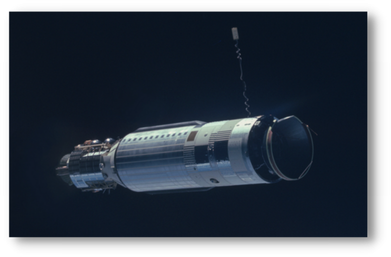
GEMINI 6 READY TO GO, BUT… OK, let’s experience launch day 57 years ago. On the morning of 25 October 1965, the pace of activity and excitement at Cape Canaveral was pegged! At Launch Complex 14, the Agena that would serve as the target for the first ever orbital rendezvous was readied for flight on its Atlas booster. Just a mile to the north, at LC 19, stood Gemini VI atop its Titan II rocket. At 0945, astronauts Thomas P. Stafford and Walter “Wally” Schirra climbed into their Gemini capsule, preparing to track down and fly in close formation with the Agena RPO and docking target. Just minutes later, at 1000, the Atlas/Agena climbed into the blue Florida sky. In n the span of six short years, the Agena had flown an amazing 140 times on national security related flights. Although this was its first manned spaceflight support mission, watching it soar skyward had become as commonplace as watching a train leave the station. Minutes later as the vehicle became a dot to the naked eye, the Agena target was released and took over the last propulsion needs to achieve orbit. The flight controller reported the separation, and then began to
relay downlink data indicated something very wrong. The Agena appeared to be wobbling. The main engine did fire as expected, but NASA and Air Force officials from the blockhouse in Florida to Mission Control in Texas became nervous. Then, the range reported sure signs of failure: radars were tracking the Agena: all five pieces of it. Yikes, that was not what was expected. Fifty minutes into flight, Carnarvon tracking station in Australia should have picked up the Agena coming around the other side of the Earth. There was nothing there. Back at the Cape, Stafford and Schirra exited their Gemini capsule. There was no target. There would be no rendezvous, and therefore no launch from the Titan pad at LC 19. I’m sure someone said “give me a break.” What next? Ugh…Gemini was still floundering as it tried to gain traction on achieving RPO and docking.
WE HAVE AN IDEA: Looking on at the Cape were two McDonnell Douglas contractors, Walter Burke and John Yardley. With unknown months of potential delay, Burke asked Yardley “Why couldn’t we launch another Gemini as a target instead of an Agena?” He recalled a previous study of a rapid-fire launch demonstration by Martin, the Titan II contractor. Listening in on the chat
were Frank Borman and James Lovell, the Gemini 7 crew next in line for a 14-day long duration mission in December 1965. Burke further detailed his idea, going so far as to sketch out a concept where Gemini 7 could be fitted with an inflatable cone as a docking mechanism. Borman drew the line on spacecraft modifications and pushed back. But Burke and Yardley continued to brainstorm the overall concept. The two McDonnell engineers then tracked down George Mueller (NASA’s manned spaceflight chief in Washington, DC) and Charles Mathews (NASA’s Gemini program manager) and explained their radical thought. The two NASA officials were pessimistic. There had been chatter amongst Cape leaders to devise the rapid-fire demo and few months back and now, two months later, the demo plan was dusted off. It had features that might help make Burke and Yardley’s idea work. Still stinging from the day’s failure, but not giving up on their new idea, Burke and Yardley described the details of the rapid launch demo to NASA’s leadership and said that if two Titan’s could be launched from LC 19 in under a two weeks span (the length of the Gemini 7 mission), a back-to-back mission was definitely doable.
DETAILS EMERGE, MAYBE IT’S A GOOD IDEA: Meanwhile, NASA was dealing with the yet to be understood Agena problem and trying to sort out what to do. Knowing that determining and correcting the Agena problem could take many months; several in the agency’s leadership immediately began to focus on the upcoming Gemini 7 flight. Burke and Yardley left Florida for Texas. Once in Houston, Texas, the day after the Agena failure, they began to discuss their plan with Robert Gilruth, the director of the Manned Spacecraft Center (MSC). Gilruth listened politely, but said to Burke, “Walter, you know things aren’t like that in real life.” Burke, pressed Gilruth—yes it might be challenging, but what from an engineering point of view was preventing it from being done? At this point, Gilruth brought in his wingman backup. He asked his deputy George Low what he thought about the concept—Low replied that he was very intrigued by the idea, but did point out one potential issue: the Gemini tracking system was not designed to handle more than one Gemini spacecraft at a time.
Still optimistic, Low asked Flight Operations Director Chris Kraft what he thought of the plan. Kraft first replied, “You’re out of your minds. It can’t be done.” Of course, “Has he lost his mind?” had been one of the first thoughts that came to Kraft when he heard Kennedy’s speech to Congress in May of 1961. Now, like then, Kraft gave it more thought and gave the idea a chance. Astronauts when asked about the plan of course loved it. Suddenly, what seemed to some as a totally ridiculous idea began to make a lot of sense. RPO was the bridge to the critical objective of docking. On the other side of the ocean, the Russians appeared to be taking no holiday in their quest for technological dominance. The end of the decade was nearly a mere four years away. NASA was now seriously considering the Burke-Yardley idea to keep up the momentum and go do a dual Gemini RPO test flight. The Cape team now looked into a fast-paced strategy involving a nine-day pad turn around. The initial assessment was that it could be done, although the tracking and control operations of two Gemini’s in orbit was still a question mark. Kraft gathered his team in mission control and introduced the Burke-Yardley plan. Motivated, focused, and relying on their detailed systems insight, one engineer quickly figured out how to solve the
tracking problem: the Mercury tracking system was still in place and could be used to handle Gemini 7 while Gemini 6 was in orbit. Rapidly things were falling in place, and even Kraft, who at first considered this a totally outrageous idea, was becoming convinced the plan could work. A little more than 48 hours had expired since the Agena launch failure.
GETTING THE GO: On the afternoon of October 27, the top NASA officials convened in Washington to formally consider the Burke-Yardley proposal. NASA Administrator James Webb listened intently as the point-counter-point discussion evolved. Webb was intrigued—but he needed to know the bottom line: would it work? Webb phoned George Mueller, his administrator for spaceflight, and asked the question. Mueller then passed that question to Gilruth in Houston. To add a bit of pressure, Mueller also informed the MSC director that if the plan was viable, Webb wished to immediately pass it along to President Johnson. Gilruth responded that he thought it was still a good plan, but wanted 30 minutes to convene his experts, including Kraft and Deke Slayton, chief astronaut, to take a vote. Mueller gave Gilruth 15 minutes. The concept had been discussed in Houston a mere 24 hours. Gilruth went around the room. The vote was unanimous: GO! (Note: no PowerPoint slides were built and they did this rapid decision making without the Internet—this is an attempt at humor).
GEMINI “76” IS GO! On Thursday, 28 October 1965, only three days since the failure, a press conference was convened at the Lyndon B. Johnson Ranch. Press Secretary Bill Moyers announced to the national news media the details of an ambitious plan: NASA would launch two Gemini spacecraft into orbit on back-to-back missions and carry out the first ever orbital rendezvous. The combination mission would become known as “Gemini 76.” So, on the 57th anniversary of this late October 1965 3-days of failure, ideas and taking a chance, the plan for the Gemini 76 dual-Gemini RPO mission was in full swing.
UNTIL NEXT ISSUE: OK, we will stop here and hold you in suspense as we enter into November 1965 and all the “wheels turning and churning” as everyone seeks to accomplish a dual-Gemini mission. Until next time when Part 2 is unveiled in “the Flash” (Hummm, I better start writing) stay awesome in your space duties.