
issue 62 | 6 nov 2022
The integrity flash
Analysis of Developments in the Space Domain
in this issue
31 Oct 2022: In another excellent Space Review article, Bart Hendrickx examined recent collaboration between Russian and Iran. Russia built and launched a remote sensing satellite for Iran this year and three more are expected to follow in the coming years. There is also compelling evidence that a Russian company is building a communications satellite for Iran which will be launched to Geostationary Orbit in 2024.
– Russia launched the Khayyam satellite into a nearly circular 500-kilometer orbit inclined 97.4 degrees.
– Russian coverage of the launch was low key with no mention of Iran.
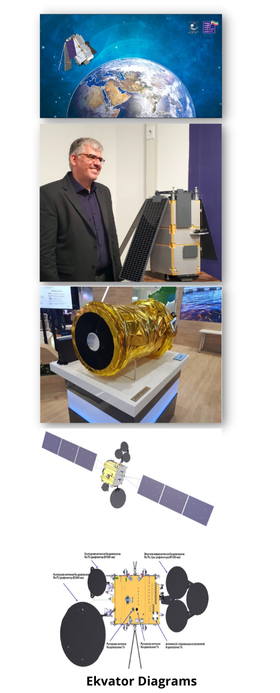
– Iran had fewer qualms about depicting the satellite. A drawing of the satellite hovering above Earth appeared on a number of Iranian websites and a scale model of the satellite was on display during a press conference held one day after the launch by the head of Iran’s space agency, Hassan Salarieh.
– Khayyam’s payload is a Korsch telescope with what are called five “optical elements”. The telescope provides imaging in one panchromatic channel and four multispectral channels (near infrared, red, green, and blue). Its linear resolution is listed as 1.1m, although one of the officials added that by Western standards it is actually 0.73m. The satellite could cover a ground swath of 12.5km from an altitude of 500km.
– Khayyam’s mission control center is located at the Mahdasht Space Center, which is roughly 60km west of Tehran, near the city of Karaj.
– It is unknown if Iran is sharing Khayyam imagery with Russia.
– Russia currently operates two high-resolution optical reconnaissance satellites of the Persona type (Kosmos-2486 and 2506). These have been in orbit since 2013 and 2015 respectively and almost certainly exceeded their design lifetime. The launch of two big next-generation spy satellites (Razdan) is years behind schedule.
– Evidence emerged in recent weeks that Russia is building a geostationary communications satellite for Iran, called the Ekvator.
-Russia plans to launch Ekvator from the Baikonur Cosmodrome with a Proton-M rocket and a Briz-M upper stage.
-Reports state Ekvator will have a total mass of about 2,300kg and a payload mass of 755kg. Two drawings of the satellite published in the report show several antennas operating in the Ka-, Ku-, and S-bands.
– Iran applied to the International Telecommunications Union for 5 GEO slots for Ka and Ku-band satellites in Mar 2017: 1) IRN-24.19E; 2) IRN-30B-24.19E; 3) IRN-30N-26E; 4) IRN-30B-34E; and 5)IRN-30B-43.5E.
-Ekvator (which may well receive a name in Farsi after it is launched) is supposed to occupy Iran’s 34°E slot within the next two years.
BREAKING NEWS: Iran’s Revolutionary Guard Corps launched a new “Ghaem-100“ satellite-capable rocket yesterday morning (5 Nov) from what appears to be the Khomeini Spaceport – more to follow in the next Final Frontier Flash!
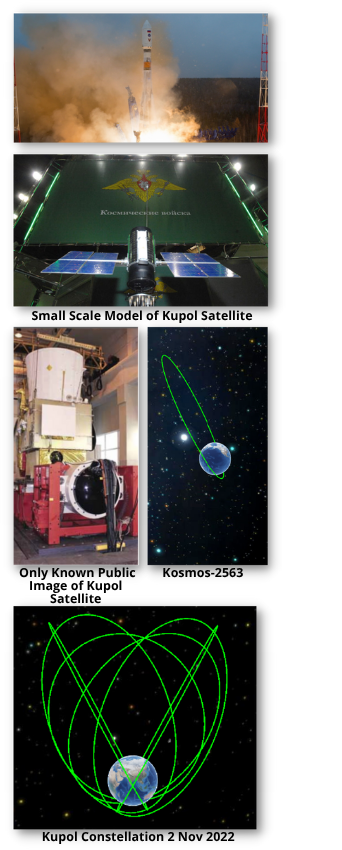
2 Nov 2022: Russia launched a Soyuz-2.1b from Plesetsk Cosmodrome with the 6th satellite of Russia’s Tundra/Kupol next-generation early warning system. It was designated Kosmos-2563 after reaching orbit. Launch Video.
– The Tundra series of satellites, also known as Kupol or Edinaya Kosmicheskaya Sistema (EKS) satellites, are the next generation of Russian early warning (EW) satellites, designed to replace the US-K and US-KMO early warning satellites of the Oko-1 system.
-Kupol satellites are part of a developing program of EW satellites to identify ballistic missile launches and complement EW radars such as the Voronezh.
-Kupol satellites are in a highly elliptical orbit (HEO) for extended dwell times over the Northern Hemisphere. Kupol 6 has an apogee of 38,534km and a perigee of 1,623km. It is inclined 63.5 degrees.
-Reportedly the Tundra satellites carry also a secure emergency communications payload to be used in case of a nuclear war.
– Kupol satellites also carry Balka, a nuclear explosion detection payload.
-Development of the EKS satellites started in 2000, but the Russian Ministry of Defense didn’t award a contract for the program until 2007.
-Kupol 1 launched in 2015, Kupol 2 in 2017, Kupol 3 in 2019, Kupol 4 in 2020 and Kupol 5 in 2021. All launches were from Plesetsk and used the Soyuz 2-1b with the Fregat upper stage.
In the Soviet era, there were no more than 9 simultaneously operating HEO satellites. More HEO satellites will be launched in the coming years. In Nov 2015, the Russian Ministry of Defense said the ultimate goal was to have a constellation of ten satellites. During 2020, Russian military officials promised to complete the deployment of the EKS constellation by 2024.
These may all be the Tundra HEO satellites as the GEO satellites lag far behind and may still be in the design phase. Satellites are only one element of the country’s EW system. Russia also possesses a large network of ground-based early warning radars, having been spectacularly upgraded over the past 15 years to provide coverage of all potential attack zones, a capability never achieved in Russia/Soviet history.
27 Oct 2022: A Russian official speaking at a United Nations meeting on outer space security, criticized Western nations’ use of commercial satellites in military operations. Konstantin Vorontsov, deputy director of the Russian foreign ministry’s department for non-proliferation and arms said that commercial systems as “quasi-civilian infrastructure may become a legitimate target for retaliation.”
– The comments added fuel to previous declarations that Russia could target space networks operated by private companies.
– Vorontsov also remarked that the West’s use of commercial satellites was “an extremely dangerous trend that … has become apparent during the latest developments in Ukraine.”
– In recent months Russia targeted its wrath at SpaceX’s internet satellite network Starlink, which has served as a communications lifeline for the Ukrainian military. Meanwhile, U.S. defense and intelligence agencies have increasingly relied on commercial imaging satellites to monitor the conflict.
– Starlink continues to be a vital element in Ukraine’s efforts to repel the invasion forces of Vladimir Putin, since its network of satellites hovering in low earth orbit (LEO) has thus far proved to be impervious to electromagnetic attack.
– Russia is calling for America to return to existing international legal agreements and norms governing outer space such as the UN treaty signed in 1967 in the United Nations.
-The U.S promised to take proportionate action for any attacks on U.S. property…“I would just say that any attack on U.S. infrastructure will be met with a response and will be met with a response appropriate to the threat that’s posed to our infrastructure,” said John Kirby, National Security Council coordinator for strategic communications.
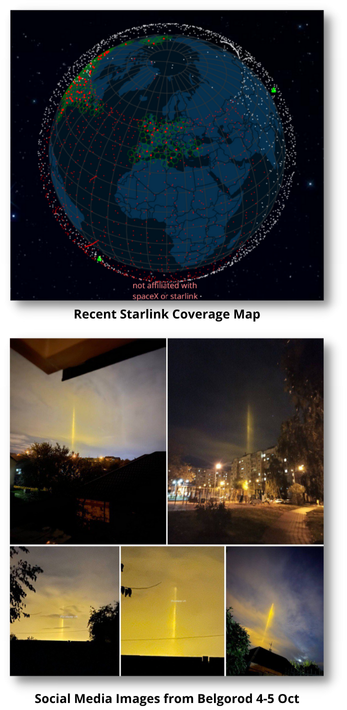
-SpaceX CEO Elon Musk said his satellites have already been targeted by cyberwarfare attacks. There has been speculation that “Peresvet” laser beams fired from Belgorod in Russia have attempted to blind Starlink” this month.
– The U.S. Department of Defense plans to increase its use of commercial space services and considering how it might compensate companies if their spacecraft are damaged during conflict.
28 Oct 2022: Russian “non-kinetic” attacks have not really succeeded in stopping the use of space assets in support of Ukraine. That has led to discussions on kinetic threats—using missiles to destroy satellites in orbit. However, destroying a modern satellite network is very difficult.
– Most privately-built satellites are small and relatively cheap, operating as networks of hundreds or even thousands
of spacecraft flying many miles apart.
-Destroying one or even several of these spacecraft could degrade the capability of the satellite network, but not put it
out of action entirely.
-The precision-guided missiles required to destroy the satellites, on the other hand, are expensive to build and launch, at a time when key components like chips and gyroscopes are difficult for Russia to import due to sanctions.
-Any serious attempt to take out a constellation would involve multiple strikes and unpredictable results. Other satellites would be threatened, as would the International Space Station. Any state that has invested in space assets would think twice about risking them with a large strike in orbit.
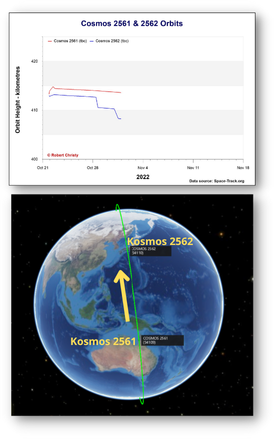
31 Oct 2022: Russia launched 2 possible inspector satellites (Kosmos 2561 and 2562) on a Soyuz 2.1b on 21 Oct. Kosmos 2562 decreased its altitude on 28 Oct and again on 31 Oct. Both maneuvers were about 2.5km. The mission of this satellite pair remains a mystery.
– Kosmos 2561 is in a 415.7 x 404.9km orbit and 2562 is in a 413 x 396.7km orbit. Both orbits remain 97.08° inclined.
– There is speculation, based on launch contracts, that the satellites might be part of the Numizmat program (which means “numismatist” or “coin collector”).
– Numizmat is a 2014 project started by the Russia’s Central Scientific Research Institute of Chemistry and Mechanics (CNIIHM). CNIIHM specializes in small satellites and their core business seems to be ASAT and inspection missions.
– CNIIHM also appears to be the prime contractor for Nivelir (“Dumpy level”), which is probably a project to build small satellites designed to inspect other satellites in space.
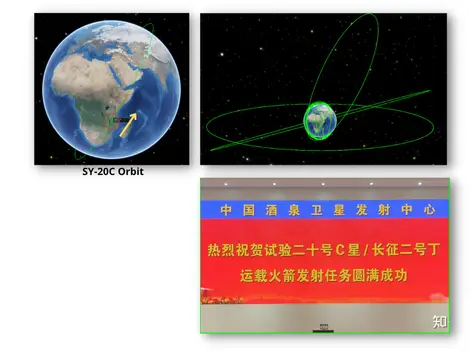
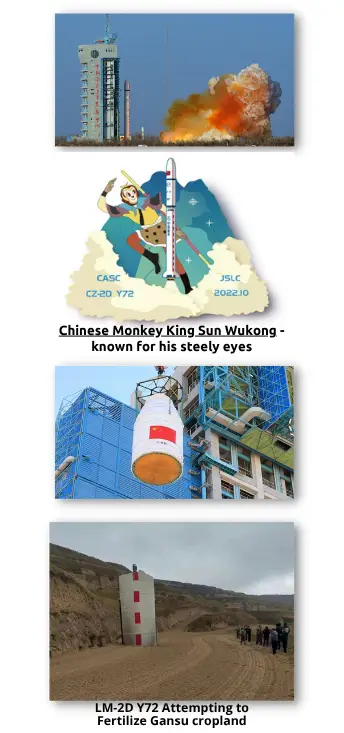
29 Oct 2022: China Aerospace Science Corporation (CASC) successfully launched a Long March 2D from Jiuquan Satellite Launch Center with the classified Shiyan-20C satellite. As expected, China released very limited information regarding the satellites mission. The size of the satellite as well as the orbital characteristics are unusual. Launch Video.
– Shiyan-20C is thought to be for technology demonstration, acting as a pathfinder for new satellite technologies. It was built by CAS Microsats.
-The satellite is currently in a 795x748km, 60-degree inclined orbit. Both the altitude and inclination are new to the Shiyan satellite family.
-Other Shiyan satellites at similar altitudes (SY-5, SY-6(02), SY-3, and SY-4) all appear to be in sun synchronous orbit.
-There are no Yaogan satellites at this altitude. Only Gaofen 3-02 and 3-03 are at similar orbit but are also in SSO.
– Shiyan-20C has a mass of ~1,200kg which is close to the Long March 2D’s capacity of 1.3 tons to 700km.
– Attitude of LM2D-Y72 was controlled by the 2nd-stage venier engines instead of a dedicated system so that the rocket mass was reduced and improved the launch capacity.
– Shiyan-20C brings the Shiyan satellite constellation to 22 satellites strong. These satellites are in a variety of orbits, including some low Earth polar orbits and some in geostationary Earth orbits.
-There have been 6 Shiyan launches from Jiuquan (SY-3, SY-4, SY-5, SY-6(01), SY-6(02) and now SY-20C). All have used the LM-2D space launch vehicle. With the exception of SY-20C all previous satellites have also had the “Tansuo” designator.
-There are no known Shiyan-20A or Shiyan-20B satellites.
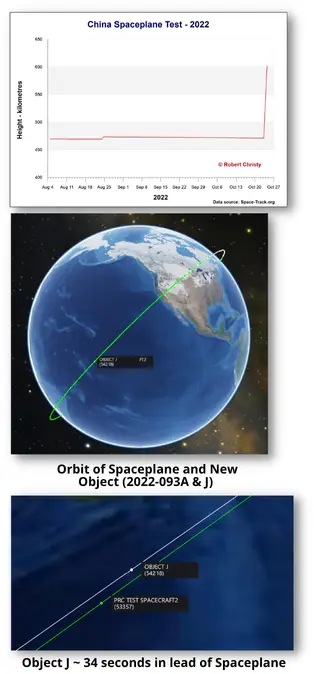
25 Oct 2022: China’s space plane performed an orbit-raising maneuver and recently secured new funding to promote new modes of transportation. The vehicle has been on orbit since its 4 Aug launch. It has spent most of its 82 days in an orbit similar to the 346 x 593km orbit inclined by 50 degrees. However, around 23 Oct the spacecraft raised its perigee to shift to a near-circular 597 by 608-kilometer orbit. On 31 Oct Space-track.org database added a new entry for an object in a similar orbit to the spacecraft (NORAD ID 54218 (2022-093J COSPAR ID)).
– Little is known about the project with China closely guarding launch operations and only announcing the mission once the spaceplane was in orbit.
– China has not provided any updates on the mission and it is unknown how long the spacecraft will remain in orbit. The first flight in Sep 2020, was a similarly clandestine mission lasting two days.
– Clues as to its dimensions did emerge after the second launch when images of the assembled debris from the spaceplane’s Long March 2F rocket and modified payload fairing at a middle school in Henan province.
– The object—the nature of which is unknown—is likely in very close proximity to the spacecraft and thus only entered into the database once it could be discerned to be a separate, discrete object with a high level of confidence. Robert Christy of Orbital Focus notes that the release of the object could have taken place anytime between 24 Oct and 31 Oct, performing station-keeping to remain close to the spaceplane. As of 3 Nov the object was ~4km from the spaceplane with gradually increasing separation.
– The project is being run by the China Academy of Launch Vehicle Technology (CALT), the main space launch vehicle maker under China’s main space contractor, CASC. CALT is also developing a reusable suborbital spaceplane, which completed its second flight in late Aug.
– CALT’s spaceplane project secured funding from the National Natural Science Foundation of China (NSFC) in September. The “suborbital long-range air-to-space transportation system” project is being led by Song Zhengyu, chief designer of the Long March 8 carrier rocket.
– The highly secret nature of the program so far is likely related to its military funding and applications. The new national funding source is unlikely to change this, given the sensitivity of hypersonic technology.
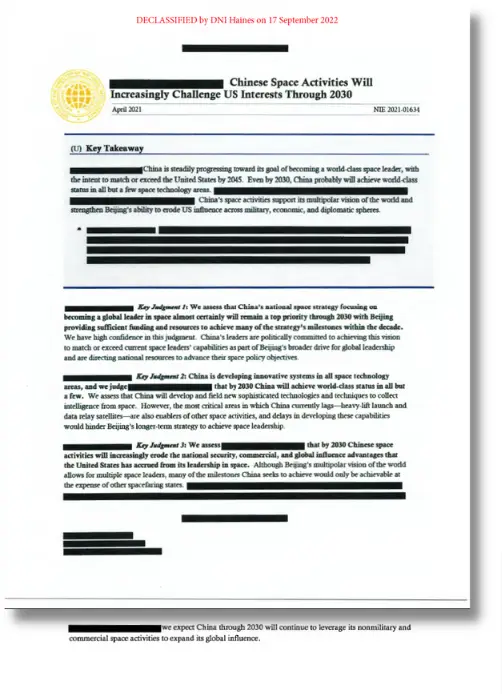
28 Oct 2022: US Director of National Intelligence, Avril Haines, declassified a short overview of China’s progress in space operations. Bottom Line: “China is steadily progressing toward its goal of becoming a world-class space leader, with the intent to match or exceed the United States by 2045. Even by 2030, China probably will achieve world-class status in all but a few space technology areas…we expect China through 2030 will continue to leverage its nonmilitary and commercial space activities to expand its global influence.”
28 Oct 2022: Chinese commercial firm Changguang Satellite Technology says it will expand its under-construction Jilin-1 constellation from 138 to 300 satellites.
– Changguang Satellite, a satellite manufacturer and operator based in Changchun, Jilin Province in northeast China, initially planned for its Jilin-1 constellation to consist of 138 satellites in orbit by 2025 to provide 10-minute revisit times.
– The 138 satellites will now constitute a first phase, to be completed by 2023, according to Changguang Satellite official Jia Hongguang, China News Service reported 27 Oct. The second phase will see the constellation expanded to 300 satellites by 2025.
– The news was reported alongside an announcement that five new satellites—Jilin-1 Gaofen 03D08 and Gaofen
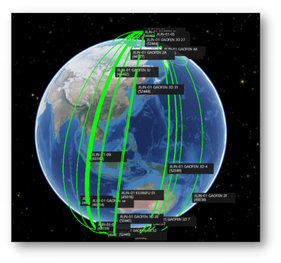
03D51-54—left the factory for the Jiuquan Satellite Launch Center in the Gobi Desert.
-Jilin-1 satellites generally deliver panchromatic imagery with a resolution of between 0.50 and 0.75m. Other satellites in the constellation have video, multispectral, multipurpose, infrared and other capabilities.
– A new batch of 16 Jilin-1 satellites were launched 10 Aug, meaning the firm now has 70 satellites in orbit. 10 of the new satellites were Jilin-1 Gaofen 03D optical satellites designed to deliver 75cm resolution from an altitude ~535km.
– The six others were Jilin-1 Hongwai 1 (“infrared 1”) satellites with infrared imaging payloads, while also equipped with GNSS occultation instruments developed by Yunyao Aerospace, a Chinese commercial satellite weather data firm.
The People’s Liberation Army Daily, the official newspaper of China’s military forces and mouthpiece of the China Military Commission, ran a commentary (Chinese), published 11 Apr, noting that companies such as Maxar and Black Sky provided satellite imagery of Russian troop movements to Ukraine following Russia’s invasion in Feb.
The commentary claims the U.S. has in recent years been “promoting the construction of so-called ‘space resilience’, attempting to blur the boundary between military and civilian spheres,” bringing commercial entities and the general public into the space arms race in order to strengthen its dominant position in space. It also framed the U.S. signing of more than 100 space situational awareness agreements as an attempt to create a “space NATO” alliance.
Editor’s Comment: Stronger Together.
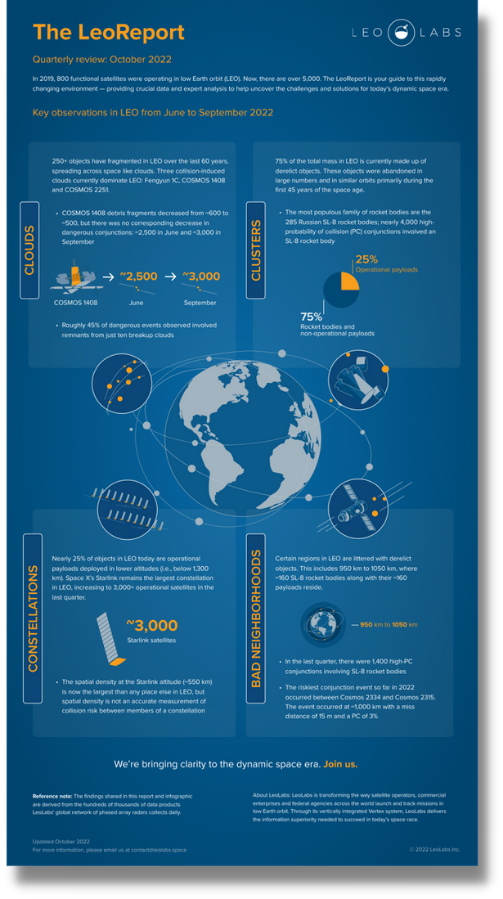
18 Oct 2022: LEO Labs released its quarterly LEOReport covering Jun-Sep 2022. The LEOReport examines LEO “Clouds,” “Clusters” and “Constellations,” with a bonus section called “Bad neighborhoods.”
CLOUDS
– Fragmentation events create “clouds” of fragments that spread rapidly across large volumes in space. Today, three major collision-induced clouds dominate the LEO environment: Fengyun 1C, COSMOS 1408, and COSMOS 2251/Iridium 33.
– From Jun-Sep 2022, the number of COSMOS 1408 debris fragments in orbit continued to decrease (from ~600 to ~500) because of atmospheric drag.
– However, the number of dangerous conjunctions did not decline: ~2,500 occurred in June and ~3,000 were monitored in August. Many of the COSMOS 1408 conjunction events occurred in bunches (described as “squalls” by Dan Oltrogge of COMSPOC). There was one such Squall in mid-August.
– Roughly 45% (47,000 of 107,000) of dangerous events observed during this period involved remnants from just ten breakup events.
Clusters
– Massive derelict objects abandoned in orbit represent a ticking time bomb of debris-generating potential. They currently account for nearly 75% of the total mass in LEO. The are often abandoned in large numbers in similar orbits…forming “clusters.”
– LeoLabs identified the top 50 statistically-most-concerning objects in LEO. While 40 of these objects were abandoned before 2001, the Chinese government has abandoned four rocket bodies in the last decade alone. However, the most populous family of rocket bodies are the 285 Russian SL-8 rocket bodies littered throughout LEO.
– There were also 16 conjunction events involving two massive derelict objects (typically large, abandoned rocket bodies and defunct payloads) that totaled over 15,000kg in combined mass. If any one of these dangerous crossings resulted in a collision, it would likely generate well over 15,000 cataloged fragments — nearly doubling the current catalog.
Constellations
– Nearly 25% of objects in LEO are operational payloads deployed below 1,300km.
– SpaceX’s Starlink remains the largest constellation in LEO with just over 3,000 operational satellites. The largest LEO Spatial density is now at the Starlink altitude (~550km).
– However this is a bit misleading due to the synchronization of active, agile, and station kept satellites, which are distinctly different than a cloud or cluster of debris.
Bad Neighborhoods
– The prototypical “bad neighborhood” is 800-900km. This region consists of a mix of several significant breakup events and hundreds of abandoned derelict objects that together create the greatest debris-generating potential in LEO.
-The closest collision event thus far in 2022 involved COSMOS 2334 and COSMOS 2315, two non-operational payloads deposited in orbit over 25 years ago. The event between these two payloads occurred at an altitude of ~1,000km with a miss distance of 15m and a probability of collision (PC) of 3%.
Jack's Astro Corner: The Gemini 76 Story – First-ever Rendezvous & Proximity Operations (Part 2 of 2)
Editor’s Note: If you missed part 1 you can find it HERE. If you’re interested in a couple of relevant videos please check out: https://youtu.be/_cHm7bJolnE (29 seconds) & https://youtu.be/ZHO_Xi4N_Mg (2.5 minutes)
Let’s pick it up from 29 Oct 1965. NASA Flight Control in Houston TX was in high gear. Gene Kranz, the Gemini Flight Director summed it up with this statement: “It was like watching Patton’s Third Army break off their offensive, perform a pivotal maneuver, turn, and march 100 miles in the dead of winter to relieve Bastogne.” The pivot from ‘wait until spring 1966 to attempt a Gemini-Agena docking mission’ to what would be a dual Gemini RPO mission was underway and at full throttle.
On 29 Oct, the Titan II that would be used to launch Gemini VII was brought to LC 19 to replace its slighter weaker brother that was slated for Gemini VI. At Goddard in Maryland, work was commencing on the reconfiguration of the tracking network that would allow two simultaneous Gemini missions. In Houston, crew training for Gemini VII’s extended flight, and Gemini VI’s rendezvous attempt, was in full swing. It was a busy time leading up to 4 Dec 1965 when Gemini VII’s launch went off flawlessly and Frank Borman and Jim Lovell began their 14-day marathon. Imagine sitting in a Volkswagen bug front seat for 14 days, weightless of course. Fortunately, these two astronauts were close and compatible good friends. They were in a nice circular orbit and that would be what Gemini VI wished for in their mission that would launch 9 days later. But first at the Cape there was a task to fix up the launch pad after Gemini VII launch and get Gemini VI out there and ready to go. No sooner had Lovell and Borman flown over the Atlantic, repairman and welders raced to the pad to begin cleanup and take care of any damage that had taken place. Fortunately, the damage was minimal. Instrumentation was replaced. In one day, Gemini VI’s Titan II booster was erected, the spacecraft mated, and all testing and documentation completed. The normal 1-2 months of preparation was accelerated to 8 days. The launch team was ready for Gemini VI’s launch on 12 Dec.
Sunday morning at 0954 EST the main engines of Gemini VI roared to life. The roar turned into a sputter and the malfunction detection system began shutting down the engines. Whoa, this was a pucker factor event. 1.2 seconds after engine start, an electrical tail plug erroneously fell from the bottom of the booster. The purpose of this plug was to initiate the mission timer in the spacecraft to notify the crew the rocket had lifted off. Thus, inside the Gemini VI spacecraft, there were indications that the rocket had begun its upward climb. The “clock” was running, but the seat of the pants indicated they were not going anywhere. Here’s what the Flight rules said, pull the D-ring (ejection handle), and await a 20G ride on the ejection seats. Not a very popular option with the astronauts. But astronaut Schirra relied on a very sophisticated decision-making tool known as his “the seat of his pants” to realize the rocket was going nowhere. He remained cool and calm by the lack of acceleration. The pad crew quickly safed the system and the astronauts, for the second time, exited their capsule. There were now only six days left in Gemini VII’s flight. A typical turnaround after such a hang fire would take four days. That of course assuming the problem that caused the shutdown in the first place had been determined and fixed. By nighttime, the engine maker had discovered that the engine had shut down before the tail plug had come loose from its connector. Obviously, the tail plug had been shaken loose by the vibration of the engine start, but the fact that it had fallen out was not a cause of the preemptive shutdown.
Aerojet began a frantic search at the pad for the root cause of the failure. By morning the next day people were tired and knew little more than the night before. Then came the moment of discovery: backtracking through the engine’s history Aerojet engineers determined that a small, thimble-size cap-type cover had been placed on the gas generator port prior to removing the generator for cleaning at the Martin factory in Baltimore. The cover had never been removed once the cleaning was done! Quickly personnel verified that, indeed, there was a cover at the oxidizer inlet port. The cover was removed, the generator cleaned and checked out, and the engine reassembled that day later. Back to GO!
On 15 Dec 1965 a great deal was riding on the success of this plan—a plan that was hatched only two months ago. Many had said it was an utterly ridiculous idea, including some of those who had since come on board to lead a risky, fast paced strategy to orbit Gemini VI and test the technique of rendezvous and proximity operations for the first time. National security and prestige were on the line, and so too were a few reputations. Schirra and Stafford climbed into Gemini VI for their third launch attempt. At 0837 the engines of the Titan II roared to life. Five seconds later, the engines were still operating, and Schirra reported from the cockpit “Oh, the clock has started. It’s a real one!” Gemini VI was on its way. Third time was a charm! Just less than eleven days after its sister ship had left the same pad, Schirra and Stafford were on their way to execute a first-ever RPO in space. At Titan II upper stage cut off, Stafford checked his on-board computer and saw 7,830 meters per second; they were in orbit and the Gemini VI was on her way to join Gemini VII.
Let’s relive the Gemini VI chase. The rendezvous profile Gemini VI would fly was dubbed “M=4” (M equals four) and involved four orbits or six hours of maneuvering to catch up to Gemini VII. Just past the half way mark, Gemini VI’s radar lock signal flickered on as it locked onto Gemini VII. At five hours, five minutes into the chase, a bright star appeared in the cockpit window. Stafford made the report over to his commander Schirra, “Hey I think I got it. That’s Gemini 7!” Although Schirra first thought it was a star, it was indeed Borman and Lovell’s spaceship twinkling from the Sun’s illumination. The tempo of mid-course corrections picked up and soon an orbital dance commenced.
Following braking and tweaking, and appropriately bringing down the range rate as the range to Gemini VII closed, Schirra and Stafford brought their spacecraft to within 40 meters and zeroed
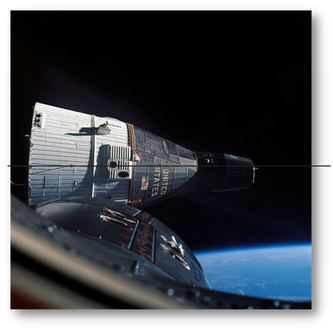
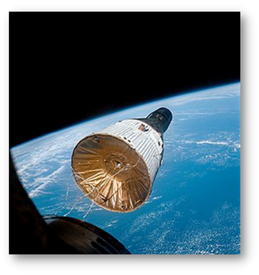
out the relative motion between the two craft. For three orbits, Gemini VI worked with the passive Gemini VII “target.” The two-spacecraft stayed within 90 meters of each other and got as close as 30 centimeters—close enough to communicate using hand written signs. For example, the Gemini VI crew were both Annapolis graduates and on board the Gemini VII was Borman a West Pointer. Well, the big game, Army-Navy, was soon to be played and the Gemini VI crew held up a sign “Beat Army.” Borman was not impressed. Get back to work! Schirra and Stafford each took turns at the controls. Docking
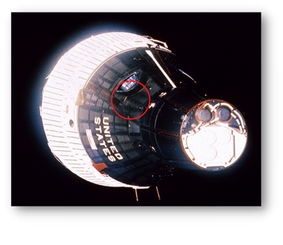
type approaches were flown and confidence soared as the four astronauts went through their paces. At one point Gemini VI “parked” 12 meters from Gemini VII and for 20 minutes stayed put in
type approaches were flown and confidence soared as the four astronauts went through their paces. At one point Gemini VI “parked” 12m from Gemini VII and for 20 minutes stayed put in a stable and hands off manner. A 90m circumnavigation maneuver to fly
around Gemini VII was accomplished. Believing the 90m goal not being representative of real station keeping, Schirra and Stafford repeated the fly around at 30m range. All the astrodynamics education Wally speaks of in his book paid off. It was not that RPO was easy, it was that they understood the dynamics and were very patient in applying thrust as they skirted about Gemini VII. As Gemini VII was about to begin its 12th day on orbit, Gemini VI bid the crew of Gemini VII
What was it that allowed the rapid decision making and light-speed execution witnessed in the era? First, we believe all of the decisions of the period, especially those that have been recounted here, were firmly grounded in the context of well-focused objective. As former NASA administratorMike Griffin recently pointed out to us, Kennedy’s speech before Congress was the quintessential directive for achieving a goal. “Man, Moon, Decade” The vision contained all that was needed to
provide a desired end state within a specified time. In the case of rendezvous, it was a noble accomplishment to target, but it was most important because it was a means to a more ambitious (and clearly defined) end. Certainly, the machines of Gemini 76 enabled the rapid turn in the final months of 1965. The Titan II was an ICBM by design, and responded as an ICBM in action. Gemini designer James Chamberlain’s vision of Gemini as a modular, simple, easily tested spacecraft paid dividends. But when we talked to some of the main actors involved about the success of Gemini 76, they focused on people and process. Gene Kranz, a Gemini flight director (who would later take over for
Chris Kraft) keyed on the personnel in “… ops and admin being the same, just changing hats.” In other words, those responsible for flight operations were also the managers/leaders/engineers. As operators, they understood from a technical and operational basis the risk and opportunities of their decisions. As managers, they were enabled to make decisions with little bureaucracy. The man in charge of all flight directors, Chris Kraft, answered the go/no-go decision for Gemini 76 for the operations crew: he was only three men removed in the management chain from the president of the US. Plus no one had to build any PowerPoint slides back then…humor!
We asked Captain Jim Lovell, USN ret, of Gemini VII and Lt Gen Tom Stafford of Gemini VI about the secrets to success of the mission recently. Lovell stated, “I don’t think technology had much to do with this—it was the management.…” Stafford responded, “We didn’t need a cast of thousands, or countless reviews, or rooms full of people, we had the goal and a can-do attitude accompanied with the will to succeed.”
Well, I’ll bring this space history lesson in for a landing. What can we learn from the first-ever RPO accomplished in space? The journey in 1965 was one of stumbling and setbacks, but on 15 December 1965 Gemini VI caught up to and danced with Gemini VII and thus with have the first ever RPO and an amazing Gemini 76 story of how we got to that day. They hurdled the unknown and found that while armed with astro knowledge and GRIT, this RPO stuff was doable. In his book “The Unbroken Chain,” Guenter Wendt, the launch pad boss (recall the Apollo 13 line by Tom Hanks “I vonder vhere Guenter vent?”) sums up the Gemini 76 mission saying “a new high point had been established in our trails for our assault on the Moon. To me, this was the crown jewel of the Gemini entire program.”
Gemini 8 would go on to accomplish the first ever docking in preparation for Apollo. In fact, the Gemini 8 mission would take a turn towards danger after it completed the rendezvous and docking. A stuck thruster put Armstrong and Scott into an accelerating tumble and Neil had to wrestle back control. With that, Neil Armstrong would solidify his place in line as the man to first set foot on the Moon. I hope on 15 Dec you’ll take time to celebrate the Gemini 76 accomplishment that was 57 years ago in 1965!


You must be logged in to post a comment.