issue 39 | 16 jan 2022
The integrity flash
Analysis of Developments in the Space Domain
in this issue
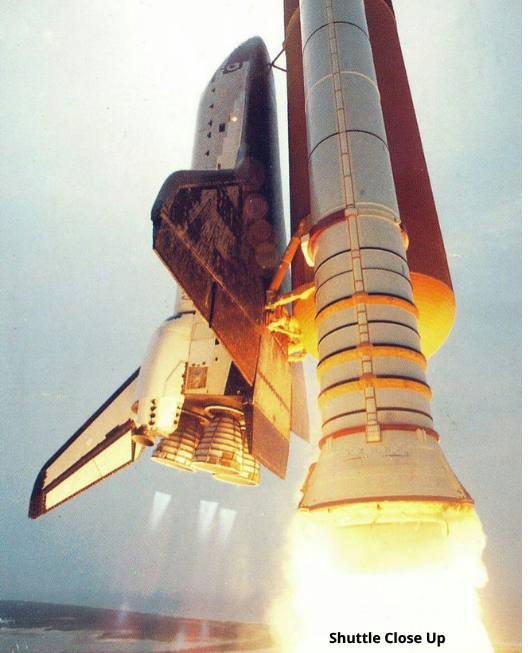
13 Jan 2022: In its third dedicated rideshare mission, SpaceX delivered 105 satellites to a 525-kilometer altitude Sun Synchronous Orbit (SSO). SpaceX’s rideshare program aims to enable frequent and economical access to popular orbits like the SSO, while also providing schedule flexibility to the customers. It costs as low as $1 million for a 200kg payload headed to an SSO. Video
– Planet, Inc., launched 44 SuperDoves Earth observation satellites as part of their SkySat Constellation.
– Kepler Communication launched six communication satellites as it aims to deliver networks all over the globe using small satellites in orbit.
– Capella launched Capella 7 & 8 satellites to grow its constellation of Very High Resolution, Low Latency, Synthetic Aperture Radar (SAR) satellites in orbit.
– Umbra Space launched its second commercial SAR satellite, Umbra-02. Alongside Umbra SAR-2001, launched on the previous transporter mission, the company plans to establish its own SAR constellation of 24 such satellites.
– Planet, Inc., established contact with all 44 SuperDove satellites, many within two minutes of the final deployment.
– The 44 satellites join Planet’s existing fleet of ~200 satellites in orbit. Planet has launched 127 satellites across eight launches with SpaceX, and over 500 satellites total since the company’s founding 10 years ago.
– The constellation of both medium- and high-resolution satellites has collected 1,700 images on average for every spot on the Earth’s landmass over the past 10 years.
– SuperDoves Flock 4 satellites feature technology that enables the constellation to capture around 1.2 million pictures per day. Maximum resolution is reportedly 50cm.
– See 5 min interview with Planet CEO including incredible satellite deployment footage.
Transporter-3 was the first of three dedicated ride share missions scheduled for 2022. Launches of large numbers of satellites on one vehicle presents tracking and identification challenges for commercial and government space tracking organizations. As of 15 Jan, 8 of the 105 objects had been added to the public catalog and were listed as “unknown” for owner/operator.

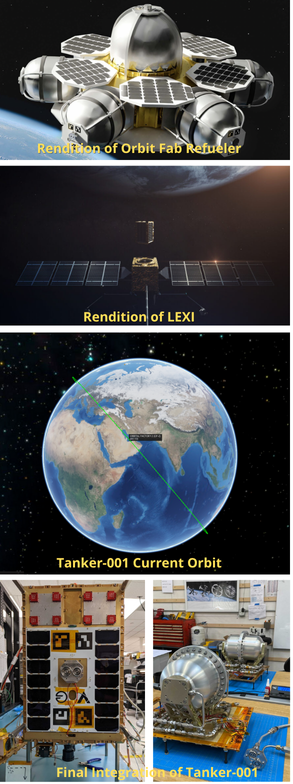
11 Jan 2022: Astroscale and Orbit Fab announced they had signed an agreement for Orbit Fab’s in-space refueling tankers to refuel Astroscale’s geostationary satellite servicing spacecraft known as LEXI, short for Life Extension In-Orbit. See Video Rendition.
– The agreement commits Orbit Fab to supply up to 1,000kg of Xenon propellant to refuel Astroscale’s LEXI vehicles, with the first projected launch in 2026.
– LEXI will provide services like station keeping and attitude control, momentum management, inclination correction, geostationary orbit relocation and retirement to graveyard orbit.
– Orbit Fab, founded in 2018, developed a refueling port known as RAFTI (Rapidly Attachable Fluid Transfer Interface). The port is offered to government and commercial operators to make their satellites compatible with Orbit Fab’s refueling tankers.
– Orbit Fab deployed its first propellant-storage tanker in low Earth orbit and plans to launch its first tanker to geostationary orbit on a SpaceX Falcon 9 lunar lander mission projected for late 2022 or early 2023. Orbit Fab’s first two fuel shuttles in LEO are expected to be operational in 2023.
– Orbit Fab’s first tanker is less than 100 pounds. The geostationary orbit tanker will be larger and carry more than 200 pounds of hydrazine.
– Orbit Fab’s CEO: “We’ve already got several million dollars worth of contracts from the Space Force and Air Force, who are funding flight qualification of the fueling ports [and efforts to deliver] both hydrazine and xenon.”
– Orbit Fab expects to deploy dozens of fuel tankers and shuttles in the next five to 10 years both in low Earth orbit and in geostationary orbit.
Both Astroscale and Orbit Fab’s core offerings are designed to provided ways for satellites to extend their useful life. Astroscale is integrating RAFTI into the LEXI Servicer to provide refueling capability alongside the company’s ongoing work to develop LEXI’s rendezvous and docking payload technology.
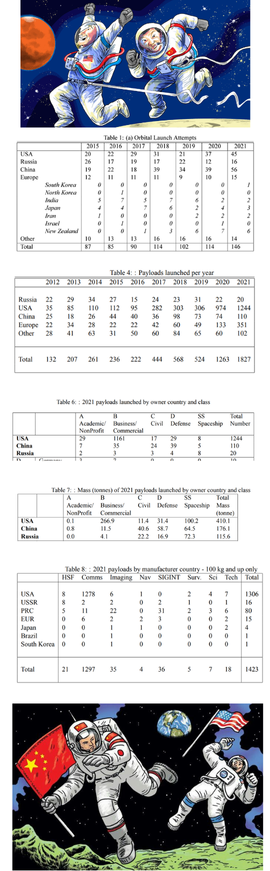
31 Dec 2021: Politico article describes various aspects of the increasing space competition between China and the United States. The article asserts China is showing no sign of slowing its pace to surpass the US and other powers in space transportation and exploration; and then describes the challenges for 2022.
– Washington, D.C., and Beijing are jockeying for advantage — and international partners — to develop the moon and locked in what increasingly looks like an arms race that could threaten the growth of satellite constellations and space stations.
– A big question is who will lead the global space industry in managing the historic growth in satellites that are increasingly at risk of colliding with orbital debris — or each other — if not better coordinated.
– Washington needs to iron out what US agency is in charge (of space traffic management), whether the Commerce Department or the Federal Aviation Administration, which licenses space launches.
– The US moon program is enlisting international partners in the form of the Artemis Accords, which now includes more than a dozen countries. But Russia and China, which are pursuing a lunar research station, are also seeking partners.
– 2022 could determine whether progress is possible on what many see as the next best thing: Agreed-upon “norms of behavior” between leading space powers that reduce the chances of conflict in orbit and help ensure space is sustainable in the years ahead.
– The UN is on a nascent diplomatic process. On Christmas Eve, the General Assembly adopted a resolution on “Reducing Space Threats through Norms, Rules and Principles of Responsible Behaviour.”
– The fact that the process is geared toward behavior and not technology — such as trying to ban certain classes of weapons, which has long been considered a nonstarter — is a sign that there may be overlapping interests.
– However, there are several “multilateral mechanisms” already in place to regulate behavior in orbit, including the Space Debris Mitigation Guidelines developed by the United Nations Committee on the Peaceful Uses of Outer Space. Despite these collective best efforts, however, states are still conducting destructive anti-satellite weapons tests.
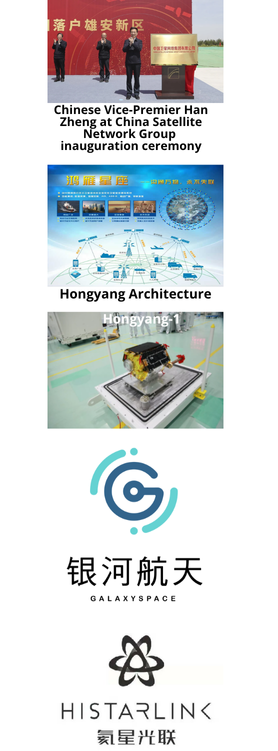
12 Jan 2021: China Satellite Network Group Co. Ltd. established two new firms to jointly construct a satellite Internet industry system in the city of Chongqing. This is the latest development in China’s quest to create a 13,000 China SatNet or “national network” satellite internet constellation. The recently approved 14th Five-year Plan for the period 2021-2026 and “long-range objectives through 2035” document call for an integrated network of communications, Earth observation, and navigation satellites. See Wall Street Journal Video comparing Starlink with China’s satellite based 6G.
– China’s satellite internet project seeks to fill gaps in terrestrial communications, provide services to rural areas and compete with Western constellations currently planned and being built out.
– The China Satellite Network Group has yet to release details of the project or its prospective partners.
– ITU filings in 2020 indicate China plans a constellation of just under 13,000 satellites in LEO to provide global communications.
– The national network project, often referred to as “China SatNet” serves a number of Chinese goals, including supporting domestic technology and economic development goals; and contributing to China’s soft power diplomacy and regional leadership efforts.
– The project appears to have broad support, including at the top levels. China’s National Development and Reform Commission (NDRC) added “satellite internet” to a list of “new infrastructures” in Apr 2020, spurring local and provincial policies seeking to foster and support satellite and space sector clusters in cities across China, such as Shanghai, Beijing, Wuhan, Guangzhou, Beijing, Shenzhen, Chengdu, Xi’an, Changsha and Wenchang and the Yangtze Delta region.
– Previous satellite internet projects, Hongyan and Hongyun, have apparently been superseded by China SatNet.
– Hongyan was to consist of more than 300 satellites and a prototype, Hongyan-1, was launched in 2018.
– In addition to state-sponsored projects there are a number of Chinese “commercial” firms developing their own solutions.
– Galaxy Space is preparing to launch a batch of six LEO communications satellites in the first quarter of the year on a Long March 2C rocket.
– Laser inter-satellite links (ISL) manufacturing company HiStarlink recently announced its Angel and Angel + rounds of funding and is planning on-orbit verification of its technology in Q1 2022, and hopes to complete on-orbit verification of the laser comms between two satellites by the end of 2022.
– HiStarlink claims to have already developed products capable of transferring data at up to 40 Gbps.
– Laser Intersatellite links are critical enablers for any proliferated LEO constellation.
26 Dec 2021: Foreign Policy examined possible Russian motivations for the kinetic ASAT test on 15 Nov 2021. By destroying its satellite in space, Russia achieved two objectives. It enhanced its defense and deterrence capabilities, and also projected its power before testing, demonstrating, and using ASAT capabilities could be prohibited or significantly restricted by international mechanisms. Additionally, Russia ensured it will be a significant party in any major international regulatory process by publicly possessing such a capability.
– The Chinese and US ASAT tests in 2007 & 2008 respectively resulted in international initiatives to manage global space activities and the passage of the U.N. Guidelines for the Long-term Sustainability of Space Activities which were adopted in 2019.
– In 2008, China and Russia presented a draft of a treaty on the Prevention of the Placement of Weapons in Outer Space.
– The suggested treaty focused only on space-based weapons; ASATs and other earth-based systems were not included.
– On 1 Nov, the UN adopted a British initiative to set up an
Open-Ended Working Group to discuss these issues and perhaps even formulate a binding legal agreement. The initiative passed the UN General Assembly First Committee. China and Russia voted against the initiative but did not rule out possible participation in the working group.
– This time, it is more likely that the international community will develop and approve more stringent regulations of space weapons…and it is likely to push the great powers to ban actions and experiments of the type carried out by Russia last month.
Russia was clearly aware of the environmental damage a high-altitude ASAT test would cause with significant debris. Russia probably took this into consideration and expected international condemnation, of which they had an interest in. One outcome of binding regulations banning the testing and use of ASATs is that such rules may prevent others from catching up to the Kremlin—while sustaining the leading role of current space powers, including Russia.

COMSpOC Analysis of Russian ASAT Debris
4 Jan 2022: The Commercial Space Operations Center (COMSPOC) released its detailed analysis of risks created from debris resulting from Russia’s Nov. 15 anti-satellite weapon test.
– Debris will continue to threaten satellites, as well as the International Space Station over the next several years.
– The satellite most imperiled in the first 24 hours after Nudol’s interceptor smashed into Russia’s Cosmos 1408 bird was one of America’s four remaining Defense Meteorological Satellite Program weather satellites, DMSP 5D-3 F18.
– COMSpOC analysis shows that the bulk of roughly 1,500 debris pieces being tracked by Space Command’s 18th Space Control Squadron — 904 pieces of which have been put in the public catalog — will de-orbit within a three year timespan.
Analysis showed 8,917 likely conjunctions between satellites and ASAT test debris of <5km in the first week of January 2022. There will be 24,958 conjunctions of <5km involving Starlink satellites.

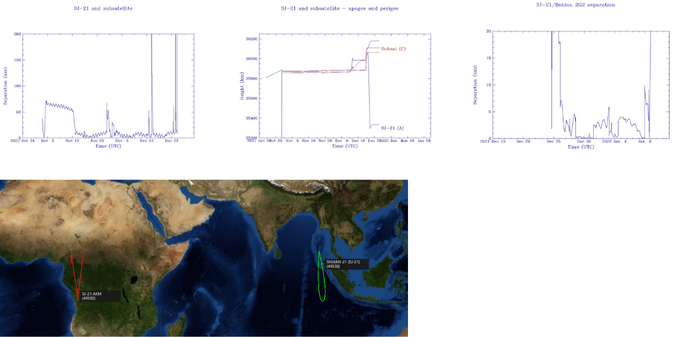
1 Jan 2022: The SJ-21 satellite launched in October released a subsatellite on around 1 Nov and performed rendezvous maneuvers to stay close to it until Dec 26, when the main SJ-21 satellite maneuvered into an elliptical orbit. The Sub-satellite is now above the GEO belt and traversing west. After ending its stationkeeping with its subsatellite, SJ-21 made rendezvous with a defunct Beidou navigation satellite from 26 Dec – 8 Jan.
Shijian-21 launched into GTO 23 Oct by a LongMarch 3B rocket and was placed into an ~8° inclined GEO Orbit. Chinese state media reported that the satellite would “test and verify space debris mitigation technologies,” but no further details have been revealed.
7 Jan 2022: China’s TJS 9, launched 29 Dec, is in GEO near 137°E. TJSW-9 was manufactured by CAST which also manufactured TJSW 1 & 4 satellites believed to perform SIGINT collection and for testing and demonstrating multi-band, high-speed communication technology for the military. It is believed that TJSW-9 is a continuation of this SIGINT satellite series.
SAST produced TJSW 2, 5, 6 & 7. TJSW 2, 5 & 6 look like missile early warning satellites similar to US SBIRS. These are apparently built on the same bus as the FY-4 GEO weather satellites. There is debate on the mission of TJSW-7, it may be another missile warning satellite or a communications test satellite or something else entirely. The location appears to place it roughly equidistant from TJSW-5 & 6 suggesting a missile warning role. The mission of TJSW-3 was identified as a GEO belt “inspector sat” that exhibited unusual behavior after launch interacting with its Apogee Kick Motor.