
issue 41 | 13 Feb 2022
The integrity flash
Analysis of Developments in the Space Domain
in this issue
5 Feb 2022: A Soyuz-2-1a rocket with a Fregat upper stage lifted off from Pad No. 4 at Site 43 in Plesetsk. According to air traffic warnings issued ahead of the launch, the mission targeted an orbit with an inclination 67 degrees toward the Equator. The mission was to deliver an unidentified Russian military satellite to orbit. Video.
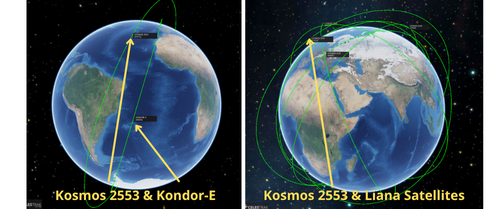
– The satellite in question is likely called Neitron, a new type of military intelligence satellite. The Ministry of Defense stated the satellite was been placed into the intended orbit and is working normally. It’s been designated Kosmos-2553.
– The Ministry of Defense officially described Kosmos-2553 as “a technological satellite equipped with newly developed on-board instruments and systems in order to test them in conditions of radiation and heavy charged particles.”
– Neitron will be joined in orbit by a sister satellite in the future, possibly named Tekhnolog. It is unclear whether Neitron is a satellite-specific name or a program name.
– Neitron was manufactured by NPO Mashinostroyeniya, a Russian design bureau that has also developed a series of Earth-imaging satellites named Kondor. These small satellites operate in low Earth orbit and can carry either optical or radar imaging payloads.
– A radar imaging Kondor was launched in 2013. A Kondor-E (export) built for the South African government was orbited in 2014. A civilian version of Kondor is set to launch later this year.
– According to posts on Russian social media, the Neitron payload is believed to be based on the Kondor platform, but it is customized for operation in a considerably higher orbit.
– Radar tracking data from the 18th Space Control Squadron of
the US Space Force, indicated Kosmos-2553 entered a 1,987 by 1,995km orbit with an inclination 67.08 degrees toward the Equator. By comparison the Kondor-E orbit is 400km.
– The launch of Neitron was scheduled for late 2018 before slipping several years likely due to technical problems with the satellite.

– The Neitron designation surfaced in Russian procurement documents around 2017 and the spacecraft was listed in a corporate newspaper published by NPO Lavochkin among payloads slated for launch on the company’s Fregat upper stage during 2018.
– The orbital inclination targeted by the Neitron matched that used by the Liana electronic-intelligence constellation. However, Pion and Lotos satellites comprising that network did not require the Fregat space tug to reach their low orbits.
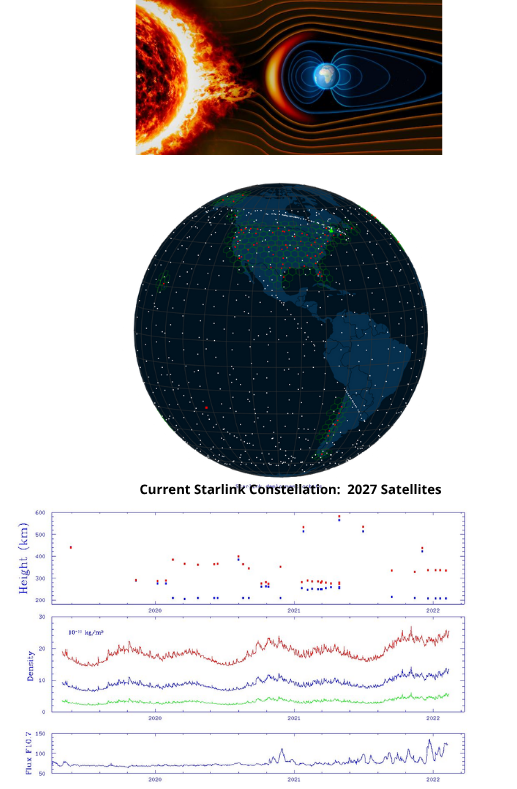
8 Feb 2022: SpaceX currently estimates 40 of the 49 Starlink satellites it launched on 3 Feb 2022 will be destroyed because of a geomagnetic storm. The storm caused “up to 50 percent higher drag than during previous launches,” keeping the deployed satellites from reaching their proper orbit around the Earth. Geomagnetic Storm Video.
– A geomagnetic storm happens after a solar flare, and the exchange of energy from the sun reaches the space surrounding Earth through solar wind, according to the National Oceanic and Atmospheric Administration. These storms can heat the ionosphere – where Earth’s atmosphere meets space.
– The Falcon 9’s second stage deployed the satellites into their intended orbit, with a perigee approximately 210km above Earth. Each satellite achieved controlled flight.
– The satellites deployed on 3 Feb were significantly impacted by a geomagnetic storm on 4 Feb. These storms caused the atmosphere to warm, increasing the atmospheric density at Starlink’s low deployment altitudes. Onboard GPS suggests the escalation speed and severity of the storm caused atmospheric drag to increase up to 50% higher than during previous launches.
– The Starlink operators commanded the satellites into a safe-mode where they would fly edge-on (like a sheet of paper) to minimize drag—to effectively “take cover from the storm.”
– Preliminary analysis show the increased drag at the low altitudes prevented the satellites from leaving safe-mode to begin orbit raising maneuvers, and up to 40 of the satellites will reenter, or already have reentered, the Earth’s atmosphere.
Plot showing deployment altitudes of Starlinks (top panel: perigee blue, apogee red); atmospheric density (middle panel) at 200 (red), 220 (blue), 250 (green) km altitude, and solar radio flux (lower panel).
9 Feb 2022: China Aerospace Science and Technology Corporation (revealed the plans in an annual ‘blue book’ on space activities. The updated target, coupled with the launch plans of other Chinese state-owned enterprises and new private firms, means China could potentially exceed 60 launches in 2022.
– CASC’s major missions will include six launches to complete the construction phase of the Tiangong space station. The Tianzhou-4 cargo spacecraft will launch following the end of the Shenzhou-13 mission in March, in order to support the next three-person crew launching on Shenzhou-14.
– Work on the Long March 2F, Long March 5B and Long March 7 rockets for launching Shenzhou, space station modules and cargo missions respectively continued during the recent Lunar New Year holiday, according to CASC.
– The module launches will be followed closely, partly due to the significance of the missions, but also because of the use of the Long March 5B. During the two previous launches, the large first stage made high-profile uncontrolled reentries which sparked acrimony.
– The rocket maker, the China Academy of Launch Vehicle Technology (CALT), says it has further optimized the two new Long March 5B rockets to ensure mission success without providing details.
– CALT also stated it will launch 4-5 Long March 11 solid rockets during the year, without specifying if launches will take place from land or sea. The new Long March 7A, a likely successor to the aging Long March 3B, is expected to launch two times.
– CASC will also focus on developing the fourth phase of China’s lunar exploration project. This includes the Chang’e 6 and 7 missions targeting the lunar south pole along with a combined asteroid sample-return and comet rendezvous mission.
– On the commercial side, Landspace, one of China’s first private launch firms, is preparing to launch its new methane-fueled Zhuque-2 rocket at the national Jiuquan Satellite Launch Center.
– iSpace is preparing to launch its fourth Hyperbola-1 solid rocket after two consecutive failures and could launch its own, methane-liquid oxygen launcher, Hyperbola-2, this year.
China launched 55 times in 2021, sending 115 spacecraft and 191.19 metric tons into orbit. Of these, 41 launches headed to low Earth orbit and 14 to geosynchronous transfer orbit.
Of the 55 Chinese launches in 2021, 48 were Long March launches. All of these were successful, sending 103 spacecraft into orbit, though the fate of Shiyan-10 remains ambiguous. Exspace launched four Kuaizhou-1A rockets, with the last ending in failure and potentially bringing further significant delays to its commercial launch plans.

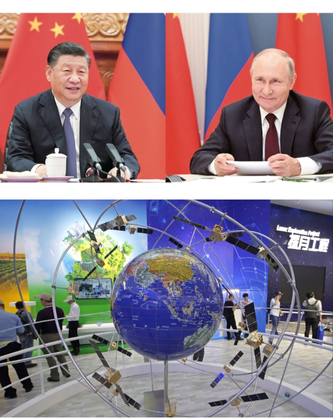
5 Feb 2022: China and Russia have agreed to coordinate their satellite navigation systems (Beidou and GLONASS respectively) as the two countries further solidify their partnership to rival the US-owned GPS. A Kremlin press released stated, GLONASS and BeiDou would continue “on cooperation in the field of ensuring the complementarity of the global navigation satellite systems in terms of system timescales.”
– The Beidou and GLONASS agreement was one of no less than 16 deals confirmed during the meeting.
– Russian President Vladimir Putin hailed “unprecedented” close ties with China at a meeting with Chinese leader Xi Jinping in Beijing ahead of the Winter Olympics opening ceremony.
– The details of the agreement were not disclosed. But it follows and further develops a 2018 agreement between the two governments to shape a framework for the two systems joining forces.
– “Both sides would coordinate…during their programming to maximize the use of resources of both systems in the future,” Clark Shu, telecommunications researcher at the University of Electronic Science and Technology of China, said.
– “For example, when a BeiDou satellite covers a Moscow area between 0700 to 0900 [hours], a
GLONASS satellite could be spared to cover the St Petersburg area during the same period or take over Moscow from 1000 to 1200 [hours].”
– China launched its BeiDou, or Northern Dipper (the ancient Chinese name for the seven brightest stars of the Ursa Major constellation) program in the 1990s. This came amid concerns that its People’s Liberation Army would be vulnerable without a satellite navigation system alternative to the GPS (Global Positioning System), owned by the US government and operated by the US Space Force. See Video.
– Russia’s GLONASS, or Global Navigation Satellite System, started as a Soviet program during the Cold War, and was restored in 2011. The constellation now has 24 satellites in orbit, yielding great advantages for military uses – thanks to its strong anti-jamming capability.
The BeiDou system, with a 1.2m accuracy of positioning that surpasses the GPS’ 5-10m range, and added services such as text messaging, also aims to draw the global civilian satellite navigation market worth billions of US dollars. It is an important part of China’s Belt and Road Initiative to deepen China’s international ties.
“BeiDou and GLONASS each have their own advantages. If they could be deeply linked or even interoperable, they could form an ideal navigation system, which would not only facilitate cross-border transport between the two sides in peacetime, but also improve the stability and survivability of the whole navigation system by relying on each other in wartime,” Chinese military expert Qian Liyan told Russia’s Sputnik news agency.
2 Feb 2022: The Washington Post published an article taking a closer look at China’s its first white paper on space-related activities in five years. The author highlights that the white paper underscores China’s larger ambition to shape international rules governing outer space and offers insights on Beijing’s plans to overcome significant obstacles facing its commercial space sector.
– China is an increasingly important space power and a potential challenger to U.S. interests. This document provides insights into China’s space priorities — in what is explicitly stated and for what is missing.
– The White Paper devotes an entire section to the global governance of space. Compared with China’s last space White Paper, the current paper articulates a more active role for Beijing in shaping international rules governing outer space.
– There are reasons to be cautious about Chinese attempts at space governance. In 2014, China and Russia proposed the Prevention of the Placement of Weapons in Outer Space Treaty. Critics emphasize that this treaty lacks mechanisms for verifying compliance and allows China and Russia to continue developing ground-based anti-satellite weapons.
– The new White Paper points out that China views space capabilities as essential for economic development and building a “digital China,” which inherently rely on satellites for communication and transportation. Today, China has far more to lose from outer space becoming littered with space debris than it did in the past — a trend that will likely increase as China continues investing in space capabilities.
– China’s interest in making international rules for outer space may not necessarily align with U.S. interests. Instead, some of these rules may be aimed at binding U.S activities while allowing China to reap the soft power benefits of “acting responsibly.”
– There is no data to suggest that China’s commercial space sector is even close to rivaling the multibillion-dollar U.S. commercial space sector, other than the number of rocket launches — a count that measures mostly government-funded activity.
– China’s commercial space sector also faces serious challenges, including the absence of a domestic national space law, the continued dominance of state-owned enterprises in the economy and limited access to military-run launch sites.
– This latest White Paper suggests Beijing seeks to solve at least some of the challenges confronting China’s commercial space sector. China will try to “optimize the distribution of the space industry in the national industrial chain,” the document notes, regulate the licensing of civil space launches and “speed up the formulation of a national space law.”
– China’s White Paper does not offer concrete plans for lunar missions or an explicit commitment to carry them out. It states the objective to “continue studies and research on the plan for a human lunar landing, develop new-generation manned spacecraft.” The absence of any concrete proposals suggests that Chinese leaders may have concerns about investing in such an expensive endeavor or about China’s ability to accomplish such a goal.


