issue 42 | 27 feb 2022
The integrity flash
Analysis of Developments in the Space Domain
in this issue
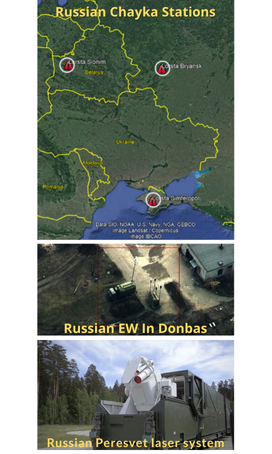
19 Feb 2022: Russian positioned its electronic warfare units along with other forces along the Ukrainian border. They include TORN and SB-636 Svet-KU signals-intelligence systems that can pinpoint Ukrainian units by tracing their radio signals, RB-341V Leer-3s that combine Orlan-10 drones carrying cellular-jamming payloads with a command post on a KamAZ-5350 truck, R-934B Sinitsa radio-jammers and R-330Zh Zhitels that block satellite links. Russia is also preparing its own forces to operate without GPS or GLONASS.
– Russia’s military doctrine assumes signals from space, including it’s own GLONASS and other GNSS, will not be available once a battle begins.
– There is little question that Russia will jam and/or spoof GPS receivers during an invasion of Ukraine, as going after GPS has become almost ubiquitous as a first military move since Kosovo.
– The terrestrial Chayka system, a version of Loran-C, is maintained to protect their homeland with navigation and timing services when signals from space are not available.
– The portable Skorpion system is designed for military use during expeditions to areas where Chayka or Loran is not available, according to western military analysts.
– “Three of Russia’s Chayka/Loran stations have Ukraine surrounded,” explained UrsaNav CEO Charles Schue, referring to a graphic he provided GPS World. “They provide ideal coverage and will allow navigation accuracy of between 20 and 50 meters over most of the Ukraine.
– Russia used cyber and electronic warfare methods to isolate Ukrainian forces in 2014.
– During that conflict Russian forces located with drones, isolated with electronic jammers then destroyed with artillery a powerful—on paper, at least—Ukrainian armored group.
– In addition to jamming communications and GPS, there is concern Russia could directly target US and other western intelligence, surveillance and reconnaissance (ISR) satellites, including commercial remote sensing birds.
– Russia has a host of non-kinetic options for targeting satellite systems that could be disruptive or destructive for American industry and its government customer.
– The Law of Armed Conflict (LOAC) clearly sets out that any satellites being used by Ukraine, no matter who owns those satellites, are lawful targets.
– Russia might feel more free to interfere with commercial remote sensing satellites than those operated by NRO and the Defense Department.
– Cyber protections used by commercial satellites may not be as robust as those used by the military or the Intelligence Community, making it both easier for Russian hackers to get in and harder to pin any shenanigans on them if they do.
– Jamming and spoofing of GPS signals essentially has been tolerated by the Pentagon…That seems to indicate that similar actions against ISR satellites might also be accepted, especially if those satellites are commercial ones.
Expect, in wartime, for Russia to again jam Ukrainian battalions. Once the units no longer can communicate and find themselves blind and without orders, the Russian artillery will rain down.
Space Observers Tracking Russian MILSATCOM
23 Feb 2022: Amateur Astronomer Scott Tilley has been tracking and reporting activity involving Russian military communications satellites.
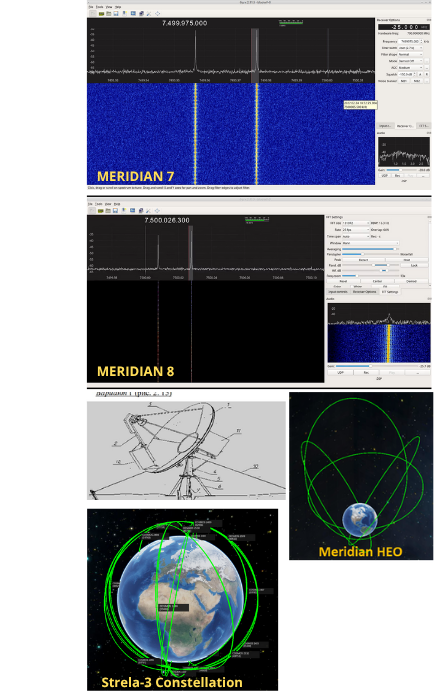
– Russia operates a constellation of High Earth Orbit (HEO) satellites to provide military communications called MERIDIAN. They have transponders on 279, 484 990MHz, C-Band and X-band.
– MERIDIAN 7 comes online as it approaches apogee. No unusual activity on X-band. It hasn’t been seen operating a transponder on 990MHz.
– Russia’s MERIDIAN 8 is emitting signals normally. No unusual activity thus far.
– Russia also operates a mirror image of the Meridian assets in GEO.
– Observers with capability on C-band should also look. Similar traffic centred around 3625MHz can be found there. TT&C signals for a significant number of Russia military satellite assets are around 3410MHz.
– Russia also operates a vast constellation of store and forward military communications satellites in low Earth orbit (LEO) call STRELA in the ~250MHz region.
– Mr Tilley also highlighted the availability of an operating manual for a tactical C/X band Russian satellite communications vehicle. He noted the manual seems relevant and current with Russian observed SOPs and OSINT.
Finally: “I would also suggest to resisting commanders that Russian satellite assets are not resistant much at all to jamming or other incidental communications as one can usually hear Asian taxis services, amateur radio repeaters, cellular services etc.“ It remains to be seen if others make use of this information and attempt to interfere with Russian military satellite communications.
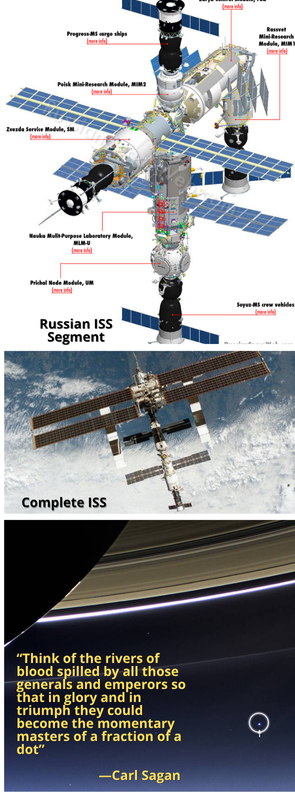
24 Feb 2022: Dmitry Rogozin, head of Russian space agency Roscosmos, unleashed a tweetstorm in response to the threat of US sanctions that could impact the space program. In the thread, Rogozin argued the Russia’s space program has operated just fine with restrictions in place since the Russian annexation of Crimea in 2014. The rant took a bizarre turn as Rogozin floated the idea of dropping the ISS on our heads should the US and other participating nations kick Russia out of the program.
– Rogozin rightly noted Russian engines help steer the ISS out of the way of space junk in orbit.
– Rogozin later stated: “”If you block cooperation with us, who will save the ISS from an uncontrolled deorbit and fall into the United States or Europe? There is also the option of dropping a 500-ton structure to India and China. Do you want to threaten them with such a prospect? The ISS does not fly over Russia, so all the risks are yours.”
– NASA’s response was measured, saying the space agency “continues working with all our international partners, including the State Space Corporation Roscosmos, for the ongoing safe operations of the International Space Station.”
– For his part, Elon Musk responded, “BTW Dmitry (Rogozin), no trampolines are required for crew, cargo, or reboost. #SpaceX has that covered. Just sayin'” in reference to Rogozin’s 2014 suggestion that NASA use a trampoline to send astronauts to orbit after US sanctions were first imposed.
– Prior to Russia’s 2014 annexation of Crimea, U.S. and Russian space programs were tightly coupled. In response to sanctions, Rogozin, then Russian deputy prime minister, threatened to deny NASA access to seats on the Soyuz capsule and halt export of RD-180 rocket engines.
– Under the threat of losing the ability to put astronauts in space, Congress gave NASA requested funding for the Commercial Crew Program.
– Atlas 5 rockets continue to rely on RD-180 engines, but United Launch Alliance has all the RD-180s it needs for its remaining Atlas launches.
– Roscosmos has struggled over the past 8 years in the face of Western sanctions. Western observers who track the Russian space industry realize the program is deeply troubled, and running on the fumes of its past and very real glory. Russian media outlets have also published critical articles in the past several months.
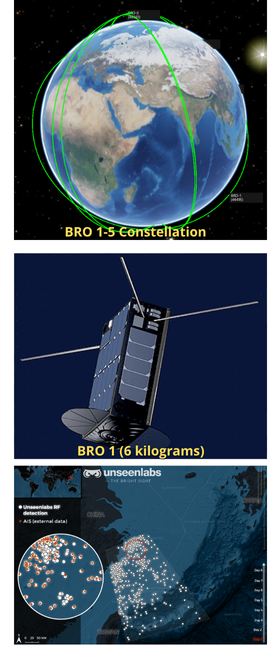
18 Feb 2022: Unseenlabs released a press report noting its ability to locate and identify Chinese vessels not using the internationally mandated Automated Information System (AIS) and subsequently disappearing from tracking systems normally used in maritime transport. Using its constellation of 4 (now 5 after 13 Jan 2022) LEO satellites Unseenlabs conducted an 8 day satellite acquisition campaign in the South China Sea. Marketing Video
– Unseenlabs conducted its collection activity from 11-18 Nov 2021 to highlight ships missing from AIS monitoring screens.
– According to Vesselsvalue, ships broadcasting AIS signals from Chinese waters has dropped 90% in the past year.
– Chinese authorities invoke national security and sovereignty issues citing the use of foreign intelligence agencies and companies using AIS to keep track of Chinese military vessels and gather sensitive economic data.
– Using its commercial radio frequency (RF) tracking sensors, Unseenlabs reported that they were able to locate 80% more ships using RF collection than solely relying on AIS broadcast. This difference is likely the result of AIS beacons being turned off or having their data transmission blocked by Chinese authorities.
– The company did not reveal any further details.
– Unseenlabs uses proprietary onboard satellite technology and states they can geolocate any vessel at sea, in near-real time, to within a kilometer, from a single nanosatellite.
– Unseenlabs’ service, focused on radio frequency geolocation of ships at sea, has been active since the first satellite launch – BRO-1 – in August 2019.
– Each new launch (2 in 2020, 1 in 2021) has increased the service’s capabilities, notably by increasing its responsiveness and the amount of data produced.
– Rocketlab launched the first three Unseenlab satellites the 4th was on a Vega rocket and the 5th on SpaceX’s Transporter 3 mission.
– The satellites are <=10-kg and travel at 7 km/sec around the Earth at altitudes between 500-550km at apogee. All operate in a sun-synchronous orbit with the exception of BRO-1 which is inclined at 45.0 °.
– Each new satellite will improve the revisit time and generate more data for pattern analysis.
– The company intends to create a constellation of 20-25 satellites.
The financing, development, deployment and operations of small satellites constellations such as Unseenlabs RF interceptors could augment nation-state collection operations. Future collaboration between commercial space operators will deliver further insights on surface activities. RF intercept/geo-location data could cue imaging satellites, such as those from Planet or Capella, to identify a vessel’s identity and mission.
15 Feb 2022: Amateur satellite tracker Scott Tilley (noted previously) and others, have been following Chang’e-5’s travels through space and provide evidence for the new lunar orbit following months of observations. See Video on Scott.
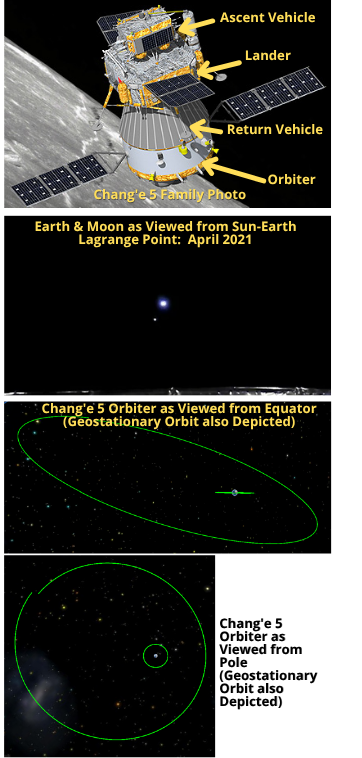
– A spacecraft involved in China’s 2020 Chang’e-5 lunar sample-return mission (Video) is now in a unique orbit around the Moon, more than a year after completing its primary mission.
– The service module, which played a large part in delivering 1.731kg of fresh lunar samples to Earth in December 2020, is now in a distant retrograde orbit (DRO) of the moon.
– A distant retrograde orbit allows a spacecraft to interact with two gravitationally stable areas in front of and behind the moon with respect to the Earth. The spacecraft’s distance from the moon means it orbits only once every couple of weeks.
– Such an orbit has not been used before but is planned for NASA’s upcoming Artemis 1 mission later this year.
– After releasing the capsule containing samples collected from Oceanus Procellarum, the orbiter itself continued its journey away from Earth, heading for the Sun-Earth Lagrange point 1, roughly 1.5 million kilometers away. The spacecraft is using extra fuel due to the precise initial orbital injection by the Long March 5.
– It is unclear what China is planning with the DRO test, but Chang’e lunar missions have earlier been sent on extended missions to add value or even as important tests for later missions.
– Jonathan McDowell, an astrophysicist at the Harvard-Smithsonian Center, stated that he believes China is probably using the Chang’e-5 spacecraft gaining experience with astrodynamics. “They are using it as a toy to play around with. It is clearly useful as a stable lunar orbit for future missions, I just don’t think it’s a specific precursor.”
– Currently the Chang’e-5 is orbit has a an apogee of 456,772km and a perigee of 190,986km.
Most lunar orbits can be rather unstable due to the moon’s mass concentrations, and require periodic station keeping (fuel). A DRO offers a stable (decades+), low cost place to park spacecraft or an asteroid (for future mining) for that matter.
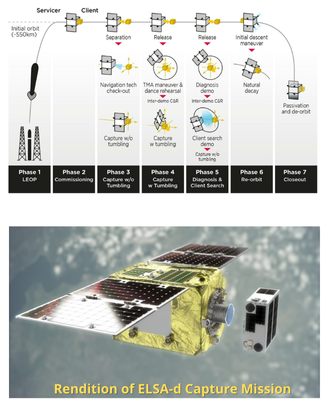
17 Feb 2022: Astroscale is preparing to resume an attempt to capture a satellite acting as a piece of debris in low Earth orbit, after pausing the demonstration three weeks ago to troubleshoot undisclosed problems. See Video
– Astroscale started moving its 175-kilogram servicer spacecraft closer to the 17-kilogram client satellite ahead of deciding whether to restart the demonstration.
– The servicer and client were a few centimeters apart before a successful capture demonstration 25 Aug 2022 controlled manually by flight operators in the U.K.
– They were separated by tens of meters at the start of a demonstration that was called off 26 Jan 2022.
– Flight operators aimed to be less involved to enable the servicer to carry out the capture mission more autonomously.
After performing a series of demonstrations designed to test the technology Astroscale plans to use to capture and remove objects in orbit, the servicer aims to de-orbit the servicer and client in a controlled descent that it says will take seven to 10 years to complete.
10 Feb 2022: At a press conference, Zhao Lijian, spokesman for China’s Ministry of Foreign Affairs said China was open to more formal lines of communication with the U.S. on space safety. “With a view to protecting the safety of Chinese astronauts and space station, the Chinese side stands ready to establish a long-term communication mechanism with the U.S. side and hopes that the U.S. will take concrete measures to prevent such incident from happening again,” he said.
– At the same press conference, Zhao also reiterated claims the country made to the United Nations in Dec 2021 that it had to maneuver its space station twice in 2021 to avoid close approaches by SpaceX Starlink satellites.
– The U.S. government tells a different story. In its own filing with the U.N., dated 28 Jan and published by the U.N.’s Office for Outer Space Affairs on 3 Feb, the U.S. says it never heard from the Chinese government about close approaches by Starlink-1095 and Starlink-2305.
– Analysis by the U.S. Space Force’s 18th Space Control Squadron found no evidence of a close approach by either Starlink satellite to China’s space station that met “the threshold of established emergency collision criteria,” thus “emergency notifications were not warranted in either case.” Had such approaches met those criteria, “the United States would have provided a close approach notification directly to the designated Chinese point of contact.”
A study by COMSPOC found that Starlink satellites account for only about 7% of all close approaches with China’s space station, with the majority coming from debris, including from China’s own anti-satellite weapon test in 2007.