issue 45 | 10 April 2022
The integrity flash
Analysis of Developments in the Space Domain
in this issue
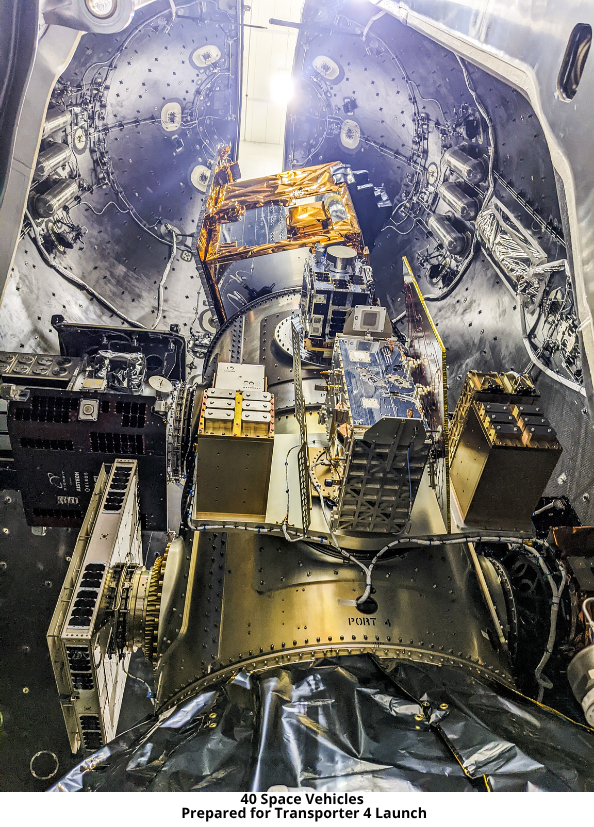
1 Apr 2022: SpaceX launched the fourth in its series of dedicated rideshare missions, placing one relatively large satellite and dozens of smallsats into low Earth orbit. See Video.
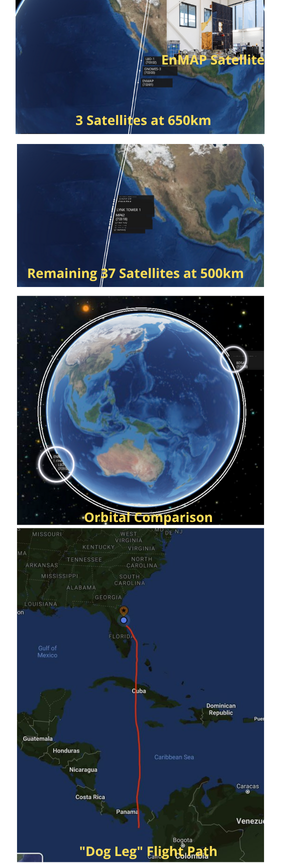
– The upper stage initially entered a sun-synchronous orbit at 650km, deploying three satellites, then maneuvered to 500km before deploying the remaining payloads.
– SpaceX used the “Polar Corridor” for this mission that allows launches from Cape Canaveral to polar orbits. With populated islands to the south, rockets complete a “dogleg” maneuver to essentially fly around them.
– This was the fourth SpaceX rideshare mission designed to carry large number of smallsats at relatively low prices.
– SpaceX launched the first Transporter mission on 24 Jan 2021, with a record 143 satellites. The Transporter 2 mission on 30 June 2021, carried 88 payloads into orbit, and Transporter 3 launched 13 Jan with 105 spacecraft.
– The manifest for Transporter 4 was down to 40 spacecraft, but that was due to EnMAP’s presence on the mission.
– At 980kg, EnMAP is heavier than any of the satellites SpaceX has flown on the previous Transporter missions. The Falcon 9 delivered EnMAP to an orbit higher than the the past rideshare launches.
– EnMAP carried a hyperspectral instrument for environmental studies.
– Swarm flew 12 of its SpaceBEE satellites, each 1/4 of a single-unit cubesat in size. Swarm is building a constellation of communication satellites to support IoT sensors.
– Satellogic flew five of its high-resolution imaging satellites on the mission. One of the five was a new “Mark 5” model with an improved multispectral camera featuring a resolution of 70cm and 40% larger imaging swath.
– HawkEye 360 flew three satellites to measure radio-frequency signals, joining nine others previously launched. The company said the new Cluster 4 satellites include enhanced antennas to better detect and geolocate terrestrial radio-frequency signals.
– Unseenlabs, flew its RF detecting BRO-7 satellite on the mission. BRO-6 will launch later this month on a Rocket Lab Electron, with a long-term goal of operating 20 satellites.
– Pixxel, an Indian startup planning a constellation of hyperspectral imaging satellites, launched its first “fully-fledged” satellite. The six-unit cubesat is designed to produce 10m visible and infrared hyperspectral imagery.
– Transporter-5 is scheduled for Jun 2022 and Transporter-6 in Oct 2022.
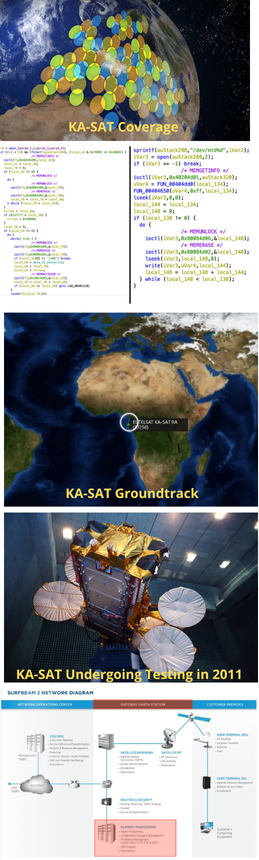
30 Mar 2022: Viasat believes the cyberattack on its KA-SAT network last month that affected modems across Ukraine and Europe was “deliberate” and intended to interrupt service, the company said in a report on the attack.
– Viasat called the cyberattack on 24 Feb as “multifaceted and deliberate.” It caused a partial interruption of KA-SAT’s consumer satellite broadband service.
– KA-SAT covers Europe and the Mediterranean region, and Viasat purchased the satellite, formerly owned by Eutelsat, last year when it purchased Eutelsat’s share of Euro Broadband Infrastructure.
– The attacker exploited a misconfiguration in a VPN appliance to gain remote access to the trusted management segment of the KA-SAT network. It’s still unclear how the threat actors gained access to the VPN.
– The attacker moved laterally through this trusted management network to a specific network segment used to manage and operate the network. They used this network access to execute legitimate, targeted management commands on a large number of residential modems simultaneously.
– Viasat concluded that an attacker had breached their management network for this subset of users and issued a command to wipe a key part of these modems
– A separate investigation from SentinelOne claimed to have discovered a new type of modem wiper software, called AcidRain.
– AcidRain is an executable that “performs an in-depth filesystem wipe and various known storage device files,” researchers Juan Andres Guerrero-Saade and Max van Amerongen said. “If the code is running as root, AcidRain performs an initial recursive overwrite and delete of non-standard files in the filesystem.”
– SentinelOne also noticed an interesting (but not conclusive) code overlap between AcidRain and another piece of malware, VPNFilter, that has been attributed by the FBI to Russia’s GRU (military intelligence service).
– Viasat said there is no evidence that the KA-SAT satellite or its ground infrastructure were directly involved, impaired or compromised.
– This very effective cyber attack was done through the ground network/Internet.
– To restore service to customers, Viasat said some modems received over-the-air updates, and Viasat has shipped nearly 30,000 modems to distributors in cases when the updates were not sufficient.
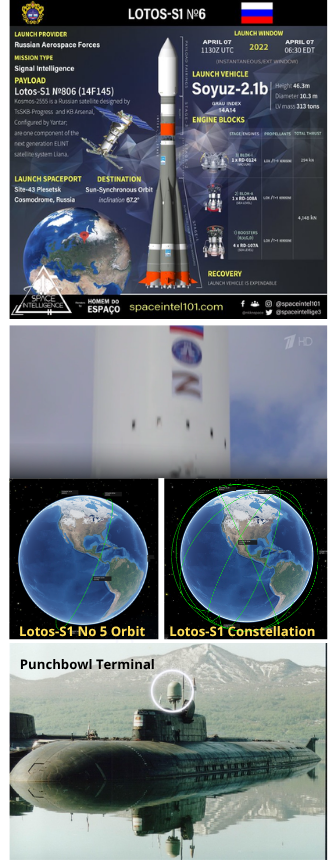
7 Apr 2022: Russia launched a Soyuz 2.1b rocket from the Plesetsk Cosmodrome, carrying a Lotos electronic signals intelligence satellite into orbit for the Russian military. Lotos-S1 number 5 was deployed into Low Earth Orbit with a separation apogee of approximately 900 km and an inclination of 67 degrees. Launch Video.
– Lotos-S1 No. 5 (conflicting naming conventions list as either 5 or 6) joins a network of five other Lotos satellites, two of which are Lotos-S, the developmental version of the spacecraft launched in 2009 and 2014.
– Lotos-S1 No. 5 is the first of a new batch of Lotos-S1 satellites ordered by Russia’s Ministry of Defence in September 2017, with a further three to be launched.
– The Liana constellation began development in 1993 and is composed of the Lotus electronic intelligence (ELINT) satellites & the PION-NKS, and ELINT and Synthetic Aperture Radar (SAR) imager.
– All of the Lotos-S satellites are in a ~900km circular orbit and inclined at 67.1°.
– These are typical orbits for ELINT satellites, which are mainly used to pick up radar transmissions. For instance, the US naval ocean surveillance satellites are at 1000km & 63,4° and the French CERES satellites at 670km & 75°.
– Lotos-S is capable of intercepting radio signals helping to locate, identify, and target various military vehicles and installations.
– Special terminals installed on Russian war ships were reported to be capable of downlinking real-time data directly from the Liana network for the purpose of weapon guidance.
– The Lotos satellites have limited, if any, COMINT capability (reception of voice communications). Better suited for COMINT are Molniya-type orbits and geostationary orbit. COMINT is probably the main purpose of the Repei-V and Repei-S satellites, which are yet to be launched.
– Unofficial sources indicate that, despite their high cost, the initial Lotos satellites in the series reportedly provided no advantages over Tselina-2, the last of which launched in 2007.-
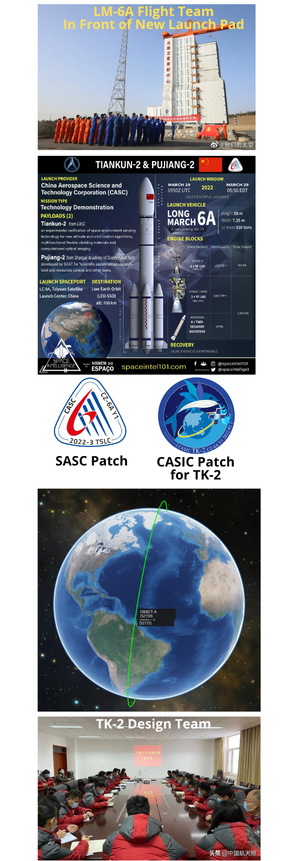
29 Mar 2022: China launched its first Long March 6A from a new launch complex at Taiyuan and successfully delivered two satellites into sun-synchronous orbits. Launch Video.
– The is the first Long March launch to include the use of solid rocket boosters, and combined both new Chinese kerosene-liquid oxygen and solid propellant capabilities. See amazing animated video of the new launch system.
– The Long March 6A launched from a new launch complex constructed specifically for the new rocket at Taiyuan.
– The new facility allows for more automated processes, such as fueling, and shorter launch preparations lasting 14 days. Images of the site also suggests a water deluge system to alleviate damage for high temperatures and cushion against acoustic vibrations.
– The new, 3.35m-diameter LM-6A bears little resemblance to the 2.25m-diameter Long March 6. The much larger 6A uses two YF-100 kerolox uses on its first stage can lift four tons to a 700km sun-synchronous orbit (SSO), compared with up to 1,000kg for the 29m-long Long March 6 which uses a single YF-100.
– In addition to the 4 booster variant used in this launch, the 6A is expected to have 2 other variants: one with 2 boosters and one without boosters.
– The LM-6A placed both satellites in a 588 x 604km x 97.8° SSO.
– SAST developed the Pujiang-2 for “scientific experimental research, land and resources census and other tasks.”
– Pujiang-1, launched on the first Long March 11 in 2015, was developed by SAST and dedicated promoting “smart city” construction, according to Chinese reports.
– The Pujiang-2 satellite is able to communicate with other satellites in low-Earth orbit; it is possible, but not confirmed, that the CASC is using the two sister Pujiang satellites to communicate with one another, similar to SpaceX’s Starlink satellites.
– Tiankun-2 satellite was developed by the Space Engineering Group under CASIC’s second academy for “experimental verification of space environment detection technology.”
– Its predecessor, Tiankun-1 was the first satellite developed independently by CASIC and launched on 3 Mar 2017. TK-1 is a technology demonstration mission to test out their new small satellite bus.
– CASIC’s second academy focuses on air and space defense systems.
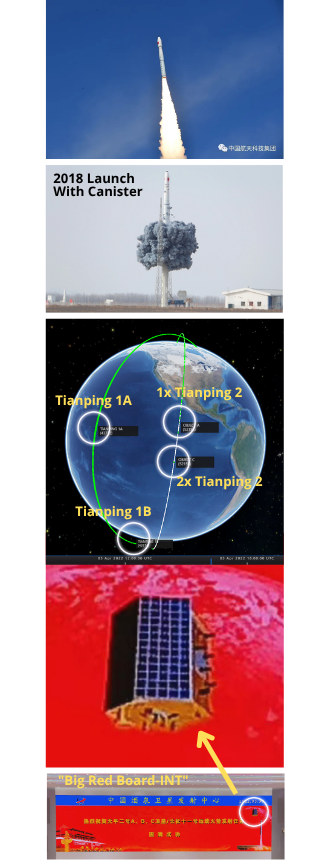
30 Mar 2022: China successfully launched three Tianping-2 satellites from the Jiuquan Satellite Launch Center morning using the Chang Zheng (Long March) 11 rocket. A day before the launch of the Tianping-2 satellites, the Chang Zheng 6A successfully launched from Taiyuan marking two orbital flights in just over 24 hours for China. Launch Video.
– The Long March 11 is known for its versatility, designed to be launched on short notice from a variety of environments, such as from land via road vehicles (CZ-11) or offshore on sea vessels (CZ-11H). The CZ-11 is believed to have been adapted from Intercontinental Ballistic Missiles (ICBM).
– Long March 11 is “cold launched” and is expelled out of a launch canister by gas. None of the footage available shows the actual rocket leaving its cannister.
– The LM-11 is comprised of four stages, all of which use solid propellant, with the fourth stage classed as a Reaction Control System (RCS). The choice for the vehicle to be fully solid-fueled comes from its origins as a missile – this kind of propulsion is more storable compared to liquid propellants, which are uncommon in quick-reaction missiles.
– Per CALT the LM-11 is planning 4-5 launches both from land sites and at sea this year, including 1-2 commercial launches.
– Tianping-2 are built by the China Aerospace Science and Industry Corporation (CASIC). Three individual satellites, Tianping-2 A, Tianping-2 B, and Tianping-2 C, were successfully inserted into orbit to perform atmospheric research, data collection, forecasting, and modeling.
– The three satellites are in a 585 x 603km x 97.8° Sun Synchronous Orbit and are believed to perform calibration for ground based radars as well as measuring upper atmospheric density. Per Chinese media, the three will conduct “atmospheric research and orbital model prediction improvement.”
– There was a LM-2D Tianping launch in 2018 that placed the Tianping 1A and Tianping 1B into a similar orbit.
– Tianping 1A/1B are also used for ground equipment calibration purposes. The TP-1A satellite provides a radar calibration target, and the TP-1B provides calibration services for responsive control equipment. TP 1B follows 1A by ~ 1hr 15min, or TP 1A follows TP 1B by ~ 20min.
– Currently two of the TP-2 satellites are orbiting in close proximity with the third satellite trailing by ~ 4min.
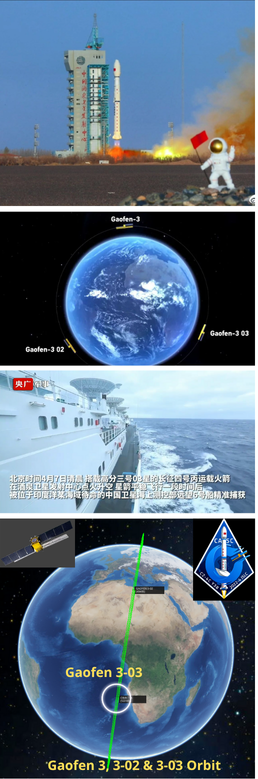
6 Apr 2022: China launched its third Gaofen 3 SAR satellite to a Sun-Synchronous Orbit (SSO) using a Chang Zheng 4C from the Jiuquan Satellite Launch Center in China. Video.
– The Gaofen-3 satellites are based on the CS-L3000B bus, built for a lifetime of up to 8 years. They are equipped with a Synthetic Aperture Radar (SAR), a data transmission system, and utilize Control Moment Gyros (CMGs) for orientation in space. The satellite is capable of 1m image resolution.
– This satellite is part of the Chinese High-resolution Earth Observation System (CHEOS) program, which was proposed in 2006 and initiated in 2010 with the goal to improve and update China’s Earth observation system.
– It is part of the Chinese government’s “One belt one road” regional development project and provides geographical and environmental mapping as well as disaster observation and prevention.
– Gaofen 3-03 will work with Gaofen 3 and Gaofen 3-02 satellites, launched in Aug 2016 and Nov 2021 respectively to focus on ocean observation.
– CAST developed all three Gaofen 3 satellites. Gaofen 3-02 and 03 feature upgrades over the first Gaofen -3, including optimized imaging, improved ship-positioning technology and real-time onboard processing that makes imagery available much faster than transmitting raw data does.
– The Chang Zheng 4C (CZ-4C) is used for low Earth orbit (LEO) and SSO missions, like this particular one. It can lift 4,200 kg to LEO and 2,800 kg to SSO. The launch mass of this payload is reported to be about 2,779 kg.
– Interesting video from Yuanwang-6 support ship in the Indian Ocean measuring and controlling the launch of the Gaofen 3-03 satellite from the Jiuquan Cosmodrome.
Gaofen 3-03 is likely the final satellite in this particular constellation. According to the “Chinese national spatial infrastructures program”, there will be three satellites, which will further support and promote the construction and development of the civil military integration of space-based information systems, while becoming an important technical support tool for the implementation of marine development, China land resources and environment monitoring and disaster prevention and mitigation.