issue 24 | 24 april 2022
The integrity flash
Analysis of Developments in the Space Domain
in this issue
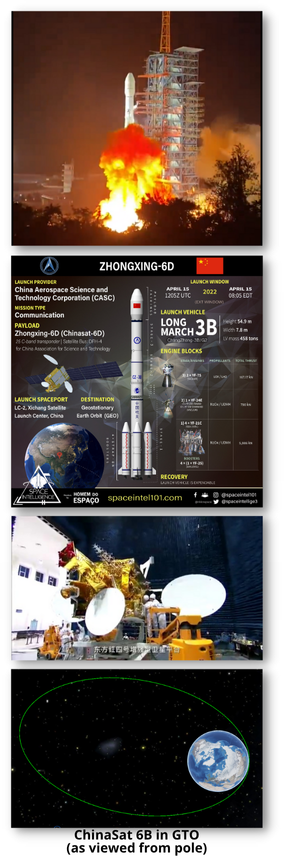
15 Apr 2022: China successfully launched the ChinaSat (Zhongxing) 6D satellite into geostationary transfer orbit via their Long March (Chang Zheng) 3B/E rocket from Xichang Satellite Launch Center. The CZ-3B/E rocket is the most powerful of the Chang Zheng 3 series China uses for most of its geostationary satellite launches. See Video.
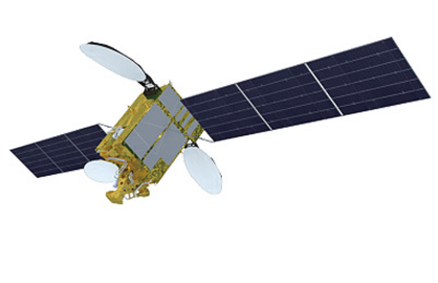
– ChinaSat 6D was built by the state-owned China Academy of Space Technology (CAST) and operated by China Satcom. Equipped with 25 C-band transponders. The satellite will provide users in China with reliable high-bit rate radio and TV uplink and downlink from its station at a longitude of 125° East.
– This is the first launch to deliver a new satellite for the ChinaSat constellation since the ChinaSat 6C mission on 3 Sep 2019.
– ChinaSat 6C also used a CZ-3B/E and is located at 125°E.
– According to official reports ChinaSat-6D is replacing ChinaSat-6A (ex-SinoSat 6) which was retired 11 years into a planned 15 year mission.
– ChinaSat-6A developed a helium-pressurization system leak shortly after launch in Sep 2010. The leak forced ground teams to resort to extreme measures to bring it into a useable orbit and reduced its operational life.
– Chinasat-6A was declared a total loss for insurance purposes after the satellite failed to recover from the attitude control issues it has been suffering since early Dec 2021.
– ChinaSat-6A is currently in a graveyard orbit above the GEO belt. While in operation it was also located at 125° E.
China Launches Environmental Monitoring Satellite
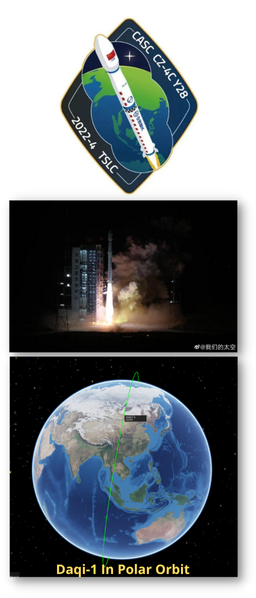
15 Apr 2022: China launched a Long March (Chang Zheng) 4C from the Taiyuan Satellite Launch Center with the Daqi-1 environmental monitoring satellite. The Daqi-1 satellite, also known as the Atmospheric Environment Monitoring Satellite, is the first of a new series of Chinese satellites designed to monitor atmospheric gases and pollution. Launch Video.
– Daqi-1 launched into a sun-synchronous polar orbit, so that the satellite passes over any given point on the Earth’s surface at the same local mean solar time each day. This allows for consistent lighting angles for each observation.
– Daqi-1 orbits at 678×687.2km orbit, inclination is 98.13°.
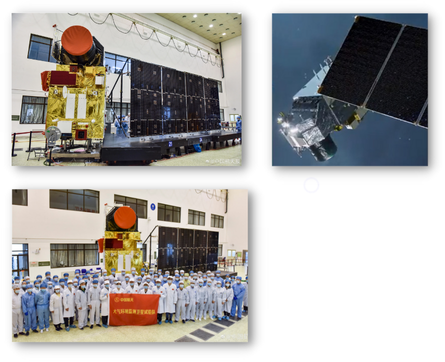
– Daqi-1 is equipped with the world’s first space-based LIDAR (laser imaging, detection, and ranging) for detecting atmospheric aerosols as well as carbon dioxide. it can also measure nitrogen dioxide, sulfur dioxide, ozone, and fine particle pollution.
– The satellite features several instruments capable of LIDAR, high-precision scanning and multi-angle imaging polarimetry, UV hyperspectral atmospheric composition detection, and wide spectral imaging. Active and passive sensing methods are used.
– The satellite supports China’s efforts to combat its well-known air pollution issues, regulate its carbon dioxide emissions, and monitor global climate change.
– Daqi-1 is equipped to communicate with later Daqi-series satellites to coordinate observations. The next satellite in the series, Daqi-2, will conduct high precision greenhouse gas monitoring. OPther Daqi satellites will follow.
Shiyan-10 Reaches Molniya Orbit
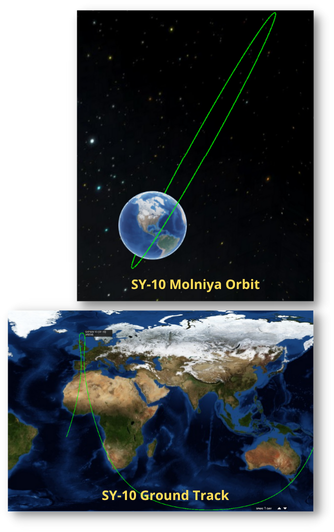
15 Apr 2022: China’s classified Shiyan (SY)-10 satellite has been tracked operating in a specialized orbit, six months after an anomaly during launch appeared to leave it stranded in an initial transfer orbit. SY-10 is now in a “Molniya” orbit according to tracking data from the U.S. Space Force’s 18th Space Control Squadron (SPCS). Related: the 18 SPCS is now the 18th Space Defense Squadron.
– SY-10 launched in Sep 2021 with an initial orbit of 177 x 40104 km x 51.0°.
– Chinese media reported that the launch proceeded normally, but the satellite operating conditions were abnormal.
– In Oct, Chinese satellite operators raised the satellite’s perigee to 1106 x 40092 km x 51.1°.
– At that time CASC announced the mission was a “success.” The announcement was deleted minutes after being posted.
– On 28 Feb SY-10 was still in that orbit and no US tracking updates until the end of Mar.
– In late-Mar, SY-10’s orbit was updated to a 1853 x 38878 km x 63.6° orbit.
– On 7 Apr SY-10 tweaked its orbit to 1484 x 38877 km x 63.6° with a period of 11h 58m, or half a sidereal day – the true Molniya orbit.
– Plane changes are exceptionally expensive in fuel expenditure. To alter SJ-10 12.5° (from 51.1° to 63.6°) required ~ 400 m/s of Δv.
– Chinese space operators likely conducted several small burns at apogee (when the spacecraft is at its lowest velocity) over the course of several orbits. Each burn put the satellite closer to the desired inclination and reduced the mass of the vehicle – allowing each sequential maneuver to be more efficient (the same fuel achieves more inclination change with the lower mass).
– The altitude changes could have been combined with plane change maneuvers or completed after the plane change. A combined plane change is more fuel efficient than conducting separate maneuvers.
– The 63° is ‘special’, as the Earth’s flattening locks in the latitude of perigee.
– Molniya orbits are traditionally used for Missile Warning, Communications to northern latitudes and Signals Intelligence.
– SY-10 is China’s first satellite to use this orbit and its overall mission remains unknown.
– There is no open source reporting to indicate China originally intended the SY-10 to use the Molniya orbit, or if the launch anomaly made Molniya the best option to salvage the mission.
– China operates its China Remote Sensing Satellite North Polar Ground Station, which is located in Kiruna, northern Sweden, which would be visible to Shiyan-10 for long periods near its apogee.
Special thanks to the Integrity ISR Space team for their assistance with fuel cost calculations!
2022 Space Threat Reports Released
April 2022: Three unclassified space threat reports were released: 1) US Defense Intelligence Agency (DIA) “Challenges to Security in Space”; 2) Center for Strategic and International Studies (CSIS) “Space Threat Assessment 2022”; and 3) Secure World Foundation (SWF) “Global Counterspace Capabilities”. All are excellent, highly recommend at least reading their Executive Summaries/Introductions.
DIA Challenges to Security In Space:
– Between 2019 and 2021 the combined operational space fleets of China and Russia grew by approximately 70 percent.
– This recent and continuing expansion follows a period of growth (2015–2018) where China and Russia increased their combined satellite fleets by more than 200 percent.
– Both China and Russia integrate and mature space and counterspace capabilities into their national and warfighting strategies to challenge the United States…and continue to incorporate space scenarios into their military exercises.
– Both nations counterspace developments continue to mature
– Adversaries observed 30+ years of U.S. military operations supported by space systems and now seek ways to expand their capabilities and deny the U.S. a space-enabled advantage
– Expanding constellations of remote-sensing satellites are reducing all countries’ ability to conceal sensitive tests, evaluation activities, and military exercises and operations
– The probability of collisions of massive derelict objects in low Earth orbit (LEO) is growing and almost certainly will continue through at least 2030
CSIS Space Threat Assessment 2022
– More countries are investing in space and counterspace capabilities, and some countries are realigning military organizations, doctrine, and strategy to include or better reflect space and counterspace capabilities.
– Russia has worked to maintain the prowess the Soviet Union held in the space domain with declining success.
– China has made civil, intelligence, and military space capabilities a priority as it continues to invest in and plan for greater access to space in the coming decade,
– CSIS identified and analyzed four key counterspace events in 2021: 1) Chinese FOBS test; 2) SJ-21 activities; 3) Russia’s ASAT test; and 4) Russian Jamming in Ukraine
SWF Global Counterspace Capabilities
– An increasing number of countries are looking to use space to enhance their military capabilities and national security
– The growing use of, and reliance on, space for national security has also led more countries to look at developing their own counterspace capabilities that can be used to deceive, disrupt, deny, degrade, or destroy space systems.
– Today there are increased incentives for development, and potential use, of offensive counterspace capabilities. There are also greater potential consequences from their widespread use that could have global repercussions well beyond the military, as huge parts of the global economy and society are increasingly reliant on space applications.
– SWF details the entire history of counterspace development for ALL nations.
20 Apr 2022: In late March Starlink released a software update which mitigated Russian jamming attacks and returned to normal operations. Dave Tremper, director of electronic warfare for the Pentagon’s acquisition office: “From an EW technologist perspective, that is fantastic. That paradigm and how they did that is kind of eyewatering to me.”
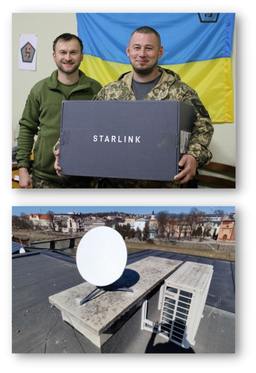
– SpaceX sent Starlink terminals to Ukraine in Feb in an effort to help Ukraine maintain its internet connection amid war with Russia. SpaceX founder Elon Musk claimed Russia had jammed Starlink terminals in the country for hours at a time.
– After a software update, Starlink was operating normally, said Musk, who added on 25 Mar that the constellation had “resisted all hacking & jamming attempts” in Ukraine.
– Since Russia’s takeover of the Ukrainian territory of Crimea in 2014, the Russian military has used electronic warfare extensively in Ukraine’s Donbas region — often to great effect, o uncovering positions of Ukrainian forces and disrupt equipment such as drones.
– The current conflict may be exposing the limits of Russia’s EW capability.
– “I think we expected a much stronger EW presence,” Tremper said. “Which isn’t to say that it’s not there, but I think the degree of coordination and synchronization of these types of operations is such that the undertrained operator will have a hard time pulling off those types of events successfully.”
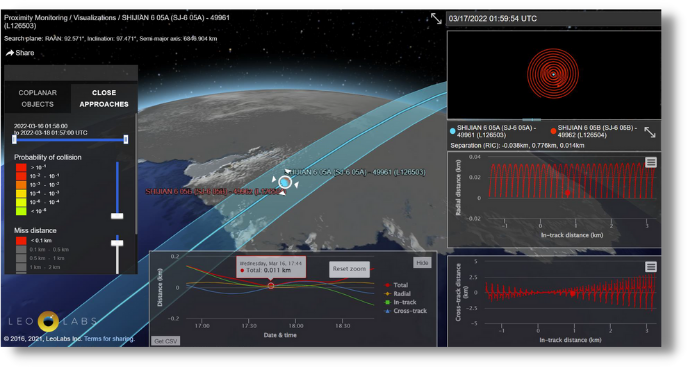
17 Mar 2022: LEO Labs analysis indicates SJ-6 05A and 05B setup for rendezvous and proximity operations (RPO) in February. LEO Labs then detected ingress maneuvers over several weeks which resulted in periods of apparent rendezvous mid-March.