issue 34 | 7 NOVEMBER 2021
The integrity flash
Analysis of Developments in the Space Domain
in this issue
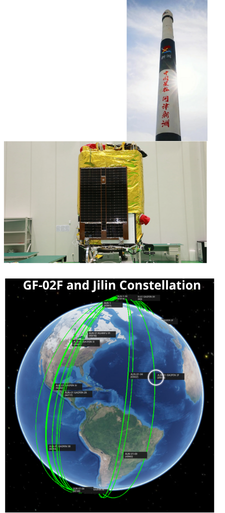
27 October 2021: China launched a Kuaizhou 1A (KZ-1A) rocket with the latest Jilin-1 Earth-imaging satellite, Gaofen 02F (GF-02F), from Jiuquan Satellite Launch Center. The KZ-1A lifted off at 06:19 UTC, deploying its payload into a sun-synchronous orbit. Launch Video.
– The Jilin-1 Gaofen-02F satellite is part of a commercial remote sensing satellite network under development by the Chang Guang Satellite Technology (CGST) Corporation.
– Gaofen, meaning “high resolution,” signifies the satellite’s role within the wider Jilin-1 system should not to be confused with the series of larger Gaofen imaging satellites operated by the Chinese government.
– The Jilin-1 constellation is expected to consist of up to 138 satellites by the end of the decade, contains different types of satellites to perform different roles. In addition to the Gaofen satellites’ high-resolution imaging mission, other satellites in the constellation provide video capture, wider-area, and multi-spectral imaging.
– The Jilin-1 constellation began with a Chang Zheng 2D launch in
October 2015 which carried the first four satellites. These included the Jilin-1 Lingqiao Yanzheng technology demonstrator, also known as the Smart Verification Satellite or Jilin-1LQ, an optical imaging satellite, Jilin-1 Guangxe-A, and a pair of Jilin-1 Shipin video-recording satellites. In the six years since, over thirty satellites have been deployed.
– The Gaofen part of the constellation consists of two series of spacecraft: Gaofen-02 and Gaofen-03. The Gaofen-02 satellites, like the GF-02F, are larger than their Gaofen-03 counterparts, with masses a little under 250 kilograms.
– Equipped with a push broom imager, Jilin-1 Gaofen-02F can image the Earth at resolutions better than 0.75 meters in panchromatic mode, capturing light at wavelengths between 450 and 700 nanometers. It can also operate in multi-spectral mode across four optical and near-infrared channels, with a resolution of about three meters.
– This launch marks the sixth flight of a Jilin-1 Gaofen-02 satellite, following the successful deployment of Jilin-1 Gaofen-02D last month. Both the 02C and 02E satellites were lost in launch failures last year – 02C aboard a Kuaizhou 1A rocket and 02E on the maiden flight of the larger Kuaizhou 11. Thirteen of the smaller Jilin-1 Gaofen-03 spacecraft are also in orbit.
– The Kuaizhou (meaning “Quick Vessel”) 1A is capable of placing an approximately 400-kilogram payload into low Earth orbit. It is a four-stage vehicle with three solid-fueled stages and a small liquid-fueled upper stage to complete orbital insertion.
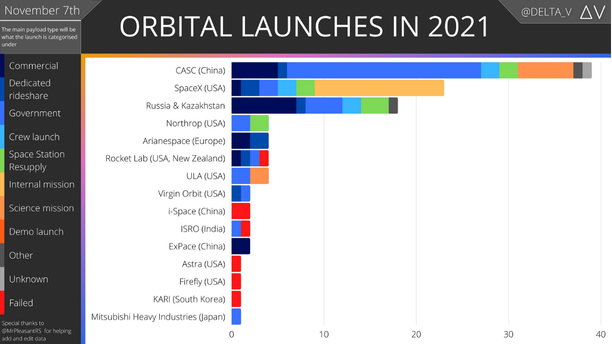
The Kuaizhou-1A is operated by Expace, which belongs to the China Aerospace Science and Industry Corp. (CASIC). The launch was the 12th KZ-1A launch and the second launch in a month. These launches follow a year being grounded after a 2020 launch failure. The mission takes China to 40 orbital launches for 2021, surpassing the 39 launches conducted by China in 2018 and 2020. The United States has so far launched 39 times this year, including Rocket Lab launches from New Zealand.
China Launches Yaogan 35 A/B/C
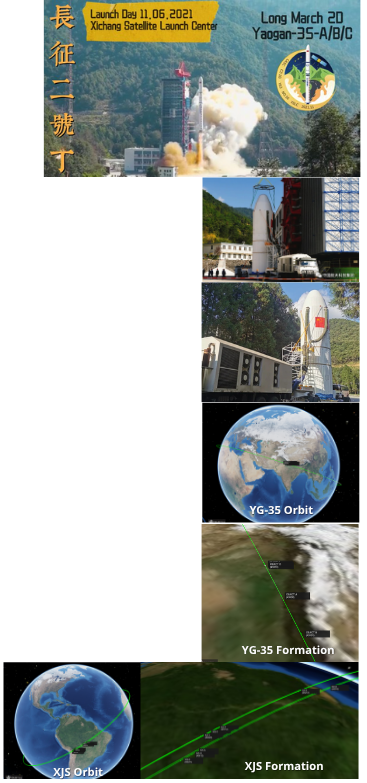
6 November 2021: China’s SAST launched a Chang Zheng 2D at 0300 UTC Nov 6 from Xichang carrying three military satellites. Launch Video
– According to official reports a new long fairing (13.4 m tall) was designed for the LM-2D for this launch to allow the satellites to be stacked in series.
– Four objects have been cataloged from the Yaogan 35 launch in a 493 x 499 km x 35.0 deg orbit. The extra object in addition to sats A, B and C is probably the CZ-2D rocket second stage.
– This is the first deployment of Yaogan 35 named satellites. There is little/no open source information regarding their capabilities.
– Other Yaogan satellites that deploy in triplets are the Yaogan 30 (30 satellites) and Yaogan 31 (12 satellites).
– Yaogan 30 satellites are believed to be SIGINT satellites and are also in 35 degree inclined orbits.
– Yaogan 30 satellites orbit at ~100km higher altitude and the satellites are equally spaced over the earth (separated by 120 degrees). Yaogan 35 A/B/C remain in close proximity, similar to Yaogan 31.
– Yaogan 31 satellites are also launched in triplets, operate in low earth orbit and within close proximity of one another.
– Yaogan 35 is at a different inclination than Yaogan 31 satellites and less than half the altitude. All Yaogan 31 satellites are inclined at 65 degrees and ~1100km altitude.
– All other Yaogan satellites operating at ~500km altitude are believed to be imagery satellites & are in sun-synchronous orbits (inclined at ~98 degrees).
– Between 2018 and 2020 China launched 8 XJS satellites with similar orbital parameters. All are 35 degrees inclined and between 460-475km in altitude.
– Few details about the satellites were disclosed by China’s government-owned media. The country’s Xinhua news agency said the satellites will be mainly used to test “new Earth-observation technology.”
– There is also reporting that the XJS satellites would test inter-satellite link technology.
– XJS A/B and XJS G/H satellites were launched in pairs. Another launch carried 4 XJS satellites (C/D/E/F). The XJS A/B featured a modified fairing as the satellites did not fit the standard fairing.
We are in the initial stages of understanding the mission of the Yaogan-35 satellites. Their orbital parameters are most similar to the XJS satellites launched over the past 3 years. Previous Yaogan variants (YG-30 and 31) that deployed in triplets are believed to fulfill a SIGINT mission. There are significant orbital and deployment differences between YG-35 and YG-30 and 31. More obvious is the rapid pace of Yaogan deployment in 2020 and 2021. In the past 20 months China has launched 30 Yaogan satellites. 23 of these satellites have been launched in 2021. More evidence to follow…
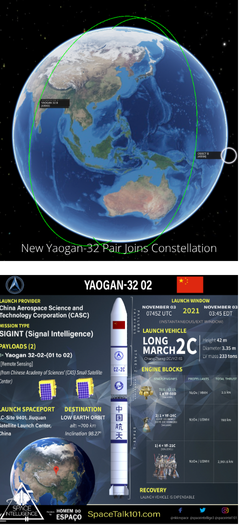
3 November 2021: China launched a pair of military satellites on its CZ-2C (Chang Zheng 2C) rocket. Lifting off from the Jiuquan Satellite Launch Center at 07:43 UTC, the CZ-2C deployed two Yaogan 32-02 spacecraft into sun-synchronous orbit following a short ascent. Video
– Yaogan 32 Group 02, consists of two satellites. While remote sensing platforms are officially operated by China’s Ministry of Agriculture, this is a cover for their military mission.
– Yaogan Weixing, usually shortened to Yaogan, is Chinese for “remote sensing satellite.” China uses this name for military payloads when it does not want to acknowledge the identity or mission of the spacecraft.
– The two satellites were placed into a 689 x 703 km x 98.3 deg, sun-synchronous orbit (SSO). Yaogan 32 Group 1 sats 1 and 2 were launched in Oct 2018 and are also in SSO.
– Very few details of the payload itself have been made public. Following the launch of the previous Yaogan 32 satellite pair, Chinese media reported their mission as “electromagnetic environment surveys” – which was previously used as cover for signals intelligence satellites.
– The Yaogan 32 spacecraft are in a sun-synchronous orbit at an altitude of about 700KM. This differs from the 1,100KM, 63-degree orbits used by US SIGINT Intruder satellites.
– Yaogan 31 satellites, the latest in a series of three-satellite clusters, appear to more closely mirror US Intruder satellites.
While a sun-synchronous orbit does not rule out a SIGINT mission, it remains to be seen what the actual nature of these satellites are and why they operate in pairs. It is currently unclear how many pairs of the Yaogan 32-type satellites China intends to launch. The Chinese government has released some information about the Yaogan constellation. Currently, there are 79 Yaogan satellites in a variety of orbits, ranging from 35° to 100° and orbital altitudes from 480 km circular orbits to 1,200 km eccentric orbits.
7 July 2021: Defense Secretary Lloyd Austin signed an unclassified, formal memo mandating that the Pentagon abide by a framework set of norms for military activities in outer space — a first for the Defense Department.
– The one-page memo lays out five “Tenets of Responsible Behavior” for DoD space operations:
- Operate in, from, to, and through space with due regard to others and in a professional manner.
- Limit the generation of long-lived debris
- Avoid the creation of harmful interference.
- Maintain safe separation and safe trajectory.
- Communicate and make notifications to enhance the safety and stability of the domain.
– The memo leaves DoD an enormous amount of operational flexibility — including the possibility of testing and using weapons (for example, lasers or even ground-based missiles) to take down adversary satellites as long as any space debris created is not “long lived.” The memo’s phrasing very clearly would allow another Burnt Frost.
26 October 2021: The UK Space Agency has awarded study contracts for a mission to remove two spacecraft from low Earth orbit by 2025. Swiss startup ClearSpace and Japan-based Astroscale received just under £700,000 ($1 million) between them to complete mission feasibility studies by the end of March.
– Under the Active Debris Removal Phase 0-A Feasibility Study being funded by the UK Space Agency, Astroscale and ClearSpace are tasked with researching how to de-orbit two defunct satellites that were not built with retrieval and removal in mind.
– The study participants can choose the two spacecraft they aim to remove as long as they were sent to orbit under a U.K. license, making the British government liable for their potential debris issues.
– Satellite tracker Jonathan McDowell of the Harvard-Smithsonian Center for Astrophysics estimates there are currently 14 defunct spacecraft in LEO that were either licensed by the U.K., owned by British entities, or registered by the U.K. with the United Nations.
– Potential targets for removal are the X-3 Prospero and its Waxwing upper stage rocket that launched in 1971, X-4 Miranda in 1973, UoSAT 3,4,5 and 12 that were sent to orbit in the 1990s, SNAP-1 (Surrey Nanosatellite Applications Platform) in 2000, UK-DMC (Disaster Monitoring Constellation) in 2003, Topsat (Tactical Operational Satellite) in 2005, UKube-1 and TDS-1 (TechDemoSat-1) in 2014, UCLSat (University College London Satellite) in 2017 and RemoveDebris in 2018.
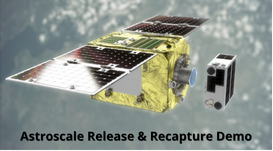
– Astroscale will likely pursue a variant of ELSA-m, a spacecraft being designed to capture and de-orbit three or four objects in a single mission for a constellation customer. Astroscale is working on ELSA-m under a public-private partnership with the European Space Agency and low Earth orbit broadband constellation operator OneWeb.
– However, as ELSA-m uses a magnetic capture mechanism, it can only capture satellites that have been equipped with a docking plate before launch. The new variant would use “some kind of robotic arm or gripping mechanism” that will enable it to capture a defunct satellite that wasn’t built to be grappled.
– The End-of-Life Services by Astroscale-demonstration (ELSA-d) spacecraft that Astroscale launched in March continues to perform tests with a tiny client satellite it brought along to act as debris. Astroscale demonstrated ELSA-d’s magnetic latching capability on August 25, when the servicer successfully completed the first test capture of the debris stand-in.
– ClearSpace is a Swiss start up that recently created a UK subsidiary. ClearSpace is teaming up with partners including British small satellite maker SSTL, Spain-based solutions provider Elecnor Deimos and U.K. government-backed nonprofit Satellite Applications Catapult.
– China is also developing debris mitigation technologies, and launched a classified satellite called Shijian-21 to geosynchronous transfer orbit Oct. 23 with few details about the mission.
There are currently an estimated 900,000 pieces of space debris including old satellites, spent rocket bodies and even tools dropped by astronauts orbiting Earth. Space debris can remain on-orbit for hundreds of years and present a real danger to the rapidly increasing number of new satellites being launched each year. Watch an excellent VIDEO from Space.com and another Video from The Verge.
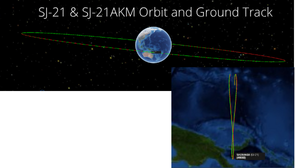
Checking in on the latest open source information regarding China’s SJ-21, TJS-3 (and TJS-3AKM) and Russia’s Luch-Olymp.
– U.S. space tracking has detected a new object orbiting
along with China’s recently launched Shijian-21 space debris mitigation technology satellite.
– Shijian-21 was launched into geosynchronous transfer orbit Oct. 23 by a Long
March 3B rocket. Both are now in GEO, ~8° inclined.
– Chinese state media reported that the satellite would “test and verify space
debris mitigation technologies,” but no further details have been revealed.
-The object is noted as a rocket body and more precisely an apogee kick motor (AKM), used in some launches for a satellite to circularize and lower the inclination of its transfer orbit and enter geostationary orbit.
– Apogee kick motors usually perform a final maneuver after satellite separation so as to not pose a threat to active satellites through risk of collision. However both Shijian-21 and the SJ-21 AKM are side by side in geostationary orbit.
– It is currently unknown whether the object is an AKM, an object possibly related to space debris mitigation tests, or part of potential counterspace operations tests. The object could be used to test rendezvous and proximity operations, refueling experiments or manipulation using a robotic arm or other means.
The nature of the Shijian-21 and the companion “AKM” will likely become more apparent over time, such as if and when the spacecraft maneuver and the nature of any changes of orbits and if these are coordinated. A maneuver by the SJ-21 AKM would indicate an active rather than passive object.
Meanwhile Off the East Coast of Africa:
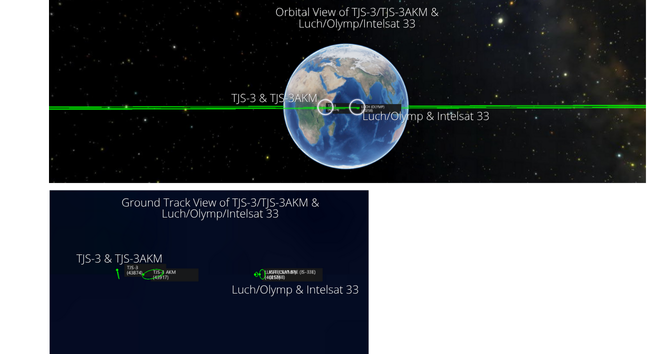
– TJS-3 remains in close proximity with the TJS-3AKM.
– Russia’s Luch-Olymp remains in close proximity with Intelsat-33.
Defense News posted an excellent article: US, China, Russia Test New Space War Tactics: Sats Buzzing, Spoofing, Spying. The article reviews some of the notable operations from all three nations over the past 5 years and includes COMSPOC visualizations breaking down each engagement.
Video: USA271 and SJ-20
Video: TJS-3 and TJS-3AKM from May 2019
Video: Luch/Olymp and Intelsat 36
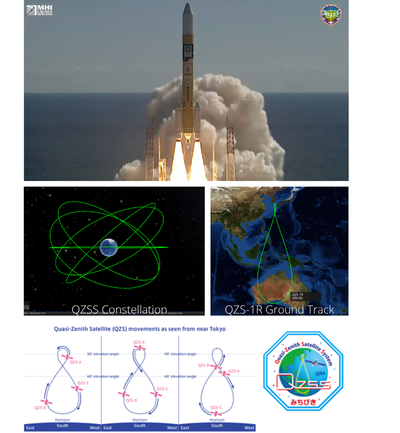
26 October 2021: Japan launched the QZS-1R position, navigation and timing (PNT) satellite aboard H-IIA rocket from LA-Y1 from the Tanegashima Space Center. The QZS-1R satellite will join other satellites as a part of the Quasi-Zenith Satellite System, or QZSS, which is a satellite navigation system for Japan. QZS-1R is now in its inclined geostationary orbit (IGSO).
– QZS-1R joins 4 other QZSS spacecraft. The QZS-1R’s orbit is inclined 34°. The inclination of the other QZSS satellites varies. Orbits are optimized for providing PNT services to Japan.
– The QZSS constellation is designed to improve the accuracy of the US GPS constellation for Japanese users in urban areas. The QZS-1R will replace the QZS-1 once it becomes operational.
– The first satellite (QZS-1) was launched on 11 Sep 2010 and now past its designed 10-year life service.
– Japan launched an additional three satellites (two with a quasi-zenith satellite orbit [QZO] and one with a geostationary orbit [GEO]) in FY2017.
– Plans are set to add three more satellites to the QZSS in 2023 to bring the constellation to 7 operational satellites.
QZSS can be used in an integrated way with GPS, ensuring a sufficient number of satellites for stable, high-precision positioning. QZS are compatible with GPS and receivers can be procured at a low cost. The quasi-zenith orbit (QZO) for QZSS is shaped like a figure eight with north-south asymmetry. This makes satellites on this orbit spend more time in the northern hemisphere (around 13 hours versus 11 hours in the southern hemisphere) and remain visible from Japan for a long period of time.
27 October 2021: Poland has joined the U.S.-led Artemis Accords for space exploration, hoping to use the agreement as a means of enhancing space cooperation between the two nations..
– While Poland is a member of the European Space Agency, Polish space companies are looking to expand their business outside Europe.
– Poland is the 13th nation to sign the accords. The US announced the Artemis Accords in 2020, intending to outline high-level principles for space exploration, based largely on the Outer Space Treaty and other agreements. Other signatories are: Australia, Canada, Italy, Japan, Luxembourg, the United Arab Emirates, the UK, the US, Brazil, South Korea, New Zealand, Ukraine and Poland.
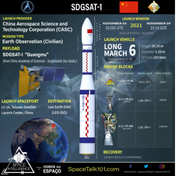
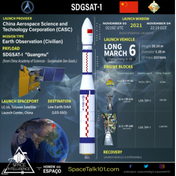
5 November 2021: China launched the SDGSAT-1 from Taiyuan on a LM-6.
– The satellite is part of the Big Earth Data Science Engineering Project of the Chinese Academy of Sciences and carries thermal infrared, multispectral & a Glimmer Imager for Urbanization for observing environmental changes on Earth.