

Analysis of Developments in the Space Domain
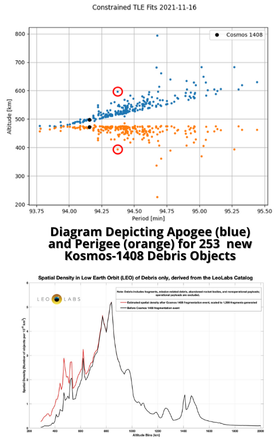
19 November 2021: LeoLabs posted a 2-part analysis of the debris field created from the 15 November Russian Nudol ASAT test (read part 1 & part 2). Conclusion: There will be some potential collision risk to most satellites in LEO from the fragmentation of Cosmos 1408 over the next few years to decades. Listen to Space Station Wake Up call from 15 November.
– While any ASAT test is a terrible idea, this one occurred in one of the worst possible orbits.
– This satellite was in a high inclination orbit, at an altitude that put it right in the middle of many other operational assets; notably, it was less than 100km above the International Space Station, and less than 100km below multiple commercial constellations including SpaceX’s Starlink fleet.
– Cosmos 1408 was also a very large satellite, with a reported mass of ~2,200 kg.
– LeoLabs detected 253 objects in the first days after the test. These objects likely represent the largest fragments with the least amount of delta velocity imparted to them, as they are orbiting closest to the original orbit of Cosmos 1408. If this is accurate, rules of thumb would indicate 5–10x more objects than this, putting total notional trackable debris counts in the area of 1,250–2,500 pieces.
– Objects ejected into lower perigees will have their orbits circularize relatively quickly, and the majority will re-enter the atmosphere over the next five years.
– Objects ejected into higher orbits will have their orbits circularize more slowly, and the majority will re-enter the atmosphere over much longer timeframes — potentially decades, depending on altitude.
– Within weeks to months of the breakup, the debris will largely be dispersed around the Earth (i.e., global spread of the fragments’ right ascension of the ascending node). Thus, ultimately the statistical collision risk to other LEO satellites will then be predominantly dependent on altitude.
– Based on previous collisions and ASAT tests, LeoLabs expected so see a greater number of objects.
– The low debris count number relative to the large mass of the Cosmos 1408 may be explained by a non-hypervelocity (<6km/sec) intercept.
– Potentially the Russian ASAT impactor approached Cosmos 1408 generally from behind to “rear end” Cosmos 1408 at a relative velocity well below 6 km/s, this would explain both the distribution of posigrade debris and the lower debris count currently observed.
Preliminary calculations suggest that the cloud of debris will increase the number of avoidance maneuvers performed by satellite operators all over the world by more than 100% in the next few years, Tim Flohrer, head of the European Space Agency’s (ESA) Space Debris Office, told Space.com.
“The peak can be even significantly higher than 100%,” Flohrer added. “In this 400 to 500 kilometer altitude, the fragments will not survive long. We expect them to decay slowly over months and years so the risk increase will still be significant after one or two years.”
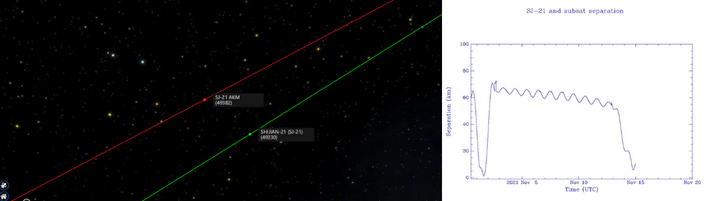
14 November 2021: The SJ-21 satellite previously released a subsatellite in synchronous orbit around Nov 1. Originally SJ-21 moved to a distance of 60 km from the sub-satellite (dubbed SJ-21 Apogee Kick Motor or AKM). On November 12, SJ-21 re-approached the AKM and is now between 5 and 10 km from it.
– Neither satellite is geostationary; they are both drifting west at about 1 degree a day – currently over 144 E.
The recently launched Yaogan-35 A/B/C satellites were of different designs: Yaogan 35A and Yaogan 35B were built by DFH Satellite (Beijing) and Yaogan 35C was built by SAST (Shanghai).
– The satellites are now orbiting at roughly 310 miles (500 kilometers) above the Earth, with an inclination of 35 degrees, similar to many earlier Yaogan series satellites, but at a lower altitude.
The purpose of these satellites is not yet known but there is speculation that Yaogan 35A and Yaogan 35B might be imaging satellites and Yogan 35C might be a radar satellite. A SIGINT / ELINT mission is also a potential.
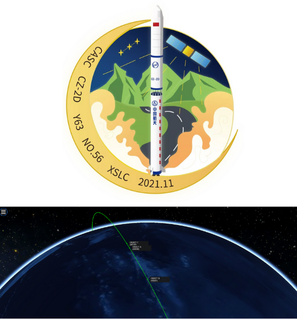
20 November 2021: China launched the Gaofen (GF) 11-03 imaging satellite using its Chang Zheng 4B rocket. The launch took place from the Taiyuan Satellite Launch Center. This is China’s forty-fourth orbital mission of 2021. See Launch Video.
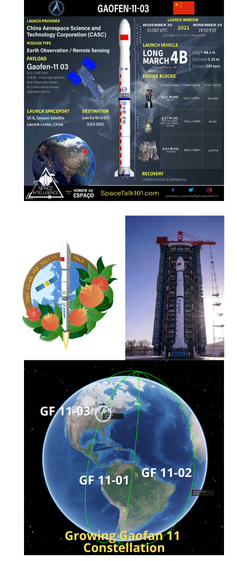
– Gaofen 11-03 is the third in a series of high-resolution optical imaging Gaofen 11 satellites. The full capabilities of the Gaofen 11 spacecraft have not been published.
– GF 11-03 has been placed in a 243 x 695 km x 97.5 deg orbit. The orbit is expected to circularize over the next 5-6 months. GF 11-01 and GF 11-02 operate in orbits between 490-500km.
– Gaofen 11 satellites are believed to form optical high-resolution component of the state-sponsored China High-definition Earth Observation System (CHEOS) constellation. Gaofen 11-01 was launched in July 2016. This was followed by Gaofen 11-02 in September 2020.
– Gaofen 11 satellites operate in sun-synchronous orbits, with a perigee of approximately 450 kilometers, an apogee of around 690 kilometers, and an inclination of 97.4 degrees.
– Gaofen means “high resolution” and aims to provide China with a global high-definition Earth-imaging capability. CHEOS is unrelated to the smaller commercial Jilin-1 Gaofen satellites.
Open Source analysis from 2018 estimated GF-11’s mirror size at 1.7m. A mirror of this size equates to a ground resolution of 8 to 10cm at perigee (~247km). At the average altitude of 470km, the resolution is still 15 to 20cm, surpassing all commercial satellites and most reconnaissance satellites. This propels China into the select club of countries that can acquire NIIRS 8-9 satellite imagery, meaning the resolution is high enough to identify small hand-held weapons.
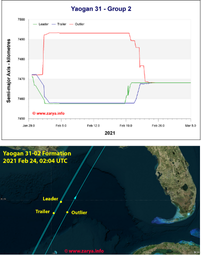
Open source analysis of Yaogan-31 (02) orbital maneuvers. Yaogan-31(02) is a cluster of three satellites similar to the United States ‘NOSS triplets’ and are suspected to perform geolocation of electronic signals.
– YG-31(02) launched on 29 Jan 2021. Shortly after launch, one satellite moved to a higher orbit and the other two dropped by a similar amount. Subsequently the higher altitude satellite began to lag behind the lower altitude satellites.
– The three satellites matched altitude/velocity after drifting apart by the equivalent of whole circuit of the Earth.
– Two of the satellites are positioned 125 km apart from each other along the same track. The outlier satellite travels at the same speed and the three vehicles form a near-equilateral triangular formation.
In this formation YG-31 can detect radio transmissions from the Earth’s surface and then pinpoint the location by measuring the slight differences in the Doppler effect as observed from the three vehicles.
11 November 2021: Astroscale signed an agreement with the government of New Zealand to study advanced concepts for orbital debris removal.
– Astroscale signed an MOU with New Zealand’s Ministry of Business Innovation & Employment (MBIE) that broadly covers cooperation on space safety and sustainability.
– The agreement outlines an initial project examining approaches for a single servicing spacecraft to remove up to three debris objects on a single mission.
– Astrocale will carry out the study with Rocket Lab and Te Pūnaha Ātea–Auckland Space Institute, examining both technical and policy issues. That could include the use of Rocket Lab’s Photon satellite bus to support such debris removal missions.
– For New Zealand the project is part of efforts to diversify the government’s space activities beyond its original and most visible role as a regulator for Rocket Lab.
– Other efforts from New Zealand include working with LeoLabs on space tracking radars located in the country and partnering on MethaneSAT, a spacecraft that will track methane emissions.
New Zealand is the latest in a series of governments that Astroscale has been working with on development of satellite servicing and active debris removal technologies. Astroscale has a contract with the Japanese space agency JAXA for a mission to perform an inspection of an upper stage left in orbit from a Japanese launch, a precursor to a later mission to deorbit the stage. That mission will be launched on a Rocket Lab Electron rocket in 2023. See CONOPS VIDEO.
Astroscale also won a contract from the U.K. Space Agency Oct. 26 to study removing two defunct satellites from low Earth orbit by 2025. Astroscale is partnering with European satellite maker Thales Alenia Space and MDA, the Canadian robotics and satellite systems specialist, for that study.

14 November 2021: China is building a specially designed ship for launching rockets into space from the seas in an effort to boost its capacity to launch satellites and recover rocket stages. Could be operational in 2022.
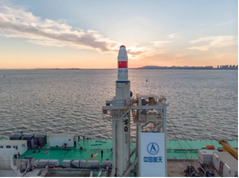
– The 533 feet (162.5 meters) long, 131 feet (40 meters) wide “New-type rocket launching vessel” is being constructed for use with the new China Oriental Spaceport at Haiyang, Shandong province on the Eastern coast.
– The ship will feature integrated launch support equipment and be capable of facilitating launches of the Long March 11, larger commercial “Smart Dragon” rockets and, in the future, liquid propellant rockets.
– The ship will help boost the rate at which China can launch from the sea and ease the pressure on China’s four main launch centers.
– Flexible positioning of the launch site means it is easier to choose a flight path which doesn’t fly over other countries and makes sure spent rocket stages and other debris fall into the sea rather than on land.
– China Rocket Co. Ltd., a commercial spinoff from CALT, is developing the “Smart Dragon” series of solid rockets. Smart Dragon 3 is expected to launch for the first time in 2022 and, at 102 (31 meters) long, will be much larger than the 64 feet (19.5 meters) long Smart Dragon 1 which launched for the first time in 2019.
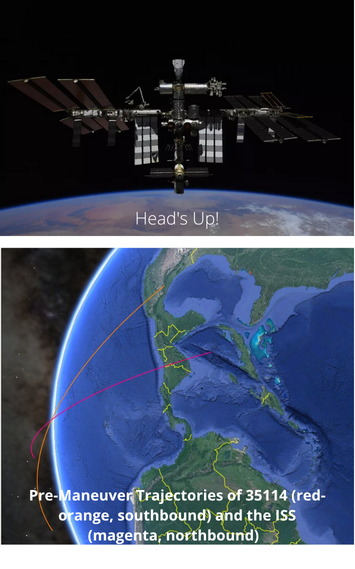
10 November 2021: The International Space Station (ISS) maneuvered to avoid a piece of Chinese space junk just hours before SpaceX launches a new crew to the orbiting laboratory. Visualization of the 2007 ASAT Test.
– Russia’s Roscosmos said the maneuver began at 3:15 p.m. EST (2015 GMT) and fire thrusters on the visiting Progress MS-18 cargo ship (dubbed Progress 79 by NASA) for 361 seconds to steer clear of the debris.
– Progress MS-18, docked to Zvezda, raised the ISS orbit by 1.2 km and its velocity by 0.7 m/s.
– The object the space station will dodge is 35114 in NASA’s catalog of space objects, and also 1999-025DKS, a piece of debris from a Chinese anti-satellite weapons test in 2007.
– As part of that test, a kinetic-energy, suborbital missile was fired at a defunct Chinese weather satellite, Fengyun-1C (which stopped working in 2002), obliterating it into thousands of pieces.
– The destroyed satellite was originally in a much higher orbit, but atmospheric drag has pulled the debris closer to Earth over the years and ultimately into the flight path of the space station.
– The two objects’ closest approach was estimated to occur on Nov. 12, according to Jonathan McDowell, an astronomer at Harvard who tracks and catalogs objects in space.
– Unofficial sources estimated the closest approach would have been 600 meters.
– McDowell tweeted on Tuesday that his calculations show that this will be the 29th space station debris avoidance maneuver, and the third related to the 2007 Chinese anti-satellite test.
– Of the 3,537 known debris objects from the test, 2,737 remain in orbit 14 yr later.
– The space station’s debris-dodging maneuver will have no impact on the Crew-3 launch and that the Dragon will be able to catch up to the station without issue.
There are currently an estimated 900,000 pieces of space debris including old satellites, spent rocket bodies and even tools dropped by astronauts orbiting Earth. Space debris can remain on-orbit for hundreds of years and present a real danger to the rapidly increasing number of new satellites being launched each year. Watch an excellent VIDEO from Space.com and another Video from The Verge.
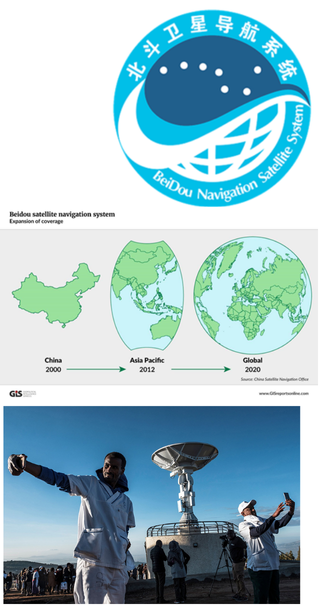
5 November 2021: China hosted the first China-Africa BeiDou Navigation Satellite System (BDS) Cooperation Forum in Beijing. Government representatives, industry leaders, and researchers from China, experts and scholars from various African national administrations and the African Union attended the event.
– One of the resolutions of the event was a joint agreement to take advantage of the Beidou system to enhance Africa’s social, economic, and environmental developments.
– Representatives from nearly 50 African nations, including eight government ministers and eight ambassadors to China, participated in the event.
– Chinese representatives pledged to coordinate with their African counterparts to promote Beidou-based services on the continent to foster local industries and businesses and help to create more jobs and reduce poverty.
– China’s National Space Administration General Secretary, Xu Hongliang, said that his administration is dedicated to sharing China’s space achievements with Africa to nurture their science and technology. They are also determined to improve space industry professional exchanges and training to facilitate African countries’ efforts to grow space capabilities.
– In June last year, the final satellite to complete Beidou’s third-generation network was lifted by a Long March 3B carrier rocket launched from the Xichang Satellite Launch Center in SIchuan province and was placed into a geostationary orbit about 36,000 kilometres above the Earth. The following month, President Xi Jinping announced that the system had been completed and had started providing full-scale global services.
– African Union Commission’s director of human resources, science and technology, Mahama Ouedraogo, reiterated that Beidou will become a significant tool in Africa’s development and expressed the Union’s anticipation to broader collaboration with China in giving access to satellite navigation to more users on the continent to inject new momentum into local economies.
The forum is an extension of China’s Belt & Road Initiative (BRI). Beidou services are key to attracting BRI partners and China has hosted similar conferences across Asia. Beijing promotes Beidou as a worldwide alternative to the U.S. GPS network—and uses the “Space Silk Road” as another channel to expand its influence. As BDS usage spreads, it means that billions of people in the Belt-and-Road region might be using it (not say, GPS) to guide themselves to that restaurant across town, locate a historical site, avoid traffic, carry out their financial transactions, pinpoint their loved ones, and so on. This will give China and, if all goes as projected, the affiliated countries considerable integrated economic and military advantages.
1 November 2021: UN First Committee, responsible for international security, approved a new working group to develop rules of the road for military activities in space, and possibly even lay the groundwork for a new treaty.
– The vote is an indication of growing political concurrence that action, not just political posturing, is required to mitigate the ratcheting risks of conflict as nations pursue technologies to best each other in the military space domain.
– The plan for the Open-Ended Working Group (OEWG), which would meet twice in 2022 and 2023 and work on a basis of consensus, was pushed by the United Kingdom and co-sponsored by a number of Western countries including the United States.
– In order to become a reality, the full UN General Assembly now needs to approve the OEWG plan during their session in December, but given the First Committee vote, this is pretty much a foregone conclusion.
– The UK efforts also track with the first-ever Defense Department proclamation on norms issued by Defense Secretary Lloyd Austin this summer.
– The resolution (A/C.1/76/L.52) allows for consideration by the new OEWG of legally binding (i.e. treaty-based) measures, as well as voluntary rules that would constrain certain military actions agreed as threatening. Such treaty-like authorities have been resisted in previous attempts.
The issue of any new treaty to prevent an arms race in outer space — a long-time UN concern, known as PAROS in diplomatic circles — consistently has been politically divisive, with factions led on one side by the United States and on the other by China and Russia.
– China and Russia both voted “No” on the OEWG’s formation, but refrained from pushing a competing UN venue for discussions based on their long-proposed treaty barring the placement of weapons in space, known as the PPWT.
– The resolution also makes reference to verification, which has been a persistent complaint of the PPWT draft — a key objection raised often by the US.
– The outcomes of the OEWG might range from specific recommendations to simply identifying what the resolution refers to as, “actions, activities and omissions” by governments and militaries.