issue 38 | 2 jan 2022
The integrity flash
Analysis of Developments in the Space Domain
in this issue
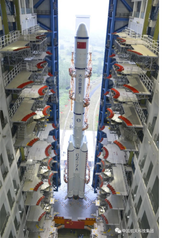
23 Dec 2021: China launched a new-generation Long March 7A rocket and successfully sent a pair of Shiyan-12 test satellites into geosynchronous transfer orbit. The Shiyan-12 satellites are stated to be for space environment studies and related technical tests and were developed by the China Academy of Space Technology (CAST), a CASC subsidiary. Both are now in GEO. See Launch Video.
– This was China’s third launch of the new LM-7A rocket. The first launch failed, the second was successful.
– At 60.7-meters-long, the LM-7A used for this dual satellite launch included an elongated fairing, making it China’s longest rocket.
– The rocket has a diameter of 3.35 meters and has four side boosters. It is capable of delivering up to 7 metric tons of payload to GTO. The Long March 7A is more capable than the Long March 3B, which can launch 5.5 tons to GTO.
– The standard LM-7 is used to launch cargo spacecraft to China’s space station. The 7A includes an additional hydrolox stage.
– CASC plans to perform 3-5 Long March 7A launches a year by 2025. The launcher can also be used for lunar and deep space missions.
The officially announced purpose of the Shiyan 12 satellites is spatial environment detection and testing. There has been open source comparison with the US GSSAP mission.
– Each satellite weighs 3 tons and both were developed by the China Association for Science and Technology (CAST), which has developed other payloads of this kind before, including the Shiyan-9 and Shiyan-11 payloads.
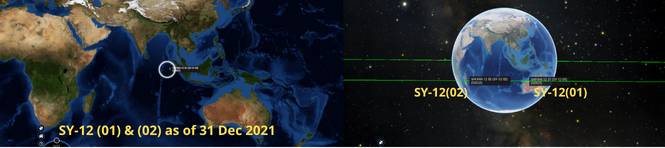
– Both Shiyan 12 satellites were tracked in geostationary orbit in proximity with one another on 31 December. Shiyan 12(01) is at 94.28°E and Shiyan 12(02) is at 94.15°E (over the Indian Ocean just East of Java.) Both are inclined .5°.
– This is the third launch in three months for the Shiyan satellites. Shiyan-10 was launched in October 2021, and raised its orbit successfully after initial reports of a failure of launch appeared on social media, and the confirmation of a successful launch was delayed.
– Both Shiyan-9 and Shiyan-10 remain in GTO-like orbits. The Shiyan-9 was launched on 11 March 2021 and also used the LM-7A.
– The Shiyan-11 technology satellite launched to LEO on a Kauizhou-1A rocket in Nov 2021. It is suspected that the Shiyan-11 mission was used to demonstrate Earth imaging services.
2021 appears to have been a highly ambitious and successful year for experimental Chinese space programs. This year there were three of the TJS (TJS-6, 7 & 9) missions launched, all to GEO. There were also three Shijian (SJ-21 to GEO and two SJ-6(05) to LEO) launches. Finally there were 6 Shiyan (SY-6(03), SY-9, SY-10, SY-11 and SY-12(01&02)) placed into a variety of orbits.
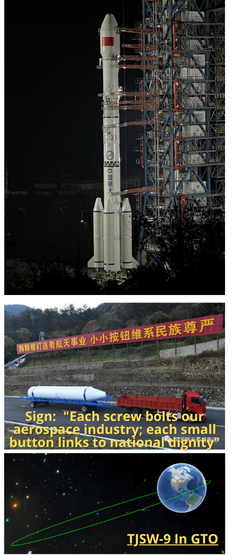
29 Dec 2021: China launched a Long March 3B from Xichang. The launch carried the Tongxin Jishu Shiyan Weixing 9 (TJSW-9) satellite into geostationary transfer orbit Video.
– The exact purpose of the TJSW series of satellites has not been made public, but they are referred to as “communication technology test satellites” for radio, TV, and general data transmission. This is generally believed to be a cover, with the TJSW satellites actually being used for military purposes.
– TJSW-9 was manufactured by CAST. CAST manufactured TJSW 1 & 4 satellites which were used for signals intelligence and for testing and demonstrating multi-band, high-speed communication technology for the military. It is believed that TJSW-9 is a continuation of this signals intelligence satellite series. As of 2 January it remains in GTO.
– China launched TJSW-7 on August 24. That satellite was manufactured by SAST which also produced TJSW 2, 5, &6. The SAST manufactured satellites are believed to be used for missile detection and early-warning, a similar role to the United States’ Space-Based Infrared System (SBIRS).
The wider TJSW series appears be underpinned by the notion of a military purpose, with SAST and CAST manufacturing different types of satellites under its umbrella, whether that be early-warning or signals intelligence. This launch was China’s 55th and final orbital launch of the year – the most that China has accomplished in a single year and more than any other country during 2021.
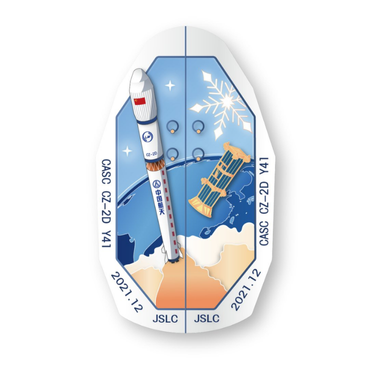
29 Dec 2021: China launched a Long March 2D from Jiuquan carrying the Tianhui 4 cartography satellite to polar orbit. The satellite will be used for Earth observation and mapping for civil and military uses. This is the first satellite of the Tianhui 4 series. Video.
– The name Tianhui translates to “Sky Drawing.” They are part of the Ziyuan program to survey the Earth for civil and military uses.
– Previous Tianhui were equipped with a panchromatic camera, a panchromatic CCD camera, with a ground resolution of five meters each, and a multi-spectral imager with a resolution of 10 meters.
The launch announcement for Tianhui-4 mentioned test of a new side-by-side dual launch adapter, but did not mention a second satellite. Two objects have been cataloged from the launch. Usually the CZ-2D stage 2 deorbits, it is possible that Tianhui-4 is actually a pair of satellites. The Tianhui 4 orbits are identical to NASA & Germany’s GRACE/GRACE-FO satellite pairs that mapped the Earth’s gravitational field.
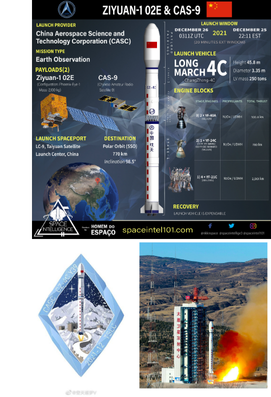
26 Dec 2021: China launched a Long March 4C from Taiyuan with the Ziyuan-1(02E) Earth Resources Observation Satellite. Ziyuan (ZY), meaning Resource, is a series of remote-sensing satellites which China uses to acquire high-resolution images that can be used for surveying Earth resources, disaster management, and ecological and land use monitoring. Video
– Ziyuan-1 02E is believed to be similar in design to the Ziyuan-1 (02D) satellite launched in September 2019. It carries the same two imaging payloads: a high-resolution visible and near-infrared camera and a hyperspectral imager, as well as a new long-wave infrared camera.
– The high-resolution camera will be able to produce images with resolutions of up to five meters when operating in panchromatic mode. When operating in multispectral mode, it can produce images across three bands with a resolution of up to 10 meters. The hyperspectral payload can image across 166 spectral bands.
There have been ten Ziyuan satellites launched to date. Four have been part of the China-Brazil Earth Resources Satellite (CBERS) program (2 of which are now dead), the other six – including Ziyuan-1 02E – are solely Chinese-operated.
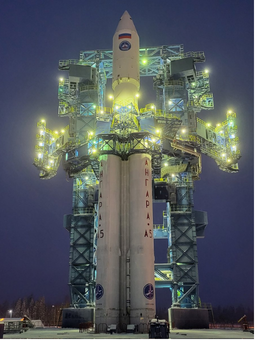
27 Dec 2021: Angara attempted to place its 2,400 kg mass simulator in a near geostationary orbit (GEO) using a new Persei upper stage. Russian reports suggest the Persei only reached an initial low Earth parking orbit before suffering an engine failure. Video.
– Angara is a fully Russian-designed and launched rocket, set to launch from the Plesetsk Cosmodrome. Development began in 1992 and is to replace several existing launch vehicles.
– The Persei upper stage failed to perform its 2nd of 3 firings, stranding it in a low parking orbit with a short life span.
– Angara’s second flight successfully delivered a 2,400kg mass simulator to GEO using the BRIZ-M upper stage.
– There was a 6-year gap between Angara’s Flight 1 and 2 and only one year between 2 and 3.
Unknown if the Persei failure will impact the launch schedule. The next known Angara A5 launch isn’t scheduled for a year and a half. Russia has formed an investigative commission within Russian space industry to look into the failed upper stage.
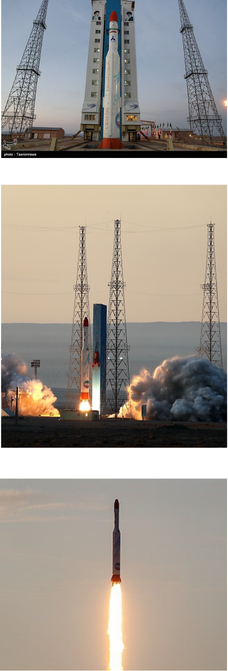
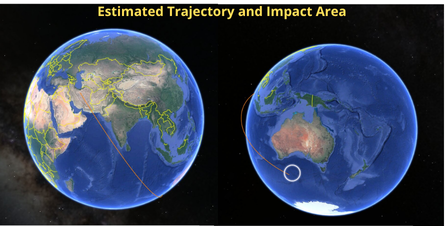
30 Dec 2021: Iran announced the launch of a Simorgh rocket from Khomeini Space Center carrying three payloads. They report that the rocket reached 7350 m/s and an altitude of 470km. If this represents an inertial velocity it would be insufficient to achieve orbit and the likely trajectory would impact south of Australia about 28 min after launch Video.
– Iranian state TV did not say when the launch was conducted nor what devices the carrier brought with it.
– Ahmad Hosseini, a Defence Ministry spokesman: stated the “performance of the space centre and the performance of the satellite carrier was done properly.’’ He described the launch as “initial,” suggesting more are on the way.
– Officials were silent on whether the launched objects had actually reached orbit. Iran’s civilian space programme has suffered a series of setbacks in recent years, including fatal fires and a launchpad rocket explosion.
– Satellite images seen by The Associated Press suggested an imminent launch earlier this month. The images showed spaceport preparations in the rural desert plains of Iran’s Semnan province, some 240km (150 miles) southeast of Tehran.
– Iran’s launch came without any announcement, nor any flight restrictions or notices to airmen (NOTAMs) noticed that could have indicated that launch activity was imminent.
Over the past decade, Iran sent several short-lived satellites into orbit and in 2013 launched a monkey into space. The government appears to have recently sharpened its focus on space and Iran’s Supreme Council of Space met for the first time in 11 years. This launch comes amid difficult Western-Iranian negotiations in Vienna over Iran’s tattered nuclear deal and follows a test last week of 16 short- to medium-range ballistic missiles during a military drill in southern Iran.
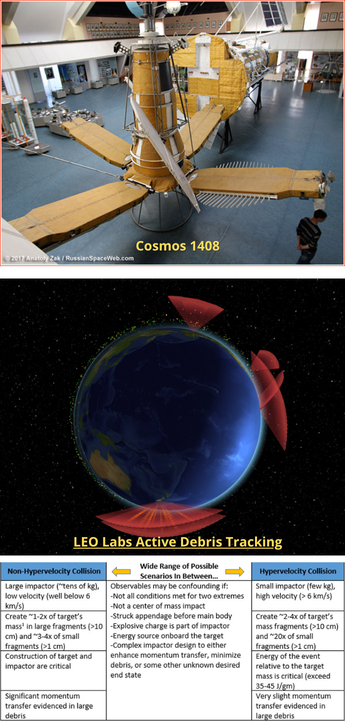
20 Dec 2021: LEO Labs published its third article with analysis from the 15 Nov 2021 Russian Nudol intercept of Cosmos 1408. Using its array of S-band radars, LEO labs has identified ~400kg of debris, or about 23% of the original mass of Cosmos 1408. Evidence points to a non-hypervelocity (<6km per second) collision which would generate larger, but fewer, pieces of debris. Regardless of the speed of the intercept, LEO Labs estimates the statistical probability of collision for satellites with mission-terminating debris in the 300–800km altitude range has likely doubled due to this event, and will remain high for many years.
– The number of Cosmos 1408 debris fragments is close to 500, and will certainly continue to rise in the coming weeks and months.
– There are 9 pieces of debris with Radar Cross Sections >1M^2. These larger objects are consistent with large appendages of the Cosmos 1408 spacecraft (4 antennas, 2 solar arrays, and several booms) that likely would have been left intact (or largely intact) from this event.
– The larger pieces of debris account for ~400kg of the original 1,750kg mass of Cosmos 1408.
– Using the typical value for trackable debris fragments of 0.10 m²/kg produce ~2,700 more fragments to account for the additional 1,350kg (total mass estimate from debris would equal the pre-event estimate of ~1,750 kg).
– The total number of smaller (<10cm) fragments were created remains unknown. These fragments constitute mission-terminating collision risks but are not reliably cataloged.
– LeoLabs will start to catalog previously untracked sub-10cm debris starting in 2022, and is deploying multiple additional S-band radars around the world over the next 12–24 months.
LEO Labs analysis continues to lend credence to a non-hypervelocity impact encounter. Such an intercept results in fewer fragments but ones that are likely longer-lived (due to their larger mass) than “typical” collision-induced fragments. The only way to mitigate this risk is to catalog these fragments, and track them accurately and frequently to produce actionable conjunction alerts for satellite operators.
17 Dec 2021: Russian state-aligned newspaper Moscovsky Komsomolets (MK), published a long and strikingly critical article reviewing the state of the Russian space program. Western observers who track the Russian space industry realize the program is deeply troubled, and running on the fumes of its past and very real glory. What is notable, however, is that a major Russian media outlet has published such a revelatory article for a domestic audience.
– Russia’s space program seeks to project its greatness in space through symbolic acts rather than technological achievements—such as the launch of a Russian movie star, sending a robot nicknamed Fedor to space, or making (entirely) hollow promises about a Moon landing in 2030.
– Because the article was published by a state-sanctioned newspaper, it was exempt from the country’s recently declared rules about independent media reporting on much of Russia’s space activities.
– MK notes that Russia’s space program has a shortage of competent and highly qualified staff, obsolete facilities and technology, and “systemic leadership weakness.”
– Roscosmos is struggling even to build its mainstay vehicles, the Soyuz rockets and Progress spacecraft. The vernier thrusters on the Soyuz boosters and in the de-orbit engines of the Soyuz-MS spacecraft depend on deliveries of chemicals produced by a German company…”That is, the West can stop Russian space launches with a single keystroke.”
– Since 2019 over 60 criminal investigations have been initiated with total losses assessed at more than 5 Billion rubles ($67.7 million).
– Roscosmos said there would be 44 space launches in 2019, and 25 were conducted. In 2020, 40 launches were planned and just 17 conducted. This year, Russia has conducted fewer than half of its planned 47 launches. Roscosmos, therefore, has decided to no longer publish its planned number of launches.
The overall portrayal of Roscosmos is that of a wasteful, increasingly decrepit enterprise where almost no money is invested into the present or future. Instead, the focus seems to be on high-paying jobs for a handful of technocrats, whose salaries are worth hundreds of thousands of dollars a year. Meanwhile, the average monthly wages for technical specialists who build the country’s rockets and spacecraft range from $500 to $1,000 a month. “As a result, hundreds of billions, if not trillions, of rubles fly away not into space, but fecklessly and pointlessly disappear down the drain,” Popov writes. “All these beautiful PR presentations of art-decorated rockets and wild promises are still little more than cover for the rapid collapse of Russia’s space industry. If nothing changes, if there is no political will to introduce strict order using maximally radical methods, space will remain Russian only in our memories.”
15 Dec 2021: Recent article in the Modern War Institute notes that there remain significant obstacles to China-Russia space cooperation. Russian fears of Chinese technological theft and the prospect of playing second fiddle to China will continue to strain the relationship. Moreover, Russia’s ASAT test demonstrates that Russia is willing to jeopardize China’s space interests when doing so serves Russian ones.
– China and Russia have a long yet complicated relationship when it comes to space. At the very outset of its space program, China benefitted from Soviet assistance, including receiving technical advisors and even an out-of-date R-2 ballistic missile that China reverse engineered, and that would evolve into China’s Long March rockets.
– As Sino-Soviet relations deteriorated, China’s space program could no longer rely on Soviet assistance, but had to instead focus more on indigenous development.
– Today, the China-Russia relationship is driven by an alignment of interests and an attempt to balance the more militarily powerful United States. As the US military relies the most on space technologies to project power globally, Russia and China are incentivized to develop capabilities to negate these advantages.
– There are important fault lines in the Russia-China relationship, ranging from nationalism to mistrust. These elements pose significant obstacles to further integration and coordination between Russian and Chinese space programs.
– In the 1990s, Russia felt burned when China undercut Russian profits by reverse engineering its space technology. More recently, in 2019, Russian state conglomerate Rostec accused China of copying a wide range of Russian military hardware.
– China has more resources to contribute for future projects including the planned lunar base ; and will be concerned that Russia could free ride on Chinese contributions in future projects.

17 Dec 2021: During a 13 Dec Parliamentary hearing, a deputy minister shared the “Malaysia Space Exploration 2030” blueprint from the Malaysian Ministry of Science, Technology and Innovation. Malaysia is developing a space blueprint to drive growth in its space sector, particularly remote-sensing satellite and component manufacturing and downstream services.
– One of the blue print’s core initiatives seeks to position
Malaysia to develop remote sensing satellites on its own and lead to the growth of a satellite component manufacturing industry as well as a satellite data-driven downstream sector.
– Malaysia will seek to sign memoranda of understanding with “agencies of excellence in developed countries in the field of space technology.”
Malaysia hopes their space sector would contribute to 0.3% of GDP and employ 500 knowledge workers by 2030. The Malaysian Space Agency was established in Dec 2019 by merging the National Space Agency (ANGKASA) and the Malaysian Remote Sensing Agency (MYSA) to improve the efficiency of delivering government services in the space sector.

21 Dec 2021: China’s recently launched Tianlian-2(02) relay satellite appears to have settled into its geostationary orbital slot. The new satellite is located at 171° west longitude, between Tianlian-1(02) and Tianlian-1(04).

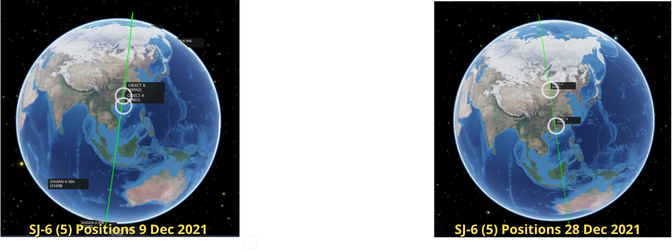
7 Dec 2021: The pair of SJ-6(05) satellites remain in lower than expected orbits (relative to previous SJ-6 missions). Apogee remains at ~468km and perigee at ~453km. Previous SJ-6 missions had apogees ranging between 582-602km and perigees between 561-574km.
The SJ-6(05) satellites have increased spacing between one another. Unknown if the spacing is due to a specific maneuver or is a result of slight orbital differences.
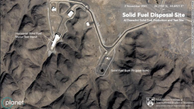
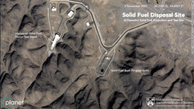
23 Dec 2021: Satellite photos taken by Planet, a commercial imaging company, between October 26 and November 9 show a burn operation occurred at a facility near Dawadmi, Saudi Arabia, according to researchers at the Middlebury Institute of International Studies, who told CNN this is “the first unambiguous evidence that the facility is operating to produce missiles.”
– The satellite images indicate the Saudis are manufacturing ballistic missiles at a site previously constructed with Chinese assistance according to experts who analyzed the photos .
– Little is known about the Saudi ballistic missiles under constructions at this site, including details like range and payload.
-The facility in question was built with Chinese assistance and new intelligence assessments showing Saudi Arabia recently purchased sensitive ballistic missile technology from China. It is possible that the missiles produced there are of Chinese design.
This is the latest example of the ability for commercial space obtaining information once exclusively available to national governments.