issue 30 | 12 september 2021
The integrity flash
Analysis of Developments in the Space Domain
in this issue
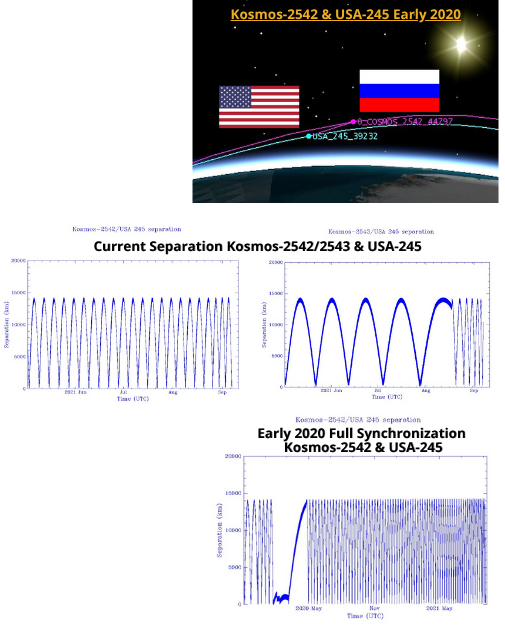
25 August 2021: An independent satellite observer noted that during the Summer 2021, Kosmos-2542 maneuvered to re-synchronize its orbit with the USA-245 military satellite. The maneuvers resulted in multiple close encounters between the Russian and US spacecraft. On August 2, Kosmos-2542 passed as close as 34 kilometers from USA-245, and on August 13, it was within 53 kilometer from its purported target. A separate satellite observer confirmed the changes to 2542’s orbit and noted that companion satellite Kosmos-2543 also maneuvered in mid-August increasing the frequency of close approaches with USA-245.
– Kosmos-2542 has been an object of interest since its launch on 25 Nov 2019 from Plesetsk. Its original orbit was within 1° inclination from USA-245.
– Russian military sources stated Kosmos-2542 could monitor Russian satellites.
– The statement seemed to link Kosmos-2542 with a 2017 launch, which also had orbital inspection capabilities. The 2017 launch featured the subsequent release of additional satellites from the primary payload
– On 6 Dec 2019, the Russian Ministry of Defense announced that a small sub-satellite had separated from the multi-functional platform in orbit (Kosmos-2543).
– Kosmos-2543 conducted a series of maneuvers after separation. Amateur observed strongly suggest these purposeful maneuvers placed Kosmos-2543 in an orbit to observe USA 245.
– Kosmos-2543 came within 20 km of USA 245 several times in January 2020.
– In June 2020, Kosmos-2543 made a series of maneuvers to place it into RPO with Kosmos-2535, including close approaches within 60km. A month later, the Russian Ministry of Defense issued a press report stating the two satellites had conducted a close-up study of a domestic satellite with the help of specialized equipment on a small satellite.
– On 15 Jul 2020, a small piece of orbital debris was spotted in the vicinity of the two satellites that appeared to have separated from Kosmos-2543 at a relative velocity between 140 to 186 meters per second (313 to 415 miles per hour).
– USSPACECOM characterized the event as a space based satellite weapons test and stated that the Russian satellites “displayed characteristics of a space-based weapon.”
There is little open-source information regarding the most recent Kosmos-2542/2543 maneuvers. Both satellites are likely the second iteration in the Nivelir 14F150 series. In the past 4 years Russia has deployed two “sub-satellites” at high-velocity, which suggests at least some of their LEO RPO activities are of a weapons nature. There is strong evidence Russia has embarked on a set of programs since 2010 to regain many of its Cold War-era counterspace capabilities.
To the Moon: China's Evolving Launch Capabilities
2 September 2021: China appears to be accelerating its plans to land on the Moon by 2030 and would use a modified version of an existing rocket to do so. The chief designer of the Long March family of rockets, Long Lehao, said China could use two modified Long March 5 rockets to accomplish a lunar landing in less than a decade.
– Lehao said one of these large rockets would launch a lunar lander into orbit around the Moon, and the second would send the crew to meet it. The crew would transfer to the lander and then spend 6 hours on the Moon’s surface. Part of the lunar lander would ascend back to meet the spacecraft and return to Earth.
– The plan requires several technology developments. The Long March 5 rocket, which has a similar capacity to a Delta IV Heavy rocket, would be upgraded to become the “Long March 5-DY.” China would also need a lunar lander and a next-generation spacecraft capable of deep space missions.
– Chinese authorities began discussing a similar lunar exploration architecture in October 2020.
– The Long March 9 remains in China’s space exploration roadmap. Lehao showed a slide showing the change, or likely evolution, of the Long March 9 super heavy-lift rocket to a reusable form and illustration of progress.
– In addition to supporting space exploration China is planning to use the LM-9 to construct space-based solar power facilities 35,786 kilometers above the Earth.
The use of an existing rocket with 7 launches would simplify the mission for China. The country’s aerospace engineers are in the early stages of developing a super-heavy lift rocket named Long March 9, it likely won’t be ready for test flights before 2030. By modifying an existing rocket, China could get to the Moon faster.

3 Sep 2021: Several websites tracking Chinese launches and other China space information have been asked to stop posting and delete historical info by the relevant government departments. Subsequently, Chinese launch threads have disappeared from a space watcher forums.
– One site, http://www.spaceflightfans.cn has an official notice of a “15 days clean up period“; another forum has all posts on Chinese launches gone.
– On 9ifly, all available information on future and present launches has disappeared.
– Official public program updates/discussions remain available.

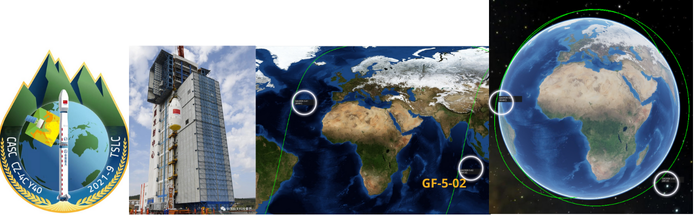
6 Sep 2021: China launched a Long March 4C from Taiyuan with the Gaofen-5-02 earth observation satellite. The satellite will complement the GF-5-01 launched in 2018. Gaofen-5’s purpose is hyperspectral observation of Earth’s environments to track environmental impacts, water quality, and atmospheric changes. Launch VIDEO.
– Gaofen (GF) is a series of Chinese civilian remote sensing satellites for the state-sponsored program China High-definition Earth Observation System (CHEOS).
– GF 5 is configured with six types of payloads. Most are dedicated to identifying particulate levels in the atmosphere. The GF-5 mission overview briefing with sensor details and applications can be found HERE.
– GF-5-02 is in a 682 x 709 km x 98.3 deg sun-synch orbit about 13 km lower at perigee and 10km higher at apogee and 135 degrees plane difference from GF-5-01

9 Sep 2021: China launched a Long March 3B with ChinaSat-9B into GTO from the Xichang Satellite Launch Center. This satellite serves as a replacement to ChinaSat-9A, launched in 2017 but inserted into a lower than planned orbit, and thus reducing its operational life. Launch Video
– ChinaSat-9B will provide live broadcast services, support 4K and 8K high-definition video program transmission using a specially designed 54MHz bandwidth transponder, and provide high-quality live broadcast transmission services for large-scale events according to CASC.
– The satellite is expected to allow 8K broadcasting of the 2022 Beijing Winter Olympics.
– ChinaSat 9A was launched into a much lower than planned orbit in June 2017 after the 3rd stage lost attitude control while in coast phase due to a software bug . As a result ChinaSat-9A used most of its fuel to get to GEO.
– In Feb 2021 Chinese media stated that the ChinaSat-9A’s propellant had been fully depleted, just over 3.5 yrs after launch.
– ChinaSat-9A’s orbit has been raised 130 kms above GEO. This is however short of the 300-kilometer raise needed to put ChinaSat-9A into an ideal GEO graveyard orbit.
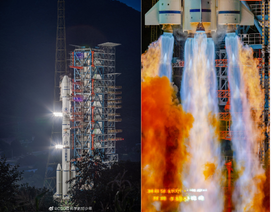
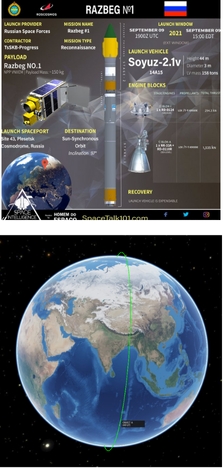
9 Sep 2021: a Soyuz 2.1v rocket launched from Site 43/4 at the Plesetsk Cosmodrome carrying the Razbeg n°1 (Kosmos 2551) satellite for the Russian Ministry of Defense.
– The Kosmos 2551 satellite is a small-sized (150kg) military optical reconnaissance satellite. Its camera has a maximum ground resolution of 0.9m.
– Kosmos-2551 was launched to a 295 x 307 km x 96.4° sun-synch orbit. It is suspected to be the operational follow on to the Kosmos-2525 EMKA test satellite
– Kosmos 2525 launched 29 Mar 2018, is no longer operational and has an decay date of 1 Apr 2021.
– Both of the Razbeg satellites were launched using the Soyuz 2-1v. Lacking the four strap-on boosters of its predecessors in the Soyuz family of rockets, Soyuz-2-1v relies solely on a modified core booster as its first stage.
Most likely, Razbeg is to become a constellation of small imaging satellites that, if necessary, can bridge the gap between Persona and Razdan and ultimately augment the imagery provided by the big spy satellites. Similarly, the US National Reconnaissance Office supplements the imagery collected by its own satellites with lower resolution photographs obtained from operators of commercial remote sensing satellites.
– China’s TJS-7 satellite has settled at 146.5E.
– TJS-3 then started moving again on Aug 30, less than a week after TJS-7 was launched. It is drifting West and has passed TJS-4 on the GEO belt.
– TJS-3 was launched to 59E with a subsatellite (“TJS-3 Apogee Kick Motor”). The subsatellite, remains at 59E. TJS-3 itself moved to 173E in Jun 2019 and then to 87E in Jan 2021. See VIDEO.
Other TJS launches occurred in 2017 (TJS-2), 2018 (TJS-3), 2019 (TJS-4), 2020 (TJS-5) and 2021 (TJS-6). There is speculation that TJSW-2, -5 and -6 might be military Huoyan-1 early warning satellites while TJS-4 may be another SIGINT collector similar to TJS-1. Missions for TJS-3 and TJS-7 are unknown.