issue 32 | 10 October 2021
The integrity flash
Analysis of Developments in the Space Domain
in this issue
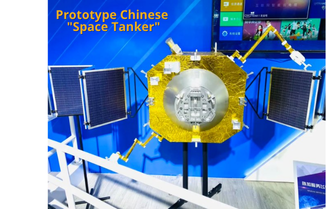
29 September 2021: Eighth Academy of China Aerospace Science and Technology Group reveals new “space tanker” satellite at the 13th China Air Show in Zhuhai. The spacecraft will operate in GEO and be equipped with robotic arms for attaching a docking mechanism and have 1.3 tons of fuel capacity, more than half its total mass.
– The front of the satellite contains the navigation system with radar and camera, enabling autonomous guidance.
– Ground controllers will task the satellite to autonomously track and approach the target satellite. When it arrives within 2 meters from the satellite, the satellite will deploy its robotic arm, and connect to the target satellite’s refueling port and deliver fuel.
– China, like the US and Russia, demonstrated on-orbit refueling capabilities. In 2017, the Tianzhou-1 cargo spacecraft successfully docked with the Tiangong-2 space laboratory, passing propellant from one spacecraft to the other.
– No dates were provided at the Air Show exhibit. There was also no mention of refueling satellites that were not equipped with a standardized re-fueling port.
– China has conducted successful Rendezvous and Proximity Operations at GEO with both their TJS-3 and SJ-17 satellites.
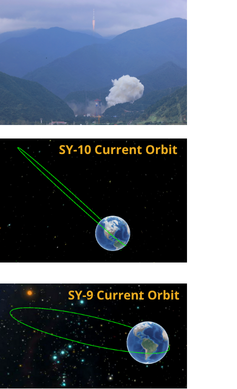
27 Sep 2021: A Long March 3B launched from Xichang Satellite Launch Center with the experimental Shiyan-10 (SY-10) satellite. On 28 Sep Chinese state media confirmed abnormal function of Shiyan-10 satellite and loss of the spacecraft after a normal flight. SY-10 remains in GTO
– U.S. Space Force’s 18th Space Control Squadron (SPCS) tracked SY-10 in a transfer orbit of 177 x 40,105-kilometer orbit inclined by 51 degrees.
– The mission payload remains unknown.
– Shiyan Weixing spacecraft are test satellites serving as pathfinders for new satellite technologies. Shiyan means “experiment” in Chinese.
– The first Shiyan satellite launched in April 2004 on a Long March-2C. After that, eight missions followed to test additional experimental technologies. All but Shiyan-9 and -10 were LEO experiments.
– Shiyan-9, also remains in GTO after its successful launch on a LM-7 in March 2021. There has been no official announcement that this launch was a failure.
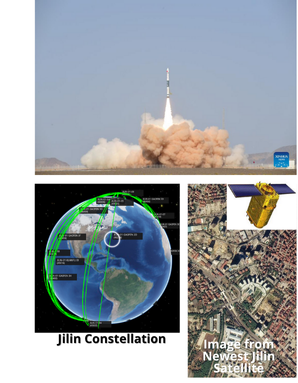
27 Sep 2021: China launched an ExPace Technology Corporation Kuaizhou-1A (KZ-1A) rocket from Jiuquan Satellite Launch Center. The KZ-1A successfully deployed a Jilin-1 high-resolution remote sensing satellite into low earth orbit. Launch VIDEO
– This was the 14th flight of a KZ-1 series rocket and the first KZ-1 launch since the Jilin-1 Gaofen-2C launch in September 2020, which ended in failure and payload loss.
– The KZ-1A is capable of delivering small satellite payloads into a Sun-Synchronous Orbit.
– The KZ-1A is 20m tall and has four stages, the first three are solid-fueled. The fourth and final stage is powered by a liquid-fueled engine in the orbital insertion stage.
– The Jilin-1 Gaofen-2D payload is a 250kg satellite and the fifth in the Jilin-1 Gaofen-2 series of remote sensing satellites. It is the third to successfully reach orbit.
– The Chang Guang Satellite Technology Corporation built and developed the Gaofen-2 series of satellites, which specializes in the design and operation of remote sensing satellites for commercial use. See VIDEO
– Jilin-1 is capable of full-color resolution better than 0.76m and a multi-spectral resolution better than 3.1m.
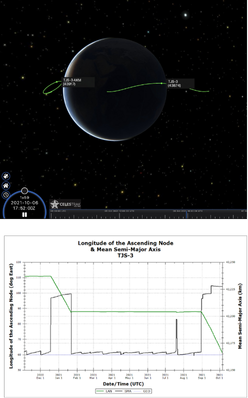
6 Oct 2021: TJS-3 has been on the move since the end of August and is now in the vicinity of what the US Space Force
identifies as the TJS-3 AKM (apogee kick motor), which continues station-keeping, despite its designation.
– Soon after its launch in 2018 TJS-3 conducted a series of maneuvers with the TJS-3 AKM. See Video.
– Shortly after its launch in 2018, Chinese news media reported that TJS-3 will test “double satellites co-position communications” as well as “multi-frequency & high speed communications”.
– While likely unrelated, TJS-3’s position puts it in close proximity to Russia’s Luch/Olymp and Intelsate-33E (see next article).
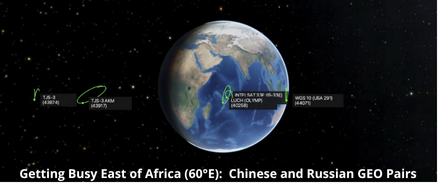
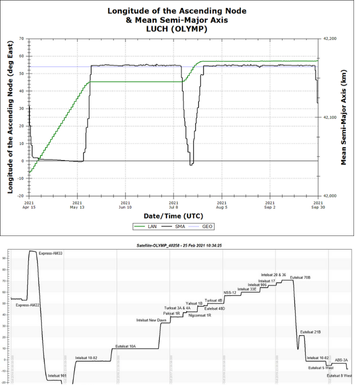
30 Sep 2021: Open Source satellite observers noted Russia’s Luch/Olymp adjusted its orbit and may be changing locations on the GEO belt. Since its 2014 launch, Luch/Olymp exhibited unusual behavior and likely serves a dual role: (1) electronic intelligence (ELINT), and (2) secure government communications. Luch/Olymp completed a series of Rendezvous Proximity Operations (RPO) with several satellites.
– Luch/Olymp launched on 28 Sep 2014 on a Proton-M SLV from Baikonur Cosmodrome.
– The name of the satellite is not precisely known. Manufacturer documents refer to it as “Olymp” or “Olymp-K” while Russian United Nations filings reference the satellite as “Luch,” which is a series of Russian “bent pipe” data relay satellites.
– There were reports that the Olymp spacecraft might use a cutting edge laser-communication system to relay data from low-orbiting spy satellites to ground control. Russia’s most advanced reconnaissance satellite Persona-3, carries a laser data-transmission system, enabling it to send information to the ground via a special relay satellite located in a geostationary orbit. In this capacity, Olymp could replace the old-generation Garpun military data-relay spacecraft.
– A Moscow-based Kommersant daily claimed the satellite would also be used for electronic espionage for the Russian security service, FSB. The newspaper did not provide any technical details or background information to back that claim.
– In the months after reaching GEO, Luch conducted a series of maneuvers that brought it close to other operational satellites around the GEO belt.
– After maneuvering in vicinity of 2 Russian GEO spacecraft (Express AM-6 & Luch-5V), Luch/Olymp positioned itself between 2 Intelsat spacecraft (Intelsat 7 and Intelsat 901). It remained in this location for over 5 months (Apr – Sep 2015).
– Luch/Olymp made several stops in the GEO belt across several months.
– In Sep 2018, the French Defense Minister stated Luch/Olymp made “too close of an apporach” to a French-Italian military communications satellite in late 2017.
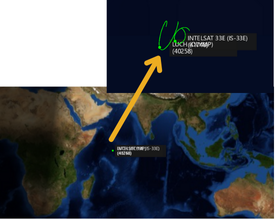
– With its latest maneuvers Luch/Olymp has settled in close proximity with Intelsat 33e. This is the second time Luch/Olymp has visited Intelsat 33e, the previous time was in early 2019.
During its five years on orbit, Luch has parked near more than a dozen commercial communications satellites for periods ranging from a few weeks to nine months. Luch/Olymp appears to be the only Russian RPO asset in GEO, while they have several satellites in LEO capable of conducting these activities. See COMSPOC video on Luch/Olymp activities.
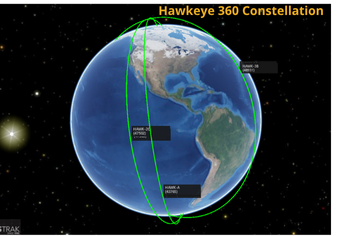
5 Oct 2021: There is ongoing research for using radio-frequency data collected by HawkEye 360 satellites to locate GPS interference hotspots. The company has briefed government and commercial customers concerned about the impact of GPS disruptions on how they could apply RF data analytics to spot interference.
– Hawkeye 360 satellites are equipped with software-defined radios, fly in clusters of three: two in tandem and a third that oscillates back and forth. Three clusters are in orbit with plans to launch more.
– Radio-frequency data collected by satellites can help to locate GNSS interference hotspots.
– The US DoD is investing in research to experiment
with commercially available data sources, both space-based and terrestrial.
– For example the Automatic Identification System (AIS) — an onboard navigation safety device that transmits and monitors the location vessels at sea in real time “has been used in some circumstances to characterize intentional GNSS disruptions and spoofing.” –Nick Estep, Defense Innovation Unit program manager
6 Oct 2021: In the run-up to elections last month, Putin declared almost every independent media organization operating inside the country a “foreign agent” to stifle dissent and criticism. The intent seems to be to destroy independent media in Russia. Now, this campaign has been extended to coverage of Russian space activities.
– Russia already prohibits reporting on space activities containing classified information, but a new law extends to coverage of a variety of other space news.
– Now any person in Russia reporting anything that might be even tangentially related to Russia’s military activities or space activities will be labeled as a foreign agent.
– Writers are required to put a disclaimer on every article or social media post: “This Report (Material) has been created or distributed by Foreign Mass Media Channels executing the functions of a Foreign Agent, and/or a Russian legal entity executing the functions of a Foreign Agent.”
– This law had an immediate chilling effect on space coverage inside Russia. Katya Pavlushchenko, a prominent space blogger, immediately announced on Twitter that she was suspending her coverage of Russian space activities due to the new law.
The biggest effect of the law will be to reduce coverage of Russia’s space activities for regular Russians. Most likely they will see state media and not much else. This ruling won’t affect coverage by organizations outside of Russia, which have reported on the Russian space corporation’s difficulties in recent years. The reality is that the Russian space corporation is run by a political figure and friend of Putin’s, Dmitry Rogozin, who appears to be using it to enrich himself.
China has also recently enacted new restrictions on coverage of its space programs.