

Analysis of Developments in the Space Domain
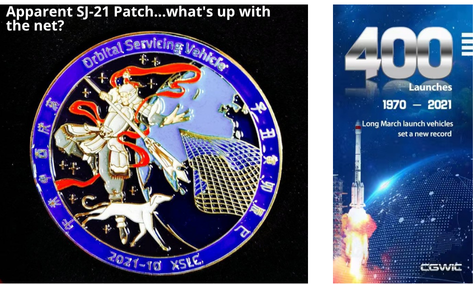
9 Dec 2021: Long March 4B launched the Shijian (SJ)-06 (05) group of satellites from Jiuquan on Dec. 9. This was the 400th launch of China’s Long March family of launch vehicles and the first SJ-6 launch in 11 years. The orbit appears to be lower than previous SJ-6 missions. See Launch Video.
– The SJ-6 (05) satellites were developed by the China Academy of Space Technology (CAST) and Aerospace Dongfanghong Satellite Co., Ltd. The last SJ-6 launch occurred in 2010.
– No images of the satellites have been published.
– Western analysis of previous SJ-6 missions and their roughly 585km Sun-synchronous orbits suggests SJ-6 satellites are designed for signals intelligence or electronic intelligence purposes.
– The news release from CAST states the purpose of SJ-6 (05) is the same as the 4 pairs a decade ago (detection of space environment & new technology validation).
– However, the newest SJ-6 satellites are orbiting ~130km (21%) lower than previous missions. SJ-6 (05)
satellites are at a similar inclination (97.4°), but have apogees between 465-467km and perigees between 451-453km.
– The SJ-6 (05) orbits are also lower in altitude than previous Yaogan or Gaofen missions. The closest of these being Yaogan 14 (493/491km) and Gaofen 14 (487/482km).
– While early in its deployment (and subject to change) the SJ-6 satellites remain in closer proximity to one another than previous SJ-6 missions.
– Previous SJ-6 missions were launched in 2 year intervals beginning with SJ-6 01A & 01B in 2004 and concluding in 2010 with SJ-6 04G & 04H. These missions orbited at 97.7 degrees with apogees ranging between 582-602km and perigees between 561-574km.
– The nature of these orbits led to speculation that the SJ-6 mission was similar to the US Poppy program, the successor to the first American electronic intelligence satellite, known as “GRAB” (Galactic Radiation and Background). Poppy was designed to detect land-based radar emitters and support ocean surveillance.
The orbit for SJ-6 (5) differs from previous SJ-6 missions. Inclination is nearly the same but altitude is ~130km lower, suggesting an imagery mission. The SJ-6 (5) satellites also orbit in closer proximity to each other than previous SJ-6 missions. This separation could change as the mission progresses.
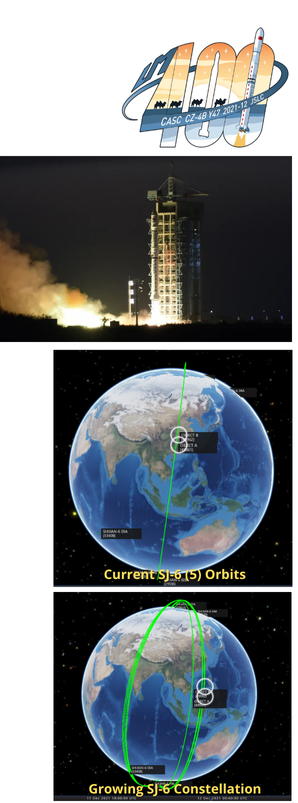
7 Dec 2021: The Chinese private spaceflight company Galactic Energy made the second flight of its Ceres-1 rocket, carrying 5 satellites into orbit. The launch was from the Jiuquan Satellite Launch Center. Launch Video.
– Ceres-1 (aka Gushenxing-1) is a four-stage rocket, using three solid-fueled stages with a hydrazine-fueled fourth stage to complete orbital insertion and refinement. Ceres-1 can launch a payload of up 400kg to Low Earth Orbit (LEO), or up to 230kgs into a sun-synchronous orbit at an altitude of 700km.
– The first Ceres-1 launch was conducted successfully on November 7, 2020, making Galactic Energy the second private Chinese company to launch a satellite into LEO.
– The main payload was the Golden Bauhinia-1-03 satellite, a technology demonstrator meant to test visible light imaging and remote sensing from LEO. It follows earlier Golden Bauhinia-1-01 and 02 satellites that have been flown to orbit.
– All 5 satellites were successfully placed into a roughly 500-km Sun-synchronous orbit (SSO).
Ceres-1 currently is planning for five launches in 2022. None of China’s private launch firms have yet to make an orbital launch attempt with a liquid propellant rocket. The Chinese government aims to ensure its commercial space sector complements, rather than competes, with its state-owned organizations. It is not clear to what extent the Chinese government has ownership in many of the new companies.
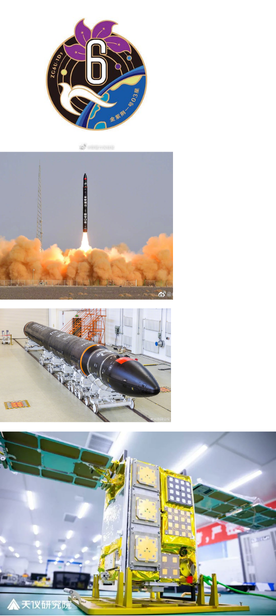
30 Nov 2021: China’s Ministry of Natural Resources and private company Tianjin Satcom Geohe Technologies Co., hosted a signing ceremony to announce the “36 Tiangang” constellation project. 36 Tiangang will be a constellation of panchromatic multispectral, hyperspectral and SAR satellites for use in disaster prevention, early warning and natural resource monitoring.
– The constellation will consist of 36 satellites. The first, a hyper-spectral satellite in a 500km SSO, with a 10m resolution , is set to launch early next year.
– The full 36-satellite constellation, with panchromatic multispectral, hyper-spectral and SAR satellites, is to be completed by the end of May in 2023. Half of the satellites will be SAR.
SAR satellites can gather data day and night, and through most weather conditions. It is typically more expensive and more difficult to use than optical imagery, and is in short supply in China. Current capabilities include the Gaofen-3 satellites as part of the national CHEOS Earth observation program, and the small satellites Hisea-1, developed by Spacety, and Qilu-1 developed by the Innovation Academy for Microsatellites (with support from the Chinese Academy of Science).
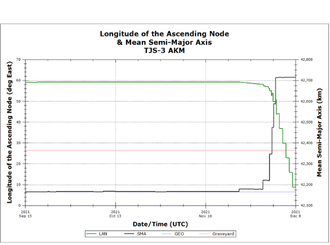
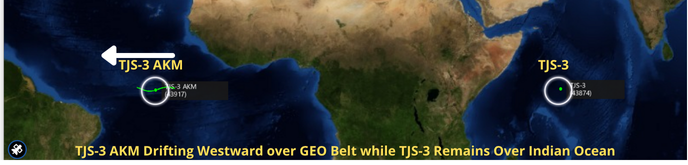
8 Dec 2021: After 2 years in orbit, the TJS-3 Apogee Kick Motor (AKM) has moved to a graveyard orbit 500km above the GEO belt. The maneuver began in late Nov 2021.
– In early Oct 2021, TJS-3 maneuvered within close proximity of TJS-3 AKM.
– Beginning ~Nov 20, TJS-3 AKM conducted a series of 6 burns to raise its orbit ~500km, from 35,815 (apogee)/35,758 (perigee) km to 36,363 (apogee)/36,306 (perigee) km.
– TJS-3 is currently stationary near 59°E longitude. While TJS-3 AKM is drifting westward and in early Dec was at 24°W.
– The TJS-3 AKM has been an object of interest since its 2018 launch when it conducted a series of maneuvers with the TJS-3. See Video.
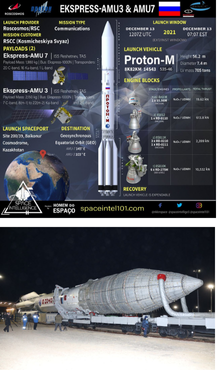
13 Dec 2021: Russia conducted a rare Proton-M launch from the Baikonur Cosmodrome. The mission lasted 18 hours to place the Ekspress-AMU3 and AMU7 communications satellites into Supersynchronous GEO. Launch Video.
– Both the Ekspress AMU 3 and AMU 7 are in 16250 x 52888 km x 1.7° Supersynchronous Transfer Orbits.
– This is a very similar deployment orbit to the Ekspress 80 and 103 mission in 2020.
– Both satellites are GEO bound with a design life of 15 years. Both are carrying enough propellant to extend this 17 years.
Ekspress AMU3 carries 39 transponders; 30 of these operate in the Ku band of the electromagnetic spectrum. It will be stationed at 103° East and provide coverage over much of Russia as well as Kazakhstan. Ekspress AMU7 also carries 39 transponders; however, only 20 of these are Ku-band. From its station at 145° East, it will cover Siberia and far-eastern Russia.
13 Dec 2021: China launched the Tianlian (TL) 2 tracking and data relay satellite from the Xichang Satellite Launch Center. Its mission is to enable communications between spacecraft and is the second TL-2 placed in orbit (the first launched in Mar 2019). The launch vehicle was a Chang Zheng (Long March) 3B/E. Video.
– The Tianlian satellites provide data relay for Chinese crewed vehicles and space assets. This includes communication with the Chinese Space Station and other LEO satellites.
– The TL-2 has a 15 year lifespan and uses the DFH-4 bus vs TL-1 satellites and the DFH-3 bus. TL-2(02) is the 7th relay satellite (5x TL-1 and 2x TL-2). All are listed as active.
– TL-2 also uses K-band frequencies (TL-1 satellites used the S-band) to enable 1.2 Gbps data transfer rates between the Chinese Space Station and ground control stations. The satellites make real-time communications including video possible between the ground and the Tianhe space station module, where three Shenzhou 13 astronauts are currently living and working. See recent podcast on China’s relay capabilities.
– TL-2(02) was the 401st Long March Launch. Prior to this launch, the most recent TL launch was the 5th TL-1 satellite in Jul 2021.
– In 2012, the Tianlian constellation achieved global coverage with the launch of the third spacecraft, TL-1(03), on 25 Jul 2012.
TL-2(02) remains in GTO as of 18 December. It passed through apogee on 15 Dec near 160° east longitude, suggesting it is aimed for either 167° E or 177° E. These locations correlate to the current locations of TL-1(02) (166.14°E) and TL-1(04) (176.68°E). TL-2(01) is also located near another relay satellite, TL-1(01).

14 Dec 2021: China’s ExPace launched a Kuaizhou-1A light-lift solid rocket from the Jiuquan Satellite Launch Center. The rocket failed after liftoff, losing two commercial satellites scheduled to test autonomous driving capability enhancement. Chinese state media tersely confirmed the failure, stating the specific reasons will be further analyzed and investigated.
– The flight carried the first two satellites for Geespace, a subsidiary of automaker Geely. The pair were intended to test navigation assistance and connectivity for autonomous driving.
– Open source discussions note it appears that the KZ-1A failed during third stage burn and impacted 1000km downrange.
– ExPace, also known as the ExPace Technology Corporation, was established as a subsidiary of the China Aerospace Science and Technology Corporation (CASC) in 2016. The establishment of ExPace allowed CASC to enter the commercial launch market.
This was the 14th KZ-1A flight and the second failure. Prior to this attempt ExPace conducted three successful KZ-1A launches across September, October and November. The KZ-1A will likely be grounded until an investigation is concluded and the causes isolated and addressed.
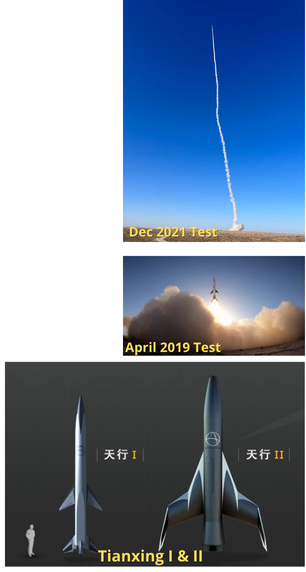
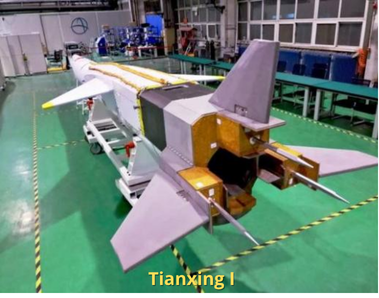
9 Dec 2021: Chinese hypersonic/spaceplane firm Space Transportation conducted a successful sub-orbital test flight of Tianxing-1 Y5B, the 5th test flight & 6th flight overall.
– There were no further details or images released for the flight.
– The Tianxing-1 is designed to launch vertically and maintain horizontal flight in the upper atmosphere using its fin-like wings, before gliding back down to Earth horizontally.
– Space Transportation conducted a test flight of a 3,700kg technology demonstrator Tianxing-1 in Apr 2019. The test was in cooperation with Xiamen University and took place just months after its Aug 2018 founding.
– A second Tianxing-1 launch occurred on 23 Dec 2019 and an engine test for Tianxing-2 on 10 Nov 2020.
– On Aug 31 2021, Space Transportation reported the first successful test flight of the Tianxing-2, representing the third flight test of the series of rockets
– The fourth test occurred on 12 Sep 2021 with another Tianxing-1 flight test mission.
– The Tianxing-2 is intended to be a modular carrier platform for carrying out flight tests over Mach 10.
– To date all launches have been sub-orbital.
Space Transportation raised $46.3 million in Aug 2021, and reportedly plans various large-scale technology verification flights through 2022. They aim for a 1st flight of a suborbital space tourism vehicle prototype in 2023, followed by a first crewed test in 2025. A first “global” hypersonic vehicle flight is slated for 2028, with a full-scale global hypersonic vehicle flight in 2030.
It is clear from China’s official space plans and industry trends that China fully intends to develop reusable launch vehicles including spaceplanes. While spaceplane development has historically been driven by the military and China’s state-owned aerospace giants, recent years have seen a greater number of civilian-oriented spaceplane projects developed by private firms. For a comprehensive look at China’s Space Plane efforts, please check out an excellent paper from the Air University’s China Aerospace Studies Institute on Chinese Space Plane developments.
28 Sep 2021: The British government released a highly anticipated space strategy that outlines its plans to turn the country into a major global space power.
– The strategy outlines five general goals for the United Kingdom in space, including growing its space economy, promoting its values of a “open and stable international order” in space, supporting research and innovation, defending national interests, and using space for national and global challenges like climate change.
– The goals are supported by four pillars: growing the U.K. space sector, enhancing international collaboration, becoming a science and technology superpower, and developing resilient space capabilities and services.
– Despite Britain’s departure from the European Union it will continue to collaborate other European nations primarily through the European Space Agency.
– The strategy said little about government funding for programs to support those goals. The expected Oct 2021 governmentwide spending review was to provide more details.
The document, included few quantitative metrics for judging progress. The strategy calls for the U.K. to be a “leading provider” of SmallSat launch services and be “at the forefront” of Earth observation, but provided little to measure how successful the country is at those goals. Missing from the strategy was one metric that the British government had been promoting for several years: to capture 10% of the global space economy by 2030.
9 Dec 2021: Mexico announced it is signing the U.S.-led Artemis Accords outlining best practices for space exploration. Mexico would become the fourteenth country to sign the Artemis Accords, a document addressing various issues regarding safe and sustainable space exploration, many of which are directly tied to the Outer Space Treaty and other international accords.
– Mexican representatives stated the country looked forward to participating in NASA’s Artemis program of lunar exploration, but did not disclose details regarding the role he thought the country would play in the effort.
– US Vice President Kamala Harris tweeted 9 Dec, “We welcome Mexico’s decision to join the Artemis Accords and conduct space exploration responsibly and sustainably.”
NASA announced the Artemis Accords in Oct 2020 with an initial group of eight signatories. Five others later joined before Mexico, most recently Poland 26 Oct. The countries who signed include both traditional partners of the United States in space, such as Canada, Japan and several European nations, as well as emerging space nations like Brazil, South Korea and the United Arab Emirates.