issue 28 | 15 August 2021
The integrity flash
Analysis of Developments in the Space Domain
in this issue
China Launches New Communications Satellite: ChinaSat 2E (Zhongxing 2E)
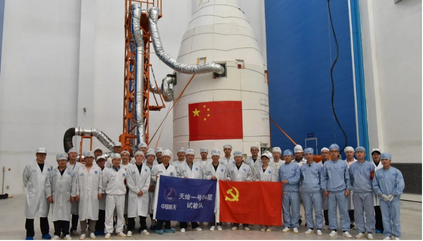
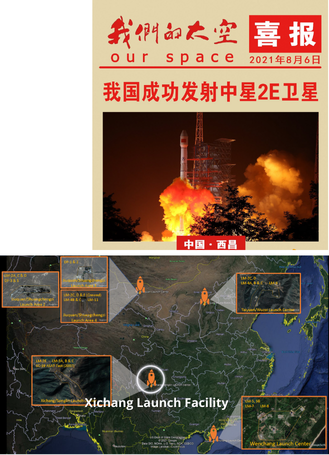
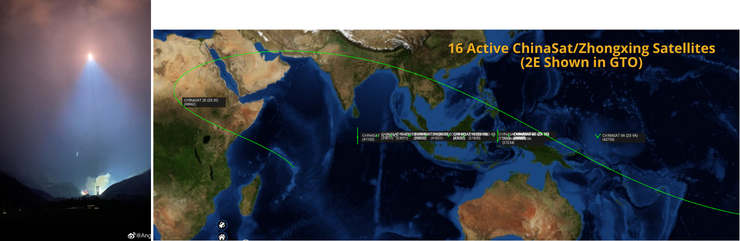
5 August 2021: China launched a Long March 3B rocket from Xichang Launch facility sending ChinaSat 2E (Zhongxing 2E) into geosynchronous transfer orbit. ChinaSat 2E joins a growing family of ChinaSat commercial/military communications satellites. The China Aerospace Science and Technology Corp. (CASC) declared the launch successful. Launch VIDEO.
– ChinaSat-2E, will provide television, radio, broadband multimedia and other transmission services. China Satellite Communications is owned by the Chinese Government, and the line of ChinaSat satellites are used to provide general communication services for the military.
– Open Source data has ChinaSat-2E in GTO as of 14 August 2021.
– Zhongxing is suspected to be the fourth satellite of the Shentong-2 military communication satellite line. They are operated by the Chinese army and provide communication services for voice and text communications.
– Liftoff mass for the newest satellite was 4,000 kg, and the service time is expected to be about 15 years.
– The Xichang launch complex is known for it’s location, which can often result in dropping stages near civilians following orbital launches. The rocket stages fly over populated areas of the Chinese mainland, and continue to pose a danger to the residents.
– In the future, launches will slowly transition to the Wenchang Spacecraft Launch Center, closer to the ocean, so that drop zones along the launch corridor do not overfly populated areas.
– This is the 28th orbital launch from China in 2021 and the 64th launch of the Long March 3 B/E in its history. The Long March 3 family has now launched 134 times.
ChinaSat 2E likely belongs to the second generation of Shentong tactical communications satellites. It is designed to deliver secure voice and data communications to ground terminals operating at the Ku-Band frequency (12 to 18 GHz). Moreover, this satellite feature advanced multiple steerable spot beam antenna technology. It allows ground users to communicate while on the move.
By the Book: A Look at China's Undergraduate and Graduate Space Training
– China’s Space Engineering University (SEU), is located on three campuses in Beijing, and is subordinate to the PLASSF Space Systems Department.
– It is the sole military academic institution educating China’s future space fighters.
– The curriculum prioritizes space engineering and information countermeasures, as well as intelligence processing and analytical skills.
– SEU offers degree programs at the undergraduate, master’s, and doctoral levels.
SEU Undergraduate Curriculum
– Recruiting brochures identified a total of 15 specialties for undergraduate studies.
1)Combat Environment Engineering; 2) Command Information Systems Engineering: 3)Communications Engineering; 4) Early Warning Surveillance; 5) Flight Vehicle Propulsion Engineering; 6) Information Countermeasures Technology; 7) Measurement and Control Engineering; 8) Navigation Engineering; 9) Operations and Mission Planning; 10) Optoelectronic Information Science and Engineering; 11) Radar Engineering; 12) Reconnaissance Intelligence; 13) Remote Sensing Science and Technology; 14) Space Equipment Engineering; and 15) Weapons Launch Engineering.
– Information about specific training objectives and course work was also listed.
– For example the Remote Sensing Science and Technology program, adds up to 882 class hours, roughly equivalent to 60 semester hours or about two years of university work.
– This is just the core program for the major; other required or optional courses available were not found in this research.
– Based on recruiting goals SEU appears to be capable of graduating several hundred officers a year to support a full range of current and future Chinese space missions.
SEU Graduate Curriculum
– Chinese online media released PLA SEU’s 2021 graduate research program.
– The announcement identified 52 research specialties offered under 10 majors.
– It also identified two different types of graduate degrees: “academic” degrees (10 listed) and “specialty” degrees (5 listed).
– Academic Degrees: 1) Aerospace Science and Technology; 2) Control Science and Engineering; 3) Cyberspace Security; 4)Information and Communications Engineering; 5) Military Command; 6) Military Equipment; 7) Military Political Work; 8) Military Training; 9) Optical Engineering; and 10) Systems Science.
– Specialty Degrees: 1) Master of Electronic Information; 2) 2.Master of Engineering Management; 3) Master of Mechanics; 4) Military Political Work; and 5) Military Equipment
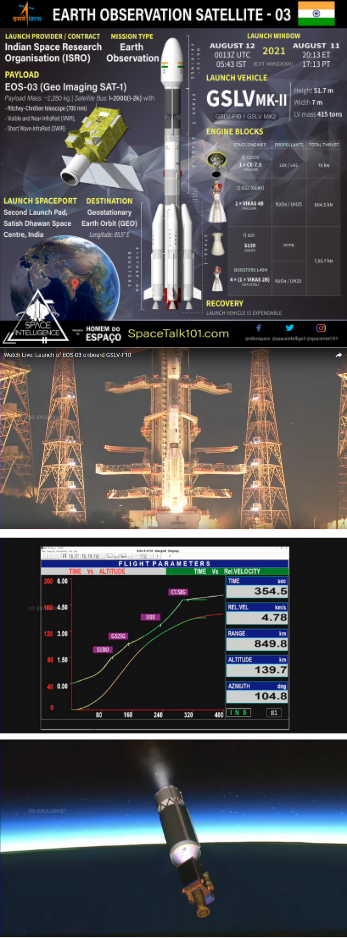
11 Aug 2021: The Indian Geosynchronous Satellite Launch Vehicle (GSLV) suffered a malfunction of its upper stage during an Aug. 11 launch, causing the loss of an imaging satellite, GISAT-1 (renamed EOS-03).
– The GSLV lifted off from the Satish Dhawan Space Centre at 8:15 p.m. Eastern.
– The initial phases of the flight, including burns by four strap-on boosters and the first and second stages, appeared to go as planned, as did the separation of the rocket’s payload fairing.
– After second stage separation, the upper stage’s cryogenic engine ignited. The stage appeared to start to roll and lose attitude control moments later, based on animations derived from launch vehicle telemetry shown on the webcast by the Indian space agency ISRO.
– The EOS-03 satellite and the GSLV CUS third stage reached a -4500 x 140 km x 17.9 deg orbit and impacted the Andaman Sea near the second stage impact zone at about 0023 UTC, 10 minutes after launch from Satish Dhawan Space Centre.
– This was the 14th flight of the GSLV, India’s largest launch vehicle, and the eighth of the Mark 2 version, which has an upper stage with a domestically developed cryogenic engine that uses liquid hydrogen and liquid oxygen.
The first Mark 2 launch, in 2010, failed to reach orbit because of a failure of that upper stage engine, but subsequent launches were successful until this latest flight.
Space is hard.
China remains the only nation with a “high resolution” satellite in GEO with Gaufen-4 (40m) and Gaufen-13 (15m).
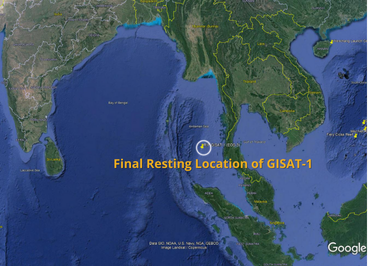
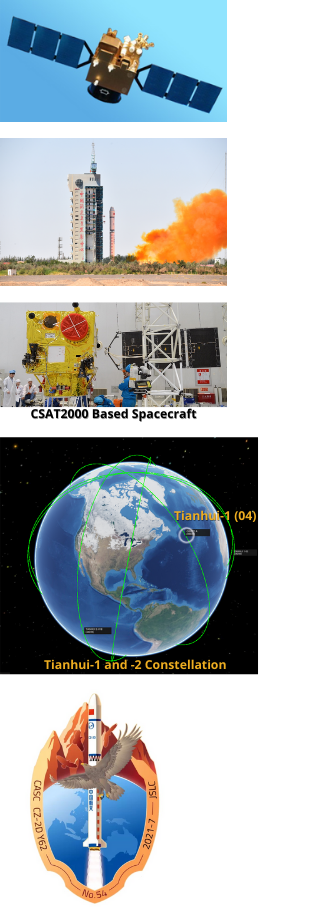
29 Jul 2021: China launched Long March 2D rocket from the Jiuquan Satellite Launch Center carrying Tianhui 1-04, the fourth in China’s series of Tianhui 1 Earth observation satellites. Launch VIDEO.
– The launched placed the approximately 1,000 kg satellite into a 97.3 degree inclined Sun-Synchronous Orbit, around 490 to 500 kilometers above the surface of the Earth.
– The Tianhui (or “sky drawing”) constellation of satellites are Earth observation satellites built by Dong Feng Hong and operated by the People’s Liberation Army.
– The Tianhui 1 series of satellites began launching in 2010 with the launch of Tianhui 1-01,
– Tianhui 1-02 and 1-03, the second and third spacecraft in the series, were launched in 2012 and 2015 respectively. The three previous Tianhui spacecraft, like 1-04, were also launched aboard Long March 2D vehicles.
– Each spacecraft is built off of the CSAT2000 spacecraft bus and is equipped with a number of electro-optical sensors.
– Like it’s three predecessors, Tianhui 1-04 is equipped with three separate Earth observation cameras: a three-line array panchromatic camera with a spatial resolution of 5m, a panchromatic CCD camera with a spatial resolution of 2m, and a multi-spectral imager with a spatial resolution of 10m.
– There are also 2 Tianhui 2 satellites in orbit. Launched in 2019 they are believed to have a similar mission.
The Tianhui-1 satellites are part of the Ziyuan program that cover different civil and military earth observation as well as remote sensing programs. The Ziyuan-1 program is focused on Earth resources and looks to have two distinct military and civil branches. The Ziyuan-2 program is understood to be used for aerial surveillance, operated by Chinese People’s Liberation Army (PLA), whereas the Ziyuan-3 series will be used for stereo imaging.