
issue 56 | 11 sep 2022
The integrity flash
Analysis of Developments in the Space Domain
in this issue
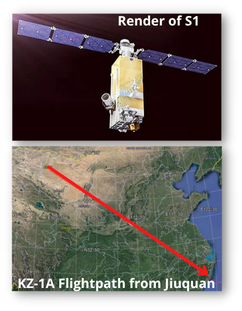
6 Sep 2022: A Kuaizhou-1A (KZ-1A) solid rocket lifted off from a transport erector launcher at the Jiuquan Satellite Launch Center. The launch successfully sent two satellites, the CentiSpace 1-S3 & 1-S4, to orbit for Beijing Future Navigation Technology Co. Launch Video.
– The CentiSpace satellites will carry out technical verification tests including navigation enhancement while in orbit.
– The payloads are two new test satellites. The first CentiSpace-1 satellite, S1, was launched on a KZ-1A in 2018, while the S2 satellite was on on a failed Kuaizhou-11 in Jul 2020.
– The 2 CentiSpace spacecraft will test numerous navigation and satellite technologies, such as laser inter-satellite communication links. This is a similar communication technology to that being used on the SpaceX Starlink constellation.
– Centispace will be a constellation of 160 LEO satellites for Beidou navigation enhancement. There are two more tech demonstration satellites, S5 & S6, planned to launch from the Yellow Sea in Oct.
– The KZ-1A has now flown 17 times overall and three times since June 2022…its most recent flight was 23 Aug.
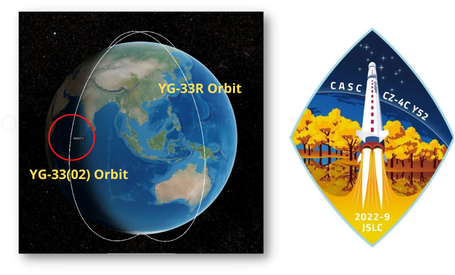
2 Sep 2022: China launched Yaogan-33(02) from of Jiuquan using the Long March 4C. The satellite itself is part of the Yaogan Weixing line, which is similar to the “USA” and “Kosmos” satellites of the US and Russia, meaning they are classified military satellites that are officially labeled “remote sensing satellites.” Yaogan-33 may be a follow on to the Yaogan-29 SAR imaging satellite. Launch Video. Drone View.
– This is actually the third Yaogan-33 satellite China launched. The first failed to reach orbit in May 2019.
– Yaogan-33R was launched near Christmas (28 Dec 2020). Both Yaogan-33R and the new Yaogan-33(02) are in 98.2°, 680 x 688 km Sun-Synchronous Orbit (SSO).
– Please note: reporting of Yaogan-33 capabilities is inconsistent: SAR, EO and SIGINT are all mentioned in different forums.
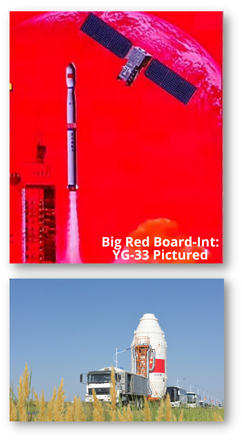
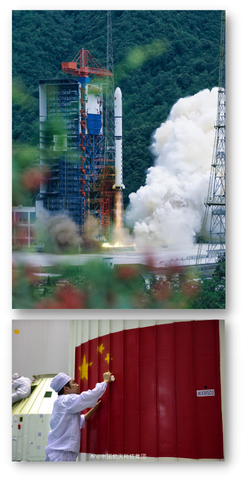
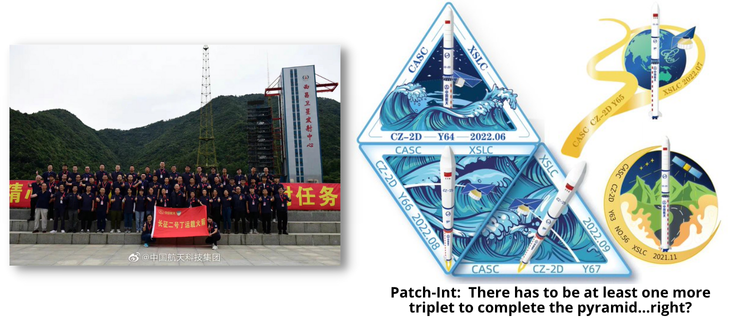
6 Sep 2022: Just 3 weeks after launching its fourth set of YG-35 satellites, China launched its fifth trio of Yaogan 35 (YG-35(05)) military reconnaissance satellites to orbit. As with the other YG-35 launches, YG-35 (05) launched on a Long March 2D rocket from Xichang Satellite Launch Center. The launch occurred less than 2 hours after a KZ-1A launch. Details from the Chinese government on the individual satellites’ on-orbit operations are sparse. Despite this, spacecraft analysis and comparisons to western missions and previous Chinese launches help build a gradual understanding. Launch Video. Launch Video from a Cool Angle!
– The new trio join four sets of Yaogan 35 satellite triplets which were sent into orbit by similar launches in Nov 2021, Jun 2022, Jul 2022 and Aug 2022. All fifteen satellites are now orbiting at roughly 310 miles (500 km) above the Earth, with an inclination of 35° to provide regular, repeated passes over areas of interest.
– The China Aerospace Science and Technology Corporation (CASC), which developed the rocket and spacecraft for the mission, stated the satellites would be used for space scientific experiments, monitoring land usage and natural resources, as well as other scientific purposes.
– The European Space Policy Institute noted in its recently published yearbook on space activities that China’s Yaogan series satellites are perceived by analysts to serve both civil and military users.
– As with the earlier pair of Yaogan 35 satellite launches, two of the satellites were developed by the Aerospace Dongfanghong Satellite Co., Ltd., and the third by the Shanghai Academy of Spaceflight Technology (SAST) – both of which operate under CASC.
– This mission also included a payload adapter, serving as an interface between the rocket stage and spacecraft being sent into orbit. It carries a 25 square meter drag sail designed to help rapidly deorbit the roughly 660-pound (300-km) adapter. SAST debuted the drag sail on the June YG-35(02) launch. CASC claims the sails are providing good results, “decaying 3 times as fast as the YG-35-01 one”.
6 Sep 2022: While NASA prepared to launch the uncrewed Artemis mission, China is progressing on its own step-by-step program to put both robotic and, eventually, crewed spacecraft on the lunar surface to keep pace with NASA-led achievements.
– China is planning ambitious sample-return missions, landings at the lunar south pole, testing the ability to 3D print using materials from regolith, and sending astronauts on a short-term lunar visit before the end of the decade.
– China’s next lunar mission is Chang’e-6 and is scheduled for 2024: an unprecedented attempt to collect rock samples from the far side of the Moon.
– The Chang’e-6 mission builds on China’s 2019 mission in which it became the first country to safely land a spacecraft on the far side of the moon. The mission was made possible by a relay satellite out beyond the Moon at Earth-Moon Lagrange point 2, where it can bounce signals between Chang’e-4 and ground stations in China.
– In 2020, Chang’e-5 performed the first sampling of lunar material in over four decades. The four-spacecraft mission used an orbiter, lander, ascent vehicle, and return capsule to successfully deliver 1.731 grams of lunar rocks to Earth. The automated rendezvous and docking in lunar orbit of the orbiter and ascent spacecraft was seen as a technology test for getting astronauts off the Moon and back to Earth.
– Chang’e-6 will attempt to collect new samples, this time from the South pole-Aitken basin, a massive and ancient impact crater on the far side of the moon.
– Chang’e-7, also scheduled for 2024, will also target the lunar south pole, a region where NASA’s Artemis 3 crewed mission is looking to land.
– The mission will involve a flotilla of spacecraft, including a new relay satellite, an orbiter, lander, rover, and a small “hopping spacecraft designed to inspect permanently
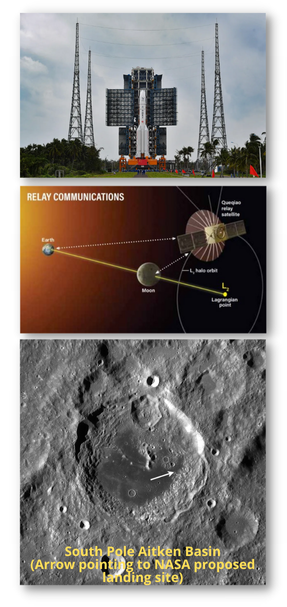
shadowed craters which are thought to contain water ice.
– Chang’e-8 is expected to launch around 2027 to test in situ resource utilization and conduct other experiments and technology tests including oxygen extraction and 3D printing related to building a permanent lunar base.
– The near-term Chang’e missions are expected to launch on China’s largest current rocket, the Long March 5.
– China is also developing a “new generation crew launch vehicle” that will essentially bundle three Long March 5 core stages together while improving the performance of its kerosene engines. The result will be a roughly 90-meter-tall rocket resembling a Long March version of SpaceX’s Falcon Heavy – capable of sending 27 tons of payload into translunar injection.
– Further down the road, China is looking to the Long March 9, an SLS-class rocket capable of sending 50 tons into translunar injection.
30 Aug 2022: Orbit Fab, a startup developing infrastructure for in-space refueling of spacecraft, will start offering hydrazine for satellites in geostationary orbit as soon as 2025 at a price of $20 million. Watch Video.
– Orbit Fab announced its plans to start offering refueling services for GEO spacecraft using a depot and “fuel shuttle” spacecraft. That depot will also be able to support spacecraft such as servicing vehicles that can travel to the depot for “self-service” refueling.
– $20M would provide up to 100kg of hydrazine. It’s
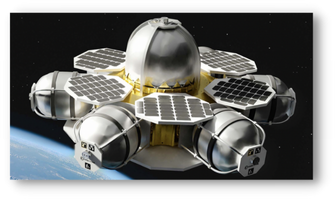
the first time the company set a price for providing fuel, a move it says it made to help potential customers better understand the economics of refueling.
– The “fuel shuttle” spacecraft will operate in a “service lane” orbit ~300km above GEO. The location is designed to keep the depot out of the active belt of GEO satellites and just below the graveyard orbit of defunct satellites.
– In addition to the depot, Orbit Fab is developing a shuttle to transport fuel to satellites.
26 Aug 2022: Capella Space unveiled its third-generation synthetic aperture radar (SAR) satellites, stating they will deliver the highest quality imagery, best resolution, and fastest order-to-delivery speeds. The first of the Capella Acadia satellites is slated to launch in early 2023.
– The Acadia series are the first significant advancement in the company’s satellite design since launching commercial operations in Jan 2021.
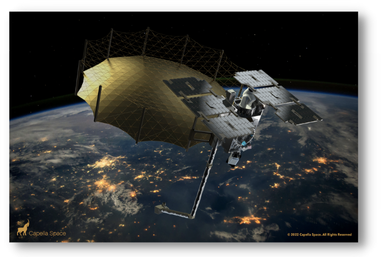
– The use of efficient laser communications technology, and a gimbaled antenna on the new satellites, will reduce the latency between image collection and download.
– The new satellites will have increased radar bandwidth from 500 MHz to 700 MHz. Slant Range Resolution will improve down to 0.214 m and Ground Range Resolution to 0.31 m for standard look angles.
– Capella is the first and only commercial Earth-observation company to enable the Inter-Satellite Data Relay System (IDRS), which allows customers to task a spacecraft in under 15 minutes for emergency or tip and cue operations.
– IDRS service was successfully commissioned on Capella Space’s Sequoia satellite in Nov 2020. The Capella satellite, situated in low earth orbit, communicated with Inmarsat’s I-4 satellite network, which operates at the L-band spectrum and sits in a high earth, geostationary orbit.
– Capella’s constellation uses a fully-automated scheduling, downlink, and processing architecture that provides access through a self-service, user-driven tasking console.
This Fortnight in GEO
Editor’s note: due to Celestrak visual tool unavailability, I could not build the normal graphic displaying position and drift of several GEO high interest objects. Just the highlights for now as reported in the ever-awesome Palski Space Domain Awareness reports.
– Russia’s Luch/Olymp decreased altitude another 96km and settled into new position -18.2345°.
– China’s SJ-17 also decreased its orbit 30km, ceasing its western drift. SJ-17 has settled into a new position, 94.2529°
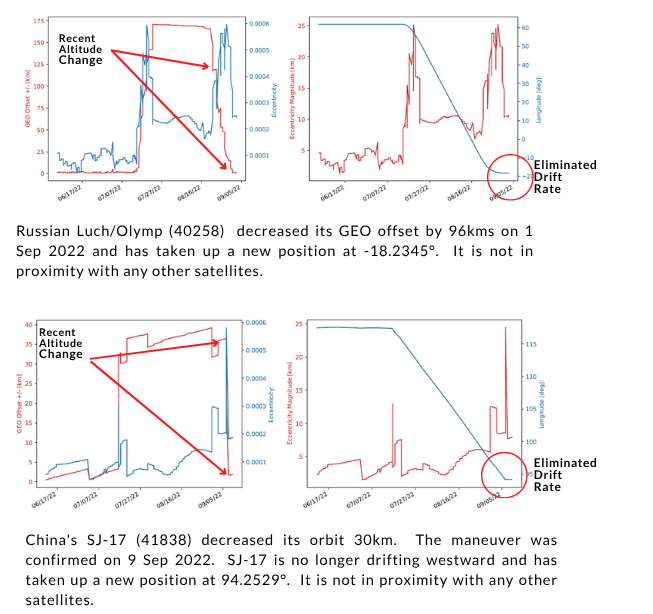
Editor’s Note: Thanks to weekly reporting from Palski & Associates Inc, we’re going to try to keep track of maneuvers of select spacecraft in GEO. For this week, orbital information is courtesy of the 2022-09-02 & 2022-09-09, Space Domain Awareness Reports from Palski & Associates Inc. Send a request to david.pierce@palski.com to get added to their distro list!
Jack's Astro Corner: Applying your Orbital Element Knowledge
So now that you are all amped up and knowledgeable on the Classical Orbital Elements and are “bustin a move” doing the Orbit Dance, I thought I’d talk about the Two-Line Element Set, or TLE. This is a term you will hear a lot! I created a colorful aide to help you unravel the TLE (see next page). The TLE is two lines of numbers that include the epoch time, orbit elements and other helpful information.
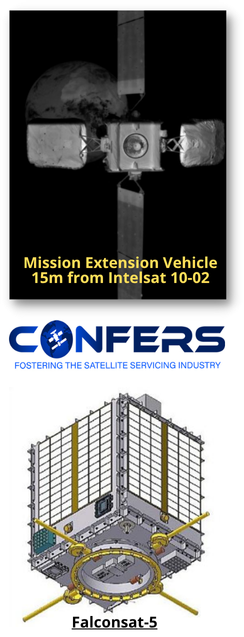
I trust you saved the 6 articles (Semi-Major Axis, Eccentricity, Inclination, RAAN, Argument of Perigee and True Anomaly) that were featured in previous Final Frontier Flashes. Maybe make a astro notebook? They talk the basics and in provide some bonus “know more” info. I also trust (hope?) you kept the “How to do a Rendezvous” article. It is an applied orbit elements paper, goes into the orbit element matching process of a rendezvous. Good idea to understand that, since it’s happening in space A LOT. Space Servicing is a research and development area that excites me. Space servicing vehicle linking up with a client spacecraft to refuel or repair, yup, that’s happening today with the Mission Extension Vehicle that Northrop Grumman is operating. The CONFERS program is defining standards for supporting the spacecraft servicing future.
A TLE is 2 lines of numbers arranged in a formatted manner to describe an orbit. It’s a time tagged set of astro numbers where you can easily find the orbital elements can. My colorful aide give you a quick “what’s where” TLE tutorial. Maybe you can snip it out and use a magnet to place it on your refrigerator. Get everyone in your home on board with knowing the TLE format and contents! Let me assure you, after examining a TLE a few times, you’ll find you don’t need the aide, you’ll know it. How do I know this? Well, back when I was on the US Air Force Academy FalconSAT team as a teacher and mentor, the cadets would have to “hand jam” the TLE into the antenna tracker. I didn’t trust the file transfer thingy and felt the cadets would be most awesome officers if they knew the TLE by heart. Well, these hand jamming FalconSAT dynamos got good at plugging in their FalconSAT TLEs. Really!
Before diving in, I want you to know there are many articles on the Internet describing the TLE history, format, data, etc. Don’t stop reading here, give me a chance to introduce the TLE aide and what is in the TLE before dashing off to these other web sites. I tend to stay away from Wikipedia, but I found their web site on the TLE is pretty in depth and accurate. Another good one is the explanation of the TLE on Celestrak. Again, there are a lot of good references on the Internet and I’d like to now ask your indulgence to my talking you through my TLE aide, that will soon adorn your refrigerator, right? 😉
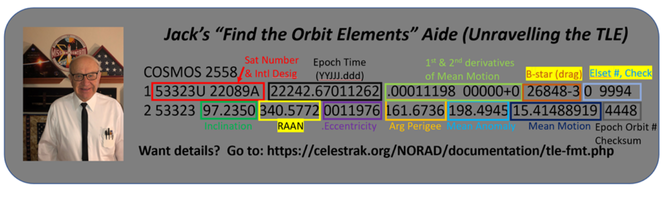
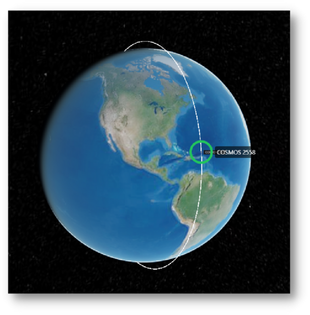
TLE LINE 1: It starts with Satellite Number and the International Designator. You’ll see I selected Cosmos 2558. It’s a LEO bird, about 450 km, and has an inclination of 97.2° (SSO, remember that?). It’s been in the news a lot. These are like “tail numbers” for the space object; which might be a spacecraft (alive or pooped out), rocket body, or debris. I like the International Designator because it has the year launched and what space object of the year it was launched as. The Epoch Time is pretty cool, as you know, 6 orbital elements need this time tag, that’s the Epoch Time. First 2 numbers are year, the next 3 are the Julian Day. That’s the day of year. Here’s a web site of a cool Julian Day converter.
As you can see, 1 Sep is JD 244. Then there’s the fraction of the day. For example, if it’s 1800 GMT, then the decimal day is .75. Now the remaining numbers include data on the rates of changes to Mean Motion and info on the drag being experienced by the space object. This drag can be atmospheric or solar radiation pressure depending on whether it’s a LEO or GEO. You’ll perhaps never have to use these, but it shows the detailed data in the TLE. Remember, Mean Motion is the angular speed of the object, if you have rates of change of Mean Motion, you can do a pretty darn precise job of predicting future position. The final numbers on line 1 are related to the element set type, and, good news, it’s always 0. Then there is the element set number which increments for each update. Finally, there’s the checksum. This is a single number that is calculated based on all the previous Line 1 numbers and verifies the first line’s authenticity and/or its integrity. The checksum ensures nothing got corrupted in transmitting the TLE data. Whew, we made it through line 1.
TLE LINE 2: Yay! It’s the orbital elements! First comes the Satellite Number (again) then you get the Tilt, Twist, Shape, Position of Perigee, Position of Satellite and finally the Mean Motion which is the parameter to find the Size. Let’s say that again only this time in orbital element speak: Inclination, RAAN, Eccentricity, Argument of Perigee, Mean Anomaly (related to True Anomaly) and the Mean Motion which if you re-read the Semi Major Axis article, you’ll find the
math to convert this to the semi-major axis. Eureka, Line 2 are the orbital elements, and thanks to Line 1, you have the time tag or Epoch Time.
So how can you get TLEs? There are many ways to accomplish this. I’m going to share with you the links to 2 websites. First is Celestrak – it does not require a user name and password and I find it is jam packed with a lot of great info and an easy way to “shop around” the Satellite Catalog. Then there’s Space-Track.org – you’ll need to register to get as password, from request to set up takes less than 15 minutes. It too has lots of great information and references.
There are other astrodynamics websites out there, perhaps you’ll use your Internet talents (of which I have none) and find other sources of TLEs and astrodynamics information.
Let me conclude with a challenge. Many folks take space related courses and really emerge with great insight and knowledge. But, if you don’t use you new insight, it will atrophy. So, what to do. Well, you can go to Space-Track or Celestrak and workout, like going to the Astro Gym. Get together with a fellow astro enthusiast and go to the Astro Gym together for a workout. Better yet, find those in your organization who are astro dynamos and do this every day, and ask them to help you stay current and grow in knowledge. Given what’s going on “out there”, we need EVERYONE to know their astrodynamics, what the orbital elements are, and better yet, we all need to be dancing the orbit element dance…show some astro spirit!
Well, anyone got any ideas for the next Jack’s Astro Corner article? Let me know, maybe I can take an astro swing at it. My email is jackfanthony78@gmail.com