issue 16B | 14 February 2021
The integrity flash
Analysis of Developments in the Space Domain
in this issue
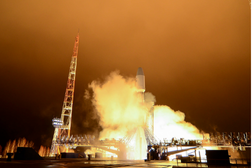
2 Feb: Russia launches its 5th Lotus-S1 electronic intelligence (ELINT) satellite from Plesetsk on a Soyuz 2-1b.
– Russian military confirmed separation of the Kosmos-2549 satellite & good communications w/ ground control.
– Kosmos-2549 first entered a 200 by 900-km elliptical orbit, but circularized its orbit at around 900 km with an inclination of 67.1°.
– Lotos-S is capable of intercepting radio signals helping to locate, identify, and target various military vehicles and installations.
– Special terminals installed on Russian war ships were reported to be capable of downlinking real-time data directly from the Liana network for the purpose of weapon guidance.
– Unofficial sources indicate that, despite their high cost, the initial Lotos satellites in the series reportedly provided no advantages over Tselina-2, the last of which launched in 2007.
– Lotus-S and PION make up the 2 satellites in Russia’s Liana ISR constellation. The two original Lotus satellites do not appear to be maintaining their orbits, and a Russian industry source said that only Lotos-S1 No. 804 (launched in 2018) satellite was operational when Kosmos-2549 launched. PION-NKS has yet to launch.
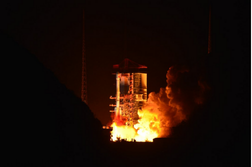
4 February: China launched the 6th secretive Tongxin
Jishu Shiyan Weixing (TJSW) satellite on a Long March 3B/G2 from the Xichang Satellite Launch Center. (Launch Video)
– TJSW-6 is a geostationary satellite and reports indicate it would be another experimental communications system.
– TSJW-1 launched in 2015 and successfully deployed China’s first large-aperture reflector antenna in orbit. It is possibly the first vehicle in the Qianshao-3 SIGINT satellite series developed by the China Academy of Spaceflight Technology (CAST). The satellite has a large mesh antenna, with a diameter of ~32 meters…ideal for SIGINT operations.
– Other TJSW launches occurred in 2017 (TJSW-2), 2018 (TJSW-3), 2019 (TJSW-3) and 2020 (TJSW-5). The same secrecy surrounded each launch. There is speculation that TJSW-2, -5 and -6 might be military Huoyan-1 early warning satellites while TJSW-4 may be another SIGINT collector.

In 2020, one-third of provincial-level governments in mainland
China received a new Party Secretary. These officials are important figures in Chinese politics, with responsibility
for local economies that can dwarf those of countries.
– 2 of the 10 new Secretaries are tied to China’s space program.
– Xu Dazhe is the Governor of Hunan province and was the China National Space Administration Chief Administrator.
– Yuan Jiajun is now the Governor and Deputy Communist Party Secretary of Zheijiang province. He was previously the commander of the Shenzhou manned spaceflight program and vice-president of CAST. He was also involved in the Lunar Mission and the joint Chinese-Russian mission to explore Mars.
30 January: First edition of the the Space Force Journal released.
power to evolve Americans, and key partners, to retain strategic leadership in the space domain.
– Second issue to be released in April. Shorter articles and artwork may be published in the interim.
– Space Force Journal seeks a broad spectrum of writings ranging from fully annotated research papers, to historical analyses, to cutting edge thought pieces, all written by members of the space community of any rank or seniority, scholars, enthusiasts, and international partners.

More than 80 nations have entered the space industry, but few are willing to follow the existing norms of conduct.
– There is a renewed great power competition between the United States, China, and Russia. Historically, great power competition accompanies a period of intensified confrontation.
– China and Russia will use coercive statecraft approaches, including coercive economics, and lawfare to exploit the “sheriff-less Wild West” of the international legal system. It’s only a matter of time before China and Russia extend these tactics to space.
– Effective leadership requires the US have capabilities to “act independently and impressively when and where it chooses.” There is no better time to reassert American space leadership.
– If the US wants to make leadership in space an American destiny, it must fight for it. The US should promote and harness exponential technologies and visionary policies to leap-frog the competition, set domain norms and values, and ensure that space remains safe and stable for all.

The US may misunderstand China’s risk tolerance, the link between Chinese sovereignty and space power, and the impact of space dominance doctrine on core Chinese interests.
– American efforts to remain the dominant space power will likely trigger counterbalancing as China attempts to maintain access to space
– Sino-US space relations could enter a period of uncontrolled escalation due to: 1) lack of a mutual restraint system; 2) an existing space law regime that fails to keep pace with a rapidly changing space environment; and 3) techno-environmental factors that create deterrence instability.
– The United States must formulate an actor-specific strategy for China that establishes deterrence stability through non-escalatory and asymmetric means.
– “We’re not good at it [relations with China], because we don’t understand their history and culture.” (Henry Kissinger). Nowhere are these strategic disconnects more apparent than in Sino-US space competition.