
Analysis of Developments in the Space Domain
12 Mar 2021: Long March 4C rocket launched from Jiuquan carrying the latest series of three Yaogan-31 (YG-31-04) reconnaissance satellites.
– The orbits of the March 12 satellites appear to match two previous launches of Yaogan-31 satellites on Jan. 29 and Feb. 24. Another clutch of satellites launched successfully in April 2018.
– All of these satellites share a similar orbit, but the additional launches likely decrease revisit times when a particular region is visible underneath the orbit of the satellites, which carries them over maritime regions such as the South Shetland Islands.
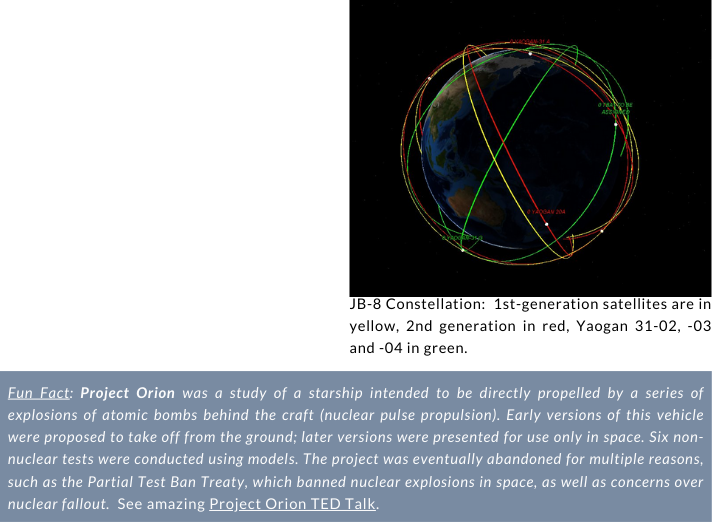
– The Yaogan-31 series of satellites are part of the Jian Bing 8 (JB-8) ELINT constellation. JB-8 satellites orbit at 1100km and are 63.4° inclined.
– 8 triplets have been launched – the last 3 expanded the constellation beyond the initial 3 orbital planes. With the launch of group 31-04, there are now 6 regularly-spaced orbital planes, indicating the constellation is now likely complete.
Western defense analysis suggests that Yaogan (“remote sensing”) satellites are military reconnaissance satellites and part of ISR systems for the People’s Liberation Army. Such satellites locate and track vessels by detecting and triangulating radio transmissions.
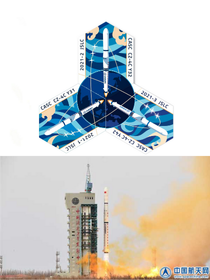
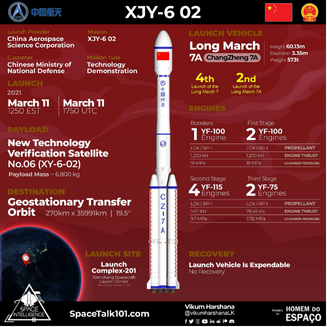
11 Mar 21: On its second attempt, China successfully launched the Long March 7A (LM-7A) from Wenchang launch facility on Hainan Island. The launch placed the Shiyan-9 experimental satellite into Geosynchronous Transfer Orbit (GTO). See Launch Video.
– The Long March 7A is a 60.1-meter-long, 3.35-meter-diameter kerosene and liquid oxygen launch vehicle with four side boosters, capable of delivering up to 7 metric tons of payload to GTO.
– The launcher draws on new kerosene engine technologies along with a stage modified from the older Long March 3B series, China’s current workhorse rocket, boosting China’s launch options to GTO.
– The Long March 7A is more capable than the Long March 3B, which can launch 5.5 tons to GTO. By launching from the coast, it also does not incur the cost and hazards of the inland 3B launches.
– The first launch of the Long March 7A failed in March 2020. A loss of pressure occurred after first stage separation, leading to engine malfunction.
– The mission carried the Shiyan-9 (SY-9) to GTO. Shiyan means “experiment” in Chinese. Xinhua news agency said the spacecraft is designed “for in-orbit tests of new technologies including space environment monitoring.”
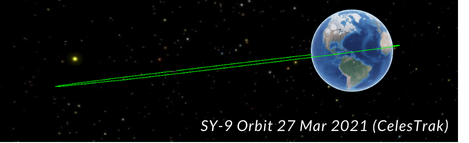
– SY-9 is currently in an elliptical, or oval-shaped, orbit ranging between 155 miles and 22,270 miles (250-by-35,840 kilometers), with an inclination of 19.5 degrees to the equator, according to independent tracking data released by the U.S. military.
China’s new Long March 5, 6, 7 and 8 rockets are designed to eventually replace the country’s older Long March vehicles, which use toxic propellants and launch from inland spaceports, often dropping spent stages near populated areas. The Long March 7A rocket is a potential replacement for the Long March 3B for launches with geostationary satellites, offering a 25% improvement in payload capacity to geostationary transfer orbit.
15 March: China’s People’s Congress emphasizes creation of integrated communications, EO & and SATNAV global constellation and building a commercial launch site.
– Building an integrated communications, EO, and SATNAV space system with global coverage, is not particularly new or surprising. China has been talking about the Belt and Road Space Information Corridor – along with the Integration of Comms, EO, and SATNAV” for several years.
– China’s announcement to build a commercial launch site is not something that has been as widely discussed as the above-mentioned integrated network. To now, China’s four launch sites remain controlled by the People’s Liberation Army.
– No details of the spaceport project were released. Information regarding location of the new launch center is not known, nor the authority overseeing operations and other matters. Jiuquan has so far hosted all private Chinese rocket launches, starting in 2018. These launch vehicles have all so far been light-lift solid rockets.
The five-year plan also highlighted the achievements in human spaceflight and lunar and deep space exploration. The “outline for the 14th five year plan and long-term targets for 2035” also includes super-heavy and reusable launch vehicles, industrialization of the Beidou system and other civilian and military space-related developments. A new dedicated space white paper is expected to be published later in 2021.

9 Mar 21: Leaders from China and Russia signed a memorandum of understanding to jointly develop a lunar research center.
– Russia’s Roscosmos and China’s National Space Administration – the two countries’ respective equivalents of NASA – announced a preliminary agreement on Tuesday to jointly develop the research facility, known as the International Lunar Research Station, or ILRS. The heads of the two space agencies signed a memorandum of understanding in a ceremony conducted via teleconference.
China and Russia released similar statements pledging to jointly develop a Roadmap for the creation” of the station, and “conduct close interaction in planning, justification, design, development, implementation, [and] operation [of] the project … including its presentation to the world space community.” No timeline has been established.

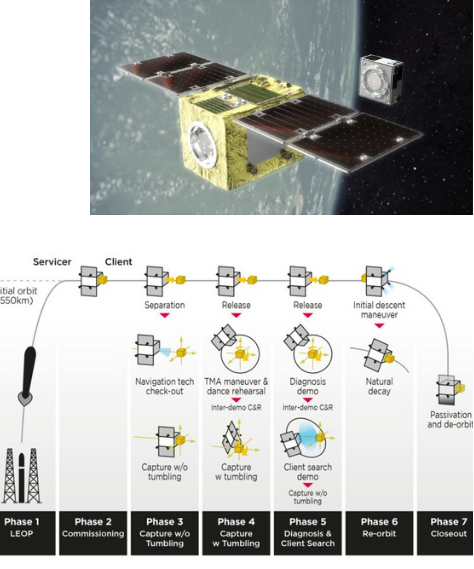
20 March 2021: Space startup Astroscale launched ELSA-d via a Soyuz rocket from Kazakhstan.
– This is the demonstration mission for its End-of-Life Services by Astroscale (ELSA) technology, which aims to dock with, and safely remove, orbital debris.
– ELSA-d comprises a 175kg servicer spacecraft and a 17-kg client satellite.
– The ELSA-d spacecraft will be controlled from the U.K., where Astroscale has built what it touts as the first mission control center dedicated to in-orbit servicing.
– The ELSA-d servicer will demonstrate a number of activities as it maneuvers around its smaller companion satellite, proving capabilities that could be used for other applications.
– In orbit, the 175-kilogram servicer — equipped with proximity rendezvous technologies and a magnetic capture mechanism — will repeatedly dock with and release the 17kg client satellite.
– Astroscale expects to complete the main demonstration elements of ELSA-d by the end of this year, ahead of a final de-orbiting phase that it expects to last between seven to 10 years.
– Astroscale is also working on a separate spacecraft called ELSA-m, designed to capture and de-orbit three to four objects in a single mission for a constellation customer.
– Currently, Astroscale’s spacecraft can only latch onto satellites with compatible docking plates.
– OneWeb, recently acquired by the British government and Indian telecom company Bharti Global, is the only constellation operator known to be installing Astroscale-compatible plates.
In related news, 2 weather satellites broke up unexpectedly in sun-synchronous LEO Orbits. NOAA-17 (US) broke up into 16 pieces on 10 March and YUNHAI 1-02 (China) broke up into 21 pieces on 18 March. The 18 Space Control Squadron reported both events.