

Analysis of Developments in the Space Domain
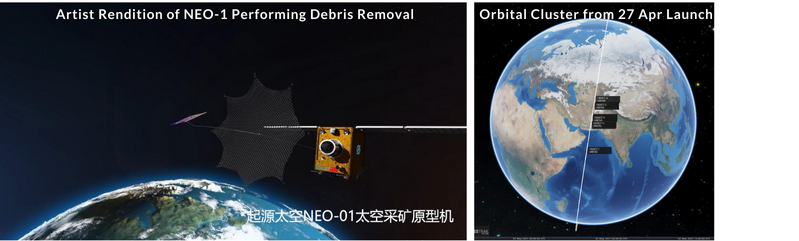
27 April 2021: China launched a small space mining/debris removal test spacecraft (NEO-1) and eight other commercial satellites into orbit on a Long March 6 rocket.
– Three main satellites were (1) Qilu-1 synthetic aperture radar; (2) Qilu-4 optical remote sensing satellites; and (3) Foshan-1 optical remote sensing satellite with a high-resolution panchromatic camera.
– NEO-1 will test near Earth asteroid observation and prototype technology for space resource acquisition in low Earth orbit.
– The mission will carry out an active debris removal test, releasing a small, square, spiral-patterned target and then attempt to capture it using a net system. The spacecraft will then lower its orbit using onboard electric propulsion.
“The goal is to verify and demonstrate multiple functions such as spacecraft orbital maneuver, simulated small celestial body capture, intelligent spacecraft identification and control,” Yu Tianhong, an Origin Space co-founder, told IEEE Spectrum last year. NEO-1 also carries a large field of view camera and other imagers. The launch service was contracted by the China Great Wall Industry Corporation (CGWIC), a subsidiary of CASC. The launch was the first CGWIC commercial rideshare according to official industry. The service is marketed as the “Long March Express” to domestic and international markets.
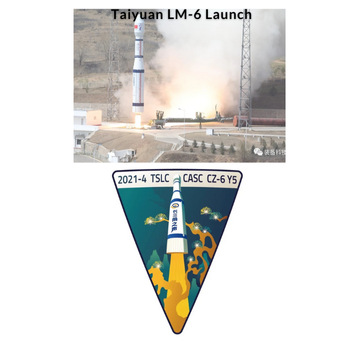

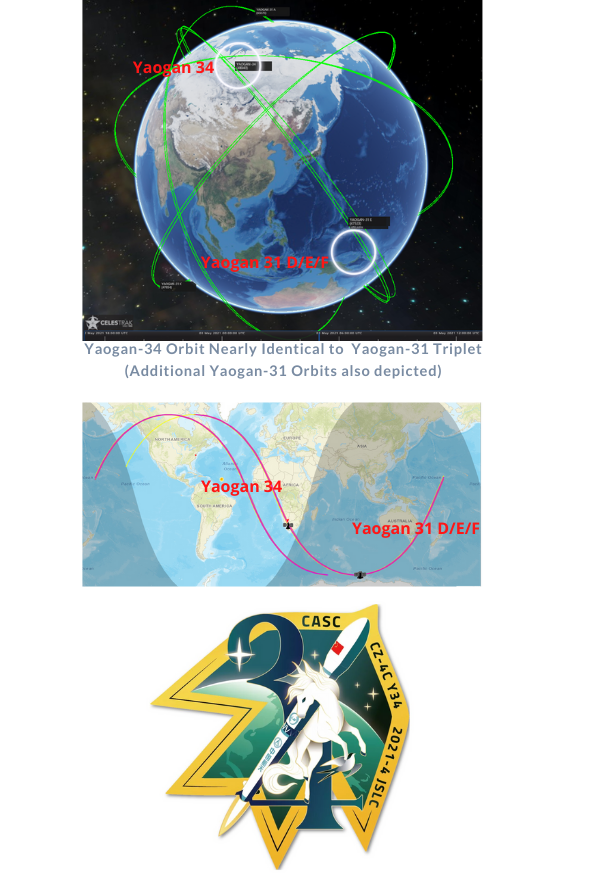
30 April 2021: A Long March-4C rocket carrying Yaogan-34 satellite launched from the Jiuquan Satellite Launch Center in northwest China. Video
– This launch is the first instance that a Long March 4C rocket has utilized a 4 meter fairing from Jiuquan.
– There is little information available on Yaogan-34. Reporting indicates it is an optical satellite and China has stated it will support a variety purposes, ranging from territorial survey, urban planning, land right confirmation, to crop yield estimation and disaster mitigation in support of the Belt and Road initiative.
Yaogan 34’s orbit is nearly identical to that of the Yaogan-31 D/E/F triplets launched on 29 January 2021. Yaogan-31 satellites are believed to be maritime reconnaissance satellites for tracking foreign naval movements. All four satellites are inclined at 63.4° and are at nearly the same altitude (1084-1099km for Yaogan 34 & 1088-1105km for Yaogan 31 D/E/F) with an orbital period that differs by approximately 6 seconds. Without further orbital adjustments Yaogan-34 will transition to lead position on 13 May.
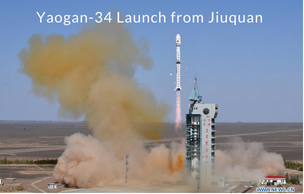
From the April 2021 Space Review: A new generation of signals intelligence satellites is under development, but may take several more years to become fully operational.
– See 31 Jan FFF for current status of Lotus and PION deployment efforts.
-The estimated 2-4 operational Lotos satellites are not sufficient to provide full-time coverage of critical areas and furnish accurate targeting data, especially for moving naval targets.
– Long-range missiles, such as Tsirkon, place even higher demands for accurate data. An additional problem is Russia currently has just one operational military data relay satellite (launched in 2015), severely limiting the Russia’s ability to send back data in real time.
– There are 4 Lotos satellites ready to launch. If they can be launched with sufficiently short intervals, they will give Russia a significant space-based ELINT capability.
– Launching the radar-equipped PION satellites are absolutely to support naval operations.
– Russian press articles stated a fully operational Liana constellation should consist of at least two Lotos and two PION satellites, but there is no sign in openly available documentation of work on a second Pion satellite, raising the question if it even exists.
Russia’s space-based SIGINT effort is lagging far behind that of the United States and China. Long delays in the Liana program are severely impacting Russia’s ability to collect accurate targeting data for its latest generation of anti-ship missiles. A replacement system (Akvarel) is still many years away from deployment. The Liana system does not appear to have significant (if any) COMINT capability. The situation will not be rectified until the first Repei satellites are launched in several years. Russia is relying on a pair of aging satellites for optical reconnaissance and does not have any radar reconnaissance satellites in orbit to image through cloud cover and during nighttime. This leaves much to be desired in Russia’s present space-based intelligence gathering capability.
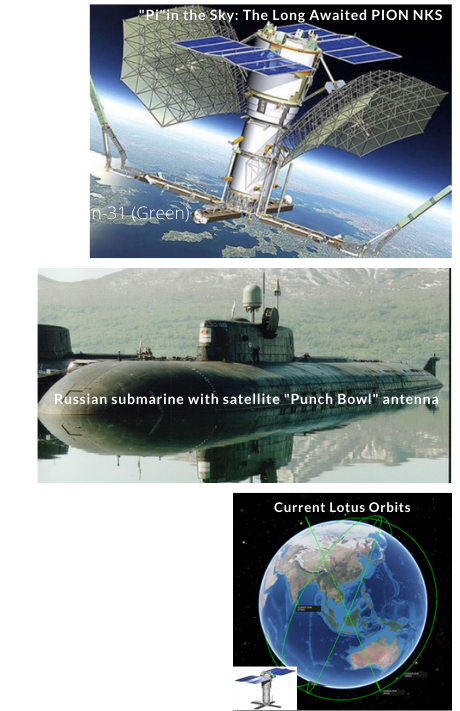
6 May 2021: China launched 3 new Yaogan 30 satellites from Xichang on a LM-2C rocket. The satellites were placed into a nearly identical orbit with 3 other Yaogan 30 satellites launched in 2017.
– The satellites are the eighth triplet of Yaogan-30 spacecraft launched since 2017 on Long March 2C rockets from the Xichang facility into similar orbits. (VIDEO)
– Xinhua reported the three Yaogan 30-08 satellites are designed for “electromagnetic environmental detection and related technological tests.” The Yaogan-30 family is likely for SIGINT missions.
– The new Yaogan-30 satellites were placed in the same plane as the initial three launched in 2017.
– The new satellites could be a replacement, given the Yaogan-30 A/B/C near 5 years on orbit. China will likely keep the older satellites on station as long as they work.
– Analysts suggest the Yaogan-30 satellites could be testing new ELINT equipment, or helping the PLA track foreign naval deployments.
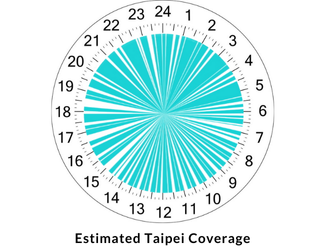
China has created a Yaogan 30 satellites constellation of six equally-spaced planes. With their 35° inclination, Yaogan 30 satellites are optimized to look at countries close to China, especially on the Pacific coast. So Taipei, the capital city of Taiwan, is a very representative target. Over a 24 hour window, the coverage is almost constant. The biggest gap is approximately 30 minutes, while most gaps are less than 10 minutes every half an hour. See VIDEO demonstrating coverage over Taipei.
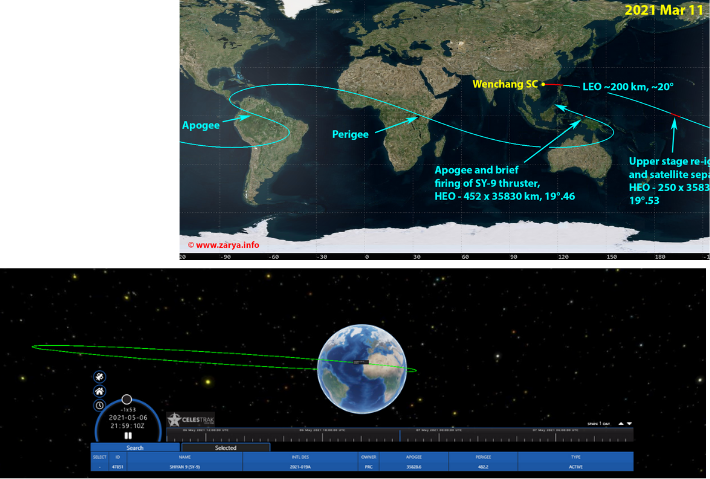
China’s first successful launch of the LM-7 on 11 March 2021 carried the Shiyan-9 (SY-9) experimental satellite. SY-9 remains in a Geosynchronous Transfer Orbit (GTO) after 2 months.
– SY-9 was placed in a GTO where the satellite normally moves into a drift orbit less than 24 hours after launch.
– Instead, SY-9 remains in a GTO. The Chinese did make a minor orbit adjustment raising the question of whether the satellite suffered a failure once on orbit.
– Launch to Geosynchronous orbit from Wenchang usually entails a short coasting period in LEO at 20° inclination. The launch vehicle re-starts as it approaches the equator to produce the transfer orbit with perigee near the original height and apogee around 36,000 km. First apogee occurs above South America and on the equator. One Earth circuit later, the satellite is back at apogee but near 130° – 140° east longitude, well in view of China and close to its final location.
– The Shiyan-9 appeared normal through the second apogee on 12 March, near 134° east, at 1025 UTC. However the anticipated orbit correction did not occur and a continuing flow of orbit data from Space-Track over the next few days showed SY-9 remained in a transfer orbit.
– The Chinese executed a very short thruster firing that raised perigee by just over 200 km.
China may have intended to SY-9 to go into geosynchronous orbit but a problem may have prevented the onboard thruster from firing as intended. Two months after launch the satellite remains in a transfer orbit, indicating that the problem cannot be fixed.
Alternatively, given the 2020 failure of an earlier LM-7A’s second stage, the Chinese may have deemed the fix too risky for the rocket to carry a major payload. Shiyan-9 may have a cluster of instruments to monitor performance during launch hence the ‘technology experiments’ in the launch announcement. The shortened apogee engine burn could have been to prove the satellite reached orbit undamaged.