issue 22 | 23 May 2021
The integrity flash
Analysis of Developments in the Space Domain
in this issue
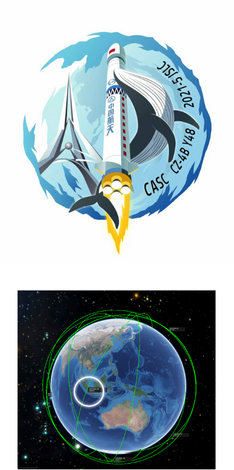
19 May 2021: China launched its 8th Haiyang (meaning “ocean”) satellite into sun synchronous orbit to conduct oceanographic research. A Long March 4B launched from Jiuquan and placed the CAST built. 1,575 kg Haiyang 2D into a 940×954 km, 66° orbit.
– The Haiyang-2D satellite will be operated by the National Satellite Ocean Application Service (NSOAS), the satellite operating agency within China’s State Oceanic Administration responsible for state-run oceanographic research.
– The Haiyang satellites’ capabilities are used for disaster relief, marine forecasting, and scientific research. Pollution monitoring is also a large part of the Haiyang program.
– The constellation consists of four Haiyang-1 satellites and four Haiyang-2s. A future series of Haiyang-3 satellites are planned to begin deployment later this year.
The Haiyang 2D satellite is a slightly refined version of the previous HY 2A and 2B satellites. It does not have the Microwave Radiometer Imager, but has a different microwave imager to perform subtly different functions, which are unknown. Also unlike its predecessors, HY 2A and 2B, Hiayang 2D will feature 2 solar panels instead of one. The Long March 4B rocket has now completed 41 successful launches since its debut in 1999. There has only been one launch failure (2013).
In February 2021 the Center for Strategic and International Studies (CSIS) released their “Defense Against the Dark Arts” report. Their Harry Potter themed report gives an excellent overview of evolving counterspace systems and potential architectural, technical and operational defenses.
– Defensive Space Operations aim to protect friendly space systems, while offensive counterspace operations aim to disrupt, degrade, or destroy adversary space systems.
– Architectural defenses are those that rely primarily on satellite constellation and ground station architectures that area more difficult for an adversary to attack
— Disaggregated Constellations: separating distinct missions onto different platforms or payloads, breaking up multi-msn satellites into msn-specific satellites that operate in parallel.
— Distributed Constellations: uses “a number of nodes, working together, to perform the same mission or functions as a single node.”
— Proliferated Constellations: deploy a larger number of the same types of satellites to similar orbits to perform the same missions.
— Diversified Architectures: multiple systems contribute to the same mission using platforms and payloads that may be operating in different orbits or in different domains.
– Technical defenses rely primarily on technologies that can be incorporated into satellites, ground stations, and user equipment that makes the system more difficult to attack.
— Exquisite SDA: provide information that is more timely, precise, and comprehensive than what is publicly available—can help distinguish between accidental and intentional actions in space.
— Space-Based Radio Frequency Mapping: monitor and analyze the RF environment that affects
space systems both in space and on Earth…provides space operators with a more complete
picture of the space environment, the ability to quickly distinguish between intentional and
unintentional interference, and the ability to detect and geolocate electronic attacks.
— Electromagnetic Shielding: Surround electronics and cables within a satellite with shielding and adding surge protection devices throughout the RF and electrical system can protect against the effects of radiation, high-powered microwave attacks, and electromagnetic pulse weapons.
— Filters and shutters: protect sensors from laser dazzling and blinding.
— Jam-Resistant Waveforms: Different types of waveforms to improve communications systems’ resistance to jamming and spoofing (i.e, frequency hopping spread spectrum and interleaving).
— Antenna Nulling and Adaptive Filtering: Satellites designed with antennas that “null” or minimize signals from theEarth’s surface or locations in space where jamming is detected
– Operational defenses rely primarily on changes in the way satellites are operated to make them more difficult to target, more resistant to attacks, or easier to restore after an attack.
— Rapid Deployment: protect from pre-emptive attack and limit adversary’s system knowledge.
— Reconstitution: Quickly replace existing space capabilities by launching more satellites.
— Maneuver: command the satellite to move out of their trajectory to avoid impact
— Stealth: Design and operate space systems in ways that make them difficult to detect and track
— Deception and Decoys: Conceal or mislead others on the “location, capability, operational status, mission type, and/or robustness” of a satellite
Commercial Space: Capella SAR Imaging
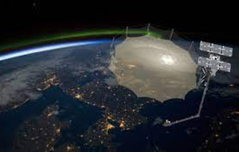
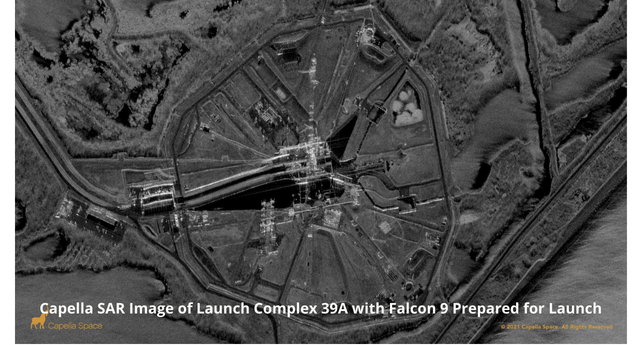
15 May 2021: In addition to 52 Starlink satellites, the Falcon 9 also placed the fifth Capella Synthetic Aperture Radar (SAR) satellite into orbit. Launch Highlights Video
Capella Space’s Whitney satellite is a 100 kg (220 lbs) Synthetic Aperture Radar (SAR) satellite. It is part of the planned 36 satellite constellation. Several satellites have been launched so far, on the I Can’t Believe It’s Not Optical Electron mission and on SpaceX’s Transporter-1 mission. Whitney will aid in disaster relief, mapping areas for agriculture and infrastructure advancement, as well as security. It has the unique capability to detect sub 0.5 meter changes in the Earth’s surface.
Key Features:
– Has the ability to deliver high-contrast, low noise, sub 0.5 meter imagery to the public
– 3.5 meter mesh reflector and and a 400W solar array
– Thermal systems can aid in taking longer images up to 4,000 km long
– Large reaction wheels allow fast satellite movement for a larger range of imaging capabilities
– A very high downlink rate of 1.2 Gbps to allow faster image download
– Real-time tasking abilities through Inmarsat
With its full constellation of 36 satellites, Capella predicts it will provide hourly coverage of any location on Earth. While this was the fifth Capella satellite placed in orbit, open source references list only 4 (the latest being Whitney 3 & 4 which launched in January 2021.) This vehicle is likely the latest of Capella’s Whitney imaging satellites. Through INMARSAT, operators can task Capella sensors in near real time, however downlink of SAR imagery must wait until the satellite is within range of an Amazon Ground Station. Capella customers include the U.S. Air Force, which awarded the firm a contract in November and the National Reconnaissance Office, which awarded the firm a study contract in December 2020.
From the February 2021 Space Review
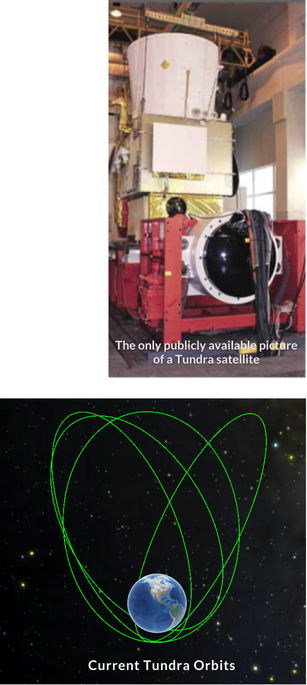
– In May 2020, Russia launched the fourth of its new-generation missile early warning satellites called Tundra. Flying in highly elliptical orbits (HEO), they continuously monitor regions from which missile attacks could potentially be launched against Russian territory. The Tundra satellites are part of the Integrated Space System (EKS), which will also include several satellites in geostationary orbit. With the fourth Tundra launch, EKS is reported to have reached its minimum baseline configuration.
– In 1999, Russia announced the EKS early warning constellation that would consist of both HEO and GEO satellites.
– The HEO Tundra satellites were launched 2015-2020. All have been launched by Soyuz-2.1b rockets with the Fregat upper stage from the Plesetsk Cosmodrome in northwestern Russia.
– Tundra satellites should have enough compute power for operators to make swift recommendations to their leadership on the need to activate launch and anti-ballistic missile systems.
– Tundra satellites carry Balka, a nuclear explosion detection payload
– The geostationary EKS satellites will be launched from Plesetsk by the Angara-A5 rocket.
– There are strong indications that the geostationary satellites will be equipped with a new payload. Unlike the staring sensor carried by the HEO satellites, the GEO spacecraft will contain a scanning system with a new generation of infrared detectors.
– Russia is having problems with the new payload module, and satellite construction is likely hampered by Western economic sanctions.
-Other complicating factors are continuing delays in the manufacture of Angara-A5 rockets (caused in part by the opening of a new production facility in Omsk, Siberia), as well as the need to use the new Persei upper stage
More HEO satellites will be launched in the coming years. In November 2015, the Ministry of Defense said the ultimate goal was to have a constellation of ten satellites. In the Soviet days, the maximum amount of simultaneously operating HEO satellites was nine. These may all be the Tundra HEO satellites as the geostationary satellites are lagging far behind and may still be in the design phase.
Satellites are only one element of the country’s early warning system. Russia also possesses a large network of ground-based early warning radars which has been spectacularly upgraded in the past 15 years or so to provide coverage of all potential attack zones, a capability achieved not even in the Soviet days.
India’s geostationary imagery satellite (GISAT-1) has yet to launch. Originally delayed from 5 March to early April due to “minor technical issues,” the COVID-19 pandemic appears to have placed the launch on indefinite hold.
– GISAT was supposed to launch in April but had to be delayed as employees at various centers of the Indian Space Research Organization (ISRO) including that of the rocket launch center in Sriharikota were affected by Covid-19.
– The ISRO Propulsion Complex (IPRC) at Mahendragiri in Tamil Nadu is supplying oxygen to hospitals to save COVID-19 patients. Given the rising demand, the Indian space agency’s rocket may not be getting oxygen to power launches for some time.
– Hours before the 5 March launch the Indian Space Research Organisation (ISRO) announced the postponement of the mission owing to a technical glitch.
– Soon after the COVID-19 pandemic and the resulting lockdown delayed the mission. The rocket had to be dismantled and cleaned up.
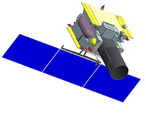
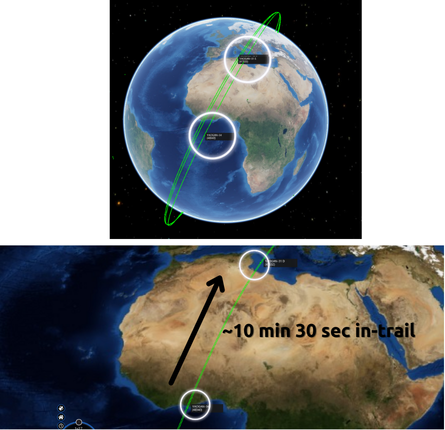
China’s Yaogan-34 satellite, launched on 30 April 2021, made slight orbital adjustments and the spacecraft will continue to trail a set of Yaogan 31 Triplets indefinitely. Before the adjustment Yaogan 34 would have passed the Yaogan 31 triplets in mid-May.
– During its first week in orbit Yaogan 34 increased its perigee and apogee (and thereby its orbital period). It continues to trail Yaogan 31 D/E/F.
– Yaogan 34’s orbit is similar to the Yaogan 31 electronic surveillance satellites, and the initial orbit plane has RAAN about three degrees to the west of the Yaogan 31 D/E/F triplet.
Yaogan 34’s orbit is nearly identical to that of the Yaogan-31 D/E/F triplets launched on 29 January 2021. Yaogan-31 satellites are believed to be maritime reconnaissance satellites for tracking foreign naval movements. There is little information available on Yaogan-34. Reporting indicates it is an optical satellite and China has stated it will support a variety purposes, ranging from territorial survey, urban planning, land right confirmation, to crop yield estimation and disaster mitigation in support of the Belt and Road initiative.