issue 23 | 6 June 2021
The integrity flash
Analysis of Developments in the Space Domain
in this issue
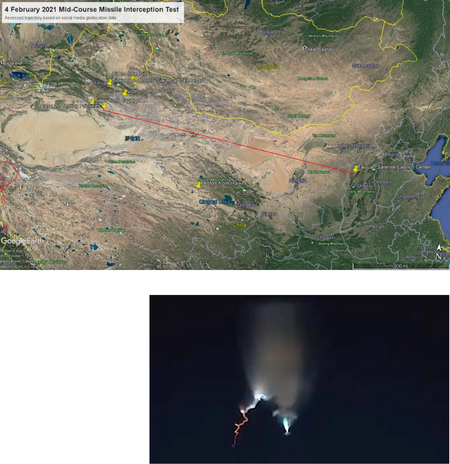
A mid-course ballistic missile intercept test conducted on 4 February 2021 may have been an Anti-Satellite (ASAT) test. China’s Ministry of Defense announced the test achieved all of its goals, but offered no additional details.
–Videos and photos posted on PRC social media outlets suggest that the PRC launched the target vehicle from the People’s Liberation Army’s (PLA) Taiyuan Satellite Launch Center, which is subordinate to the Space Systems Department of the PLA Strategic Support Force (PLASSF), sometime between 2000 and 2010 CST.
– A larger body of media posted on social media indicates that the interceptor launched from somewhere in Xinjiang by 2030 CST. The geolocations of five separate videos taken of the interceptor launch suggest that the PLA launched the interceptor from Base 21 in Hoxud County.
– Studies on the PRC’s BMD program strongly suggest that the PLA might use a BMD program as a cover for ASAT programs given the poor press associated with ASAT tests.
– The PLA views kinetic ASAT and mid-course BMD operations under the singular umbrella of “space operations” rather than two discrete mission types. The only mission distinction between the two is that mid-course BMD is a “space defense” mission while kinetic ASAT is a “space control” mission.
– The PLA places the greatest amount of emphasis on the
ability to establish space superiority through non-kinetic and kinetic strikes against adversary satellites and space vehicles. The ability to destroy ballistic missiles in space appears to be a secondary requirement at best.
– Circumstantial evidence suggests the SSF Space Systems Department is responsible for developing mid-course interceptors. The PLA SSF is tasked with overseeing the PLA’s strategic space, cyber, electronic, and psychological warfare missions. Given this mission set, the SSF’s involvement in developing mid-course interceptors suggests a space-centric mission for systems.
– Multiple press and academic outlets identify personnel assigned to the PLA’s 63620 Unit as conducting research and development of mid-course interceptors as recently as 2016. This strongly suggests that 63620 Unit is one of the primary entities tasked with developing mid-course interceptors, including the 4 Feb test.
– 63620 Unit operated under Base 20 at Jiuquan Satellite Launch Center (JSLC) and likely transferred to the PLASSF in its entirety along with JSLC in 2016.
– Online flight tracking data indicates there was a U.S. Air Force RC-135S Cobra Ball flying in the Yellow Sea during this period. There are only three of these aircraft in total, which are specially configured to gather telemetry and other electronic intelligence, from missile and other large rocket launches.
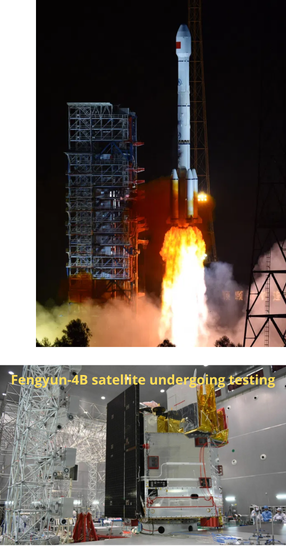
2 June 2021: China successfully launched the Fengyun-4B weather satellite into geosynchronous transfer orbit using a Long March 3B from the Xichang Satellite Launch Center in southwest China. Launch Highlights Video
– The 5,400-kilogram Fengyun-4B (Chinese for “Winds and Clouds”) satellite will be used for weather analysis and forecasting, and environmental and disaster monitoring.
– Payloads include a Geostationary Interferometric Infrared Sounder, radiation imager, space environment packages for sensing high, medium and low energy particles, an imaging telescope for X-ray to extreme Ultraviolet activity monitoring, a geostationary high-speed imager and a lightning mapping imager.
– The new payloads will improve China’s high-frequency monitoring of the atmosphere and observation ability of a number of smaller-scale and shorter-duration weather phenomena.
– Fengyun-4B (FY-4B) will operate in geostationary orbit at 123.5°E for seven years. This is an improvement over the five-year lifetime of the Fengyun-4A, launched late 2016. FY-4A is at 104.7°E.
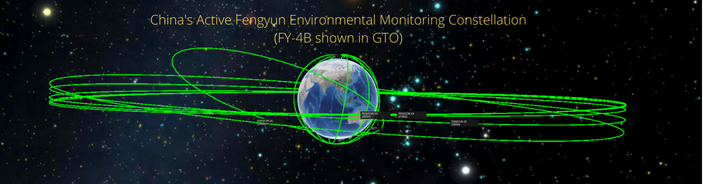
– When it enters service the Fengun-4B will be China’s 10th active environmental monitoring satellite. The active constellation consists of Fengyun-2, Fengyun-3, and Fengyun-4 satellites.
– Fengyun-3 and -4 are China’s second generation weather satellites. Fengyun-3 operate in LEO, Fengyun-4 in GEO
– China maintains 4 environmental monitoring satellites in LEO (Fengyun 3A, 3B, 3C & 3D) and 6 satellites in GEO (Fengyun 2E, 2F, 2G, 2H, 4A and now 4B).
– In 2016 China announced its intentions to launch 14 more meteorological satellites into orbit by 2025.
Since 2016 China has launched 4 Fengyun satellites, FY 2H, 3D, 4A and 4B. There will likely be one more FY-4 and then 5 additional satellites for multiple meteorological purposes
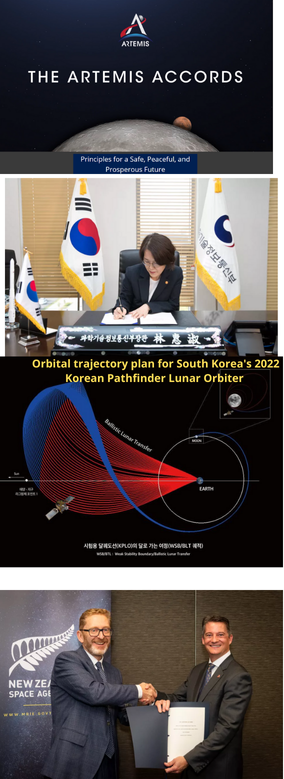
South Korea and New Zealand Latest to Join Artemis Accords
24 May 2021: South Korea became the 10th country to sign the Artemis Accords during a ceremony in Seoul.
31 May 2021: New Zealand became the 11th country to sign the Artemis Accords during a ceremony in Wellington.
The Accords take their name from NASA’s Artemis program, which aims to establish a sustainable human presence on and around the moon by the end of the 2020s.
– South Korea’s interest in the moon has grown greatly in recent months, with South Korean president Moon Jae-in declaring in March that the East Asian nation aims to send its own lander to the moon by 2030.
“By 2030, we will achieve our dream of landing on the moon by using our own launch vehicle. The technological prowess, experience and confidence that will be gained from exploring the moon, the first step in space exploration, will provide a solid foundation for space development.”
– South Korea is developing a three-stage liquid rocket known as the Korea Space Launch Vehicle, or Nuri. A first flight is currently planned for October this year.
– The Korea Pathfinder Lunar Orbiter (KPLO) for launch on a SpaceX Falcon 9 rocket in August 2022. KPLO will carry a 15-foot (5 meters) resolution camera, a wide-field polarized camera, a magnetic field sensor, a gamma ray sensor and space internet test payload, all developed by South Korea.
– New Zealand gave no specific guidance yet for what it will contribute to the Artemis pact. The country is urging progress on sustainability in space mining and stated it signed the Artemis Accords to emphasize the need for careful management of space resources on the moon.
-New Zealand was among eight countries that “helped craft the principles espoused in the Artemis Accords,” NASA administrator Bill Nelson said…New Zealand did not sign with the initial group of eight countries in 2020, and reasons for the delay were not disclosed.
Various signatories have widely differing views on how space resources should be used. In the United States, the Commercial Space Launch Competitiveness Act grants American companies rights to space resources that they extract. Luxembourg and the United Arab Emirates have similar national laws. Australia, by contrast, is one of a handful of countries that has ratified the Moon Agreement of 1979, which declares the moon and its resources the ‘common heritage of mankind’ and requires an ‘equitable sharing’ of the benefits of those resources among all nations. Brazil is rumored to be the next nation to sign the Accords.