issue 26 | 19 July 2021
The integrity flash
Analysis of Developments in the Space Domain
in this issue
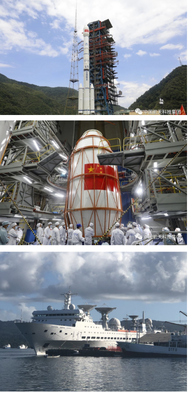
6 July 2021: The Chinese Aerospace Science and Technology Corporation (CASC) launched their fifth Tianlian 1 series tracking data and relay communications satellite from the Xichang Satellite Launch Center in central China. Launch Video.
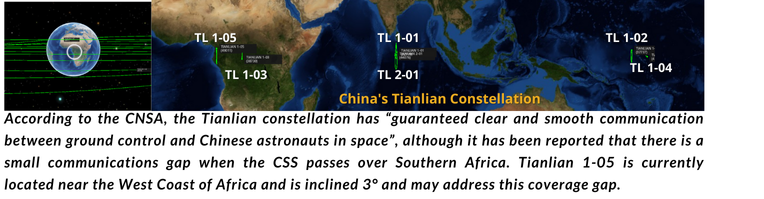
– The carrier rocket placed Tianlian 1-05, into a 200×41,991 km Geostationary Transfer Orbit at an inclination of 17.5°. The Chinese National Space Agency (CNSA) did not announce what location above Earth the spacecraft would be placed, however recent observations show the satellite over the African west coast at 10.5° east longitude.
– Tianlian 1-05 is the 5th in China’s series of Tianlian Tracking Data Relay Satellites, a series of communications satellites placed in geostationary orbit, operating together to provide communications coverage for Chinese spacecraft. Watch Deep Dive Podcast.
– The first Tianlian spacecraft, Tianlian 1-01 was launched from Xichang aboard a Long March 3C on April 25 2008, and was placed in Geostationary orbit at 77 degrees East. The second spacecraft, Tianlian 1-02, launched in 2011.
– In 2012, the Tianlian constellation achieved global coverage with the launch of the third spacecraft, Tianlian 1-03, on July 25, 2012. A fourth satellite, Tianlian 1-04, launched from Xichang aboard a Long March 3C/E on November 22, 2016.
– Tianlian 1-05, like it’s four predecessors, is based off the Dongfanghong-3A (DFH-3A) satellite bus, which also served as the base spacecraft for the Chinese Chang’e 1 and Chang’e 2 lunar orbital missions.
– Tianlian 1-05 is possibly the last time we will see the DFH-3 satellite bus launched. With development starting in 1986, DFH-3 has been a workhorse for decades.
– China is also in the process of assembling a constellation of second generation Tianlian satellites, known as the Tianlian 2 constellation, which began with the launch of Tianlian 2-01 on 31 March 2019.
– The Tianlian 2 series is based on the DFH-4 bus and represents a leap in mission planning and systems management over the Tianlian 1 series. The agency has yet to confirm when the second Tianlian 2 satellite will be launched. Open sources indicate the Tianlian 2-02 and Tianlian 2-03 will be deployed soon.
– Compared with the first-generation model, Tianlian 2 satellites feature stronger capabilities, heavier carrying capacity and longer life spans, according to Zhao Hong, chief designer of the Tianlian 2-01. “Because of its newly developed antennas, the data transmission speed of the new-generation type is twice that of the first generation,” Zhao said. Tianlian 2 satellites can serve more spacecraft and have a larger operational range, he added.
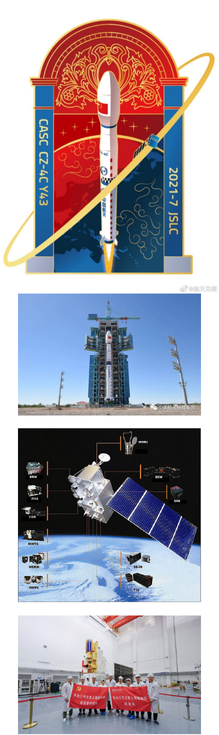
4 July 2021: China launched a Long March 4C from Jiuquan Satellite Launch Center, northwest China, sending the Fengyun-3E meteorological satellite into a roughly 805-kilometer-altitude sun-synchronous orbit. The satellite has a design lifetime of eight years and is described by Chinese media as designed to provide more accurate morning weather forecasts. Launch Video.
– Fengyun-3E (FY-3E) is one of China’s next generation weather satellite after Fengyun-4B, which was launched in June this year. It will add to the nine Fengyun weather satellites that are already orbiting around Earth.
– FY-3E fills a critical gap for China’s environmental monitoring constellation. “In the past, we had meteorological satellites in the morning and afternoon orbits, but had none for early morning orbit. Now, we have such a satellite, thus the gap in observations at dawn will be filled,” Yang Jun, Director General of the National Satellite Meteorological Center, told CCTV. Watch China FY-3E promotional video.
– Fengyun-3E carries 13 instruments and should make substantial contributions to ocean and ice monitoring, climate monitoring, atmospheric chemistry and space weather.
– Overall, FY-3E is the 5th Fengyun 3 to launch but only the third operational satellite since Fengyun 3A and 3B were both test platforms, with 3C as the first completely operational model.
– The Fengyun 3 program traces its roots to 1998, with design and build of the first craft from the Shanghai Aerospace Administration commencing in 1999.
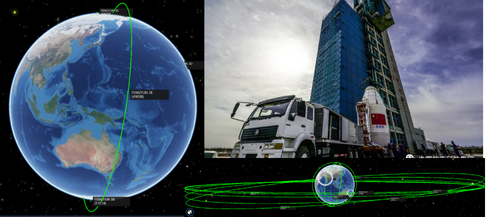
Since 2016 China has launched 5 Fengyun satellites, FY 2H, 3D, 4A, 4B and 3E. The China Meteorological Administration plans to launch Fengyun-3F to Fengyun-3J, as well as Fengyun-4C to Fengyun-4G in the upcoming years and decades, covering their need for meteorology satellites until 2040, with the last satellites planned to launch in 2030 and 2033 respectively.
Commercial Earth Observation Capabilities Onboard the SpaceX Transporter-2 Mission
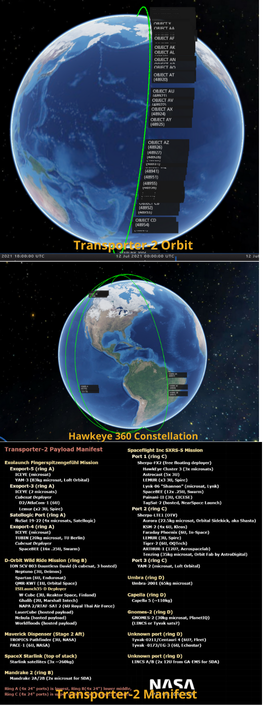
30 Jun 2021: SpaceX successfully launched 88 satellites into a 525km Sun-Synchronous orbit on their second dedicated rideshare mission, Transporter-2. On board were a number of commercial earth observation satellites: Aerospacelab, Capella, Hawkeye360, Iceye, Kleos Space, Satellogic and Umbra.
– Of the 88 satellites, 3 were Starlink satellites and 85 were from external customers (including orbital transfer vehicles).
– Aerospacelab: Launched the ARTHUR-1 technology demonstration satellite built to the 12U CubeSat form factor. The primary objective of the mission allows for satellite imagery to provide 5m resolution.
– Capella: The Capella 5 Synthetic Aperture Radar (SAR) satellite promises 50cm resolution. The launch brings the total number of Capella SAR satellites to 6, with all but one in polar orbit.
– Hawkeye 360: HawkEye Cluster 3 joins the company’s HawkEye Cluster 2 on orbit as part of its second generation of advanced RF-sensing satellites. Cluster 3 significantly expands the current constellation’s global revisit and collection capacity. Seven additional clusters are fully funded and scheduled for launch in 2021 and 2022 to achieve collection revisits as frequent as every 20 minutes.
– ICEYE: launched 4 ICEYE SAR satellites. Three satellites are of the latest technology generation and will be added to the ICEYE constellation. The fourth satellite will be operated as a demonstration mission for the company’s next-generation spacecraft. With this launch, ICEYE has 14 satellites into orbit. They advertise resolution up to 25cm.
– Kleos Space: Similar to Hawkeye 360, Kleos operates clusters of satellites to geolocate radio frequency emissions. Transporter-2 delivered their second cluster of 4 satellites to orbit.
– Satellogic: The Argentinian company launched 4 NuSat imagery satellites to join 20 others already on orbit, 10 of which were launched by China. NuSat advertises imaging resolution up to 1m.
– Umbra: California start-up company launched its first SAR satellite on Transporter-2. The company plans to grow the constellation to at least 24 satellites, which will give it global coverage. Umbra has a patented antenna design. The antenna folds up “like origami” to fit in a very small package, but unfolds to create a very large aperture needed to see a wide swath of the ground and provide images down to about 15 centimeters resolution.
On-Orbit commercial capabilities continue to rapidly expand. Space-X has conducted 2 dedicated rideshare missions in 2021 and has plans to offer 4 SSO launces per year and frequent launches to mid-inclination orbits. Cost to polar orbit start at $1M for a 200kg payload. Various sizes and configurations are available. The next Transporter mission is scheduled for December 2021.
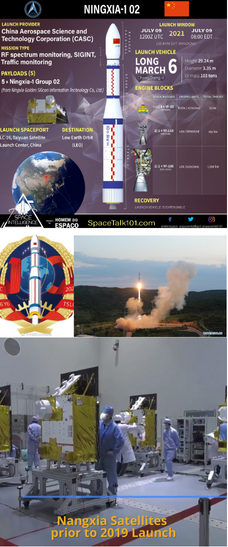
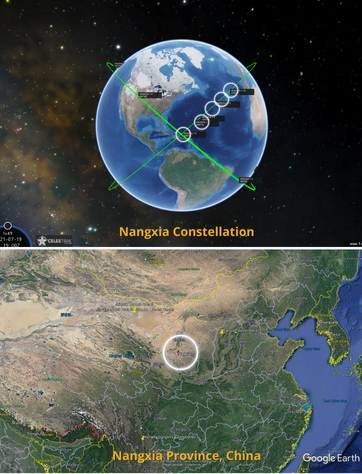
09 Jul 2021: China launched a Long March 6 from Taiyuan sending 5 Ningxia remote sensing satellites into orbit. The launch doubled the Ningxia constellation to 10 satellites. Launch VIDEO.
– These satellites are thought to be commercial remote sensing satellites, designed to monitor EM spectrum signals. The Ningxia-1 satellites form a system designed to gather intelligence from electric signals and other systems that are utilized by foreign governments or groups, or SIGINT.
– These electronic signals can be used in communications, weapons, or radar systems.
– The Ningxia satellites were constructed by the DFH (Dongfanghong) Satellite Company. These satellites are owned and operated by the Ningxia Jingui Information Technology Company. These satellites also go by the name of Zhongzi.
– U.S. military tracking data indicated the rocket deployed its payloads in an orbit at an altitude of about 535 miles (860 kilometers), with an inclination of 45 degrees to the equator.
– Ningxia-1 is part of a planned 30 satellite constellation owned by a private company in Ningxia.
– The launch is the sixth flight of a Long March 6 rocket since 2015. The Long March 6 is sized to haul a payload of up to 1,100 pounds (500 kilograms) to a sun-synchronous polar orbit a few hundred miles above Earth.
As with many Chinese payloads, little is known about the Ningxia-1 satellites. Prior to the 9 July LM-6 launch there were five satellites in orbit, which were launched in November 2019. Each satellite has a mass of roughly 140 kg (310 lb) and is equipped with a solar array and batteries. The satellites are built by DFH Satellite Company. Chinese media provided a full description of the performance of the Long March-6 without mentioning any specifics regarding payload. The Ningxia satellites do not fly in tight formation as the Hawkeye 360 and Kleos Space likely limiting their ability to perform accurate geolocation.